
10 Indian breakfast swaps for PCOS and PMOS
Ten Indian breakfast swaps for PCOS and PMOS, each one replacing a high-insulin trigger with a protein-first alternative that keeps you full, focused, and metabolically stable.
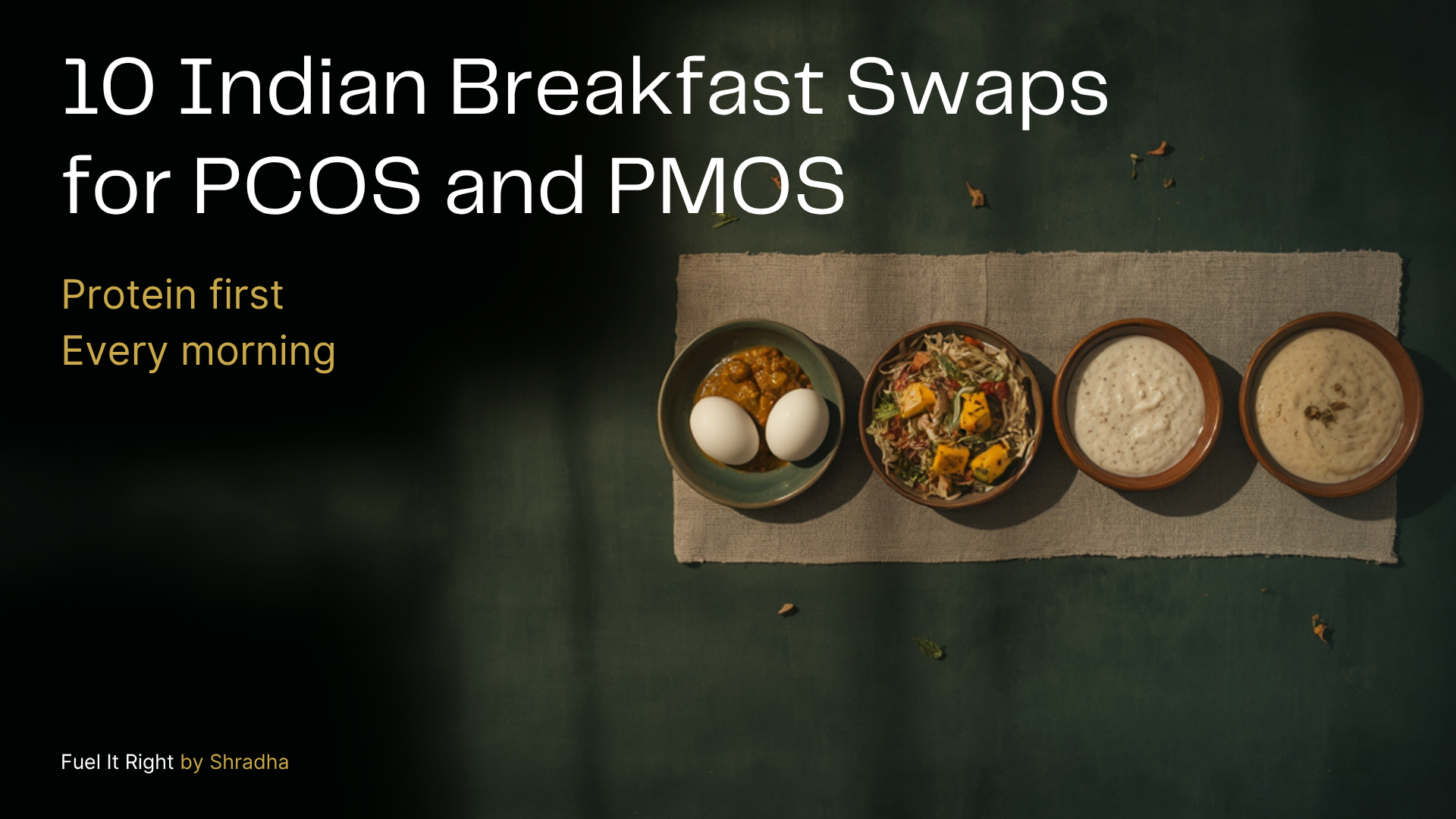
Table of Contents
1. Why Breakfast Is the Most Important Meal for PCOS/PMOS
2. What Makes a Breakfast Work for PCOS/PMOS
3. The 10 Swaps
4. After the Swaps: What to Drink in the Morning
5. Conclusion
6. FAQs
Why Breakfast Is the Most Important Meal for PCOS/PMOS
For women with PCOS and PMOS, breakfast is not just the first meal of the day. It is a hormonal event that sets the insulin, cortisol, and glucose pattern for the next 6 to 8 hours.
When you wake up, cortisol is naturally at its highest part of the body's mechanism for alertness. If the first thing you eat spikes blood sugar, you add an insulin surge on top of an already-elevated cortisol baseline. For a woman with insulin resistance driven by PCOS/PMOS, this double hit sets a high-insulin, high-cortisol tone that drives cravings, energy crashes, acne flares, and worsened hormone balance through the rest of the day.
The blog on insulin resistance and PCOS/PMOS covers this mechanism in full. The blog on PCOS/PMOS and cortisol explains why the morning pattern affects the entire hormonal day. The bottom line: what you eat first matters more than what you eat last. The swaps below are built around this principle.
The morning meal does not just feed you. It programs your insulin and cortisol pattern for the next six to eight hours.
What Makes a Breakfast Work for PCOS/PMOS
Before the swaps, here is the framework. A PCOS/PMOS-appropriate breakfast does three things:
• Leads with protein triggers GLP-1, blunts insulin response, minimum 15 to 20g.
• Contains fibre slows glucose absorption, reduces glycaemic response to carbohydrates.
• Minimises refined carbohydrates eaten alone like maida bread, cornflakes, poha alone, fruit juice alone.
The one rule that covers all 10 swaps Protein must be the first thing you eat at breakfast. Before chai. Before fruit. Before anything. If you apply only one thing from this blog, make it this. The rest of the swaps build on this foundation. |
The 10 Swaps
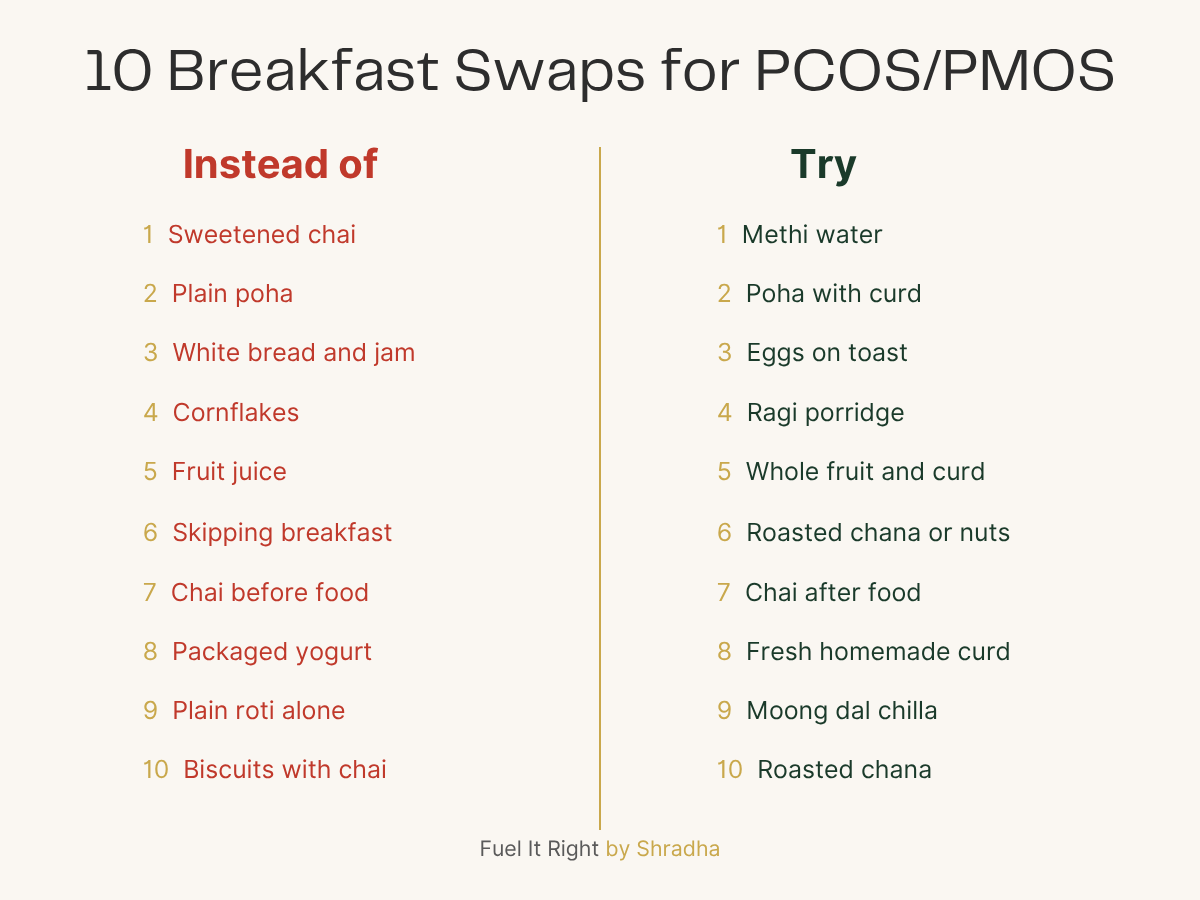
Each swap below shows what to replace, what to replace it with, why it works for PCOS/PMOS, and a quick practical tip to make it easier.
SWAP 1 Instead of: Sweetened chai as the first thing you consume Try: Warm water with a pinch of haldi and kali mirch, or methi seed water Why it works: Chai on an empty stomach spikes cortisol and provides no protein or fibre to buffer the subsequent breakfast. Haldi water reduces morning inflammation. Methi seed water, half a teaspoon soaked overnight, reduces fasting glucose and improves insulin sensitivity through galactomannan fibre. Either option sets a better hormonal baseline before the first meal. Quick tip: Soak methi seeds the night before. Takes 30 seconds. Takes zero cooking. |
SWAP 2 Instead of: Plain poha or upma as the only breakfast item Try: Poha or upma with a side of curd, a boiled egg, or a handful of roasted chana Why it works: Poha and upma are not bad foods. The problem is eating them alone, with no protein. Adding curd, an egg, or protein-rich chana on the side before eating the poha converts a high-GI breakfast into a protein-buffered meal with a significantly lower insulin response. The carbohydrate is the same. The metabolic outcome is completely different. Quick tip: Keep curd in the fridge at all times. Eat one bowl before the poha, every single morning. |
SWAP 3 Instead of: White bread with butter or jam as breakfast Try: Multigrain or sourdough toast with eggs or paneer Why it works: White bread with butter provides almost no protein and drives a rapid glucose spike. Replacing the white bread with multigrain or sourdough reduces the GI, and adding eggs or paneer converts a purely carbohydrate meal into a protein-led one. Two eggs on one slice of multigrain toast provides 14 to 16g of protein which is enough to blunt the morning insulin pattern. Quick tip: Keep boiled eggs in the fridge ready to eat. Takes 2 minutes to peel and plate. |
SWAP 4 Instead of: Cornflakes or packaged cereals with milk Try: Homemade oats with curd, nuts, and seeds, or ragi porridge Why it works: Most packaged breakfast cereals, including those marketed as healthy or high-fibre, have a GI between 70 and 85 and contain added sugar. They drive one of the largest morning insulin surges of any common breakfast food. Homemade oats with a base of curd instead of milk adds protein from the curd, reduces the GI, and feeds the gut bacteria that manage insulin sensitivity. Ragi porridge has a GI of approximately 65 and is rich in calcium and fibre. Quick tip: Use curd as the liquid base for oats instead of milk. Stir in, let sit for 5 minutes. Warm or cold. |
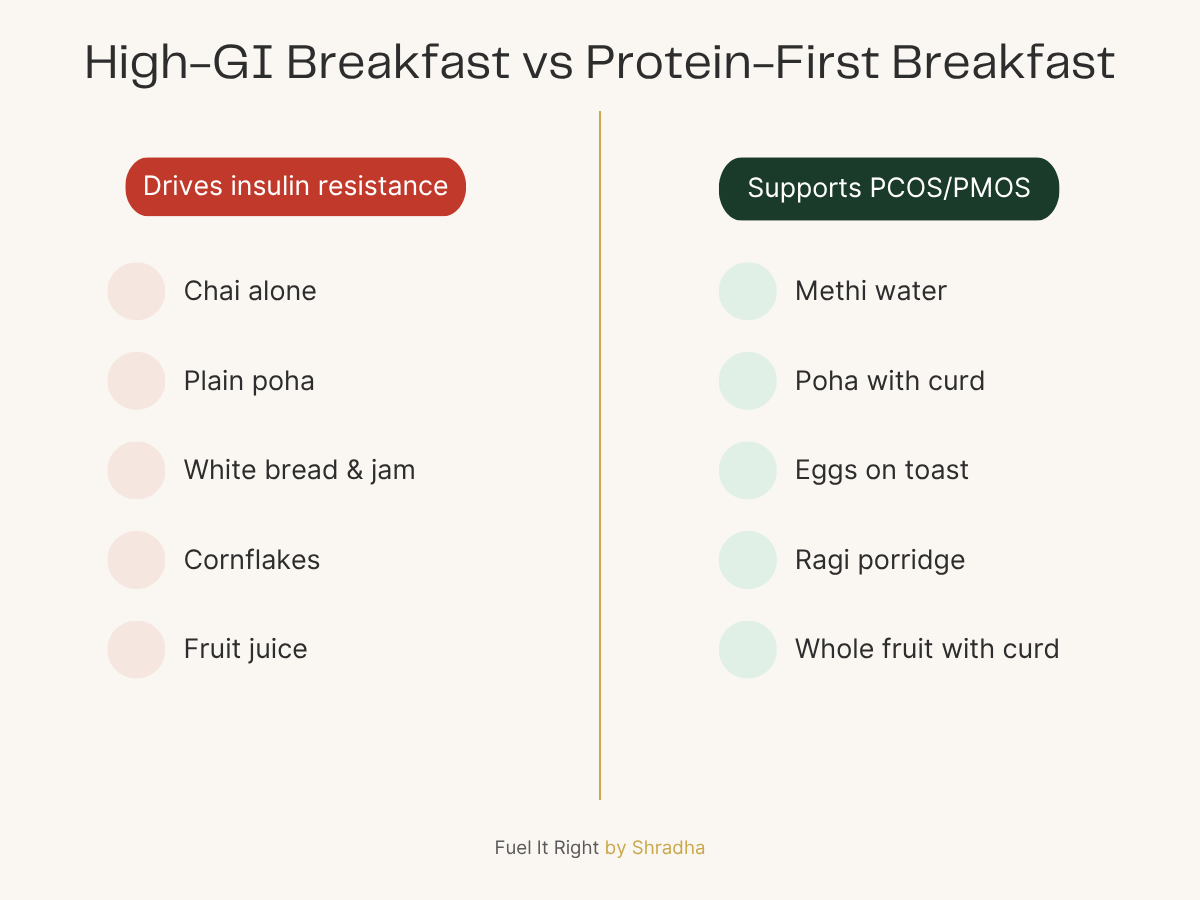
SWAP 5 Instead of: Fruit juice as the morning drink Try: Whole fruit eaten with curd or nuts, or chaas Why it works: Packaged fruit juice removes the fibre from fruit and concentrates the fructose. delivering a large fructose load directly to the liver, which drives hepatic de novo lipogenesis. Even freshly squeezed juice produces a significantly higher glucose and insulin response than the same fruit eaten whole. Whole fruit with curd or nuts slows absorption and adds protein. Chaas provides live cultures, protein, and hydration with no fructose load. Quick tip: Replace the morning juice glass with a small bowl of whole fruit and curd. Same fruit, very different metabolic outcome. |
SWAP 6 Instead of: Nothing until 10am or 11am (skipping breakfast) Try: Any protein-containing food within 1 hour of waking Why it works: Skipping breakfast triggers a cortisol response as the body treats low blood sugar as a stress signal. For women with PCOS/PMOS who already have elevated cortisol, this extends the morning HPA axis activation and worsens the insulin-androgen cascade that follows. Even a small protein-containing snack within one hour of waking, a handful of nuts, a boiled egg, a small bowl of curd, is significantly better than waiting until late morning. Quick tip: Keep roasted chana, walnuts, or a pre-boiled egg in a container the night before. Zero morning preparation. |
Want a breakfast protocol built for your specific PCOS/PMOS picture?
Book a free 30-minute discovery call. Bring your blood report. We will build your personalised morning routine around your HOMA-IR, cortisol pattern, and lifestyle.
SWAP 7 Instead of: Regular chai or coffee as the only morning beverage Try: One cup of chai or coffee after food, plus one cup of spearmint tea Why it works: Caffeine before food elevates cortisol significantly. After a protein-containing meal, the cortisol response to caffeine is substantially smaller. Spearmint tea has consistent clinical evidence for reducing free testosterone within 30 days of two cups daily, making it the most evidence-based beverage intervention for the androgenic symptoms of PCOS/PMOS. For the skin and hair connection, see the blog on PCOS/PMOS and skin. Quick tip: Brew spearmint tea the same time you make your morning chai. One habit, one cup, every morning. |
Read the Blog on PCOS/PMOS and skin here.
SWAP 8 Instead of: Flavoured yogurt or packaged lassi Try: Fresh homemade curd or plain chaas Why it works: Flavoured yogurt and packaged lassi contain significant added sugar and often use stabilisers and preservatives that reduce live culture content. They are not equivalent to fresh homemade curd. Fresh curd provides live Lactobacillus and Bifidobacterium cultures that directly support the gut-hormone axis, the gut bacteria that manage androgen clearance, produce serotonin, and improve insulin sensitivity. For the full gut-hormone connection, see the blog on gut and PCOS/PMOS. Quick tip: Set curd the night before from a tablespoon of starter culture. Ready in the morning. Costs a fraction of packaged yogurt. |
Read the Blog on Gut and PCOS/PMOS here.
SWAP 9 Instead of: Maida paratha or plain roti as the only breakfast Try: Moong dal chilla, besan chilla, or ragi roti with a side of sabzi or curd Why it works: A plain maida or wheat roti eaten alone provides minimal protein and a significant carbohydrate load. Moong dal chilla uses split moong dal as the batter — delivering 8 to 10g of protein per chilla alongside the same eating experience as a roti. Besan chilla does the same with chickpea flour. Ragi roti adds calcium, fibre, and a lower GI than wheat. Any of these eaten with a small bowl of curd or sabzi completes the protein-first requirement. Quick tip: Make moong dal chilla batter the night before and refrigerate. Cook in 5 minutes in the morning. |
SWAP 10 Instead of: Biscuits, Marie biscuits, or namkeen with chai as breakfast Try: A handful of roasted chana, walnuts, or pumpkin seeds Why it works: Biscuits, including supposedly digestive or whole-wheat varieties, are predominantly refined flour with refined oil. They are among the most insulin-disruptive breakfast patterns available in an Indian kitchen. Roasted chana provides protein, fibre, and a low GI. Walnuts provide protein, omega-3, and magnesium. Pumpkin seeds provide zinc and magnesium, both important for adrenal and hormonal function in PCOS/PMOS. These require zero preparation. Quick tip: Keep a jar of roasted chana on the kitchen counter. When the hand reaches for biscuits, it finds chana instead. |
After the Swaps: What to Drink in the Morning
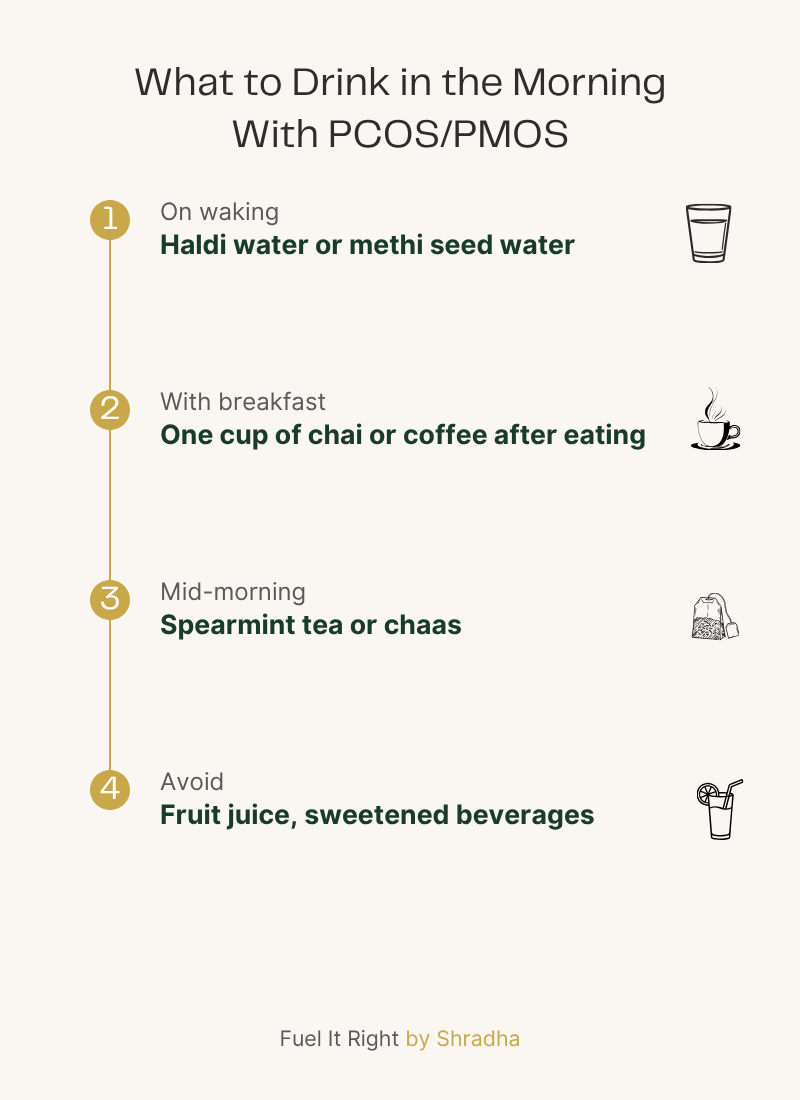
The morning drink pattern matters almost as much as the food. Here is the optimal sequence:
• On waking: warm water with haldi and kali mirch, or methi seed water.
• With or just after breakfast: one cup of chai or coffee, after eating, not before.
• Mid-morning: chaas, spearmint tea, or jeera water.
• Avoid: fruit juice at any point in the morning, sweetened beverages, flavoured milk drinks.
Want to know how your gut health is affecting your PCOS/PMOS symptoms?
Take the free Gut Health Quiz. 2 minutes. Get a personalised read and receive the free 3-Day Indian Gut Reset straight to your inbox.
Conclusion: Start With One Swap This Week
You do not need to change all 10 breakfasts at once. One consistent swap, applied every morning for two weeks, produces a measurably better morning insulin and cortisol pattern than ten swaps applied inconsistently.
If you currently drink chai on an empty stomach, start by eating something with protein first, anything, before the chai. That single change is Swap 1 and it sets the foundation for everything else.
If you eat cornflakes every morning, replace them with ragi porridge or oats with curd. That is Swap 4 and it may be the highest-impact change in the entire list.
If you skip breakfast entirely, keep a jar of roasted chana or a pre-boiled egg in the fridge. That is Swap 6 and it stops the morning cortisol cascade before it starts. For the complete daily food protocol beyond breakfast, the blog on PCOS and PMOS. What to eat, when, and why covers the full framework.
Book a Free 30-Minute Discovery Call
Tell me your current breakfast and bring your blood report. We will build a morning protocol specific to your PCOS/PMOS metabolic picture.
Or call us: +91 7057063984
FAQs: Indian Breakfast Swaps for PCOS and PMOS
Q1. Is poha really bad for PCOS/PMOS?
Poha is not bad. Poha eaten alone without any protein is the problem. Beaten rice has a medium-to-high glycaemic index and no protein content. When it is the only breakfast item, it drives a glucose spike without any protein to buffer it. Adding curd, a boiled egg, or roasted chana alongside poha before eating it converts the meal into a protein-buffered one with a significantly lower insulin response. The poha itself does not need to be removed, the habit of eating it alone does.
Q2. I cannot eat in the morning. I have no appetite. What should I do?
Morning appetite suppression is itself a sign of dysregulated cortisol in PCOS/PMOS. When cortisol is high in the morning, appetite is often suppressed. This becomes a cycle: no appetite leads to skipping breakfast, which triggers more cortisol, which further suppresses the next morning's appetite. The solution is to start with something very small, a small handful of nuts, half a boiled egg, one tablespoon of curd, rather than a full meal. This is enough to signal the body that food is available and begin breaking the cortisol cycle. Over 1 to 2 weeks, morning appetite typically returns.
Q3. I have very little time in the morning. Which swap requires the least effort?
Swap 6 — keeping roasted chana, walnuts, or a pre-boiled egg ready, requires zero morning effort. Roasted chana in a jar on the counter takes 10 seconds to eat. A pre-boiled egg takes 2 minutes to peel. Methi seed water requires 30 seconds the night before. These three options together cover Swaps 1, 6, and 10 with essentially zero morning cooking. If you have 5 extra minutes, moong dal chilla batter made the night before and stored in the fridge cooks in 5 minutes.
Q4. Is ragi good for PCOS/PMOS?
Yes. Ragi has a glycaemic index of approximately 65, lower than wheat flour and significantly lower than maida. It is rich in calcium, iron, and dietary fibre. The fibre content slows glucose absorption and feeds the gut bacteria that manage insulin sensitivity. Ragi porridge or ragi roti as a breakfast carbohydrate is a meaningful upgrade over wheat or maida-based options.
Q5. Can I eat fruit for breakfast with PCOS/PMOS?
Yes, but not as the first or only item and not as juice. Whole fruit eaten alongside protein like curd, nuts, eggs produces a significantly lower glucose response than fruit eaten alone or juiced. The fibre in whole fruit slows absorption. The protein from the accompanying food buffers the insulin response. A small bowl of papaya, guava, or berries with a serving of curd is metabolically appropriate. A glass of fruit juice on an empty stomach is not.
Q6. Does the time I eat breakfast matter?
Yes. Eating within one hour of waking reduces the extension of the morning cortisol spike into the day. The longer the gap between waking and eating, the longer the cortisol-dominant, glucose-unstable state continues. This is independent of what you eat like eating something small early is metabolically better than eating a larger protein-rich meal at 11am for PCOS/PMOS management.
Q7. I already eat a healthy breakfast. Why am I still having PCOS/PMOS symptoms?
Breakfast is one intervention among several. If breakfast is already protein-first and low-GI, look at the rest of the day: is the sequence rule being followed at lunch and dinner (vegetables first, dal second, carbohydrates last)? Is curd being eaten twice daily? Is there consistent meal timing? Are anti-inflammatory spices being used daily? And most importantly, what do the blood markers show? A HOMA-IR above 2.5 despite good breakfast habits suggests the metabolic load from other meals or other lifestyle factors is still driving insulin resistance.
Q8. Is overnight oats a good option for PCOS/PMOS?
Yes, with modifications. Standard overnight oats made with milk and fruit can be high-GI depending on the oat type and additions. Swapping the milk base for curd adds protein and probiotic benefit. Using rolled oats rather than instant oats reduces the GI. Adding nuts and seeds adds fat and protein. Keeping the fruit small and whole rather than blended keeps the fibre intact. Overnight oats with curd, nuts, chia seeds, and a small amount of whole fruit is a strong PCOS/PMOS breakfast option.
About the Author
Shradha | Nutritionist and Dietitian | Fuel It Right. Practising out of Goa, India, with a focus on gut health, PMOS/PCOS, thyroid disorders, and weight management using real Indian food. No supplements. No machines. Just food, and the science behind it.
fuel-it-right.com | @fuelitright