
The Gut-PMOS Connection: How Your Microbiome Is Driving Your Hormones
The gut-PMOS connection is one of the most under-addressed aspects of this condition. Your microbiome directly drives insulin resistance, androgen levels, and hormone clearance. Here is how.
Table of Contents
1. Why the Gut Was Left Out of the PCOS Conversation for Decades
2. What the Research Now Confirms: 34 Studies, One Clear Pattern
3. The Three Mechanisms: How Your Gut Drives Your Hormones
4. The Estrobolome: Your Gut's Hormone Housekeeping System
5. The Leaky Gut-Inflammation-Insulin Resistance Loop
6. What Indian Women's Gut Microbiomes Look Like With PMOS
7. The Indian Foods That Rebuild Your Gut-Hormone Balance
8. What Does Not Work: Probiotics Alone
9. Conclusion
10. FAQs
Why the Gut Was Left Out of the PCOS Conversation for Decades
The gut-PMOS connection was not part of the clinical conversation when PCOS was first named. The condition was framed as reproductive - ovaries, periods, fertility. The gut was a separate system managed by a separate specialist. The idea that the trillions of bacteria in your digestive tract were directly influencing your androgen levels, insulin sensitivity, and hormone clearance was considered outside the scope of PCOS management.
The 2026 PMOS rename changes this. By defining the condition as polyendocrine and metabolic, it creates the clinical mandate to look at every system that influences metabolism and hormonal balance, and the gut microbiome is now recognised as one of the most significant.
What the science now shows A Nature Reviews Endocrinology meta-analysis of 34 studies published in April 2026 found consistent gut dysbiosis in PCOS across all studies, reduced Lactobacillaceae, elevated Firmicutes, and a pattern that correlated directly with insulin resistance severity. This is not one study or a hypothesis. Across 34 independent studies, women with PMOS show the same disrupted gut bacterial profile. |
What the Research Now Confirms: 34 Studies, One Clear Pattern
The gut microbiome research on PMOS has reached a point of clinical consistency that is difficult to dismiss. Multiple large reviews have now confirmed the same finding: women with PMOS have a measurably different gut bacterial profile from women without PMOS, and the difference correlates with the severity of their metabolic and hormonal disruption.
The Core Findings
• Reduced microbial diversity: women with PMOS have fewer different bacterial species overall, which reduces the gut's functional range.
• Reduced Lactobacillaceae: the beneficial bacteria that support gut lining integrity, reduce inflammation, and support hormone clearance are consistently lower.
• Elevated Firmicutes: bacteria associated with increased energy extraction from food, weight gain, and inflammation are elevated.
• Elevated Enterococcus: specifically identified in normal-weight women with PMOS and insulin resistance: providing the first gut-specific marker for lean PMOS.
• Reduced Faecalibacterium prausnitzii: one of the most anti-inflammatory bacteria in the gut, consistently depleted in women with PMOS, inflammatory bowel conditions, and metabolic syndrome.
• Increased gram-negative bacteria: producing lipopolysaccharides that breach the gut lining and enter the bloodstream, directly triggering inflammation and insulin resistance.
A comprehensive review published in 2025 stated: recent advances underscore the gut microbiome's critical role in modulating insulin resistance and metabolic homeostasis in PMOS, with gut dysbiosis-driven inflammation, gut-brain hormonal signalling, and immune modulation as the underlying mechanisms connecting PMOS with metabolic dysfunction.
The Three Mechanisms: How Your Gut Drives Your Hormones
Understanding the gut-PMOS connection requires understanding the three specific pathways through which your microbiome influences your hormonal and metabolic state. These are not speculative, they are mechanistically mapped in the current literature.
Mechanism 1 | Short-chain fatty acid production. Beneficial gut bacteria ferment dietary fibre into short-chain fatty acids, particularly butyrate, propionate, and acetate. Butyrate is the primary fuel for colon cells and directly repairs gut lining integrity. Propionate and acetate regulate insulin secretion and fat metabolism. In women with PMOS, fibre-fermenting bacteria are depleted, SCFA production drops, gut lining becomes permeable, inflammation rises, insulin resistance worsens. |
Mechanism 2 | Lipopolysaccharide translocation. Gram-negative bacteria in a disrupted gut produce lipopolysaccharides. Bacterial fragments that breach a permeable gut lining and enter the bloodstream. This triggers chronic low-grade inflammation, directly worsening insulin resistance. Studies in animals confirmed this mechanism: LPS infusion alone was sufficient to cause chronic inflammation, obesity, and insulin resistance, without any dietary change. |
Mechanism 3 | Hormone metabolism and clearance. The gut microbiome directly processes oestrogen and androgens. Specific bacterial populations determine how much of these hormones are cleared versus recirculated. In women with PMOS, this clearance function is disrupted, more androgen and oestrogen recirculates rather than being eliminated. The gut is not just responding to hormonal imbalance. It is actively perpetuating it. |
The Estrobolome: Your Gut's Hormone Housekeeping System
The gut-PMOS connection is perhaps most striking in the estrobolome, the community of gut bacteria specifically responsible for metabolising oestrogen.
What the Estrobolome Does
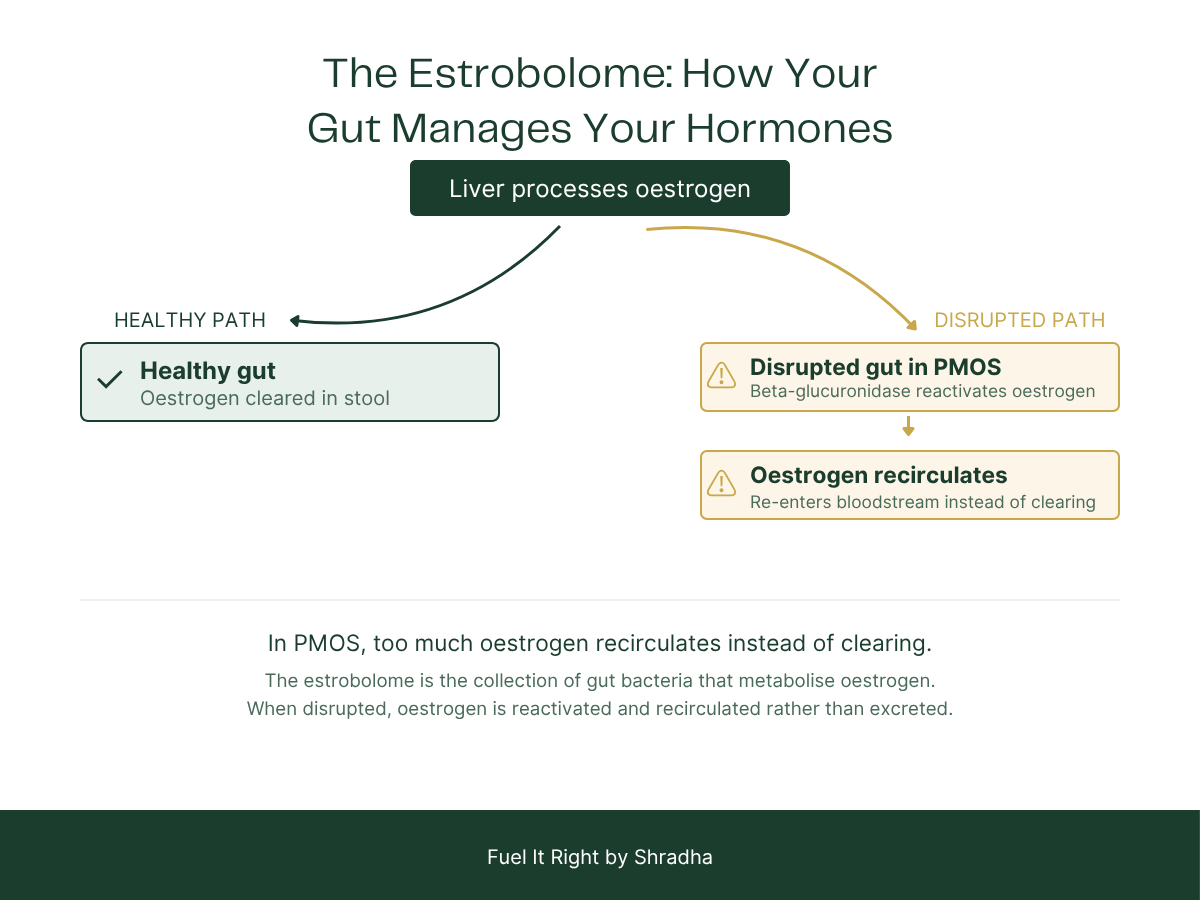
The estrobolome produces an enzyme called beta-glucuronidase. This enzyme determines whether oestrogen that has been processed by the liver gets eliminated in stool or gets reactivated and recirculated in the bloodstream. In a healthy gut with diverse bacterial populations, clearance is efficient. In a disrupted gut, beta-glucuronidase activity tips toward recirculation.
For women with PMOS, excess oestrogen recirculation compounds the hormonal imbalance already driven by insulin-stimulated androgen production. The gut is doing some of the body's hormone housekeeping, deciding how much keeps circulating versus how much gets cleared. In PMOS, that balance is consistently off.
Androgens and the Gut: A Two-Way Disruption
The relationship between gut bacteria and androgens runs in both directions. Elevated androgens reshape the gut environment, altering the bacterial populations that can survive and thrive. An imbalanced microbiome worsens how the body processes androgens. Each disrupts the other. This bidirectional loop is why addressing gut health is not secondary to addressing PMOS, it is simultaneous.
The Leaky Gut-Inflammation-Insulin Resistance Loop
One of the most clinically significant aspects of the gut-PMOS connection is what happens when the gut lining becomes permeable, commonly referred to as leaky gut.
How Leaky Gut Develops in PMOS
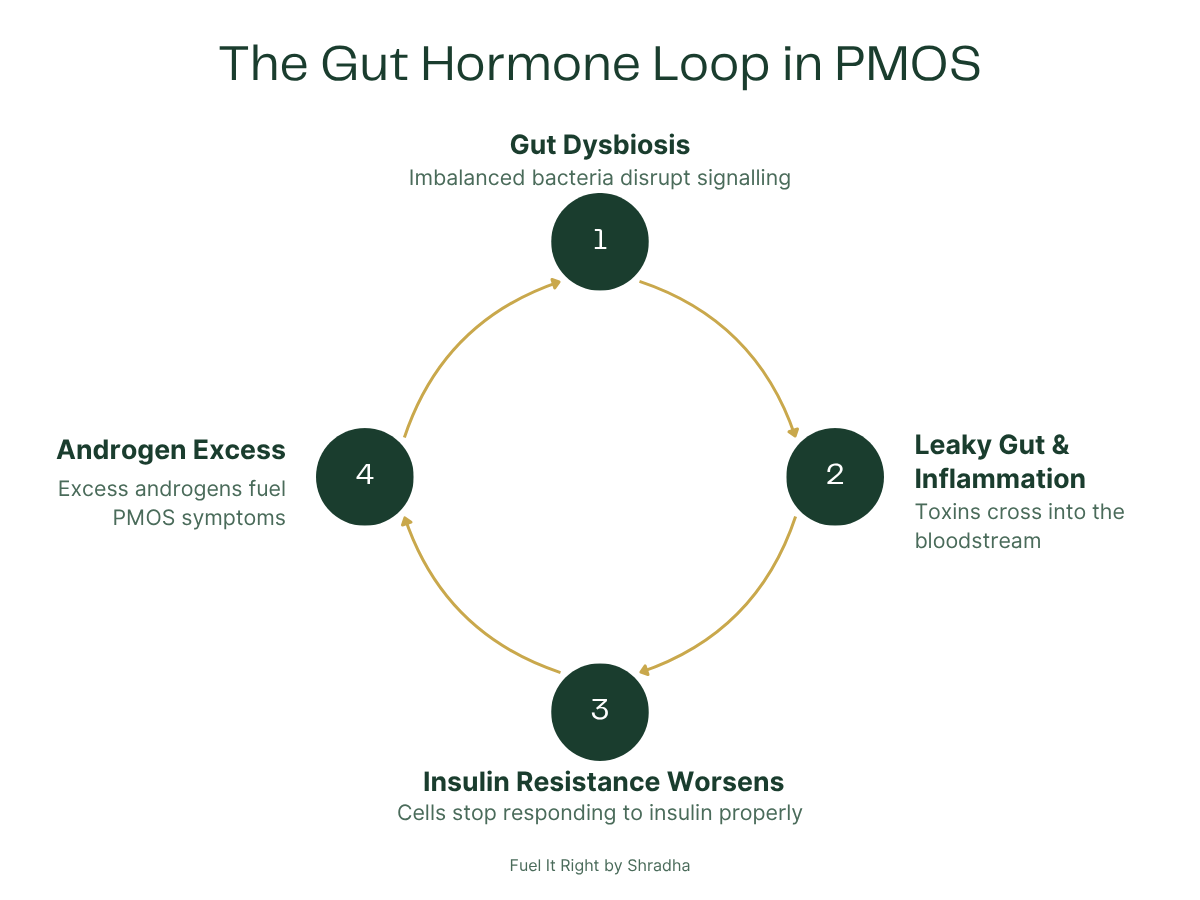
A healthy gut lining acts as a selective barrier allowing nutrients through while blocking bacterial fragments and toxins. This barrier integrity depends on tight junction proteins that are maintained by butyrate from beneficial bacteria. In PMOS, reduced butyrate-producing bacteria means reduced tight junction integrity. The barrier weakens.
When lipopolysaccharides from gram-negative bacteria breach the weakened gut lining and enter the bloodstream, the immune system responds with inflammation. This inflammation activates pathways, specifically serine kinase pathways, that directly interfere with insulin receptor signalling. Insulin resistance worsens.
The result: gut dysbiosis leads to gut permeability, which leads to endotoxemia, which leads to inflammation, which worsens insulin resistance, which drives more androgen production, which further disrupts the gut environment. The loop is self-reinforcing.
The clinical implication A 2026 Frontiers in Endocrinology review confirmed that gut microbiome dysbiosis contributes to PMOS by altering intestinal permeability, promoting endotoxemia, and worsening hormonal and metabolic dysfunction. Diet, as a modifiable factor, offers a therapeutic route to restore microbial balance and improve outcomes. This is not a supplement claim. This is peer-reviewed endocrinology. |
What Indian Women's Gut Microbiomes Look Like With PMOS
The gut-microbiome research in PMOS has been predominantly conducted on Western populations. The limited but growing evidence from Indian women shows the same dysbiosis pattern with additional India-specific factors that worsen it.
The India-Specific Picture
A gut microbiome study of Kashmiri Indian women with PCOS found significant differences in microbial composition between women with and without the condition with links to specific reproductive health, metabolic, and hormonal markers. Bifidobacterium was found to be elevated, while Eubacterium showed a novel association with FSH levels.
Indian women carry an additional gut health burden from dietary patterns. A daily diet built predominantly around refined carbohydrates like white rice, maida, sweetened chai, biscuits, packaged snacks starves the fibre-fermenting bacteria that are already depleted in PMOS. The Indian diet, as commonly consumed in urban settings, is one of the most gut-dysbiosis-promoting dietary patterns for a woman with PMOS.
What Makes the Indian Gut Different
• Lower baseline fibre intake than Mediterranean or East Asian diets directly reduces SCFA-producing bacteria.
• High refined carbohydrate load feeds inflammatory bacterial strains while starving beneficial ones.
• Low fermented food diversity, traditional curd is the primary probiotic source, but is increasingly replaced by flavoured yogurt and packaged alternatives with no live cultures.
• Antibiotic overuse extremely prevalent in India and directly destroys gut bacterial diversity.
• Chronic stress, high cortisol from urban professional lifestyles directly disrupts gut motility and microbiome composition.
The Indian Foods That Rebuild Your Gut-Hormone Balance
This is where the gut-PMOS connection becomes actionable. The Indian kitchen has everything needed to rebuild the bacterial populations that PMOS depletes, without supplements, without imported superfoods, without expensive interventions.
Food | Bacteria it feeds or supports | PMOS benefit |
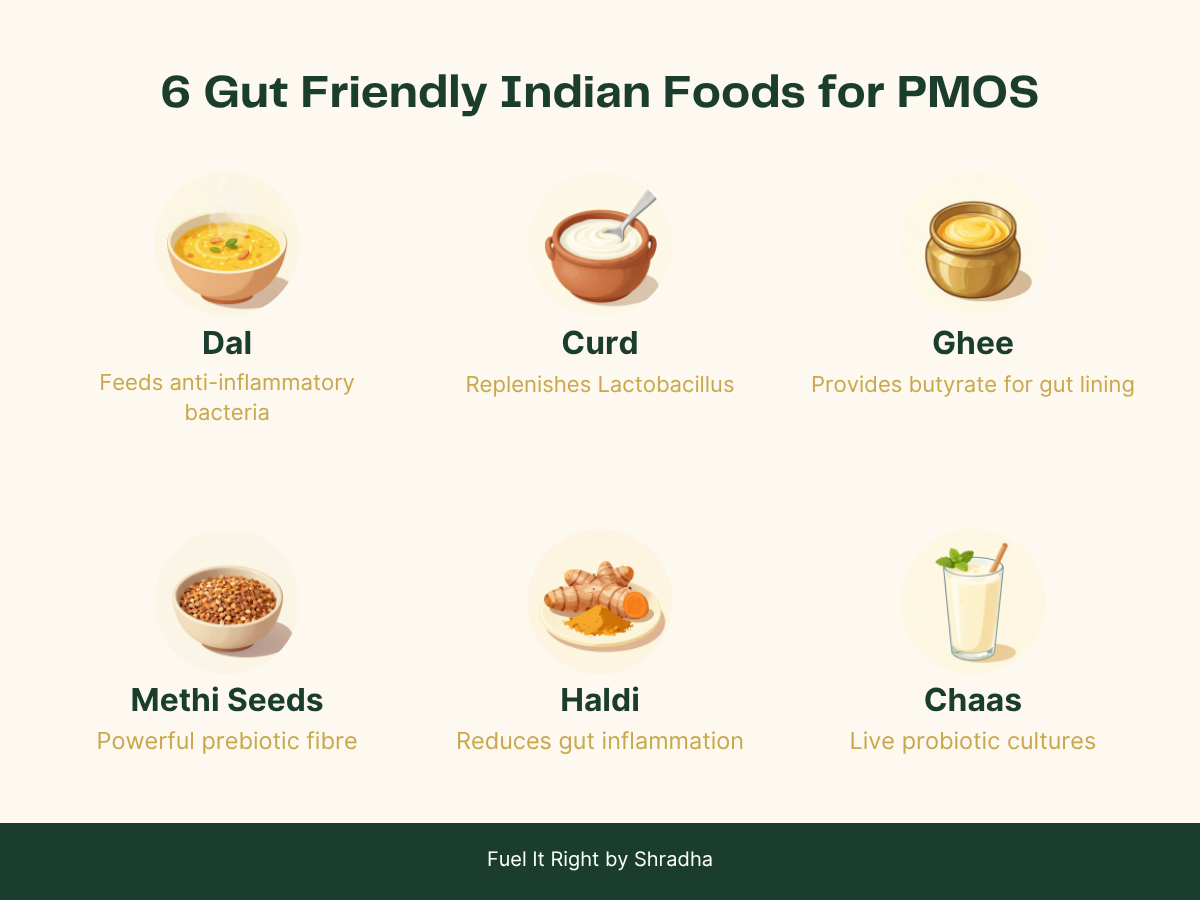
Curd (fresh homemade) | Lactobacillus, Bifidobacterium | Directly replenishes depleted beneficial bacteria. Supports gut lining. Improves oestrogen clearance. |
Dal and legumes | Faecalibacterium prausnitzii, Akkermansia | Primary prebiotic food. Feeds the most anti-inflammatory gut bacteria. Improves SCFA production and gut barrier integrity. |
Methi seeds | SCFA-producing bacteria | Galactomannan fibre is highly prebiotic. Also reduces post-meal glucose spike. Dual benefit for gut and insulin. |
Seasonal sabzi | Diverse beneficial species | Polyphenols act as selective prebiotics. Diversity of vegetables = diversity of bacteria fed. Most important principle. |
Jeera (cumin) | Lactobacillus, reduces pathogenic species | Reduces bloating by inhibiting gas-producing bacteria. Improves enzyme activity and gut motility. |
Haldi (turmeric) | Anti-inflammatory support | Curcumin reduces intestinal inflammation and directly supports gut lining repair. Works best with black pepper and fat. |
Chaas (buttermilk) | Live Lactobacillus cultures | Liquid probiotic. More bioavailable than set curd. Curry leaves in chaas add prebiotic benefit. |
Ghee | Butyrate-producing bacteria | Ghee contains butyrate directly. Also stimulates butyrate production by feeding the right bacterial populations. Repairs gut lining. |
Cooked and cooled rice | Resistant starch-fermenting bacteria | Resistant starch formed when rice is cooked and cooled acts as a powerful prebiotic. Reheating destroys the benefit. |
What Does Not Work: Probiotics Alone
Given the gut-PMOS connection, it might seem that taking a probiotic supplement is the solution. The evidence does not support this as a standalone intervention.
Specific probiotic strains that target mechanisms that lead to inflammation and insulin resistance in PMOS do show potential. However, studies are still limited in scale and duration. Probiotics should currently be viewed as adjunct, evidence-informed options, not primary treatment.
The reason is straightforward: a probiotic supplement introduces a limited number of bacterial strains into a disrupted gut environment. Without the dietary fibre to feed them, the existing dysbiosis to address structurally, and the reduction in inflammatory foods that are killing them, supplemented bacteria have a poor survival rate. Probiotics work when there is something to keep them alive. That something is food.
The correct sequence Step 1: Remove what is killing your gut bacteria. Refined carbs, packaged snacks, excess sugar, antibiotic overuse where avoidable. Step 2: Feed what you want to grow. Dal, seasonal vegetables, methi seeds, cooked and cooled rice, fibre at every meal. Step 3: Introduce live bacteria. Fresh homemade curd, chaas, possibly a specific probiotic strain if clinically indicated. Step 4: Repair the gut lining. Ghee, haldi, bone broth if non-vegetarian, glutamine-rich foods. This is the sequence. Jumping to Step 3 without Steps 1 and 2 is why probiotic supplements produce inconsistent results in PMOS. |
Conclusion: Your Gut Is Not Separate From Your PMOS. It Is Central to It.
The gut-PMOS connection is now one of the best-supported areas of PMOS research. Across 34 studies, the same pattern emerges: reduced beneficial bacteria, elevated inflammatory species, disrupted hormone clearance, worsened insulin resistance. The gut is not a bystander in PMOS. It is an active participant in the metabolic and hormonal disruption that defines the condition.
The good news is that the gut is also one of the most responsive systems to food. Not supplements. Not elimination diets. Real food like fibre, fermented, anti-inflammatory, sequenced correctly can measurably shift the microbiome in the direction that reduces inflammation, improves insulin sensitivity, and restores hormone balance.
If you want to understand what your specific gut picture looks like and how to build a food protocol around it, start with the 3-Day Indian Gut Reset. And if you want to go deeper, book a free 30-minute discovery call.
Book a Free 30-Minute Discovery Call
Tell me your symptoms and your diet. We will map your gut-hormone picture and build your food protocol from there.
FAQs: The Gut-PMOS Connection
Q1. How do I know if my gut health is affecting my PMOS?
The most direct indicator is hsCRP [high-sensitivity C-reactive protein]. A value above 1.0 mg/L indicates active systemic inflammation, which is almost always driven in part by gut dysbiosis in women with PMOS. Other signals: persistent bloating, irregular bowel movements, acne that does not respond to dietary changes, and fatigue that is disproportionate to your sleep. Ask for hsCRP on your next blood panel.
Q2. Does healing my gut actually improve PMOS symptoms?
The research supports this directly. In partner-clinic data tracking over 6,000 Indian women on consistent body-composition-led protocols, two-thirds saw HOMA-IR return to normal within six months, and cycle regularity improve alongside it. Gut health was central to those protocols. The mechanism is clear: reduced gut inflammation improves insulin sensitivity, which reduces androgen production, which improves ovulation and cycle regularity.
Q3. Should I take a probiotic supplement for PMOS?
Probiotics are adjunct, not primary treatment. Specific strains show potential for reducing inflammation and improving insulin sensitivity in PMOS, but studies are limited in scale and duration. A probiotic supplement without the dietary fibre to sustain it has poor long-term efficacy. Build the dietary foundation first like dal, curd, sabzi, methi, ghee and then consider a targeted probiotic if clinically recommended.
Q4. What is the single best food for gut health in PMOS?
Dal. Specifically, the fibre in dal feeds Faecalibacterium prausnitzii which is one of the most anti-inflammatory bacteria in the gut, consistently depleted in women with PMOS. One full cup of cooked dal or legumes daily is the most impactful single food change for gut health in PMOS. Most Indian women are eating a fraction of this.
Q5. I eat curd every day but my symptoms are not improving. Why?
Three possible reasons. First, commercial flavoured yogurt and packaged curd drinks are not equivalent to fresh homemade curd with live cultures. Check what you are actually eating. Second, curd without prebiotic fibre to sustain the bacteria has limited long-term impact. Third, if refined carbohydrates and packaged foods are still dominant in your diet, they are killing the bacteria faster than curd can replenish them. Address the whole dietary pattern, not just one food.
Q6. Does leaky gut cause PMOS or does PMOS cause leaky gut?
Both. The relationship is bidirectional and self-reinforcing. PMOS-driven insulin resistance and androgen excess alter the gut environment, promoting dysbiosis and weakening gut lining integrity. A leaky gut then allows lipopolysaccharides into the bloodstream, driving inflammation that worsens insulin resistance. Both directions operate simultaneously. This is why addressing gut health is a treatment for PMOS, not just a consequence of it.
Q7. How long does it take to see gut health improvements in PMOS?
Measurable changes in gut bacterial populations occur within 3 to 4 weeks of consistent dietary change. Inflammatory markers like hsCRP begin to shift within 6 to 8 weeks. Symptomatic changes like reduced bloating, better energy, clearer skin are often noticeable within 2 to 4 weeks. Hormonal changes like reduced acne, improved cycle regularity typically lag behind metabolic improvements by 2 to 3 months.
Q8. Can stress undo gut health improvements in PMOS?
Yes, significantly. Cortisol directly disrupts gut motility, alters microbiome composition, and increases gut permeability. Chronic high stress, common in urban Indian professional women, can undermine dietary gut health interventions substantially. Cortisol elevation also raises LH and worsens insulin resistance independently of diet. Stress management is not optional in PMOS management when cortisol is a driver.
About the Author
Shradha | Nutritionist & Dietitian | Fuel It Right. Practising out of Goa, India, with a focus on gut health, PMOS/PCOS, thyroid disorders, and weight management using real Indian food. No supplements. No machines. Just food, and the science behind it.
fuel-it-right.com | @fuelitright | +917057063984