
Millets for Diabetes: Do They Beat Rice and Roti?
What a 2024 meta-analysis of 12 trials and a Chennai dosa trial show about millets for diabetes, how they compare with rice and roti, and how to use them well.
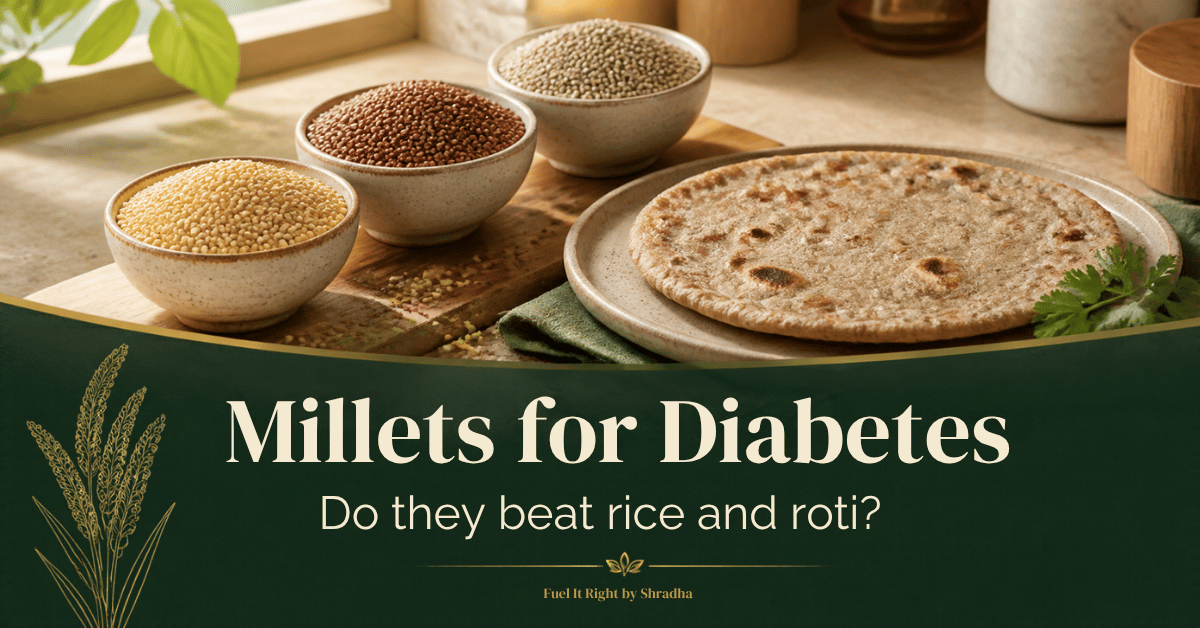
Table of Contents
• What the Research on Millets for Diabetes Shows
• A 2024 Meta-Analysis of 12 Trials
• What Glycemic Index Tells You About Millets
• A Chennai Trial: Foxtail Millet Dosa vs Rice Dosa
• Why I Do Not Treat This as Settled
• Are Millets Better Than Rice for Diabetes?
• Millets vs Rice and Wheat
• Which Millet Is Best for Diabetes
• Portions Still Matter
• Millets and Your Thyroid
• Who Should Be Careful
• How to Use Millets for Diabetes at Home
• Start With One Meal
• Mix and Rotate
• Track Your Own Response
• Common Mistakes With Millets for Diabetes
• A Simple Day With Millets
• What Matters More Than the Grain
• The Bottom Line on Millets for Diabetes
• Frequently Asked Questions About Millets for Diabetes
Millets for diabetes is one of the questions my clients ask most, and it usually comes with a plan attached. Swap rice for ragi, bajra or jowar, and your sugar will supposedly sort itself out. Millets are everywhere now, from rotis to biscuits to noodles, so the claim feels settled.
Here’s the short answer on millets and diabetes. Pooled trials show that eating millet regularly lowers fasting sugar a little. But most of that research is small, short and done in India. And a large Indian dietary study found that swapping grains, without cutting total carbohydrate, did not lower diabetes risk.
In this post on millets for diabetes, I explain what the trials found, which millets seem to work best and where people go wrong. I also cover portions, thyroid questions and how I suggest my clients use millets at home.
Key Takeaways • A 2024 meta-analysis of 12 trials found that fasting sugar fell by about 12 percent in the millet groups, while it barely moved in the control groups. • After-meal sugar was borderline, and HbA1c showed no clear pooled change, though the HbA1c trials lasted only 30 to 90 days. • Millets have a lower glycemic index than white rice on average, but the range is wide. Foxtail and barnyard millet score lowest, while ragi, bajra and jowar sit in the middle. • The ICMR-INDIAB dietary study found that swapping refined cereals for millet flour, without lowering total carbohydrate, was not linked to lower diabetes risk. • My advice: swap one meal at a time, keep your portion in check, add dal and vegetables, and watch your own sugar readings. |
What the Research on Millets for Diabetes Shows
The concept of millets for diabetes is simple. Millets are whole grains that have more fiber than polished rice, and they tend to raise blood sugar more slowly. Researchers in India have been testing millets for diabetes for years, so there is real data to look at.
Here is what the main reviews and trials found, and how much weight I give each one.
A 2024 Meta-Analysis of 12 Trials
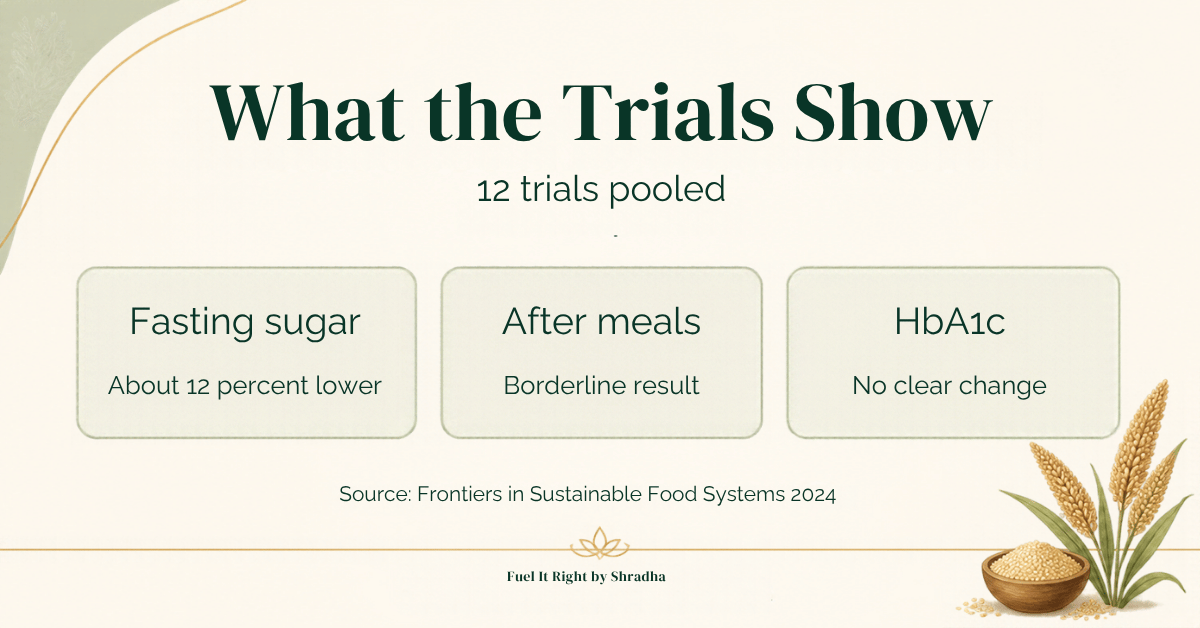
A 2024 paper in Frontiers in Sustainable Food Systems, by Anitha and colleagues, pooled 12 randomized trials that compared millet meals with the usual staples. Eleven were done in India and one in Sri Lanka. The millets included finger millet, which is ragi, as well as barnyard, foxtail and job's tears millet.
Diabetes. The millet groups had much lower fasting sugar levels. For the millet groups it dropped by about 12 percent, and for the control groups it barely changed, less than 1 percent. The result was pretty consistent across trials.
After-meal sugar fell by about 15 percent in the millet groups, but the pooled result sat right on the edge of statistical significance. HbA1c, your three-month average, showed no clear pooled change. The HbA1c trials ran for only 30 to 90 days, which the authors say may explain it.
What Glycemic Index Tells You About Millets
A 2021 review by the same research group looked at 64 studies of millets for diabetes and blood sugar. Across 39 of them, the average glycemic index of millets was about 55. For milled rice it was about 72, and for refined wheat about 74.
The distribution matters too. That average of 55 had a wide range of plus or minus 20, so some millet foods came close to rice. Foxtail and barnyard millet were in the low group, below 55. Pearl millet (bajra), finger millet, kodo, little millet and sorghum (jowar) were in the middle, from 55 to 69.
Processing counted as well. The review found that minimally processed millets did the best job of lowering glycemic index and glycemic load compared with milled rice and refined wheat. That is why I lean toward whole millet grains and flours, not packaged millet products.
A Chennai Trial: Foxtail Millet Dosa vs Rice Dosa
One of my favorite studies is a small Indian trial, because it uses a real Indian breakfast. In Chennai, 105 adults with type 2 diabetes took part. They took tablets but no insulin. Each ate a rice dosa one day and a foxtail millet dosa on another, two days apart, so each person was their own control.
The millet dosa had a glycemic index of about 59, against about 78 for the rice dosa. After-meal sugar was significantly lower with the millet dosa, and fasting sugar did not change. Most of the participants, 89 percent, liked the taste.
The limits are clear. It was one meal, at one hospital, and the glycemic index was measured in 10 healthy volunteers, not in people with diabetes. The authors say more work is needed. It shows that one swap can help after a meal, not that millets for diabetes work as a treatment.
Shradha's Tip If you want to test millets, start with the dosa swap. Same breakfast, same time, millet instead of rice, then check your sugar two hours later and compare. |
Why I Do Not Treat This as Settled
I like my millets and still hold the evidence on millets for diabetes loosely. The quality of the 2024 review was rated as moderate and the authors saw signs of publication bias. Small studies are more likely to be published when they are positive.
The control diets were poorly described, so we often do not know what the millets replaced. Nobody compared different amounts, millet types or cooking methods. The 2024 review was also funded by the Odisha Millet Mission, a state programme that promotes millets, and both reviews share many authors. That does not make the results wrong, but I would like independent teams to repeat them.
The bigger warning comes from the ICMR-INDIAB dietary analysis behind my post on rice and diabetes. It found that replacing refined cereals with whole wheat or millet flour, without lowering total carbohydrate, was not linked to a lower risk of type 2 diabetes. Changing the grain helps less than cutting the overall carbohydrate load.
Are Millets Better Than Rice for Diabetes?
The truth about millets for diabetes is that they are usually only a small step up from white rice and refined wheat, not a completely different kind of food. How much better they are depends on which millet you choose, how you prepare it and what else you eat.
Millets vs Rice and Wheat
Compared with polished white rice, millets for diabetes bring more fibre and, on average, a lower glycemic index. Compared with whole wheat roti, I did not find good head-to-head trials, so I would not claim that millets win.
The ICMR-NIN dietary guidelines for 2024 take a middle path. They advise that at least half of your cereals should be whole grains and millets together. They also say cereals should supply no more than 45 percent of your daily energy. Notice the second number. It is about how much grain you eat, not only which one.
Which Millet Is Best for Diabetes
The usual guide for millets for diabetes is the glycemic index. Foxtail and barnyard millet come out on top, and ragi, bajra and jowar are in the middle. I wouldn’t treat it as a strict ranking, because results varied a lot between studies, and the data on little millet were inconsistent.
Rotating between two or three millets keeps meals interesting. Ragi, jowar and bajra are easy to roll into rotis, while foxtail and barnyard millet cook much like rice.
Portions Still Matter
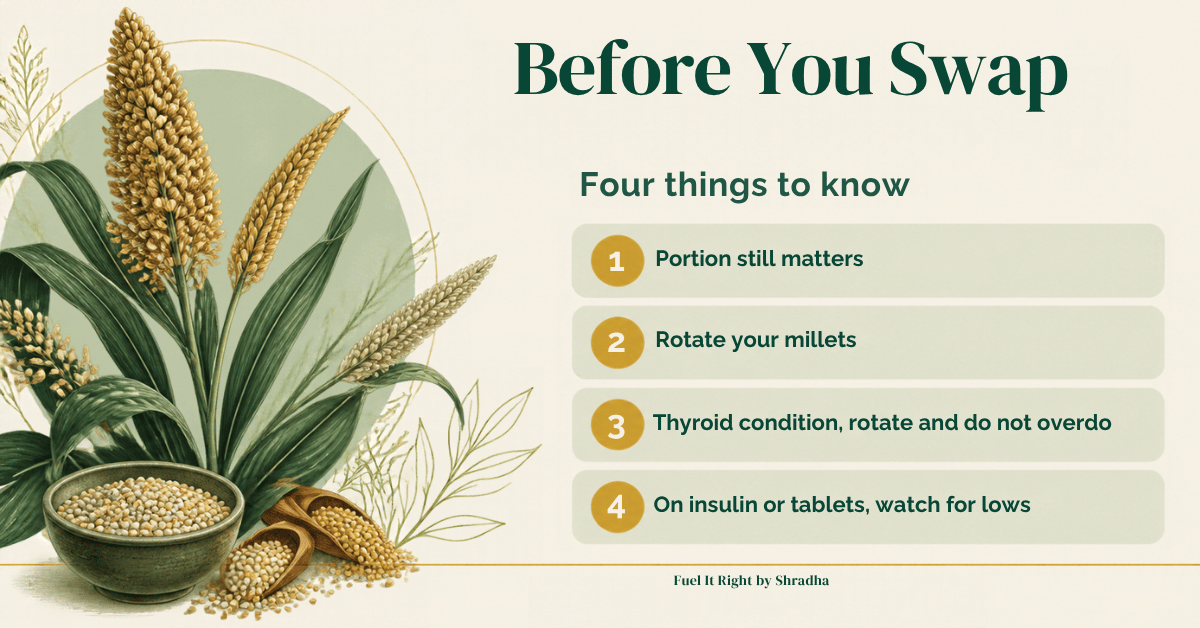
Millets for diabetes are still carbohydrate. A large bowl of foxtail millet can raise your sugar much as a large bowl of rice does. The ICMR number above and the INDIAB finding both point the same way: total carbohydrate matters.
I follow the same rule as I do with rice. Have about one katori of cooked grain, half the plate of vegetables and then dal, paneer, egg, fish or chicken. Fiber and protein slow the sugar rush.
Millets and Your Thyroid
People with thyroid conditions often ask whether millets are goitrogenic. A 2024 systematic review looked at nine studies, eight on pearl millet, which is bajra, and one on fonio. Six were animal studies, and the three human studies were cross-sectional, so they cannot show cause and effect.
The evidence that pearl millet causes goiter is weak, although they saw some suggestive signs that justify more research, the authors concluded. Many animal studies used raw millet or diets made up entirely of millet. A varied diet is unlikely to be a risk, the authors think, but they note that studies in healthy people are missing.
If you have a thyroid condition, I would rotate millets instead of eating bajra every day, and keep taking your medicine as prescribed. My post on goitrogenic foods explains why dose matters more than the food name.
Who Should Be Careful
If you are on insulin or a sulfonylurea, a big shift to millets for diabetes can change your sugar. Check your readings more often for the first two weeks, and let your doctor know about the change. Be aware of the signs of a low: shakiness, sweating, sudden hunger or confusion.
People with kidney disease, or a gut condition that limits fibre, need individual advice before they raise millet intake. I did not find trials on those groups, so I would rather you ask than guess.
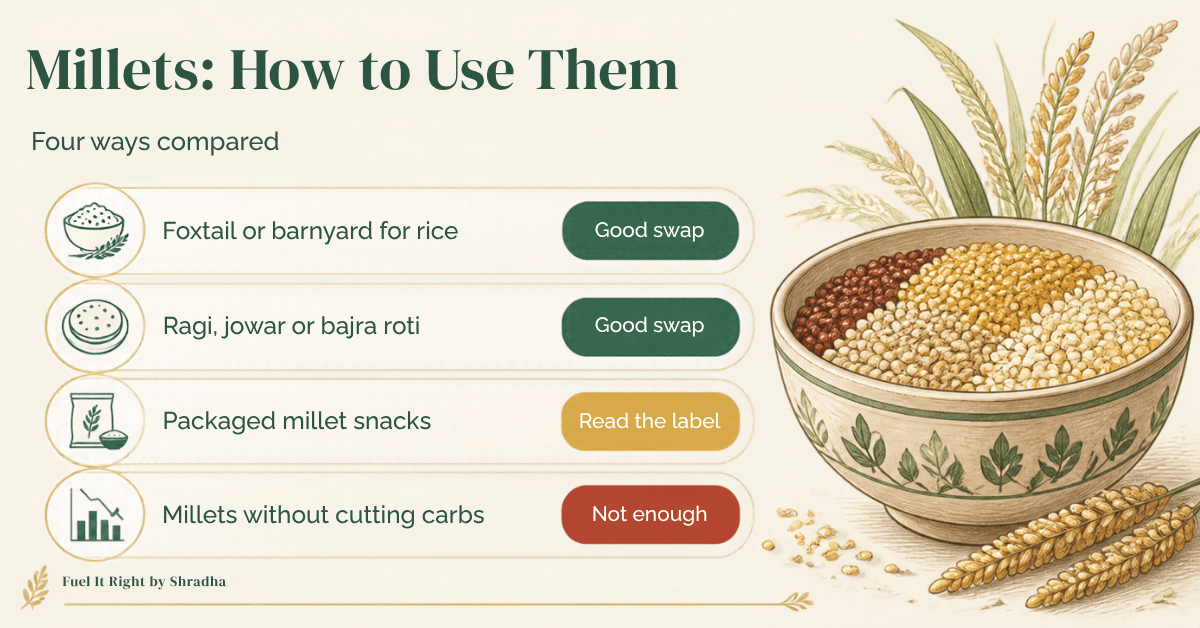
Foxtail or Barnyard Instead of Rice Good swap |
These had the lowest glycemic index in the 2021 review, and the Chennai trial used foxtail. They cook much like rice, so the change is easy. How to make it work: Keep the portion the same as your rice, and add dal and vegetables. |
Ragi, Jowar or Bajra Roti Good swap |
These sit in the middle on glycemic index, but they are filling and easy to use in everyday rotis. How to make it work: Use whole flour, not refined, and keep to your usual number of rotis. |
Packaged Millet Biscuits and Noodles Read the label |
I did not find trials on these products. A millet label does not tell you how much of the flour is millet, how refined it is, or how much sugar and fat were added. How to make it work: Check the ingredient list, and treat them as an occasional snack. |
Millets Without Cutting Total Carbohydrate Not enough |
The INDIAB analysis found no lower diabetes risk from swapping grains alone. How to make it work: Keep the grain portion in check and add protein and vegetables. |
WHAT YOU'VE HEARD Millets are a free pass, so you can eat as much as you like. |
WHAT'S ACTUALLY TRUE Millets are still carbohydrate. They tend to raise sugar a little less than white rice, but a large portion still raises it, and the INDIAB analysis found no benefit from swapping grains without cutting total carbohydrate. |
How to Use Millets for Diabetes at Home
If you want to try millets for diabetes, I suggest going slowly. You do not need a new kitchen or special products, just a few swaps that you can keep up.
Start With One Meal
Choose a meal of the day to replace your millets for diabetes, usually breakfast or lunch. In that meal replace the rice or refined flour, keeping the quantity the same, and keeping everything else on the plate the same for two weeks.
Switching every meal at once makes it hard to see what is working. A stomach that is not used to fibre may also protest with gas or bloating, so build up over a few weeks.
Mix and Rotate
For millets for diabetes, rotate between two or three millets through the week instead of using one every day. If the family resists a full switch, mix a little millet flour into your usual atta and raise the share slowly. Whole grains and whole flours are the point, not refined ones.
Cook millet grains like rice, with a little more water. For rotis, knead with warm water, since millet flour has no gluten and breaks easily.
Track Your Own Response
If you are testing at home, check your sugar two hours after your usual rice or roti meal for a few days. Then check two hours after the millet version of the same meal. Compare the two and share your readings with your doctor.
People vary, and your own numbers on millets for diabetes matter more than any average. If your sugar does not move, that is useful to know too.
Common Mistakes With Millets for Diabetes
The most common mistakes I see with millets for diabetes are simple. People double the portion because millets feel healthy. Others buy packaged millet snacks and count them as a healthy swap. Some stop at the grain and never add dal, vegetables or protein.
Another mistake is expecting millets to replace medicine or fix a high sugar alone. In the trials, millets for diabetes lowered sugar a little. They did not remove the need for treatment. Keep taking your medicines as prescribed.
A Simple Day With Millets
With your doctor’s approval, you can include millets for diabetes in your daily diet in the following ways. For breakfast, you can try foxtail millet dosa or ragi chilla with vegetable chutney and an egg or paneer on the side. For lunch, you can have one jowar or bajra roti, dal, sabzi and kachumber salad.
For dinner, keep to vegetables, protein and a small portion of cooked millet, or one roti. You do not need millets for diabetes at every meal. One or two a day is plenty.
What Matters More Than the Grain
Millets are one lever for diabetes, and not the biggest one. Walking after meals, enough protein and lesser refined carbohydrates do a lot, along with your medicines.
If you want to start there, read the post on walking after meals and the post on fruit.
Shradha's Tip Do the plate test before you change the grain. If half your plate is not vegetables and a quarter is not protein, fix that first. A millet swap on a rice-heavy plate tends to help less. |
If millets leave you bloated or gassy, the Gut Health Quiz is a good place to start.
The Bottom Line on Millets for Diabetes
Millets do help diabetes, but only modestly. A 2024 meta-analysis of 12 trials found fasting sugar dropped about 12 percent in the millet groups. Post-meal sugar was borderline, and HbA1c showed no clear pooled change. A small Chennai trial found that a foxtail dosa raised post-meal sugar less than a rice dosa.
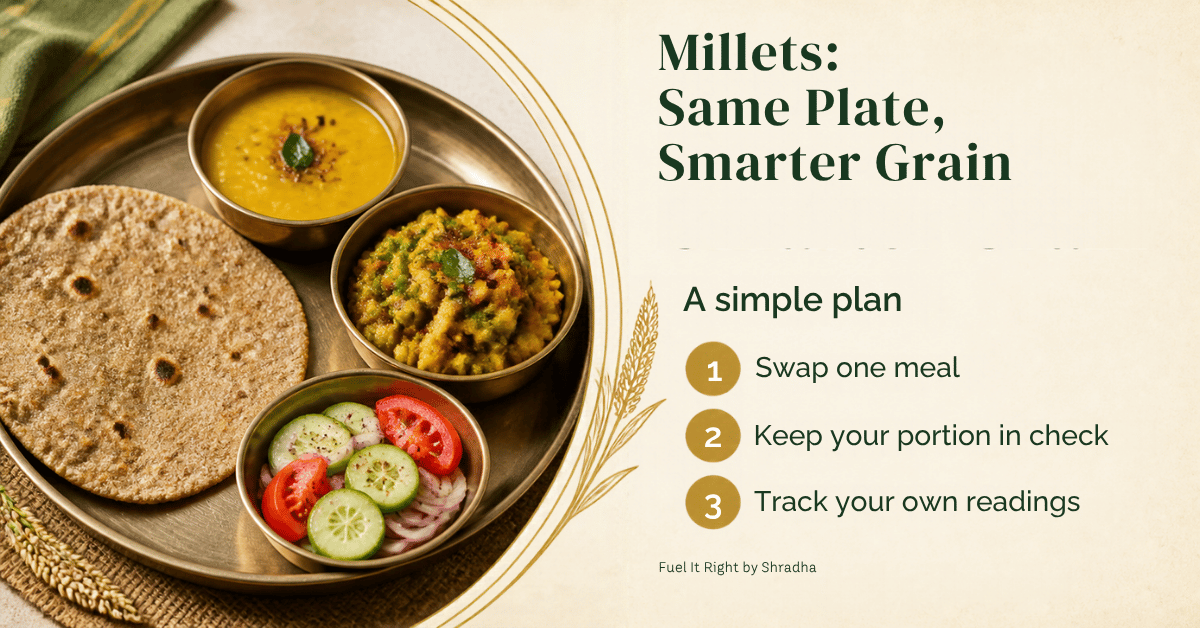
My view on millets for diabetes is simple. They are a good swap for white rice and refined flour, not a free pass. Choose whole millets, keep your portion in check, add dal and vegetables, and track your own readings.
If you are following this series, you may also like the posts on karela, apple cider vinegar and cinnamon, all put through the same check.
Want help building a millet plan that fits your diabetes and your medicines?
Book a consultation:
Call or WhatsApp: +91 7057063984 or
Frequently Asked Questions About Millets for Diabetes
Are Millets Good for Diabetes?
Millets for diabetes can help a little. A 2024 meta-analysis of 12 trials found lower fasting sugar, but HbA1c showed no clear pooled change, and the evidence is mostly Indian and small.
Is Millet Safe for a Diabetic Person?
Most people with diabetes can safely enjoy millets as part of a balanced plate. Watch your portion, check your sugar if you take insulin or tablets, and tell your doctor about any big change.
Which Millet Is Best for Diabetes?
Foxtail and barnyard millet had the lowest glycemic index in the 2021 review, while ragi, bajra and jowar sat in the middle. I suggest rotating them instead of picking one.
Is Ragi Good for Diabetes?
Ragi, or finger millet, had an intermediate glycemic index in the 2021 review and was one of the millets in the 2024 trials. It can fit in a portion you control, with dal and vegetables.
Is Millet Better Than Rice for Diabetes?
Millets have a lower average glycemic index compared to white rice. However, the ICMR-INDIAB analysis found that replacing grains without reducing total carbohydrates was not associated with a lower risk of diabetes, so portion size still matters.
How Much Millet Can I Eat in a Day?
I did not find trials that set an amount. I suggest about one katori cooked, or your usual number of rotis, at one or two meals, with vegetables and protein. ICMR-NIN advises that cereals supply no more than 45 percent of energy.
Can Millets Replace Diabetes Medicines?
No. Millet meals lowered sugar a little in trials, but none replaced treatment. Keep taking your medicines as prescribed and tell your doctor about diet changes.
Are Millets Bad for Thyroid?
The evidence linking pearl millet to goiter is weak, relying mostly on animal studies and a few cross-sectional human studies. If you have a thyroid problem, rotate millets, keep portions moderate, and take your medicine as directed.
Shradha | Nutritionist & Dietitian | Fuel It Right