
Cinnamon for Diabetes: Does It Lower Blood Sugar?
What a 2025 umbrella review and a 12-trial meta-analysis show about cinnamon for diabetes, why cassia needs a daily limit, and how to use it safely, if at all.
Table of Contents
• What the Research on Cinnamon for Diabetes Shows
• The 2025 Umbrella Review
• Why the Numbers Look Bigger Than They Are
• A Closer Look at 12 Trials
• An Older Pooled Analysis
• Why Results Differ So Much
• Is Cinnamon Safe for Diabetes?
• Is Cinnamon Good for Diabetic Patients?
• Cassia, Ceylon and Coumarin
• How Much Cinnamon Is Too Much
• Low Sugar and Medicines
• Who Should Skip It
• How to Use Cinnamon for Diabetes at Home
• If You Want to Try It
• Which Cinnamon to Buy
• Use It in Food
• Track Your Own Response
• Common Mistakes With Cinnamon for Diabetes
• A Simple Day With Cinnamon
• What Matters More Than Cinnamon
• The Bottom Line on Cinnamon for Diabetes
• Frequently Asked Questions About Cinnamon for Diabetes
Cinnamon for diabetes is probably the first home remedy someone suggested to you. A pinch in your tea, a stick in your dal, a spoonful in your oats, and your sugar will supposedly come down. It sits in every Indian masala dabba, which is part of why the claim spreads so easily.
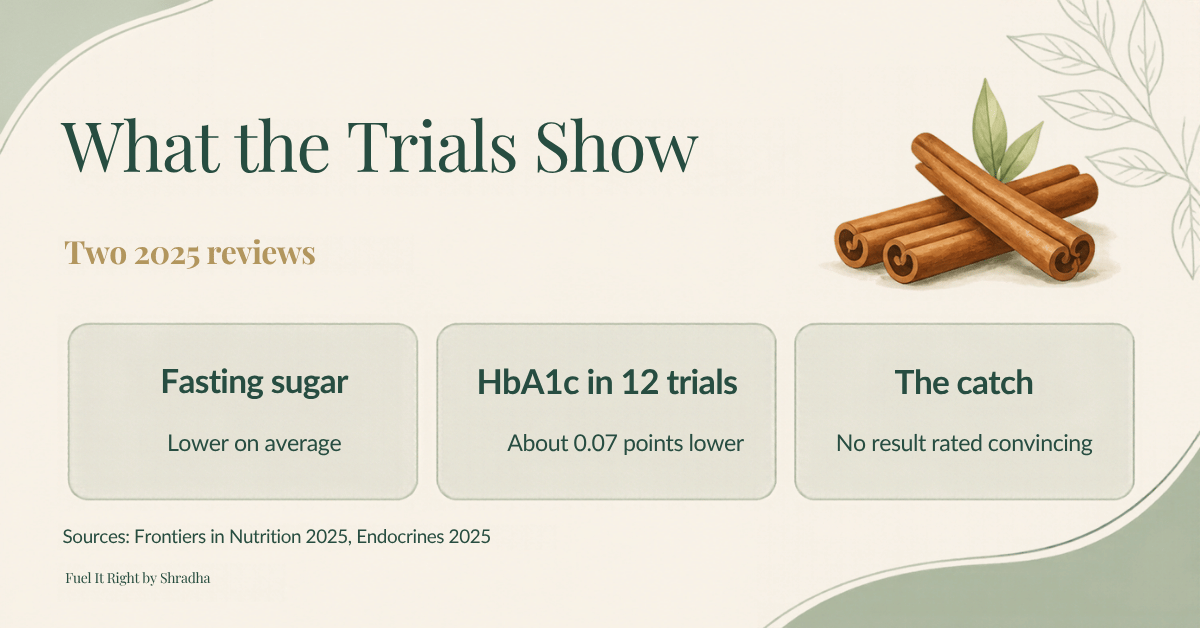
Here is the short answer on cinnamon for diabetes. Pooled trials suggest it may lower fasting sugar a little. But the effects are small, the trials differ a lot, and no review I read rated the evidence as convincing. There is also a catch most people miss: the common market type, cassia, has a coumarin limit.
In this post on cinnamon for diabetes, I explain what the research found and how big the effect really is. I also cover which cinnamon to buy, who should skip it, and how I suggest my clients use it.
Key Takeaways • A 2025 umbrella review of 21 meta-analyses found that cinnamon lowered fasting sugar and HbA1c on average, but it rated none of the results as convincing. • The real size is modest. A meta-analysis of 12 trials found HbA1c fell by only about 0.07 points, and that result disappeared when one trial was removed. • Most cinnamon sold in the market is cassia, which is high in coumarin. For an adult weighing 60 kg, about 2 g a day of cassia reaches the safe limit used by German food safety scientists. • Many trials used 1 to 3 g a day, so cassia at trial doses can pass that limit. Ceylon cinnamon is much lower in coumarin. • Cinnamon may add to the sugar-lowering effect of diabetes medicines, so tell your doctor before you start. |
What the Research on Cinnamon for Diabetes Shows
The idea behind cinnamon for diabetes is that compounds in the bark may help your body respond to insulin or slow how fast sugar enters the blood. Researchers have tested this for years, with very mixed results.
More recently, reviewers have pooled many trials together. Here is what the most useful of them found, and what I make of it for people living with diabetes.
The 2025 Umbrella Review
In a 2025 paper in Frontiers in Nutrition, Gou and colleagues combined 21 existing meta-analyses of randomized trials on cinnamon. Together, they included 45 unique studies, with doses ranging from 0.12 to 6 grams a day and durations from 1.5 to 12 months.
Fasting blood sugar came out lower with cinnamon. HbA1c, your three-month average sugar, was lower too, though by a smaller amount. Insulin resistance, measured as HOMA-IR, also looked better, but the result was no longer clear after the authors adjusted for likely missing small studies.
Dose and timing came up as well. The authors say doses above 1.5 g a day and shorter trials of two months or less may show bigger benefits. I could not read the table behind that statement, so I treat it as a pointer, not a rule.
Why the Numbers Look Bigger Than They Are
The review reports effects in standard deviations, a statistical unit. Fasting sugar dropped by about 0.6 of one, and HbA1c by about 0.26. Those figures do not tell you how many mg/dL you will lose, and that is the first thing I want to know.
The grading matters more. For fasting sugar, the authors rated 3 comparisons as suggestive and 10 as weak. For HbA1c, 4 comparisons were weak and 8 were not significant. Nothing was rated convincing or highly suggestive.
That is the honest picture of cinnamon for diabetes. There is a signal, but it is faint and uneven. It is not strong enough to call cinnamon a treatment.
A Closer Look at 12 Trials
A recent meta-analysis in adults with type 2 diabetes gives a better sense of size. It pooled 12 randomized trials, drawn from 14 studies across many countries, with 5 from Iran and 2 from India. The authors suggest 1 to 3 g a day for 12 weeks.
HbA1c fell by only 0.07 points on average across 9 trials with 605 people. That is far too small to notice. Fasting sugar fell by just 1.7 mg/dL, and that was not statistically significant. After-meal sugar fell by about 6 mg/dL in 3 trials.
The HbA1c result also vanished when a single trial was removed, so it is fragile. Several trials had unclear risk of bias, and the authors urge caution. Small and shaky is not the same as useless, but it is not a reason to rely on cinnamon for diabetes.
An Older Pooled Analysis
A 2019 meta-analysis of 16 trials on cinnamon for diabetes found it lowered fasting sugar by about 0.55 mmol/L, or about 10 mg/dL. There was no significant change in HbA1c. The trials disagreed with each other a lot, which makes that average less reliable.
The authors reported that cinnamon was generally well tolerated in the included trials. They called for trials using standard cinnamon products because the products in the trials were not the same.
Why Results Differ So Much
There are a number of reasons for the mess in cinnamon diabetes research. The trials used different doses, from less than 1 gram to 6 grams a day. The trials lasted different amounts of time. People were on different medications and had different initial sugar levels. And the cinnamon itself was not the same.
Cinnamon is a bark, and its species, extract and preparation vary. A university extension factsheet in the US notes that few studies are large enough to be representative. In short, nobody can tell you the exact dose and type of cinnamon that works.
Shradha's Tip If cinnamon helps at all, it is a small nudge. A kachumber salad before your meal and a short walk after it may do more for your after-meal sugar, with no coumarin to count. |
Is Cinnamon Safe for Diabetes?
In food amounts, cinnamon is a normal spice. The questions start when you use it as a daily remedy, because the amount, the type and your medicines all matter. Safety comes first when I look at cinnamon for diabetes.
Is Cinnamon Good for Diabetic Patients?
For most diabetic patients, cinnamon in food is fine. A sprinkle on oats or a stick in your dal is no known problem. The real questions about cinnamon for diabetes are whether larger daily amounts help enough, and whether they are safe over years. Neither is settled.
Please do not stop or reduce any medicine because you started cinnamon. If you try cinnamon for diabetes, watch for low sugar and tell your doctor.
Cassia, Ceylon and Coumarin
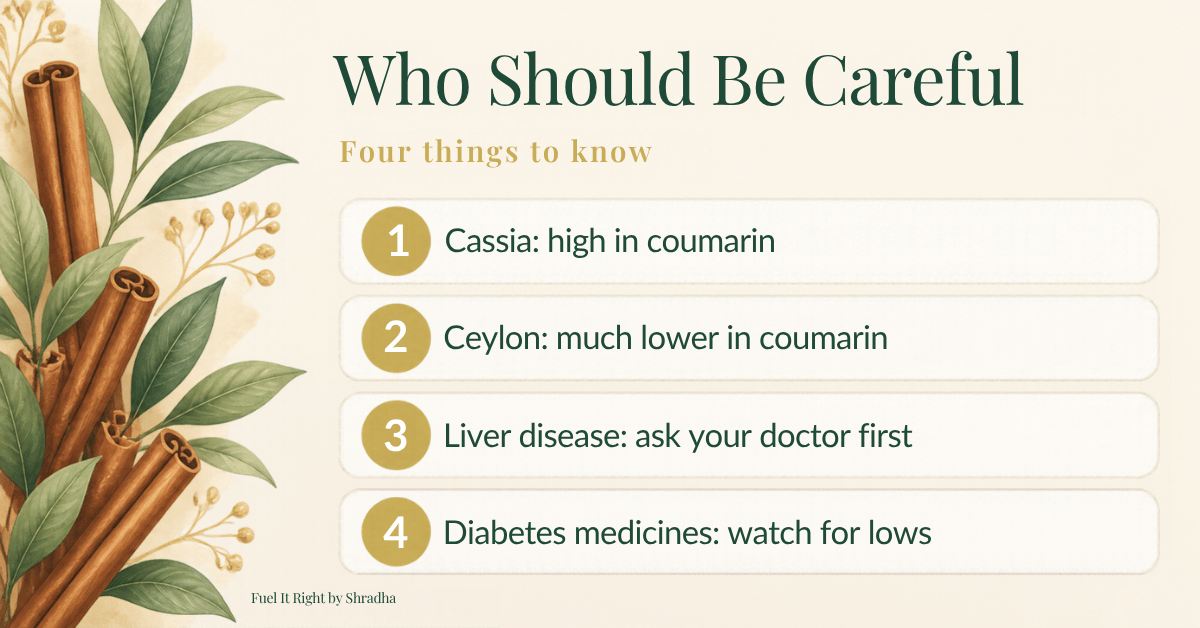
There are two main types. Ceylon cinnamon, also called true cinnamon or Cinnamomum verum, is low in coumarin. Cassia is darker, thicker and stronger in flavour, and it is high in coumarin.
India has treated this as a real problem. In November 2023, FSSAI asked state food safety officers to run market checks for cassia sold as cinnamon, in both whole and powdered form. Its cinnamon standard includes a coumarin limit, to help tell the two apart. So the powder in your kitchen could well be cassia.
Coumarin is the concern. In a small group of sensitive people, coumarin taken as a drug for a few weeks has raised liver enzymes, and in severe cases caused liver inflammation. The effects are usually reversible. Germany's food safety institute knows of no documented liver damage from eating cinnamon itself.
How Much Cinnamon Is Too Much
Germany's food safety institute uses a tolerable daily intake of 0.1 mg coumarin per kg of body weight a day. Cassia averages about 3,000 mg coumarin per kg of cinnamon, with some samples reaching 10,000. This means about 2g a day of cassia reaches the limit for a 60kg adult and about 0.5g for a 15kg child.
A level teaspoon of ground cinnamon weighs about 2.6 g. So one teaspoon of cassia a day sits just above the limit for a 60 kg adult. Trials often used 1 to 3 g a day, so cassia at trial doses can pass it. An occasional sprinkle is not the worry. Daily teaspoons for months are.
Low Sugar and Medicines
Cinnamon for diabetes may add to the effect of your diabetes tablets. A drug interaction database lists a moderate interaction with metformin and says the dose you need may fall. It advises close monitoring for low sugar.
Know the signs of a low: shakiness, sweating, sudden hunger, a pounding heart or confusion. If you notice them, check your sugar and tell your doctor. This matters most if you take insulin or a sulfonylurea.
Who Should Skip It
If you have liver disease or take medicines that affect the liver, I would suggest you skip daily cassia. Anyone with a known allergy to cinnamon should avoid it as well. If you take diabetes medicines, ask your doctor first and tell them about any cinnamon you take in any form.
The trials ran for weeks to a few months. So the long-term safety of daily cinnamon for diabetes is not known.
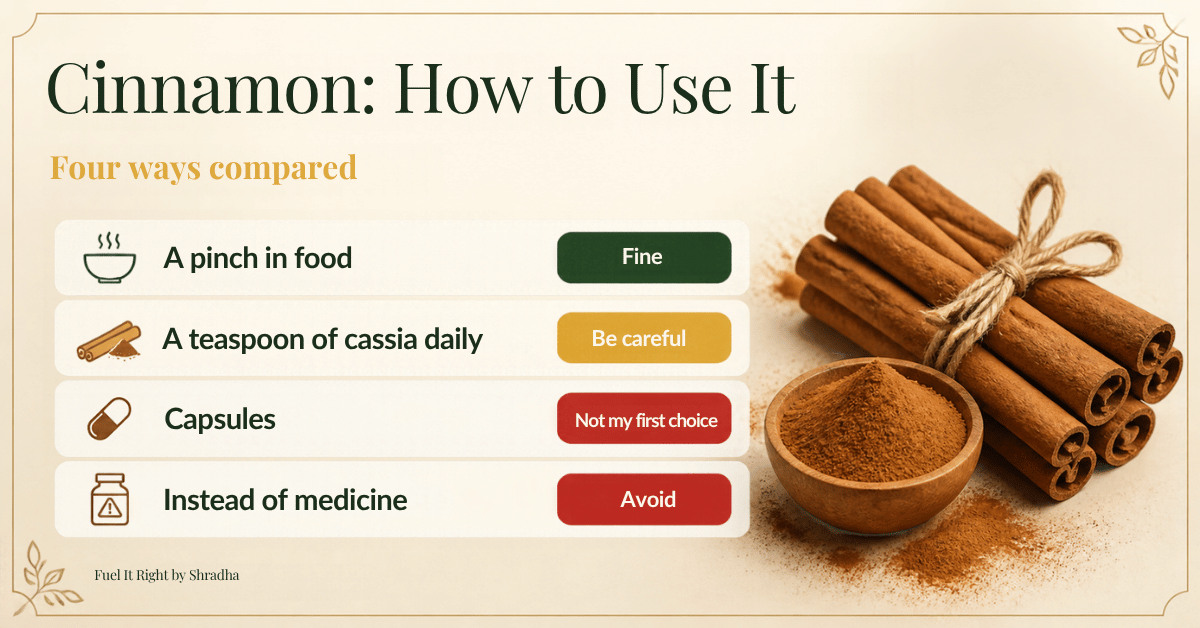
A Pinch in Food Fine |
A sprinkle on oats or a stick in dal adds flavour with very little coumarin. It will not move your sugar much, but it is a safe habit. How to make it work: Enjoy it, and keep your other habits strong. |
A Teaspoon of Cassia Daily Be careful |
This sits close to the safe coumarin limit for many adults, and the benefit is small. How to make it work: Choose Ceylon if you want a daily spoonful. |
Cinnamon Capsules Not my first choice |
The dose and the type of cinnamon vary between products, and the label may not say which one is inside. How to make it work: Food first fits my approach better. |
Cinnamon Instead of Medicine Avoid |
No trial shows cinnamon can replace diabetes medicines, and the pooled effects are small. How to make it work: Keep taking your medicines as prescribed. |
WHAT YOU'VE HEARD Cinnamon water every morning brings blood sugar down. |
WHAT'S ACTUALLY TRUE Pooled trials show a small average effect, and the best review rated none of it as convincing. Daily cassia can also add up to more coumarin than is advised. |

How to Use Cinnamon for Diabetes at Home
If your doctor approves and you want to try cinnamon for diabetes, here’s how I recommend my clients do it. None of it requires any special product.
If You Want to Try It
Start small with cinnamon for diabetes. A quarter teaspoon of powder, or a small piece of stick, is enough to begin with. If it is cassia, I would stay at or under about 1 g a day for an adult, which is roughly a third of a teaspoon.
The trials used bigger doses, but they were not designed to tell us what is safe to repeat for years. I would rather you stay low and consistent.
Which Cinnamon to Buy
If you are planning to use cinnamon for diabetes on a daily basis, go for Ceylon cinnamon, also known as Cinnamomum verum. Ceylon cinnamon sticks are thin and roll into many layers, whereas cassia is thicker with one hard layer.
Powder is harder to judge by eye. Check the label for the species name, and buy sticks and grind them at home if you can. If the label only says cinnamon or dalchini, assume it may be cassia.
Use It in Food
The gentlest way to use cinnamon for diabetes is in meals you already eat. Add a stick to dal or sabzi, a pinch to oats or curd, or a little to chai. The amount stays small, and it arrives with other foods.
I did not find trials on these food uses, so this is practical advice, not a research result. It is a way to enjoy the flavour without chasing a dose.
Track Your Own Response
If you do home testing, note your fasting sugar for two weeks before you start. Then record for a few months and check your HbA1c at your next test. That is how you find out whether cinnamon for diabetes does anything for you.
Keep your meals, walking and medicines the same during that time, so you can see what is causing the change. Share your numbers with your doctor.
Common Mistakes With Cinnamon for Diabetes
The mistakes I see most often are simple. People take heaped teaspoons of cassia every day, because they think more works faster. Others buy capsules without checking what is in them.
Some stop their medicines because a friend said cinnamon is enough. That is the one that worries me most. Another mistake is stacking remedies. Cinnamon, vinegar, karela and methi together may add up to a bigger sugar drop than you planned, so add one thing at a time. These combinations have not been tested together.
A Simple Day With Cinnamon
Here is how cinnamon for diabetes can fit into a normal day, if you and your doctor agree. For breakfast, have oats cooked with milk and a pinch of cinnamon, plus a handful of nuts. At lunch, have dal with a small stick simmered in, one roti, a vegetable and a kachumber salad.
For dinner, keep things light, with vegetables, protein and a small portion of rice or roti. You do not need cinnamon at every meal. Once a day, in a food you already eat, is plenty.
What Matters More Than Cinnamon
Cinnamon is at best a little helper, even if cinnamon for diabetes works for you. The big levers are your plate, your movement and your medicines. Eating vegetables and protein before carbs, walking after meals and choosing whole grains do more.
If you want to start there, read the post on walking after meals and the post on fruit. If you are curious about another kitchen remedy, the post on apple cider vinegar covers the research.
Shradha's Tip Change one thing at a time. If you add cinnamon, keep your medicines, meals and walking the same for a few weeks, so you can see what the cinnamon is doing. |
If spices upset your stomach or leave you bloated, the Gut Health Quiz is a good place to start.
The Bottom Line on Cinnamon for Diabetes
Cinnamon for diabetes has a real but faint signal. A 2025 umbrella review of 21 meta-analyses found lower fasting sugar and HbA1c but rated none of the results as convincing. A meta-analysis of 12 trials found HbA1c fell by only 0.07 points.
My view on cinnamon for diabetes is simple. Cinnamon is a good spice and a weak treatment. If you want to try it, prefer Ceylon, keep the amount small, and tell your doctor if you take diabetes medicines. Track your own readings.
If you are following this series, you may also like the posts on karela, apple cider vinegar and methi seeds, kitchen remedies put through the same check.
Want help working out whether cinnamon, or any home remedy, fits your diabetes plan and your medicines?
Book a consultation:
Call or WhatsApp: +91 70570 63984 or
Frequently Asked Questions About Cinnamon for Diabetes
Does Cinnamon Really Lower Blood Sugar?
Cinnamon for diabetes may lower fasting sugar a bit but the effect is small and uneven. A 2025 umbrella review of 21 meta-analyses found none of the results convincing.
Is Cinnamon Safe for a Diabetic Person?
Cinnamon for diabetes is usually fine in food amounts. Daily teaspoons of cassia can pass the coumarin limit, so choose Ceylon, and ask your doctor first if you take diabetes medicines.
How Much Cinnamon Can I Take Daily for Diabetes?
For an adult, I suggest staying at or under about 1 g a day of cassia, roughly a third of a teaspoon.. Trials used 1 to 3 g or more, but that can pass the coumarin limit.
Ceylon or Cassia: Which Is Better for Diabetes?
Trials used different types, so nobody can say which works better. Ceylon is low in coumarin, so I prefer it for daily use.
Can I Take Cinnamon With Metformin?
Ask your doctor first. A drug interaction database lists a moderate interaction and says your medicine dose may need review.
Does Cinnamon Water Work for Diabetes?
I couldn't find any trials on cinnamon water. A small piece of stick soaked in warm water is a gentle way of using it but don't expect it to replace medicine.
Do Cinnamon Capsules Work for Diabetes?
Capsule products differ in dose and type, and the label may not say which cinnamon is inside. I did not find good trials comparing them with cinnamon in food, so I prefer food.
Can Cinnamon Harm My Liver?
Cassia contains coumarin which has been shown to raise liver enzymes in sensitive people when taken as a medicine. The effects are generally reversible and German scientists are not aware of any documented liver damage from eating cinnamon, but stay within the limit.
Shradha | Nutritionist & Dietitian | Fuel It Right