
Apple Cider Vinegar for Diabetes: Hype or Help?
What a 2025 meta-analysis and a single trial show about apple cider vinegar for diabetes, why the big numbers need caution, and how to use it safely, if at all.

Table of Contents
• What the Research on Apple Cider Vinegar for Diabetes Shows
• The 2025 Meta-Analysis
• Why I Do Not Take the Big Numbers at Face Value
• A Single Trial Using 30 mL a Day
• How Might Vinegar Work?
• What About the Weight Loss Claims?
• Is Apple Cider Vinegar Safe for Diabetes?
• Is Apple Cider Vinegar Good for Diabetic Patients?
• Teeth and Throat
• Stomach Emptying and Insulin Timing
• Low Potassium and Medicines
• Who Should Skip It
• How to Use Apple Cider Vinegar for Diabetes at Home
• If You Want to Try It
• Use It in Food Instead
• Track Your Own Response
• Common Mistakes With Apple Cider Vinegar for Diabetes
• A Simple Day With Vinegar
• What Matters More Than Vinegar
• The Bottom Line on Apple Cider Vinegar for Diabetes
• Frequently Asked Questions About Apple Cider Vinegar for Diabetes
Apple cider vinegar for diabetes is the remedy someone in your family has already told you about. A spoonful before meals, they say, and your sugar will behave. It sits in nearly every Indian kitchen cupboard now, next to the lemon and the jaggery.
Here is the short answer. Pooled trials suggest apple cider vinegar may lower blood sugar. But the studies are few and small, and the numbers look better than I would expect, so I do not treat them as proof. It also has real risks for your teeth, your throat and your potassium levels.
In this post on apple cider vinegar for diabetes, I explain what the research found and why I read the big numbers with caution. I also cover who should avoid it, and how I suggest my clients use it, if they want to try it at all.
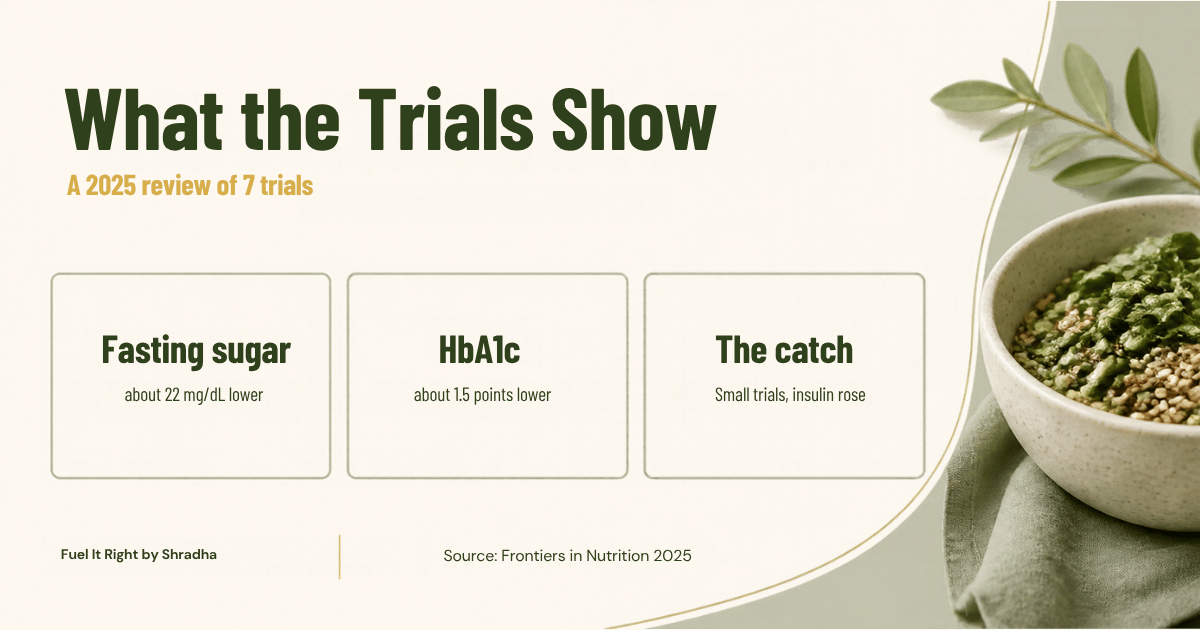
Key Takeaways • A 2025 meta-analysis of 7 trials found that apple cider vinegar lowered fasting sugar by about 22 mg/dL and HbA1c by about 1.5 points in people with type 2 diabetes. • Only 7 small trials were pooled, and the authors say insulin levels rose unexpectedly and that more studies are needed. That is why I treat the result as a hint, not a promise. • In the pooled data, effects were larger at doses of 10 mL a day or more. A separate trial used 30 mL a day for 8 weeks, which is a lot of acid to drink. • Vinegar can harm tooth enamel, burn the throat if undiluted, lower potassium and slow stomach emptying, so people on diabetes medicines should talk to their doctor first. • A well-known 2024 trial on apple cider vinegar for weight loss was retracted in September 2025. Be careful with big claims. |
What the Research on Apple Cider Vinegar for Diabetes Shows
The theory behind apple cider vinegar for diabetes is that acetic acid, the main active part of vinegar, may alter how your body handles a meal. Apple cider vinegar is made by fermenting apple juice, and it is acidic which matters later in this post.
Small studies on vinegar have been around for years. More recently, researchers have pooled several trials together. Here is what the most useful of them found, and what I make of it for people living with diabetes.
The 2025 Meta-Analysis
A 2025 review in Frontiers in Nutrition, by Arjmandfard and colleagues in Iran, pooled 7 trials of apple cider vinegar in adults with type 2 diabetes. A news report on the paper puts the total at 463 people. The authors registered their plan in advance, which is a good sign.
The average drop in fasting blood sugar was about 22 mg/dL, and your three-month average sugar, HbA1c, fell by about 1.5 points. Both ranges were less than zero, meaning that it was unlikely that the result was due to chance alone.
Dose mattered too. For each extra mL of vinegar a day, fasting sugar dropped by about 1.3 mg/dL. The effects were bigger at doses of 10 mL a day or more, which is a little over two teaspoons.
Why I Do Not Take the Big Numbers at Face Value
An HbA1c drop of 1.5 points would be as large as what some diabetes medicines achieve. For a kitchen vinegar, that is surprising, and when a result looks too good, I slow down.
The pooled data on apple cider vinegar for diabetes came from only 7 small studies. Small trials tend to overstate effects. I also could not see how long the trials ran. Nor could I see the certainty rating the authors gave the evidence, because I only read the abstract and a news report.
Vinegar was also found to raise insulin levels, which the authors called an unexpected finding that differed from previous studies. Insulin resistance itself was unchanged. The authors advise caution regarding the insulin and HbA1c results, stating that more research is required.
A Single Trial Using 30 mL a Day
A 2023 trial in Frontiers in Clinical Diabetes and Healthcare, led by Jafarirad, tested apple cider vinegar for diabetes at 30 mL a day for 8 weeks. The adults had type 2 diabetes, and both groups were given the same healthy diet advice.
In both groups fasting sugar fell but only significantly in the vinegar group. HbA1c differed between the groups after 8 weeks and LDL cholesterol fell in the vinegar group. I could only read the abstract so I can't tell you the exact sizes.
Thirty mL is two tablespoons. That is a lot of acid for a daily habit, and I will come back to what it can do to your teeth and your stomach.
How Might Vinegar Work?
Researchers suggest a few ideas. Vinegar may slow how fast the stomach empties, help muscles use sugar, reduce sugar release from the liver, or boost insulin release. These are hypotheses, not proven mechanisms.
The slower stomach emptying idea is the most talked about, and it is also the one that can cause trouble, as you will see in the safety section.
Shradha's Tip If vinegar helps at all, it probably helps by changing how fast a meal digests. You get a similar effect from eating vegetables and protein first, with no acid at all. |
What About the Weight Loss Claims?
You might have seen a trial that says apple cider vinegar helps you lose weight. That’s what a March 2024 study in BMJ Nutrition, Prevention and Health found in Lebanese young adults.
On 25 September 2025, the journal retracted it. Statisticians could not replicate the results, and found errors and irregularities in the data. The authors called them honest mistakes, but they agreed with the retraction.
That trial was about weight, not diabetes, so it does not cancel the studies on apple cider vinegar for diabetes. But it is a good reminder that one exciting trial is not enough to build a daily habit on.
Is Apple Cider Vinegar Safe for Diabetes?
Vinegar is a common kitchen product that is used in small quantities with food. Risks increase when it is undiluted, taken in large quantities, or mixed with certain medicines. Safety is the first question I ask about apple cider vinegar for diabetes.
Is Apple Cider Vinegar Good for Diabetic Patients?
For many diabetic patients, a small amount in food or a diluted drink with a meal is fine. Nothing says it is harmful in food portions. The real question is whether it does enough to bother with, and that is not proven.
Please do not stop or reduce any medicine because you started vinegar. If you try apple cider vinegar for diabetes, watch for lows and tell your doctor.
Teeth and Throat
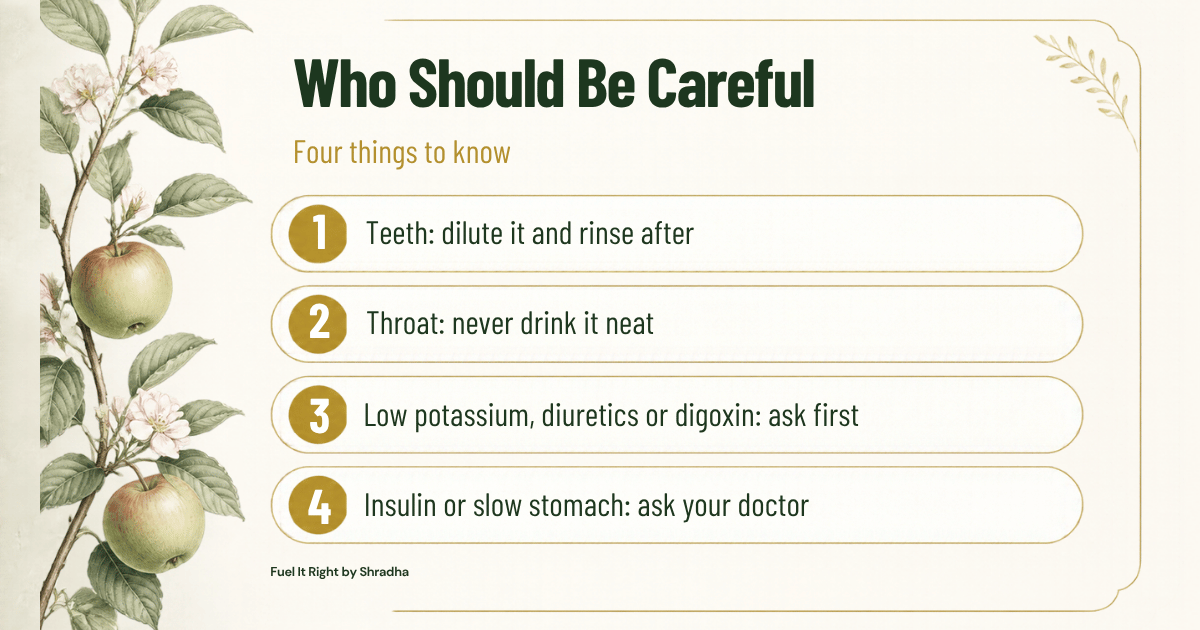
Vinegar is acidic, and acids can weaken tooth enamel over time. The risk with apple cider vinegar for diabetes is highest with regular, undiluted use. Dilute it, drink it with a meal, or use a straw. Rinse with plain water afterward and wait about 30 minutes before brushing.
Undiluted vinegar can also burn the throat and the food pipe, and it can make reflux or stomach upset worse. One part vinegar to at least ten parts water is a sensible rule. Never take a neat shot.
Stomach Emptying and Insulin Timing
If apple cider vinegar for diabetes slows how fast your stomach empties, that may help your after-meal sugar. But for someone on insulin, the timing between the injection and the meal matters. A slower stomach could throw that off.
People with gastroparesis, a condition where the stomach already empties slowly, should avoid vinegar. I take this from health sources rather than from the trials, so please check with your doctor.
Low Potassium and Medicines
Large amounts of apple cider vinegar have been linked to low potassium. This is most important if you are taking diuretics, which lower potassium anyway, or digoxin, a heart medicine. People with advanced kidney disease may also have trouble processing the extra acid.
If you take tablets or insulin for diabetes, vinegar may add to their sugar-lowering effect. So know the signs of a low: shakiness, sweating, sudden hunger, a pounding heart or feeling confused. Check your sugar and tell your doctor.
Who Should Skip It
If you have gastroparesis, severe reflux, advanced kidney disease or low potassium, I would suggest skipping apple cider vinegar for diabetes. If you are on insulin, a sulfonylurea, diuretics or digoxin, check with your doctor first. Let your doctor know about any vinegar you take, in any form.
The trials I found ran for a few weeks to a few months. So the long-term safety of a daily dose of apple cider vinegar for diabetes is not known.
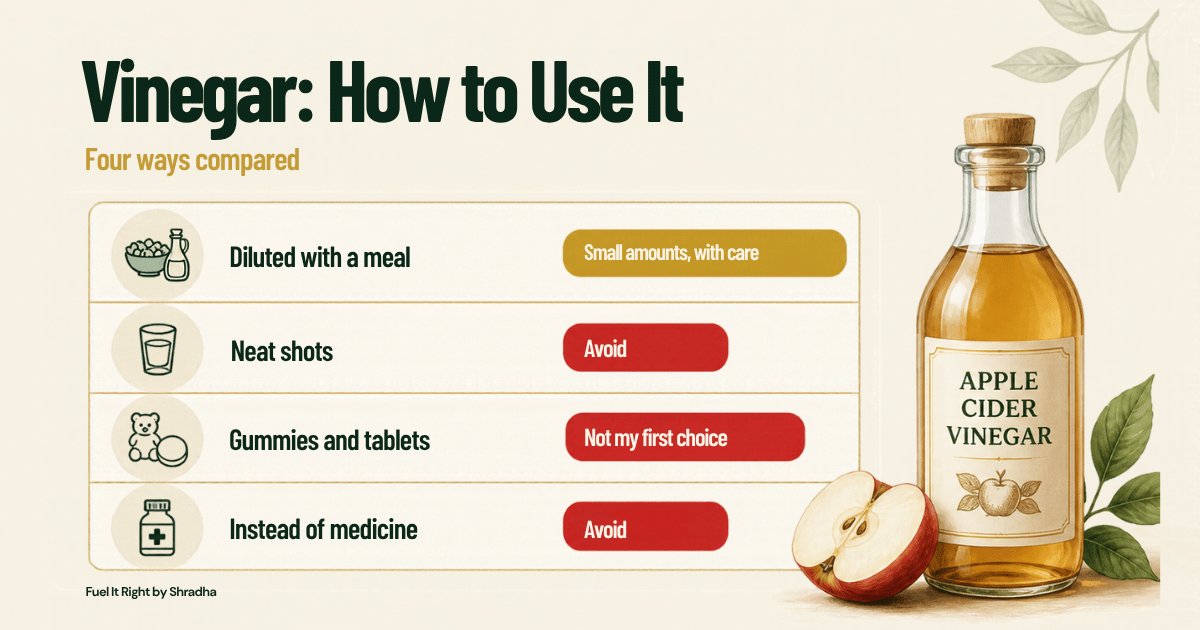
Diluted Vinegar With a Meal Small amounts, with care |
A teaspoon or so in a full glass of water is the form closest to what people use at home. The trials used larger amounts, so I cannot promise it lowers your sugar. How to make it work: Use a straw, rinse your mouth with water after, and tell your doctor. |
Neat Shots of Vinegar Avoid |
Undiluted vinegar can burn the throat and wear down enamel, with no extra benefit shown. How to make it work: If you want vinegar, always dilute it. |
Vinegar Gummies and Tablets Not my first choice |
I did not find good trials on gummies, and the amount of vinegar in each product varies. How to make it work: Food-first options fit my approach better. |
Vinegar Instead of Medicine Avoid |
No trial shows vinegar can replace diabetes medicines, and the studies were small. How to make it work: Keep taking your medicines as prescribed. |
WHAT YOU'VE HEARD A shot of apple cider vinegar every morning fixes high blood sugar. |
WHAT'S ACTUALLY TRUE The best evidence is a small pooled effect from 7 small trials, with unexpected results on insulin. It does not replace medicines, and neat shots can harm your teeth and throat. |

How to Use Apple Cider Vinegar for Diabetes at Home
If your doctor is fine with it and you want to try apple cider vinegar for diabetes, here is how I suggest my clients go about it. None of it needs a special product.
If You Want to Try It
Start small with apple cider vinegar for diabetes. One teaspoon in a full glass of water, taken with a meal that has carbohydrates, is enough to begin with. Some health sources suggest one to two tablespoons diluted in water, 10 to 20 minutes before a high-carb meal.
I would go slowly and stay at the lower end unless your doctor agrees to more. The trials used bigger doses, but they were not designed to tell us what is comfortable for your teeth and stomach.
Use It in Food Instead
The gentlest way to use apple cider vinegar for diabetes is in food. A splash in a kachumber salad, a dressing for sprouts, or pickled onions served with a meal all work. The amount is small, and the vinegar arrives with fibre.
I did not find trials on salad dressings, so this is a practical suggestion, not a research result. It is a way to enjoy the taste without drinking acid.
Track Your Own Response
If you are testing at home, write down your fasting sugar for 2 weeks before you start. Then track it for a few months, and get your HbA1c checked at your next test. That’s how you’ll know if apple cider vinegar for diabetes does anything for you.
Keep your meals, walking and medicines the same during that time, so you can see what is causing the change. Share your numbers with your doctor.
Common Mistakes With Apple Cider Vinegar for Diabetes
The mistakes I see most often are simple. People take a neat shot on an empty stomach, because they think stronger works faster. Others sip it all day, which bathes the teeth in acid for hours.
Some stop their medicines because a friend said vinegar is enough. That is the one that worries me most. A third mistake is stacking remedies. Vinegar, karela and methi together may add up to a bigger sugar drop than you planned so add only one thing at a time. Combined remedies have not been tested together so I cannot say how they interact.
A Simple Day With Vinegar
Here is how apple cider vinegar for diabetes can fit into a normal day, if you and your doctor agree. For breakfast, have eggs or a besan chilla with a cup of tea. At lunch, dress a kachumber salad with a splash of vinegar and eat it beside dal, one roti and a vegetable.
For dinner, keep things light, with vegetables, protein and a small portion of rice or roti. You do not need vinegar at every meal. Once a day, with your biggest carb-heavy meal, is plenty for most people.
What Matters More Than Vinegar
Even if you find that apple cider vinegar for diabetes works for you, vinegar is a minor helper at best. The major levers are your plate, your movement and your medicines. Eating vegetables and protein before carbs, walking after meals and choosing whole grains make a bigger difference.
If you want to start there, read the post on walking after meals and the post on fruit. If you are thinking about meal timing, the post on intermittent fasting has the research.
Shradha's Tip Change one thing at a time. If you add vinegar, keep your medicines, meals and walking the same for a few weeks, so you can see what the vinegar is doing. |
If acidic drinks upset your stomach or leave you bloated, the Gut Health Quiz is a good place to start.
The Bottom Line on Apple Cider Vinegar for Diabetes
There is encouraging but shaky evidence for apple cider vinegar for diabetes. A meta-analysis from 2025 showed lower fasting sugar and HbA1c, but it included only 7 small trials and the insulin results were surprising. One trial using 30 mL a day for 8 weeks showed similar results.
My view on apple cider vinegar for diabetes is simple. Vinegar is a fine ingredient and an unproven treatment. If you want to try it, dilute it and use it with a meal. Protect your teeth, tell your doctor if you take diabetes medicines, and track your own readings.
If you are following this series, you may also like the posts on karela and methi seeds, two more kitchen remedies put through the same check.
Want help working out whether vinegar, or any home remedy, fits your diabetes plan and your medicines?
Book a consultation:
Frequently Asked Questions About Apple Cider Vinegar for Diabetes
Does Apple Cider Vinegar Really Lower Blood Sugar?
Apple cider vinegar for diabetes may help to reduce sugar, but it is not proven. A 2025 meta analysis of 7 trials found lower fasting sugar and HbA1c, but the trials were small and the authors called for more research.
Is Apple Cider Vinegar Safe for a Diabetic Person?
Apple cider vinegar for diabetes is usually fine in small diluted amounts with food. Avoid neat shots, and ask your doctor first if you take insulin, sulfonylureas, diuretics or digoxin.
How Much Apple Cider Vinegar Should I Take for Diabetes?
I suggest starting with one teaspoon in a full glass of water with a meal. Some sources suggest one to two tablespoons diluted, but the trials used larger amounts that may not suit your teeth or stomach.
When Is the Best Time to Take It?
Some health sources suggest 10 to 20 minutes before a high-carb meal. I prefer taking it with the meal, diluted, so it is not on an empty stomach.
Can I Take Apple Cider Vinegar With Diabetes Medicines?
Ask your doctor first. Vinegar may add to the sugar-lowering effect of your tablets or insulin, and large amounts may lower potassium.
Do Apple Cider Vinegar Gummies Work for Diabetes?
I haven't seen good trials with gummies. I prefer diluted liquid vinegar or vinegar in food because the amount of vinegar varies between products.
Will Apple Cider Vinegar Damage My Teeth?
It can, because vinegar is acidic. Dilute it, use a straw, rinse your mouth with water afterwards, and wait about 30 minutes before brushing.
Can Apple Cider Vinegar Help Me Lose Weight?
I would not count on it. A well-known 2024 weight loss trial was retracted in September 2025 after statisticians could not replicate the results.
Shradha | Nutritionist & Dietitian | Fuel It Right