
Insulin Resistance and PMOS: The Root Cause
Insulin resistance is the root cause of PMOS that no one explained to you. Here is the full cascade, from your first meal of the day to your acne, hair fall, and irregular cycles and what Indian food can do about it.
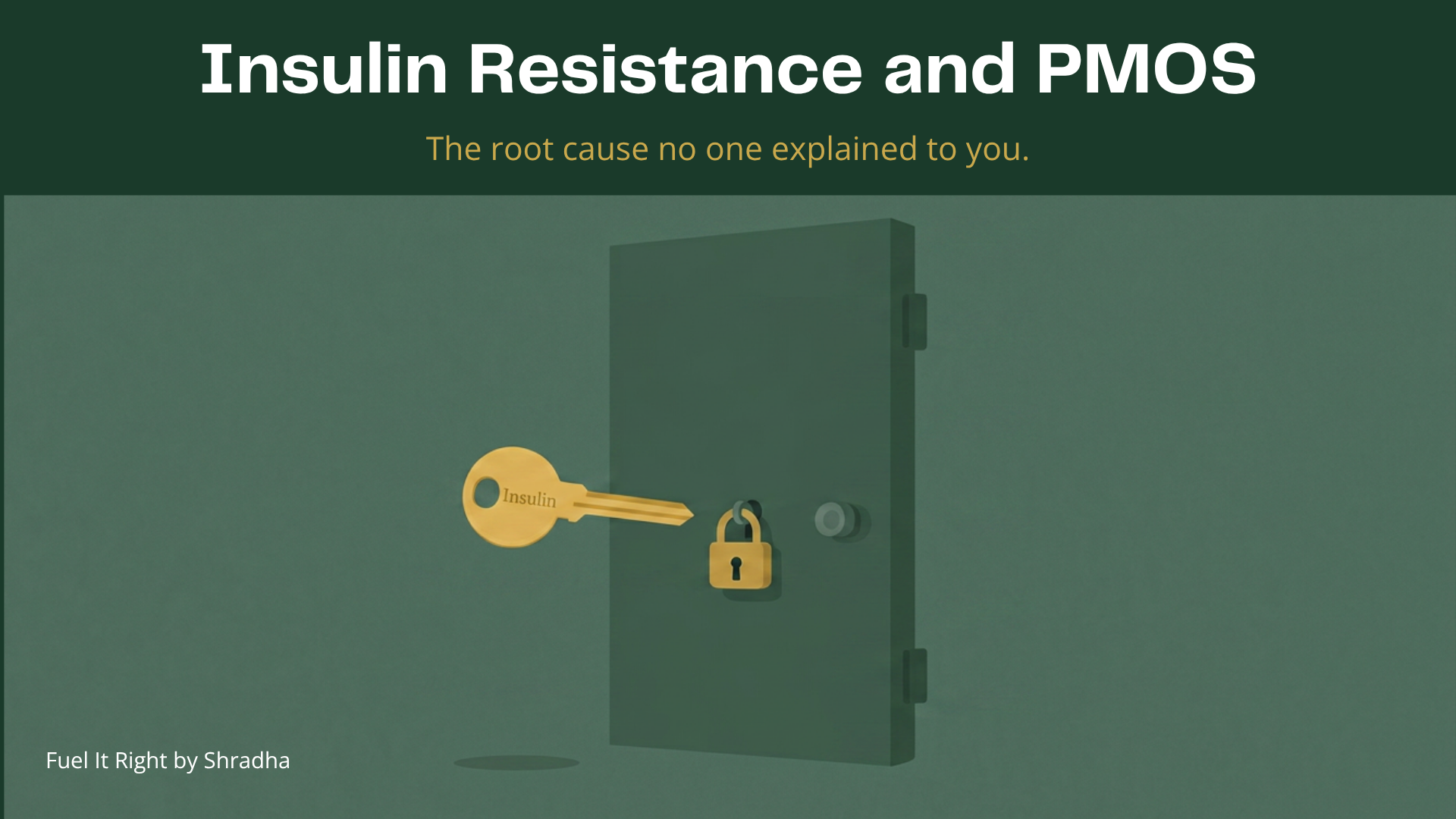
Table of Contents
1. What You Were Told and What Was Left Out
2. What Insulin Resistance Actually Is
3. The Full Cascade: From Your Breakfast to Your Blood Report4. How to Measure Your Insulin Resistance
5. Why Indian Women Develop Insulin Resistance Earlier
6. The Long-Term Consequences of Untreated Insulin Resistance in PMOS
7. How Indian Food Addresses Insulin Resistance at the Root
8. The Breakfast That Changes Everything
9. Conclusion
10. FAQs
What You Were Told and What Was Left Out
Insulin resistance in PMOS is the most important thing most women with this condition were never told. They were told they had PCOS. They were told to lose weight. They were given the pill. They were sent home. The mechanism driving almost everything like the acne, the hair fall, the weight that will not shift, the cycles that will not regularise, was never explained.
The 2026 PMOS rename corrects this. By placing metabolic in the name itself, it mandates that insulin resistance be treated as the primary driver of the condition rather than a secondary feature. But the rename is ahead of most consultations. Most women are still leaving their doctor's office without understanding what is actually happening in their bodies.
The number that frames everything Insulin resistance is present in 70 to 85% of all women with PMOS including 75% of lean women with normal BMI. It is not a complication of the condition. It is the root of it. As Dr Torsha Chatterjee, endocrinologist, told Down To Earth: hyperinsulinemia directly contributes to increased ovarian androgen production, reduced SHBG levels, worsening hyperandrogenism, menstrual irregularities, acne, hirsutism, and ovulation disruption. |
What Insulin Resistance Actually Is
Understanding insulin resistance in PMOS starts with understanding what insulin does and what happens when cells stop listening to it.
The Normal Mechanism
When you eat carbohydrates, your blood glucose rises. Your pancreas releases insulin which is a hormone whose job is to act as a key that unlocks your cells and allows glucose to enter and be used for energy. In a healthy metabolic state, cells respond to insulin readily. Glucose enters. Blood sugar normalises. Insulin levels return to baseline.
When Cells Stop Responding
Insulin resistance is a cellular defect not a dietary failure. Specifically, as noted in the molecular research, it is an abnormality in serine phosphorylation at the insulin receptor level that makes muscle and fat tissue resistant to insulin's signal. The key no longer fits the lock reliably.
The pancreas responds by producing more insulin, compensation to force the door open. This works for a while. Blood glucose stays normal. But the chronically elevated insulin has consequences far beyond glucose management.
What chronic high insulin does that your doctor may not have mentioned • Signals the ovaries to produce excess androgens like testosterone, DHEAS • Suppresses SHBG production. More free androgen circulates and drives symptoms • Disrupts the LH/FSH ratio. LH rises, follicle maturation is disrupted, ovulation fails • Promotes visceral fat storage even in lean women • Drives chronic low-grade inflammation worsening every system simultaneously • Suppresses the estrobolome disrupting hormone clearance in the gut |
Also read about Lean PMOS.
The Full Cascade: From Your Breakfast to Your Blood Report
Insulin resistance in PMOS does not develop overnight. It is the cumulative result of repeated insulin surges, often beginning with the first meal of the day, that gradually erode cellular insulin sensitivity over months and years.
1 | You eat a high-carbohydrate breakfast Poha, white bread, cornflakes, sweetened chai, fruit juice are the standard Indian breakfast triggers a significant glucose spike within 30 minutes. No protein. No fibre. Rapid absorption. |
↓
2 | Blood glucose spikes sharply Without protein or fibre to slow absorption, glucose enters the bloodstream rapidly. The pancreas releases a large insulin surge to manage it. |
↓
3 | Cells become progressively less responsive Repeated large insulin surges gradually downregulate insulin receptor sensitivity. Cells require more and more insulin to achieve the same glucose uptake. Insulin resistance deepens. |
↓
4 | Pancreas compensates with more insulin Fasting insulin rises. Fasting glucose remains normal, the compensation is working. But hyperinsulinemia is now present and doing damage downstream. |
↓
5 | Ovaries receive excess insulin signal Insulin directly stimulates ovarian theca cells to produce more androgens. LH rises. The LH/FSH ratio shifts above 2:1. Follicle maturation is disrupted. Ovulation becomes irregular or absent. |
↓
6 | Androgens drive the visible symptoms Elevated testosterone causes acne along the jaw, scalp hair thinning, excess facial or body hair. Elevated DHEAS may cause the same. SHBG drops, more free androgen circulates, symptoms worsen even as total testosterone stays within the lab's reference range. |
↓
7 | Inflammation and gut dysbiosis compound the loop Chronic high insulin promotes visceral fat, which produces inflammatory cytokines. The gut microbiome shifts toward dysbiosis. Both worsen insulin resistance further. The cycle is now self-reinforcing. |
How to Measure Your Insulin Resistance
If insulin resistance is the root of PMOS, measuring it is non-negotiable. Yet most women with PMOS have never had it directly measured. Here is what to ask for and how to interpret it.
The Tests That Actually Measure It
• Fasting insulin: not on a standard panel; must be requested by name. Optimal: below 10 mIU/L. Above 15: significant insulin resistance. Above 20: severe.
• HOMA-IR: calculated from fasting insulin and fasting glucose. Formula: (fasting insulin x fasting glucose) / 405. Optimal: below 1.5. Above 2.5: clinically significant.
• 75g OGTT with 2-hour reading: catches post-meal insulin dysregulation that fasting tests miss. Essential for Indian women where postprandial glucose rises first.
• Fasting glucose and HbA1c: useful but insufficient alone. Normal fasting glucose does not rule out insulin resistance.
For the full panel with optimal ranges and what each number means, see the PMOS diagnosis checklist.
Why Your Fasting Glucose Looks Normal
The body compensates for insulin resistance by producing more insulin. For years, sometimes a decade, this compensation keeps fasting glucose in the normal range. Your lab reports normal. Your doctor says you do not have diabetes. But the insulin driving that normal glucose is already disrupting your ovaries, your androgens, your gut, and your inflammation levels. Fasting glucose is the last thing to change. Fasting insulin is the first.
Why Indian Women Develop Insulin Resistance Earlier
Insulin resistance in PMOS presents earlier, at lower BMI, and with greater metabolic consequence in Indian women than in Western populations. Three specific factors drive this.
The South Asian body phenotype | Indian women store disproportionately more visceral fat at the same BMI as European women. A BMI of 22 in an Indian woman may carry the metabolic fat profile of a European woman at BMI 27. Visceral fat directly produces inflammatory signals that worsen insulin resistance independent of total body weight. |
The dietary environment | The standard Indian diet like white rice, maida roti, sweetened chai, biscuits, packaged snacks is predominantly high-glycaemic and low in protein. Every refined carbohydrate meal drives an insulin surge. Repeated daily across years, this pattern is one of the most effective drivers of progressive insulin resistance in a genetically predisposed population. |
The genetic predisposition | Daughters of women with PMOS have approximately 50% higher risk of developing the condition. 43% of Indian women with PMOS have a family history of type 2 diabetes. The cellular insulin signalling defect has a heritable component. The dietary and lifestyle environment then determines how early and how severely it manifests. |
The Long-Term Consequences of Untreated Insulin Resistance in PMOS
Untreated insulin resistance in PMOS is not a stable condition. It progresses. The consequences are not hypothetical, they are well-documented and specific.
• 4x higher risk of type 2 diabetes - over half of women with PMOS will develop type 2 diabetes by age 40 if insulin resistance is not addressed
• Cardiovascular disease - dyslipidemia, elevated triglycerides, low HDL, and rising blood pressure accumulate silently. Women with PMOS have significantly elevated lifetime cardiovascular risk.
• Non-alcoholic fatty liver disease - present in 32.9% of Indian women with PMOS. Driven by excess insulin signalling fat storage in the liver.
• Metabolic syndrome - present in 24.9% of Indian women with PMOS. A cluster of conditions that together multiply cardiovascular and diabetes risk.
• Worsening hormonal disruption - as insulin resistance deepens, androgen production increases, SHBG drops further, and ovulation becomes progressively less frequent.
• Mental health consequences - insulin dysregulation directly affects brain glucose metabolism and neurotransmitter production, contributing to the anxiety and depression seen at significantly elevated rates in women with PMOS.
The good news Insulin resistance is one of the most responsive conditions to dietary intervention. Unlike genetic conditions that require pharmaceutical management, the cellular insulin signalling defect in PMOS responds directly and measurably to food. To what you eat, in what order, and at what time. This is not a claim. It is the basis of the 2026 PMOS metabolic management framework. |
Also read: PMOS is a metabolism problem
How Indian Food Addresses Insulin Resistance at the Root
Addressing insulin resistance in PMOS through food is not about restriction or elimination. It is about three things: reducing the insulin surges that deepen resistance, feeding the gut bacteria that improve insulin sensitivity, and providing the anti-inflammatory nutrition that breaks the cycle.
The Three Principles
1 | Reduce post-meal insulin spikes Protein and fibre before carbohydrates at every meal. This single change reduces post-meal glucose response by up to 30% without changing what you eat. Dal before rice. Sabzi before roti. Eggs before toast. The sequence matters more than the quantity. |
2 | Feed insulin-sensitising gut bacteria Faecalibacterium prausnitzii, fed by dal and legumes, directly improves insulin sensitivity. Lactobacillus, fed by curd and chaas, reduces inflammation that worsens insulin resistance. The gut is not separate from insulin management. |
3 | Anti-inflammatory nutrition daily Methi seeds reduce fasting glucose and insulin through their galactomannan content. Haldi reduces inflammatory cytokines that worsen insulin resistance. Jeera improves insulin receptor activity. These are not wellness claims. They are mechanisms with clinical evidence. |
The Breakfast That Changes Everything
If there is one intervention that addresses insulin resistance in PMOS more consistently than any other, it is the first meal of the day. Not what you eat for dinner. Not your total calorie intake. Your breakfast.
Why Breakfast Drives the Entire Day's Insulin Pattern
The first meal of the day sets the hormonal tone for the following 8 to 12 hours. A protein-first breakfast, eaten within an hour of waking, stabilises cortisol, reduces the morning insulin surge, and maintains insulin sensitivity through the afternoon. A high-carbohydrate breakfast without protein does the opposite: a sharp insulin spike, followed by a glucose crash, followed by cortisol elevation, followed by cravings and a second insulin surge.
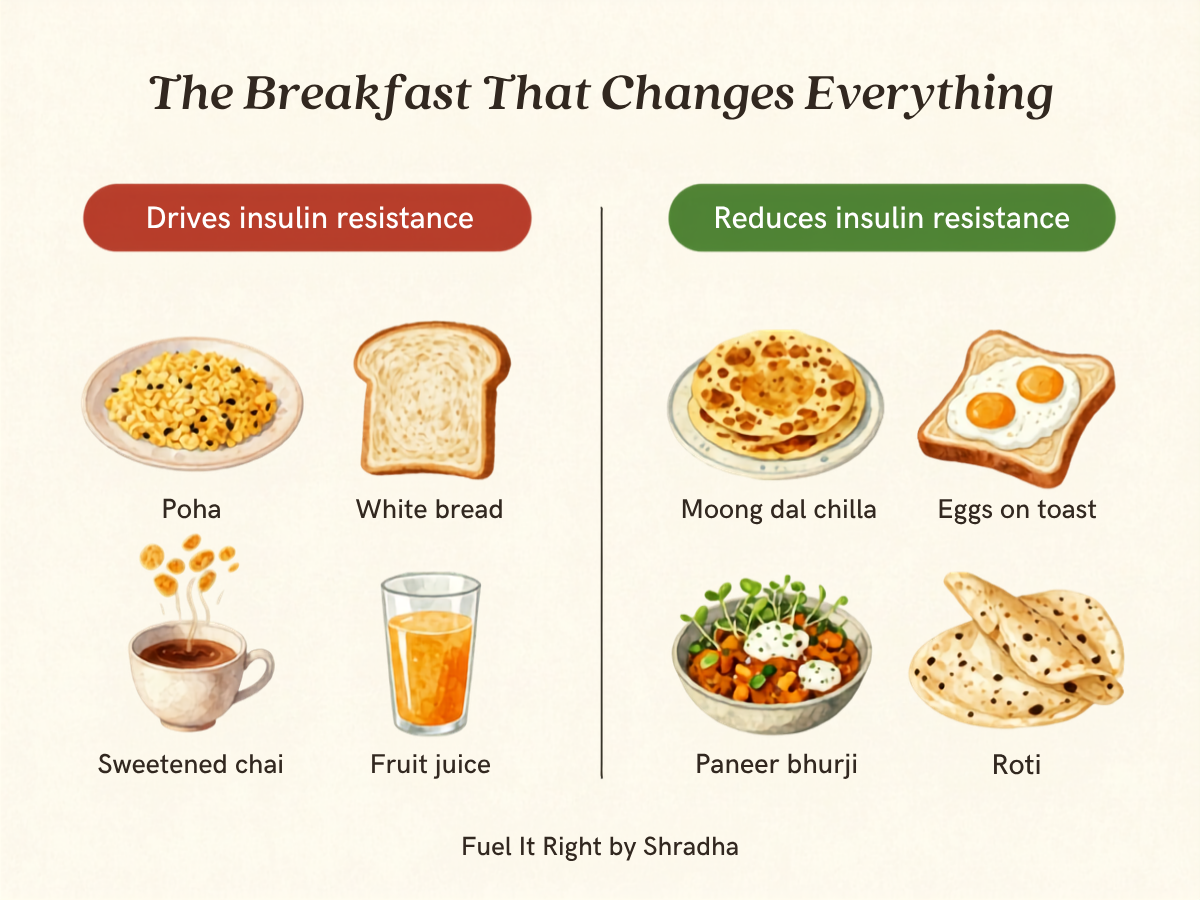
Most Indian breakfasts like poha, upma, white bread and butter, cornflakes with milk, a glass of juice, are high-glycaemic and low in protein. They are the most consistent daily driver of insulin resistance in Indian women with PMOS.
Meal | What most Indian women eat | What addresses insulin resistance |
Breakfast | Poha or upma alone, white bread and butter, cornflakes, sweetened chai, fruit juice | Moong dal chilla + green chutney, 2 eggs + 1 multigrain toast, sprout salad + curd, paneer bhurji + 1 roti |
Mid-morning | Nothing, biscuits, packaged snack, sweetened coffee | Roasted chana + 1 fruit, handful of nuts, chaas |
Lunch | Rice or roti first, then sabzi and dal | Sabzi first, then dal, then rice or roti last. Same food, different sequence. |
Evening | Tea with biscuits, vada pav, samosa, packaged chips | Jeera water or tulsi tea, makhana, roasted peanuts, cucumber with hummus |
Dinner | Large heavy meal, rice or roti dominant, eaten after 9pm | Lighter than lunch. Dal + sabzi + 1 roti. Finish by 8pm if possible. |
Conclusion: The Root Cause Finally Named
Insulin resistance in PMOS was always the root cause. The ovaries were never the problem, they were responding to excess insulin. The acne was never a skin problem, it was an androgen problem driven by insulin. The weight was never a willpower problem, it was a metabolic problem driven by chronically elevated insulin that directed the body to store rather than use.
The PMOS rename does not change what was happening in your body. It changes whether anyone will investigate and address it properly. As noted in the 2026 clinical commentary from Gini Hospital: the ovaries are not the cause of this condition. They are a victim of it. The real culprits are insulin resistance, androgen excess, and a dysregulated endocrine system. The new name finally says this out loud.
Start with your breakfast. Ask for your fasting insulin. Calculate your HOMA-IR. Read the number — not just normal or abnormal. And if you want to understand what your specific insulin picture looks like and what food protocol to build around it, book a free 30-minute discovery call.
Book a Free 30-Minute Discovery Call
Bring your fasting insulin result — or ask for one. We will tell you exactly what it means and where to start.
FAQs: Insulin Resistance and PMOS
Q1. How do I know if insulin resistance is driving my PMOS?
The most direct test is fasting insulin alongside fasting glucose, used to calculate HOMA-IR. A HOMA-IR above 2.5 indicates clinically significant insulin resistance. The indirect signals are: normal fasting glucose but persistent PMOS symptoms, acne that worsens after high-carbohydrate meals, significant afternoon fatigue and sugar cravings, and triglycerides above 100 mg/dL with HDL below 55 mg/dL on your lipid panel.
Q2. Can insulin resistance be reversed?
Yes, meaningfully and measurably. Partner-clinic data tracking over 6,000 Indian women on consistent food-first protocols found two-thirds returned to normal HOMA-IR within six months. The cellular insulin signalling defect responds to reduced insulin surges, increased fibre and protein, gut microbiome improvement, anti-inflammatory nutrition, and consistent meal timing. This is not anecdote. It is tracked clinical outcome data.
Q3. I have normal fasting glucose. Does that mean I do not have insulin resistance?
No. Fasting glucose is the last marker to change. For years the body compensates by producing excess insulin to keep glucose normal. During this compensation period, which can last a decade, fasting glucose looks fine while insulin resistance is actively driving PMOS symptoms. Ask for fasting insulin and HOMA-IR by name. Normal fasting glucose is not a clean bill of metabolic health.
Q4. Will metformin fix my insulin resistance?
Metformin reduces hepatic glucose production and improves insulin sensitivity through the AMPK pathway. It is a useful tool and is appropriately prescribed in moderate to severe insulin resistance. But it does not address the dietary drivers that are deepening the resistance daily. Women on Metformin without dietary change often see limited improvement. Food addresses the mechanism at the point of entry, the meal. Metformin addresses the downstream effect. Both can work together.
Q5. I am not overweight. Can I still have significant insulin resistance?
Yes. As noted by endocrinologist Dr Torsha Chatterjee, insulin resistance may be present in nearly 70 to 80% of women with PMOS, including many who are not overweight. The cellular defect is independent of body weight. South Asian women develop it at lower BMI thresholds than Western populations. Do not use your weight as reassurance. Use your fasting insulin.
Q6. How quickly does changing my breakfast affect my insulin levels?
Measurable changes in post-meal insulin response can be seen within days of consistent protein-first, carb-last meal sequencing. HOMA-IR improvements are typically measurable at 6 to 8 weeks. Symptomatic changes like reduced afternoon energy crashes and sugar cravings are often noticeable within 2 weeks. Androgen-driven symptoms like acne and hair fall take longer. Typically 3 to 6 months of consistent metabolic improvement.
Q7. Why does the sequence of eating matter. Protein first versus carbs first?
When you eat protein and vegetables before carbohydrates, gastric emptying slows, glucose absorption is delayed, and the insulin response to the subsequent carbohydrate is significantly blunted, by up to 30% in clinical studies. The same food eaten in the wrong order produces a higher insulin spike. For women with PMOS whose insulin sensitivity is already compromised, meal sequencing is one of the highest-leverage dietary changes available.
Q8. Is insulin resistance permanent?
The underlying genetic predisposition to the cellular signalling defect is inherited. But the severity of insulin resistance, how clinically significant it is at any point in time, is highly modifiable through food, lifestyle, and where necessary, pharmacological support. Women who address the dietary drivers consistently see HOMA-IR improve, androgen levels reduce, and cycles regularise. The condition does not disappear, but it becomes manageable and its long-term consequences become preventable.
About the Author
Shradha | Nutritionist & Dietitian | Fuel It Right. Practising out of Goa, India, with a focus on gut health, PMOS/PCOS, thyroid disorders, and weight management using real Indian food. No supplements. No machines. Just food, and the science behind it.
fuel-it-right.com | @fuelitright | +91 7057063984