
PCOS, PMOS and Skin: Acne, Hair Fall and Darkening Explained
Acne, hair fall, and darkening of the skin are not cosmetic problems in PCOS/PMOS. They are metabolic signals. Here is what each one is telling you and how real Indian food addresses the root cause.
Table of Contents
1. Your Skin Is Talking. Are You Listening?
2. Why PCOS/PMOS Shows Up on Your Skin
3. Acne: Why It Keeps Reoccurring and What Your Skincare Is Missing
4. Hair Fall: Why You Are Losing Hair and How to Slow It
5. Darkening of Skin: What That Patch on Your Neck Is Actually Telling You
6. The Gut-Skin Axis: Why Your Microbiome Drives Your Complexion
7. What Indian Food Does for Each Skin Symptom
8. What to Stop Doing: The Habits Making It Worse
9. Conclusion
10. FAQs
Your Skin Is Talking. Are You Listening?
PCOS/PMOS and skin are connected in a way that most women spend years trying to fix from the outside. Creams for the acne. Serums for the hair fall. Brightening treatments for the dark patches. Nothing works for long. Because none of those things address what is actually happening.
The acne along your jawline is not caused by your cleanser. The hair falling out in the shower is not caused by hard water. The dark patch on your neck that no amount of scrubbing removes is not a hygiene problem. They are all metabolic signals, and they are all pointing to the same root.
That dark patch on your neck is not dirt. The acne on your jaw is not your diet. The hair in your drain is not stress. They are all the same metabolic signal.
Studies report that the dark, velvety skin darkening, seen in PCOS/PMOS, in roughly 30 to 56% of women with the condition. The dermatologic manifestations of hyperandrogenism, chiefly hirsutism, acne vulgaris, androgenic alopecia, and acanthosis nigricans, are among the cardinal manifestations of PCOS/PMOS according to research published in the Indian Dermatology Online Journal. These are not side effects of the condition. They are the condition, made visible on your skin.
Why PCOS/PMOS Shows Up on Your Skin
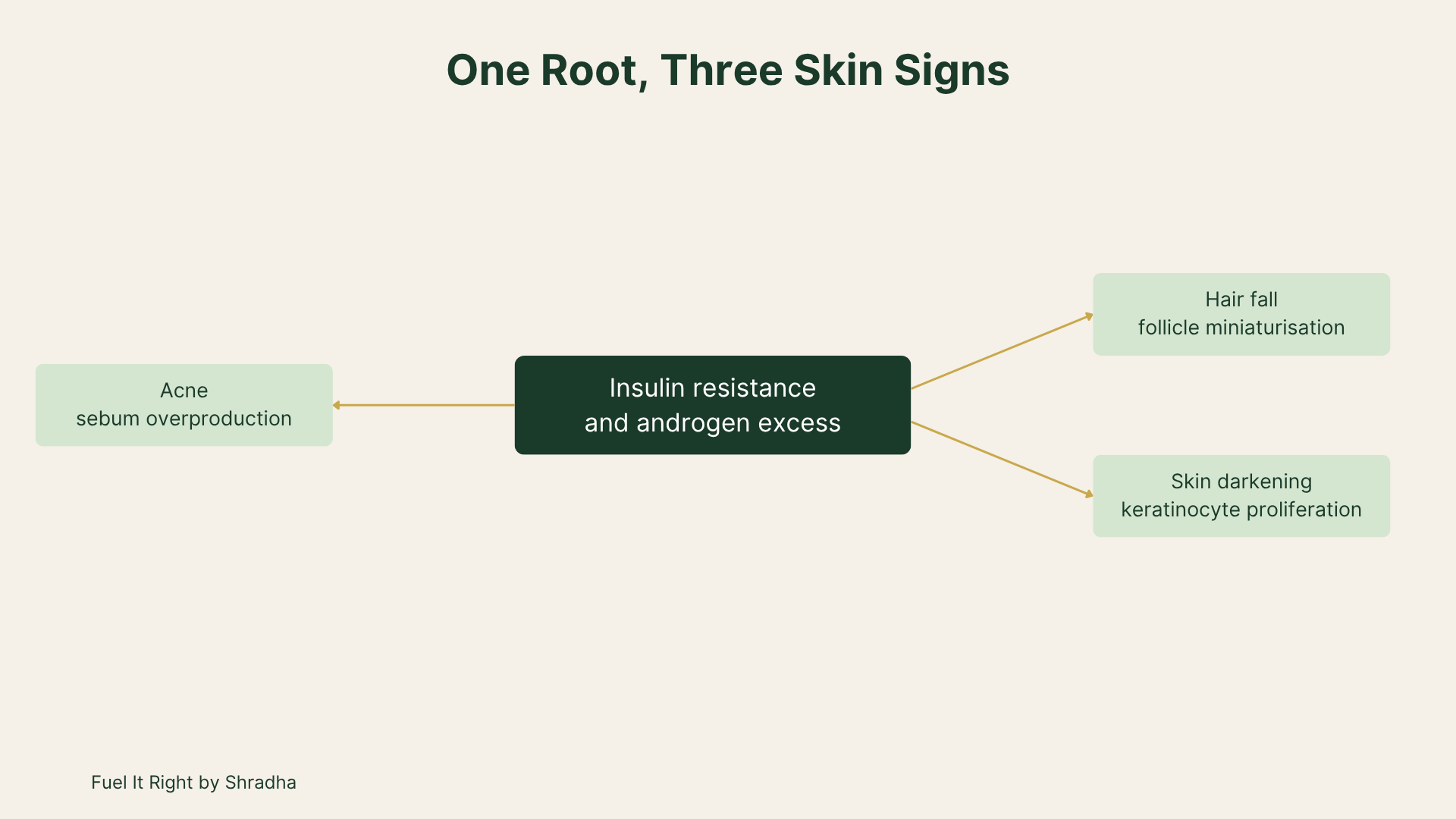
PCOS/PMOS skin symptoms share two primary drivers: androgen excess and insulin resistance. Understanding which is driving which symptom is the key to addressing them through food.
Androgens and Your Skin
Elevated testosterone and DHEA, driven by the insulin resistance at the root of PCOS/PMOS, directly affect the skin in three ways. First, they stimulate sebaceous glands to produce more sebum which is the oil that creates the environment for acne. Second, they act on hair follicles like on the scalp, they shrink the follicle and shorten the hair growth cycle, causing hair loss; on the face and body, they enlarge follicles and produce excess hair growth. Third, they interact with insulin at the skin level to drive the cellular proliferation that causes darkening.
Insulin Resistance and Your Skin
Chronically elevated insulin activates insulin-like growth factor 1 (IGF-1) receptors in the skin. This activation directly stimulates keratinocyte proliferation which is the overproduction of skin cells that causes the thickened, darkened appearance. It also stimulates sebum production independently of androgens. For more on how insulin resistance works throughout the body, see the blog on insulin resistance and PCOS/PMOS.
This means every high-glycaemic meal like the poha without protein, the biscuits at 4pm, the white rice at dinner with nothing before it, is directly stimulating the mechanisms that produce your acne, your hair fall, and your skin darkening. Not metaphorically. Biochemically.
Acne: Why It Keeps Coming Back and What Your Skincare Is Missing
Hormonal acne in PCOS/PMOS is distinctly different from teenage acne. It tends to be deeper, more inflamed, more cystic, and clustered specifically along the lower face, jawline, chin, and neck. It often worsens in the week before a period. It does not respond consistently to topical treatments because the driver is internal, not on the skin surface.
Why Topical Treatments Do Not Work Long-Term
Benzoyl peroxide, salicylic acid, and retinol can reduce the surface expression of acne. They cannot reduce the sebum production driven by elevated androgens. They cannot reduce the inflammation triggered by insulin resistance and gut dysbiosis. They address the symptom, not the cause. This is why women with PCOS/PMOS who go off the acne medication find the acne returns, often within weeks.
The Dairy and Acne Question
For women with PCOS/PMOS and acne, dairy deserves specific attention. Cow's milk stimulates IGF-1 and contains bovine androgens that directly worsen hormonal acne. This does not mean eliminating all dairy. It means moderating full-fat milk consumption and observing whether reducing it improves acne. Curd and paneer in moderate amounts are generally better tolerated than large quantities of full-fat milk.
The Spearmint Tea Evidence
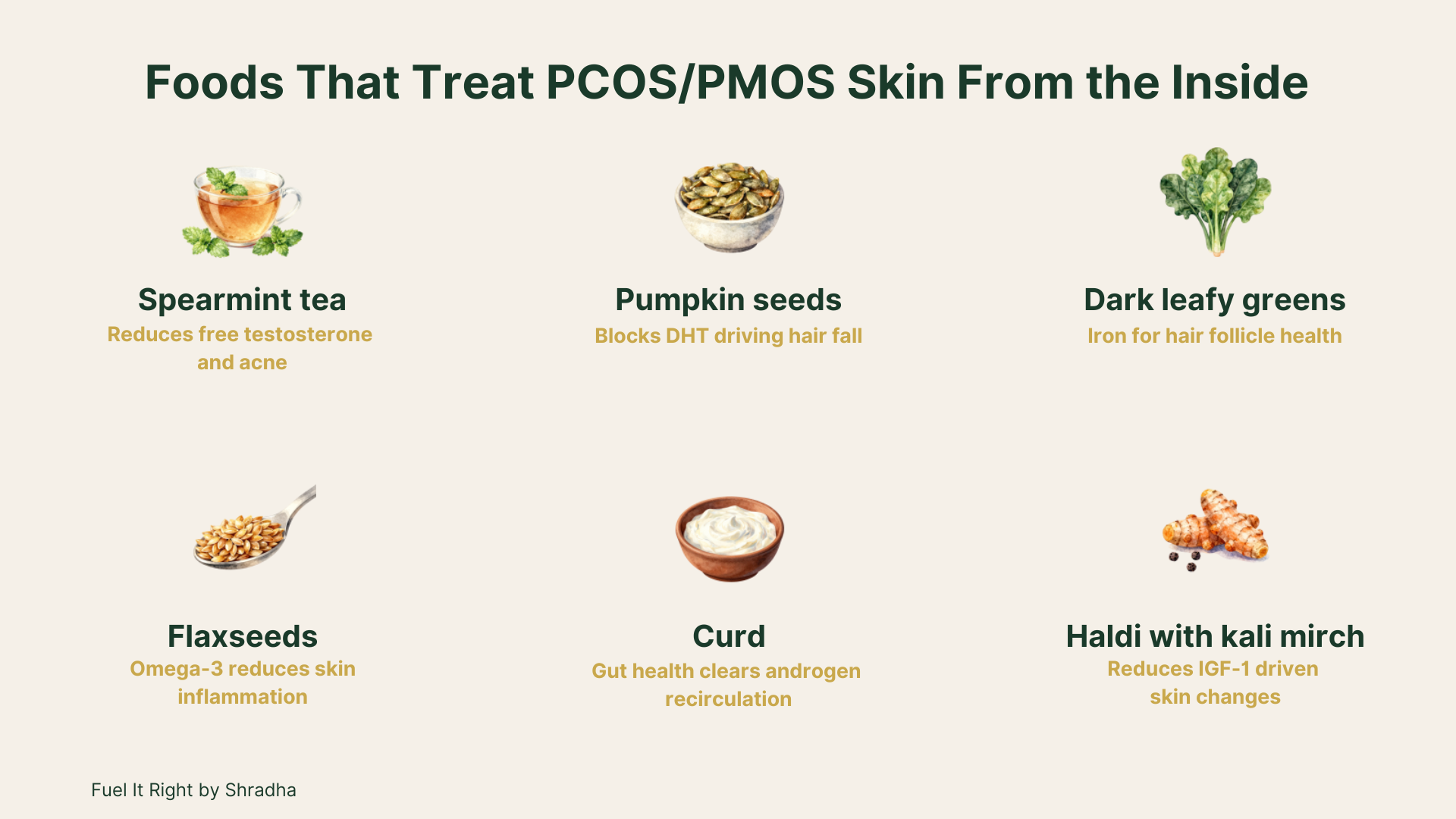
Spearmint tea has consistent clinical evidence for reducing free testosterone in women with PCOS/PMOS, and with it, acne and hirsutism. Two cups of spearmint tea daily for 30 days produces measurable reductions in free androgen levels. This is not a wellness claim. It is peer-reviewed clinical evidence. Easy to add. Costs nothing. Worth trying for a month before drawing conclusions.
The most common mistake in PCOS/PMOS acne management Treating the skin without treating the insulin resistance and androgen levels driving it. No topical treatment, no matter how expensive, can outpace the sebum being produced by elevated androgens in an insulin-resistant metabolic environment. The skincare is the maintenance. The food is the treatment. |
Hair Fall: Why You Are Losing Hair and How to Slow It
Androgenic alopecia in PCOS/PMOS, female pattern hair loss, is one of the most distressing symptoms of the condition and one of the most under addressed. Unlike temporary hair fall from nutritional deficiency, androgenic alopecia involves a structural change in the hair follicle that requires a hormonal intervention to slow.
The Mechanism
Elevated DHT, dihydrotestosterone, a potent form of testosterone, binds to androgen receptors in scalp hair follicles. It progressively miniaturises the follicle, shortening the hair growth phase (anagen) and lengthening the resting phase (telogen). The result: finer, shorter hairs with each growth cycle, and increasingly visible scalp. The process is slow but cumulative. The earlier the androgenic load is reduced, the more follicular function is preserved.
What Indian Food Can Do
• Reducing insulin resistance directly reduces androgen production. Less DHT means less follicle miniaturisation. This is the most impactful single intervention available.
• Pumpkin seed oil has emerging clinical evidence for blocking 5-alpha reductase which is the enzyme that converts testosterone to DHT. A small daily serving of pumpkin seeds addresses this through food.
• Spearmint tea reduces free androgen levels, reducing the DHT available to act on hair follicles.
• Iron and ferritin deficiency independently worsen hair fall and are extremely common in Indian women with PCOS/PMOS. Dark leafy greens, rajma, methi, and sesame seeds provide dietary iron alongside the hormonal interventions.
• Biotin from eggs, nuts, and seeds supports hair structure but does not address androgen-driven hair loss. Do not confuse supplementing biotin with treating androgenic alopecia.
What to check before treating hair fall Ask for serum ferritin, free testosterone, DHEAS, TSH, and free T3 before assuming the hair fall is purely androgenic. Low ferritin below 30 ng/mL causes significant shedding that mimics androgenic alopecia but responds completely differently. Thyroid dysfunction is the second most common driver. Both require specific interventions alongside the androgenic management. |
Darkening of the Skin: What That Patch on Your Neck Is Actually Telling You
Acanthosis nigricans in PCOS/PMOS, the dark, velvety patches that appear on the back of the neck, underarms, inner thighs, and skin folds, is one of the most misunderstood symptoms of the condition. It is routinely mistaken for a tan, for poor hygiene, or for a fungal infection. Indian women in particular face the additional burden of being told it is just their natural skin tone.
You cannot scrub off acanthosis nigricans. It is insulin resistance made visible on your skin.
What Is Actually Happening
Chronically elevated insulin activates IGF-1 receptors in skin cells. This triggers abnormal proliferation of keratinocytes and fibroblasts in the dermis, producing the thickened, velvety, hyperpigmented appearance. The degree of darkening correlates directly with the severity of insulin resistance. As insulin resistance improves, acanthosis nigricans slowly fades, but this takes months, not weeks.
Why It Matters Beyond Cosmetics
Acanthosis nigricans in PCOS/PMOS flags a higher long-term risk of type 2 diabetes. Its presence, regardless of body weight, is a reliable visible indicator that insulin resistance is significant. For lean women with PCOS/PMOS who have been told they cannot have insulin resistance because they are not overweight, acanthosis nigricans on the neck or underarms is clinical evidence that they do. Ask for fasting insulin and HOMA-IR immediately.
For the relationship between lean PCOS/PMOS and insulin resistance, see the blog on lean PCOS/PMOS.
Managing skin symptoms of PCOS/PMOS in Goa?
My team works with clients whose acne, hair fall, and skin darkening are PCOS/PMOS driven. Real Indian food protocols. No supplements. No machines.
+91 7057063984
The Gut-Skin Axis: Why Your Microbiome Drives Your Complexion
The gut-skin connection in PCOS/PMOS is one of the most practically important, and least discussed, aspects of skin symptoms in this condition. Your gut microbiome directly influences your skin through three pathways.
Gut Dysbiosis Drives Systemic Inflammation
Lipopolysaccharides from gram-negative bacteria in a disrupted gut breach a permeable gut lining and enter the bloodstream. This triggers the systemic inflammation that worsens every skin symptom like acne, pigmentation, oil production, and sebaceous gland hyperactivity. Reducing gut dysbiosis is not a separate project from clearing acne. It is the same project.
Gut Bacteria Regulate Androgen Metabolism
The estrobolome which is the gut's hormone-metabolising community directly regulates how androgens are processed and cleared. A disrupted microbiome reduces androgen clearance, keeping more testosterone and DHT circulating and active in the tissues that drive acne and hair loss. Rebuilding the microbiome through dal, curd, and chaas is a direct androgen management intervention through the gut.
Gut Health and Skin Barrier Function
The gut lining and the skin share similar barrier functions and similar bacterial communities. Research consistently shows that women with acne have measurably different gut microbiome profiles from women without acne, independent of hormonal status. For women with PCOS/PMOS, this gut-skin connection compounds the hormonal skin disruption.
Your skin is reflecting your gut health.
Take the free Gut Health Quiz, 2 minutes.
Get a personalised read on your gut pattern and receive the free 3-Day Indian Gut Reset straight to your inbox.
What Indian Food Does for Each Skin Symptom
Addressing PCOS/PMOS skin symptoms through food requires a specific protocol for each symptom, while addressing the shared metabolic root simultaneously.
Symptom | Root cause mechanism | Key food interventions |
Jawline and chin acne | Elevated androgens stimulate sebum. Insulin resistance drives IGF-1 activation in sebaceous glands. Gut dysbiosis increases systemic inflammation. | Protein-first meals to reduce insulin surges. Spearmint tea twice daily. Reduce full-fat milk. Curd and chaas to rebuild gut. Haldi and adrak daily. |
Back and chest acne | Same androgen and insulin mechanism as facial acne, with additional contribution from friction and heat on skin already inflamed from systemic causes. | Same as facial acne. Additionally: dal daily for gut bacteria that reduce androgen recirculation. Omega-3 from flaxseeds and walnuts for anti-inflammatory support. |
Scalp hair fall | DHT from elevated androgens miniaturises hair follicles. Insulin resistance accelerates the process. Iron and ferritin deficiency compounds it. | Reduce insulin resistance. Protein-first every meal. Pumpkin seeds daily. Spearmint tea. Check ferritin. Have dark leafy greens, rajma, til for iron. |
Excess facial or body hair | Elevated testosterone and DHEA stimulate follicle growth in androgen-sensitive areas like chin, jaw, chest, stomach. | Spearmint tea consistently reduces free testosterone. Reduce insulin resistance to reduce ovarian and adrenal androgen production. Spearmint is the most evidence-based food intervention. |
Dark neck and underarms (acanthosis nigricans) | Insulin resistance activates IGF-1 receptors in skin cells, causing abnormal keratinocyte proliferation. Degree of darkening tracks insulin resistance severity. | The only intervention that fades acanthosis nigricans is reducing insulin resistance. Protein-first meals, consistent meal timing, reduction of refined carbohydrates. Visible fading takes 3 to 6 months of consistent metabolic improvement. |
Skin tags | Signal significant insulin resistance. Same IGF-1 mechanism as acanthosis nigricans. Often appear alongside dark skin patches. | Same as acanthosis nigricans. Addressing insulin resistance is the only effective route. Methi seeds daily and protein-first eating are the most consistent food interventions. |
Oily skin and enlarged pores | Androgen excess increases sebaceous gland size and sebum production. Insulin resistance amplifies this through IGF-1 activation. | Reduce androgens through insulin resistance management. Spearmint tea. Reduce high-glycaemic foods, especially refined carbohydrates and sugar without protein. |
What to Stop Doing: The Habits Making It Worse
PCOS/PMOS skin symptoms are worsened by specific daily patterns that are extremely common in Indian women's lives, and rarely connected to skin by dermatologists or gynaecologists.
The Dietary Habits That Worsen Skin
• High-glycaemic breakfast with no protein. The morning insulin surge directly stimulates sebum production and IGF-1 for the next 4 to 6 hours
• Full-fat milk in large quantities. Bovine androgens and IGF-1 in milk directly stimulate acne and hair loss pathways
• Packaged snacks and biscuits between meals. Refined oils and refined carbohydrates in combination create the most reliable skin-worsening dietary pattern
• Sweetened beverages. Fructose from cold drinks and packaged juices directly activates hepatic lipogenesis and increases the inflammatory load that worsens all skin symptoms
The Skincare Habits That Confuse the Picture
• Over-washing the face. Stripping sebum triggers compensatory sebum production and worsens the oiliness that was the original complaint.
• Heavy oil-based face creams in PCOS/PMOS. The skin is already producing excess oil. Adding occlusive layers traps sebum and worsens acne.
• Scrubbing acanthosis nigricans. You cannot scrub off insulin resistance. Scrubbing damages the skin and worsens the appearance of the darkening through irritation.
• Treating hair fall with only topical products. Minoxidil and biotin serums address the follicle externally. DHT produced by androgen excess continues miniaturising the follicle internally regardless of what you apply.
The most impactful single change for PCOS/PMOS skin Eat protein at breakfast, every day, before anything else. Moong dal chilla, eggs, sprouts, paneer bhurji. The morning insulin surge is the largest daily driver of sebum production, androgen stimulation, and IGF-1 activation in the skin. Reducing it consistently reduces acne, slows hair fall, and, over months, begins to fade acanthosis nigricans. It takes one change. Applied every morning. |
Your skin is reflecting your metabolic picture. Let us read it together.
Book a free 30-minute discovery call.
Tell me your skin symptoms and bring your blood report. We will tell you exactly which metabolic drivers are behind each one and what food addresses them.
Conclusion: Treat Your Skin From the Inside
PCOS/PMOS skin symptoms like acne, hair fall, and darkening of the skin are not cosmetic problems. They are metabolic signals that the same root issue is active: insulin resistance driving androgen excess, driving inflammation, driving the visible changes you see in the mirror every day.
The skincare industry has conditioned women to treat these symptoms externally. Dermatologists who do not understand the PCOS/PMOS mechanism often prescribe topical treatments that manage the surface while the internal driver continues unchecked. This is why so many women with PCOS/PMOS have spent years on acne treatments that work partially, inconsistently, and temporarily.
Food addresses the root. Protein-first meals reduce the insulin surges that drive everything. Spearmint tea reduces the androgens that drive acne and hair loss. Dal and curd rebuild the gut that regulates androgen clearance and skin inflammation. Haldi and adrak reduce the inflammatory load. Pumpkin seeds and dark leafy greens support the follicle and the adrenal glands. None of this is complicated. All of it is already in an Indian kitchen.
Book a Free 30-Minute Discovery Call
Tell me your skin symptoms. Show me your blood report.
We will connect the metabolic picture to what you are seeing in the mirror, and build your food protocol from there.
calendly.com/shradhajp/30min
Call or WhatsApp: +91 7057063984
FAQs: PCOS, PMOS and Skin
Q1. Why does my acne come back every time I stop the medication?
Because the medication addresses the surface manifestation like bacterial colonisation of blocked pores, or the pill reducing androgen levels, without addressing the metabolic root. The moment the medication stops, insulin resistance continues stimulating sebum production and IGF-1 activation, and androgens continue being elevated. Acne recurs because the driver is still present. Addressing insulin resistance through food reduces the driver, not just the surface expression.
Q2. The dark patch on my neck has been there for years. Can food actually fade it?
Yes, but it takes time. Acanthosis nigricans fades as insulin resistance improves. The degree of darkening tracks the severity of insulin resistance, as HOMA-IR drops toward 1.5, the dark patches begin to lighten. Expect 3 to 6 months of consistent dietary change before visible improvement. The process is slow because the cellular changes in the dermis require time to reverse. Scrubbing and brightening creams cannot accelerate this, only metabolic improvement can.
Q3. I have acne but I am not overweight. Can PCOS/PMOS still be the cause?
Yes. Androgens drive acne independent of body weight. Lean women with PCOS/PMOS have the same elevated androgen levels as women with weight-related PCOS/PMOS, sometimes higher, because adrenal androgens like DHEAS are often the primary driver in lean women with stress-driven presentations. If you have jawline and chin acne that worsens before your period, ask for free testosterone, DHEAS, and fasting insulin regardless of your weight.
Q4. How long does spearmint tea take to reduce acne in PCOS/PMOS?
Clinical studies show measurable reductions in free testosterone within 30 days of two cups daily. Skin improvement typically follows the androgen reduction by 4 to 6 weeks which is the time required for one complete skin cell turnover cycle. Expect visible improvement in acne after 6 to 8 weeks of consistent spearmint tea alongside dietary changes. Spearmint tea alone without addressing insulin resistance produces partial results.
Q5. My hair is falling out but my thyroid is normal. Could it still be PCOS/PMOS?
Yes. Androgenic alopecia in PCOS/PMOS proceeds independently of thyroid status. If your free testosterone or DHEAS is elevated and your HOMA-IR is above 2.5, androgen-driven hair loss is occurring regardless of normal thyroid results. Also check serum ferritin, a level below 30 ng/mL causes significant hair shedding that is often mistaken for or compounds androgenic alopecia. Both can be present simultaneously.
Q6. Can reducing dairy completely clear my acne?
Reducing full-fat milk specifically, not all dairy, produces measurable improvement in hormonal acne for many women with PCOS/PMOS. The mechanism is bovine androgens and IGF-1 in milk stimulating acne pathways. Curd, paneer, and chaas are generally better tolerated than large quantities of full-fat milk because fermentation modifies the IGF-1 content. A 4-week trial of replacing full-fat milk with curd and plant-based alternatives is worth conducting before drawing conclusions.
Q7. I have been told my skin darkening is just my natural complexion. How do I know if it is acanthosis nigricans?
Acanthosis nigricans has specific characteristics that distinguish it from natural skin tone variation: it appears in body folds like the back of the neck, underarms, inner thighs, and groin rather than uniformly across the skin; it has a velvety, slightly thickened texture that is different from the surrounding skin; and it developed over time rather than being present since birth. If the darkening appeared gradually, feels slightly rough or raised, and is concentrated in skin folds, ask for fasting insulin and HOMA-IR.
Q8. What is the most important test for PCOS/PMOS skin symptoms?
Fasting insulin and HOMA-IR, alongside free testosterone and DHEAS. These four values tell you which driver is dominant. High fasting insulin with high HOMA-IR and normal androgens: insulin resistance is the primary skin driver, so focus on meal sequencing and blood sugar stability. High free testosterone and DHEAS with moderate insulin resistance: androgen excess is the primary driver, so add spearmint tea and gut health interventions. All elevated: both pathways are active, address both simultaneously through the food protocol.
About the Author
Shradha | Nutritionist and Dietitian | Fuel It Right. Practising out of Goa, India, with a focus on gut health, PMOS/PCOS, thyroid disorders, and weight management using real Indian food. No supplements. No machines. Just food, and the science behind it.
fuel-it-right.com | @fuelitright