
Intermittent Fasting for Diabetes: Benefits and Risks
What trials of an 8 hour eating window and two low-calorie days a week show for diabetes, the low sugar risk with medicines, and how to try fasting safely.
Table of Contents
• What the Research on Intermittent Fasting for Diabetes Shows
• An 8 Hour Eating Window
• Two Low-Calorie Days a Week
• Pooled Results for Eating Windows
• Why I Do Not Treat This as Settled
• Is Intermittent Fasting for Diabetes Safe?
• Low Blood Sugar and Your Medicines
• Who Should Not Try It on Their Own
• How to Try Intermittent Fasting for Diabetes Safely
• Step 1: Talk to Your Doctor First
• Step 2: Start With a Gentle Overnight Gap
• Step 3: Make the Eating Window Count
• Step 4: Check Your Sugar More Often
• Common Mistakes With Intermittent Fasting for Diabetes
• A Simple Day on a 10 Hour Window
• The Bottom Line on Intermittent Fasting for Diabetes
• Frequently Asked Questions About Intermittent Fasting for Diabetes
Intermittent fasting for diabetes is a question my clients now ask almost every week, usually after a video or a relative's success story. They want to know whether skipping meals can bring their sugar down, and whether it is safe with their tablets or insulin.
Here’s the short answer on intermittent fasting for diabetes. In small trials it lowered HbA1c about as much as ordinary calorie cutting. But the trials were short, and the biggest risk, low blood sugar, was managed by reducing medicines first, which most people at home don’t do.
In this post on intermittent fasting for diabetes, I explain what the main trials found and who should avoid it. I also cover how I suggest my clients try it safely, and why your doctor must be part of the plan.
Key Takeaways • A 2023 six month trial of 75 adults with obesity and type 2 diabetes found that eating only between 12 and 8 pm lowered HbA1c by 0.91 points compared with usual eating. • A 2018 trial of 137 adults found that two low-calorie days a week lowered HbA1c about as much as daily calorie cutting, by 0.3 and 0.5 points over 12 months. • A 2025 pooled analysis of eating-window trials found a very small HbA1c drop of 0.11 points, with large differences between studies. • In the 2018 trial, about 35 percent of people on sulfonylureas or insulin (16 of 46) had a low or high sugar event in the first two weeks, even though their medicines were reduced beforehand. • My advice: do not start before your doctor reviews your medicines, begin with a gentle 12 hour overnight gap, and stop and eat if your sugar is 70 mg/dL or below. |
What the Research on Intermittent Fasting for Diabetes Shows
Intermittent fasting for diabetes covers several patterns. Some limit the hours you eat each day, which is called time-restricted eating. Others use two low-calorie days a week, often called 5:2. I look at one trial of each below, and then at a pooled analysis.
An 8 Hour Eating Window
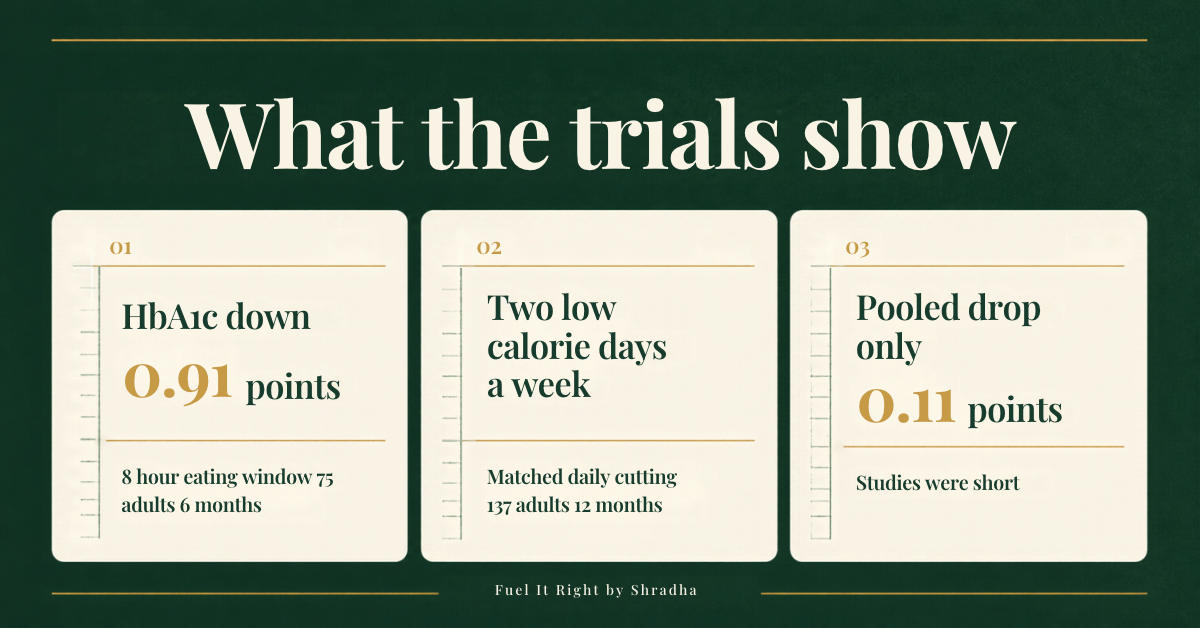
A 2023 trial in JAMA Network Open, by Pavlou and colleagues, is the best test of intermittent fasting for diabetes that I found. It followed 75 adults with obesity and type 2 diabetes for six months at the University of Illinois Chicago. Their average age was 55, their average BMI was 39, and their average HbA1c was 8.1 percent.
One group ate only between 12 and 8 pm, with no calorie counting. A second group cut calories by 25 percent a day and a third carried on as usual. Compared with usual eating, HbA1c fell by 0.91 points with the eating window and 0.94 points with calorie cutting. The two did not differ.
Weight fell by 3.6 percent with the eating window, which was a clear drop. The calorie-cutting group lost 1.8 percent, which was not statistically significant. The eating-window group ate about 313 fewer calories a day. My reading is that intermittent fasting for diabetes works mainly by helping people eat less, not through a special fasting effect.
The limits matter. The trial was small, and only 68 percent of the calorie-cutting group met their calorie goals, which may flatter the eating window. The authors say larger and longer trials are needed. A BMI of 39 is also far above that of many of my clients, so I would not assume the same results in leaner people.
Two Low-Calorie Days a Week
Carter and colleagues tested intermittent fasting for diabetes in a different way in a 2018 trial in JAMA Network Open . In South Australia, 137 adults with type 2 diabetes were given one of two plans for 12 months. One plan was two non-consecutive days a week of 500 to 600 calories. The other was 1,200 to 1,500 calories every day.
HbA1c fell by 0.3 points with the two-day plan and 0.5 points with daily cutting, which the authors judged equivalent. Weight fell by 6.8 kg and 5.0 kg. But the weight comparison did not meet the authors' equivalence test, and 40 of the 137 people did not finish.
Note that the researchers reduced medicines that can cause low sugar before this intermittent fasting for diabetes trial began. That is a safety step you cannot safely copy by yourself.
Pooled Results for Eating Windows
A meta-analysis of trials of time-restricted eating, a form of intermittent fasting for diabetes, was published by Nam and colleagues in the International Journal of Molecular Sciences in 2025. The people had type 2 diabetes or impaired fasting glucose. It covered eight trials and 312 people, and six trials were pooled.
For intermittent fasting for diabetes, pooled HbA1c fell by only 0.11 points, which is small, and the studies disagreed strongly. Fasting sugar fell by 0.74 mmol/L, about 13 mg/dL, and time in range rose by about 10.5 percentage points. The trials ran from about three weeks to six months.
The paper is also inconsistent in how it describes its designs, so I treat the pooled numbers as a rough guide. A 2026 conference review, not yet published, found that only two trials had directly compared intermittent fasting with calorie cutting for at least 12 weeks. They were the two trials above, and the review judged the approaches similar.
Why I Do Not Treat This as Settled
Most trials of intermittent fasting for diabetes were done for six months or less. Nobody has shown what happens over years or whether it protects your heart or kidneys. The two main trials I read were done in the United States and Australia, not on Indian diets.
A preliminary 2024 report at an American Heart Association meeting linked an eating window of 8 hours or less to a higher risk of heart death. It included over 20,000 US adults followed for about eight years.
That report was observational, based on two days of recalled food, not yet peer reviewed, and it did not look at diabetes. It does not show that fasting caused harm. It is one more reason I want longer trials of intermittent fasting for diabetes before I recommend short windows to everyone.
Is Intermittent Fasting for Diabetes Safe?
The safety question on intermittent fasting for diabetes is mostly about medicines. If you take insulin or a sulfonylurea, going longer without food can push your sugar too low.
Low Blood Sugar and Your Medicines
In the 2018 trial, they first cut low sugar medicines. Nevertheless, around 35 percent of people on sulfonylureas or insulin, 16 of 46, had a low or high sugar event in the first two weeks. That tells you how real the problem is for intermittent fasting for diabetes.
A 2021 review of Ramadan fasting in Frontiers in Endocrinology covered 68 studies and 26,706 people with type 2 diabetes. In one observational study, about 20 percent of people on sulfonylureas had symptomatic lows. The rates were about 26 percent with glibenclamide, 17 percent with glimepiride and 14 percent with gliclazide. In another, about 19 percent of people on insulin alone had lows, against about 5 percent on tablets alone.
The reviewers found no clear evidence that Ramadan fasting harms people with diabetes overall, but they could not reach firm conclusions. DPP-4 inhibitors looked safer than sulfonylureas, and education before fasting went with fewer events.
These are observational numbers, so they show a pattern, not precise risks. Ramadan fasting also means no water in daylight, so it is not the same as a daily eating window.
Who Should Not Try It on Their Own
I would not suggest intermittent fasting for diabetes without close medical supervision in some groups. They are people who take insulin or a sulfonylurea, are pregnant or breastfeeding, have had an eating disorder, or have kidney disease or frequent lows. The trials I read did not test these groups, so this is my caution and not a trial result.
Fasting can also set off binge eating in some people. An expert quoted on the heart association report raised the same concern, and I share it.
Shradha's Tip Do not start a fasting plan in the week before travel, a festival or a medicine change. Pick a calm two weeks, so you can tell whether it is really working. |
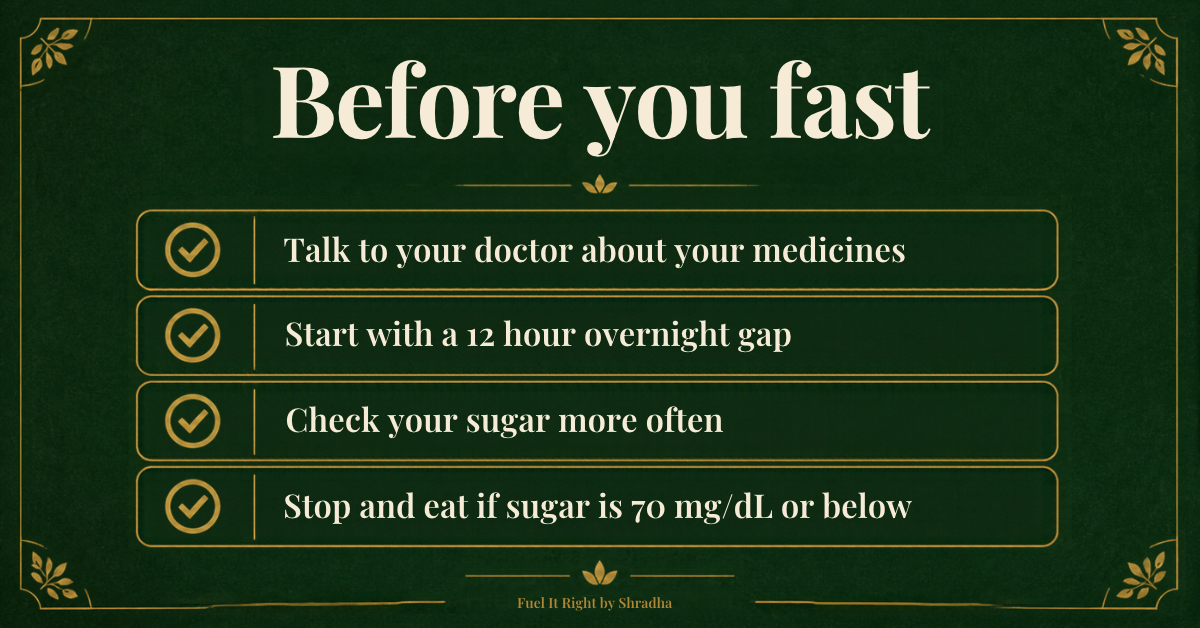
8 to 10 Hour Eating Window Worth discussing |
It lowered HbA1c by 0.91 points in a six month trial of 75 adults, much like calorie cutting. The trial was small and the group had a high BMI. How to make it work: Start with a 12 hour overnight gap and shorten it slowly, with your doctor's approval. |
Two Low-Calorie Days a Week Needs a doctor plan |
It matched daily calorie cutting on HbA1c over 12 months, but medicines were reduced first and about 30 percent of people dropped out. How to make it work: Do not try it alone if you take insulin or a sulfonylurea. |
Fasting Without Changing Medicines Risky |
In the trial, low-sugar medicines were cut before fasting began. Fasting on the same doses can raise the chance of a low. How to make it work: Ask your doctor to review your doses before you change how you eat. |
Fasts of 24 Hours or More Not enough evidence |
I did not find trials in my reading that tested long fasts in people taking diabetes medicines. How to make it work: Keep your overnight gap to 12 hours or a little more for now. |
WHAT YOU'VE HEARD Skipping meals is a quick way to bring sugar down. |
WHAT'S ACTUALLY TRUE In trials, the benefit looked similar to ordinary calorie cutting, and it built up over weeks to months. Long gaps can drop sugar too low if you take sulfonylureas or insulin. |
How to Try Intermittent Fasting for Diabetes Safely
If you and your doctor decide to try intermittent fasting for diabetes, I suggest this order. It starts with your medicines, then moves to gentle changes, and keeps your sugar readings in view.
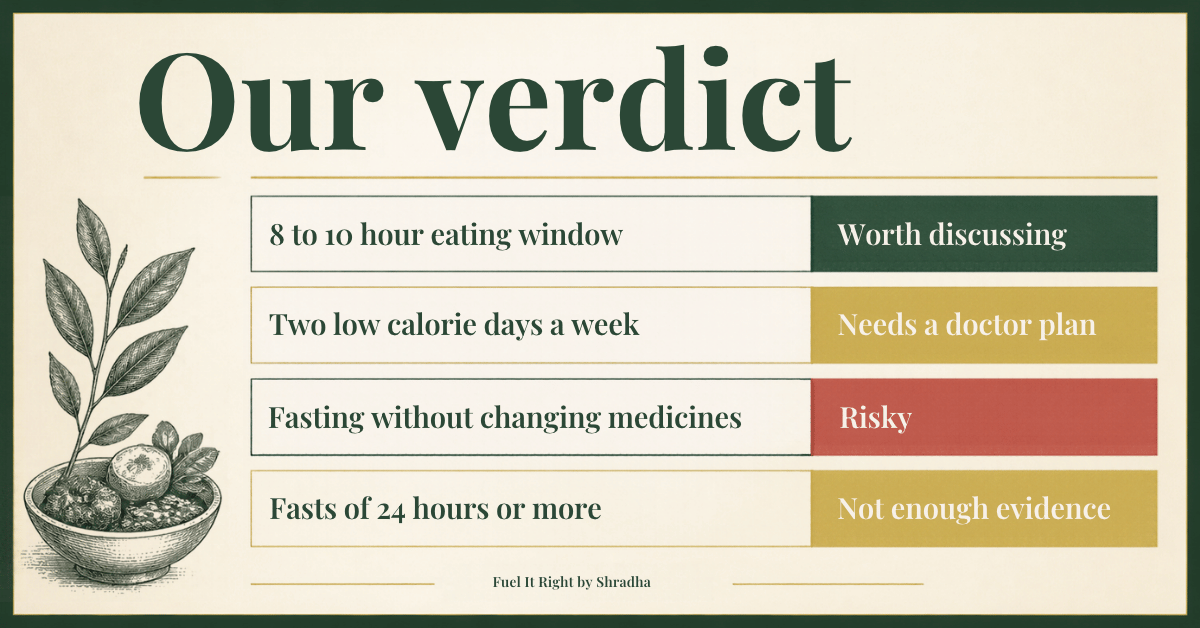
Step 1: Talk to Your Doctor First
Before intermittent fasting for diabetes begins, take your last two weeks of sugar readings and a list of your medicines. Ask whether any dose or timing should change, and which reading means you should stop. In the 2018 trial, this step was built in before anyone started.
Step 2: Start With a Gentle Overnight Gap
Begin with a 12 hour gap, such as eating dinner at 7:30 pm and breakfast at 7:30 am. If that works, progress to a 10 hour eating window. The trial used noon to 8 pm, but I did not find a trial showing which window is best, so I pick the one you can stick to.
Leave 2 to 3 hours between dinner and bed, as I explain in my post on high fasting sugar in the morning.
Step 3: Make the Eating Window Count
The window only helps if what you eat in it is sound, so food quality matters as much as timing. Fill half your plate with vegetables, add dal, paneer, egg, fish or chicken, and keep the grain to about one katori cooked. My post on rice and diabetes and my post on millets explain the grain portion in more detail.
A short walk after meals also helps. The post on walking after meals covers the evidence.
Step 4: Check Your Sugar More Often
Check when you wake up, before breaking your fast and two hours after your first meal. If your sugar is 70 mg/dL or lower, or if you feel shaky, sweaty or confused, stop the fast, eat something and call your doctor. Write down your readings for your next visit.
Common Mistakes With Intermittent Fasting for Diabetes
The mistakes I see most with intermittent fasting for diabetes are predictable. People overeat when the window opens, or make up for the gap with sweets. Others stop their medicine on their own, skip water, or jump straight to a 6 hour window.
Another mistake is filling the window with fruit and snacks. A shorter window is not a licence to eat anything inside it.
A Simple Day on a 10 Hour Window
Here is a day of intermittent fasting for diabetes that I might suggest, if your doctor agrees. At 8:30 am, have a moong chilla with chutney and an egg or paneer. At 1 pm, have one roti or a small portion of cooked millet, dal, a sabzi and a salad.
At 4 pm, have a small snack such as roasted chana or curd. At 6:30 pm, have dal, vegetables and one roti. Outside the window, stick to water and unsweetened tea or coffee.
I have many clients who already fast for Navratri, Ekadashi or Ramadan. The same safety rules apply. Fasting foods that are mostly sago, potato or deep fried can raise sugar sharply, so plan those days with your doctor too.
Shradha's Tip If you take medicines that can cause lows, keep a quick sugar source within reach on fasting days, such as glucose tablets. Ask your doctor what suits you. |
If long gaps between meals leave you bloated or acidic, the Gut Health Quiz is a good place to start.
The Bottom Line on Intermittent Fasting for Diabetes
Intermittent fasting for diabetes lowered HbA1c by about 0.3 to 0.9 points in trials, about the same as ordinary calorie cutting. Pooled results were smaller and varied a lot, the studies were short, and low sugar on medicines is a real risk.
My view on intermittent fasting for diabetes is simple. It’s an option, not a shortcut. Talk to your doctor, start with an easy overnight gap, pack the window with good food, and watch your sugar.
If you are following this series, you may also like the posts on karela and apple cider vinegar, both put through the same check.
Want help working out if fasting is safe for you and your diabetes medicines?
Book a consultation:

Frequently Asked Questions About Intermittent Fasting for Diabetes
Is Intermittent Fasting Good for Diabetes?
Intermittent fasting for diabetes lowered HbA1c in small trials, about as much as calorie cutting. But the trials were short and mostly in people with high BMI, so it is an option and not a first choice for everyone.
Is Intermittent Fasting Safe for Diabetics?
For people with diabetes, intermittent fasting is safest for those on diet or low-risk tablets, with a doctor’s review. If you take insulin or a sulfonylurea, the risk of low sugar is real and medicines may need changing first.
Can Intermittent Fasting Reverse Type 2 Diabetes?
I cannot say that. The trials I read measured HbA1c and weight, not remission. HbA1c fell, but I did not find evidence in these trials that fasting reverses diabetes.
What Is the Best Intermittent Fasting Schedule for Diabetes?
I did not find a trial that shows the best schedule. The 2023 trial used an eating window from 12 to 8 pm. I suggest the shortest gap you can keep comfortably, starting with 12 hours overnight.
Can I Take Diabetes Medicines While Fasting?
Do not change or skip medicines on your own. Ask your doctor first, because sulfonylureas and insulin can cause lows during long gaps without food.
Does Intermittent Fasting Lower Blood Sugar?
One pooled analysis published in 2025 showed eating-window plans reduced fasting sugar by approximately 0.74 mmol/L, or 13 mg/dL. The impact on HbA1c was small and the studies were highly heterogeneous .
Is 16:8 Fasting Good for Type 2 Diabetes?
A 16:8 plan means an 8 hour eating window. One 2023 trial of 75 adults found it lowered HbA1c by 0.91 points over six months, but the trial was small and the group had a high BMI.
Who Should Avoid Intermittent Fasting for Diabetes?
I suggest avoiding intermittent fasting for diabetes on your own if you take insulin or a sulfonylurea, are pregnant, have had an eating disorder, or have kidney disease. Talk to your doctor first.
Shradha | Nutritionist & Dietitian | Fuel It Right