
High Fasting Sugar in the Morning: Causes and Food Fixes
Why high fasting sugar in the morning happens, what a 2024 CGM study, a 2013 night-low study and a 2025 dinner study show, and what to do about it.
Table of Contents
• What Causes High Fasting Sugar in the Morning
• The Dawn Phenomenon
• The Somogyi Effect
• Other Causes I Check For
• Can Dinner Change High Fasting Sugar in the Morning?
• The Last Meal and Next Morning Sugar
• Late Dinners and Your Genes
• Bedtime Snacks
• What to Do About High Fasting Sugar in the Morning
• Step 1: Find Your Pattern
• Step 2: Fix the Evening Plate
• Step 3: Leave Medicines to Your Doctor
• Step 4: Track for Two Weeks
• Common Mistakes With High Fasting Sugar in the Morning
• A Simple Evening Plan
• The Bottom Line on High Fasting Sugar in the Morning
• Frequently Asked Questions About High Fasting Sugar in the Morning
High fasting sugar in the morning is one of the most frustrating things my clients with diabetes describe. They eat carefully, skip the sweets, walk after dinner, and still wake up to a number that looks worse than their afternoon readings.
The short answer to high fasting sugar in the morning is that it often comes from your own body’s early morning hormones, called the dawn phenomenon. Not what you ate at night. Dinner still seems to matter a little in small studies, but bedtime snacks have very little support.
In this post on high fasting sugar in the morning, I explain the two main causes. I also cover what the research says about dinner and bedtime snacks and what I suggest my clients do. And I explain when a reading needs your doctor, not a food change.
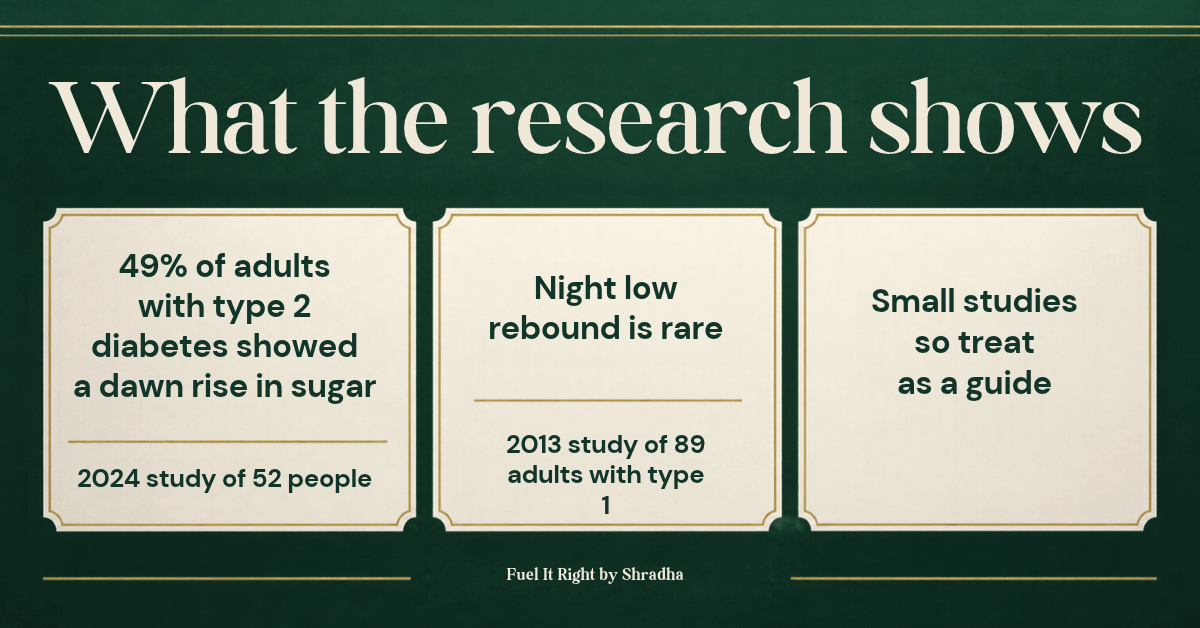
Key Takeaways • In a 2024 study of 173 adults wearing glucose sensors, about 49 percent of the 52 people with type 2 diabetes showed a dawn phenomenon, a natural rise in sugar in the early morning. • The Somogyi effect, a high morning reading that follows a night time low, was rare in a 2013 study of 89 adults with type 1 diabetes. • In a small 2025 study, the sugar rise after the last evening meal tracked with the next morning’s fasting sugar, but this was a correlation and not proof. • A tiny 2020 trial found an egg-based bedtime snack lowered fasting sugar compared with a yogurt snack, but neither differed from having no snack. • My advice: check your sugar around 2 to 3 am before you change food or medicine, and never adjust insulin or tablets on your own. |
What Causes High Fasting Sugar in the Morning
Before you change your dinner, you need to know which pattern you have. High fasting sugar in the morning has at least two very different causes, and they need opposite responses.
The Dawn Phenomenon
Between about 3 and 8 a.m., your body releases hormones like cortisol, growth hormone and glucagon. They tell your liver to release glucose so you have energy to get up. In people without diabetes, insulin rises to match it. In diabetes, insulin may not keep up, so sugar goes up.
A 2024 paper in Scientific Reports, by Barua and colleagues, looked at this with glucose sensors worn by 173 adults. Fifty-two of them had type 2 diabetes. Using a statistical model, the team found a dawn phenomenon in 49 percent of that group, with a 95 percent range of 37 to 63 percent.
The authors also noted that those with type 2 diabetes had a larger increase on average than the other groups. The more often the dawn rise occurred, the higher the HbA1c tended to be. So about half of my clients with type 2 diabetes may experience high fasting sugar in the morning for this reason alone.
The wide range, 37 to 63 percent, tells you the estimate is imprecise. It came from only 52 people with diabetes, so I treat it as a rough guide.
The Somogyi Effect
The other classic cause of high fasting sugar in the morning is the Somogyi effect. The idea is that your sugar drops too low overnight, your body releases hormones to rescue it, and you wake up with a rebound high.
A 2013 paper in Diabetic Medicine tested this in 89 adults with type 1 diabetes who wore glucose sensors. After nights with a low, the average fasting reading was 5.5 mmol/L, which is about 99 mg/dL. After nights without a low, it was 14.5 mmol/L, about 261 mg/dL. Only two readings above 10 mmol/L followed a low night, and both came after likely treatment of the low.
The authors concluded that the Somogyi effect is rare, which is the opposite of what many of us were taught. They also noted that a fasting reading of 5 mmol/L or lower, about 90 mg/dL, may be a sign that a silent low occurred during the night.
Keep one limit in mind. This study was in type 1 diabetes. I did not find a matching study in type 2 diabetes. So I cannot say how often a night low causes high fasting sugar in the morning in my clients on tablets or insulin.
Other Causes I Check For
When I see high fasting sugar in the morning, I also ask about medicine timing, the size and time of dinner, poor sleep, snoring and stress. This is my clinical routine. I did not find trials in my reading that rank these causes, so I cannot tell you which matters most.
This is why I do not give a standard diet for high fasting sugar in the morning. Two people can have the same number on the meter for very different reasons. One needs a doctor to review the evening medicine and the other needs an earlier dinner. The first job is always to find out which one of them you are.
Can Dinner Change High Fasting Sugar in the Morning?
Many people blame last night's dinner for high fasting sugar in the morning. The research gives a mixed answer, and the studies are small, so I hold the findings loosely.
The Last Meal and Next Morning Sugar
A 2025 study in Nutrients, by Diaz-Rizzolo and colleagues, followed 33 adults aged 50 to 75. They were overweight or had obesity, and had prediabetes or type 2 diabetes managed by diet or metformin. On a controlled day, everyone ate dinner at 6 pm and a last snack at 10 pm, and wore a glucose sensor.
The rise in sugar in the 3 hours after the last meal was associated with the fasting sugar the next morning (correlation 0.70). The grams of carbohydrate in that meal was not significantly associated (p = 0.072). The association disappeared after the authors adjusted for insulin sensitivity.
My reading is that how your body handles the last meal reflects how well your insulin works. A simple rule such as no carbohydrate at night is not supported. The limits are real: a small exploratory study, one controlled day, and only a handful of people with type 2 diabetes.
Late Dinners and Your Genes
A larger randomized crossover trial in Diabetes Care, published in January 2022, tested early and late meals in 845 adults in Spain. The late meal produced higher blood sugar. The effect was mainly seen in carriers of a variant in the melatonin receptor gene MTNR1B, about half of the group.
I treat this as a hint and not a rule. The participants did not have diabetes, late eating was mimicked with a glucose drink, and sugar was measured for only two hours. It does support leaving a gap between dinner and bed.
Bedtime Snacks
The most direct test I found is a 2020 trial in Clinical Nutrition, by Abbie and colleagues. Fifteen adults with type 2 diabetes tried three conditions for three days each: an egg-based low-carbohydrate snack, a yogurt-based higher-carbohydrate snack, and no snack.
Compared with the yogurt snack, the egg snack lowered fasting glucose (p = 0.04) and night time glucose. But neither snack differed significantly from having no snack. So I cannot tell you a snack helps with high fasting sugar in the morning. It may only be that the yogurt snack did worse.
If you take insulin or a sulfonylurea and have night lows, your doctor may want you to have a bedtime snack for safety. That is a medicine decision, so please ask before adding or dropping one.
Shradha's Tip Change one thing at a time. Keep your dinner time the same for a week, then make dinner earlier or lighter for a week. Check your fasting sugar each morning and compare. |
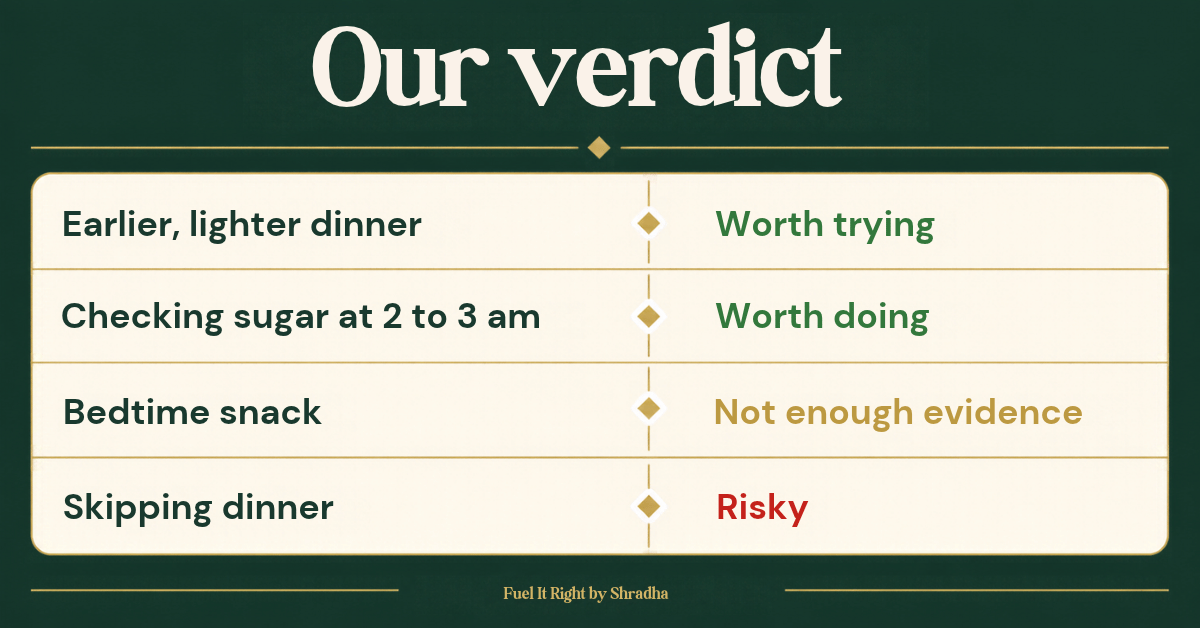
Earlier, Lighter Dinner Worth trying |
The small 2025 and 2022 studies point the same way, and the change is low risk. The evidence is weak, so it may not fix a hormone-driven rise. How to make it work: Eat 2 to 3 hours before bed, with vegetables and protein, and a small portion of grain. |
Checking Sugar at 2 to 3 am Worth doing |
The dawn phenomenon and the Somogyi effect can look the same on a morning reading. An overnight reading helps to tell them apart. How to make it work: Check for three nights, and show the numbers to your doctor. |
Egg or Protein Bedtime Snack Not enough |
One small crossover trial of 15 people found no clear difference from having no snack. How to make it work: Do not add a snack on your own. Ask your doctor first. |
Skipping Dinner Risky |
I did not find trials supporting it. If you take insulin or a sulfonylurea, skipping meals can raise the risk of a low sugar at night. How to make it work: Eat a balanced early dinner instead. |
WHAT YOU'VE HEARD A high morning reading means last night's dinner was too sweet or too big. |
WHAT'S ACTUALLY TRUE Often it does not. A natural hormone rise explained high fasting sugar in the morning in about half the adults with type 2 diabetes in one 2024 study, and in a small 2025 study the carbohydrate in the last meal was not significantly linked to next morning sugar. |
What to Do About High Fasting Sugar in the Morning
Here is the order I follow with clients who have high fasting sugar in the morning. It starts with finding out the pattern, then moves to food, and keeps your doctor in charge of medicines.
Step 1: Find Your Pattern
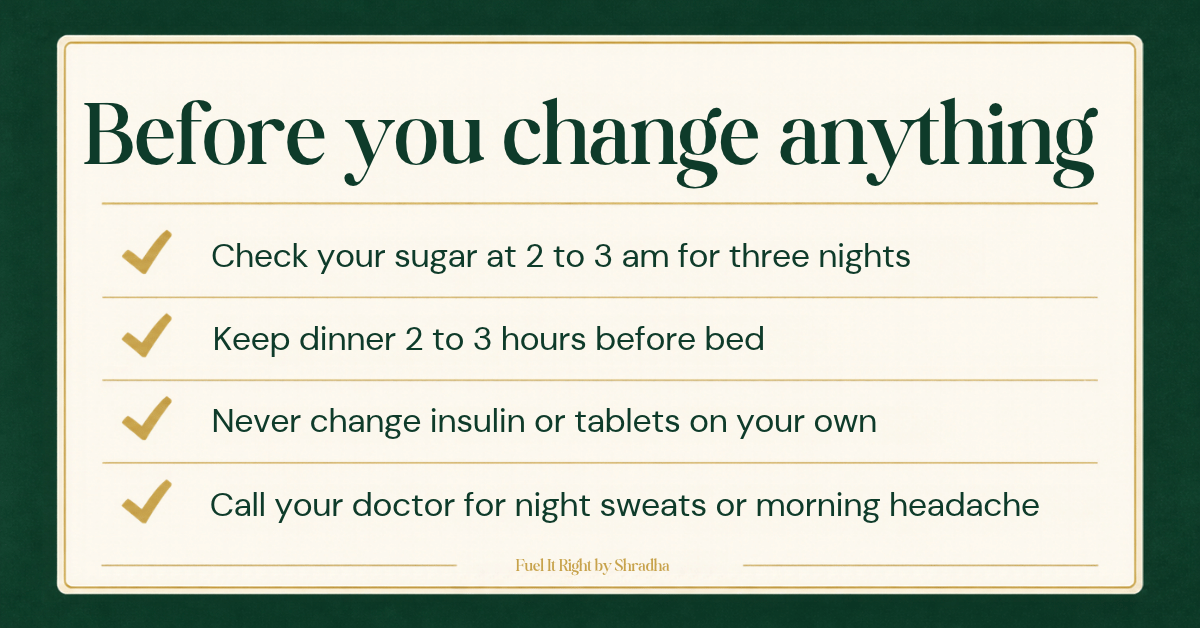
For three nights, check your sugar at bedtime, at about 2 to 3 am and on waking, if your doctor agrees. A sensor makes this easier because it records the whole night. Take the numbers to your appointment, along with a note of what you ate and when.
This step is a surprise to many of my clients. They've been testing only at breakfast for months, and the missing overnight data was the whole puzzle. Three nites of numbers can save you from changing your food, or your medicine, for the wrong reason.
If you are low or low-normal at 3 am and high on waking, a night low may be involved. If you are steady at 3 am and rising by morning, a dawn rise is more likely. I cannot tell you which you have from one reading, and neither can you.
Step 2: Fix the Evening Plate
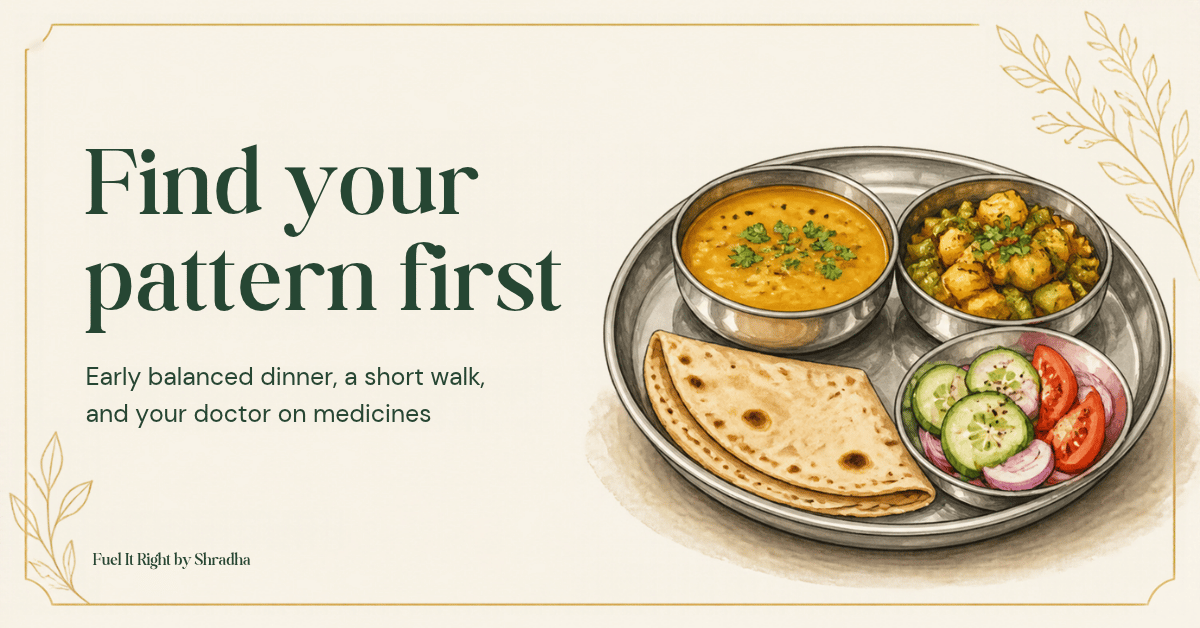
Eat dinner 2 to 3 hours before bed. Fill half your plate with vegetables, add dal, paneer, egg, fish or chicken, and keep the grain to about one katori cooked. My post on rice and diabetes explains why rice portions matter.
Then take a 10 to 15 minute walk after dinner. The post on walking after meals covers the evidence. These steps help your evening sugar, though I cannot promise they fix a dawn rise.
Step 3: Leave Medicines to Your Doctor
Don’t change insulin or tablets because of one high reading. If your readings are high most mornings, get your doctor to check the dose and the timing. If you take insulin or a sulfonylurea and have low readings, night sweats or a headache in the morning, call your doctor.
Step 4: Track for Two Weeks
Write down your dinner time, what you ate, your evening walk and your waking reading. After two weeks, you and your doctor can see whether your high fasting sugar in the morning changed with the evening plan.
Common Mistakes With High Fasting Sugar in the Morning
I see the same mistakes the most in people who have high fasting sugar in the morning. They skip dinner, wake up hungry or low and overeat. Or they add a big bedtime snack because they heard it helps. Or they stop their medicine after one good reading.
Another mistake is cutting out all carbohydrate at night while keeping fruit and sweet snacks late in the evening. Test once, change one thing, and judge it over two weeks.
A Simple Evening Plan
Here is an evening plan I give clients with high fasting sugar in the morning, if their doctor agrees. At 7:30 pm, have dal, a vegetable sabzi, a salad and one roti or a small portion of cooked millets, with paneer or an egg on the side.
Next, take a 10-minute walk, keep the lights low and go to bed at the same time each night. Do not have the bedtime snack unless your doctor has told you to. Let this plan work for two full weeks before you judge your high fasting sugar in the morning, because one night tells you very little.
Shradha's Tip Test at the same time every morning, before tea and before you walk. Standing up and moving can raise the reading, so a consistent routine gives you numbers you can compare. |
If poor sleep or an unsettled stomach is part of your story, the Gut Health Quiz is a good place to start.
The Bottom Line on High Fasting Sugar in the Morning
High fasting sugar in the morning often comes from the dawn phenomenon, which appeared in about half of the adults with type 2 diabetes in a 2024 study. The Somogyi effect, a rebound after a night low, was rare in a 2013 study of adults with type 1 diabetes.
I have a simple take on high fasting sugar in the morning. Find your pattern first, have an early and balanced dinner, walk after eating and leave changes to medicine to your doctor.
If you are following this series, you may also like the posts on karela, apple cider vinegar and cinnamon, all put through the same check.
Want help finding why your fasting sugar stays high, and a dinner plan that fits your medicines?
Book a consultation:
Frequently Asked Questions About High Fasting Sugar in the Morning
Why Is My Fasting Sugar High in the Morning?
High fasting sugar in the morning is often a dawn phenomenon, a natural hormone rise between about 3 and 8 am. Less often it is a rebound after a nite low. Check at 2 to 3 am to tell them apart.
What Is the Dawn Phenomenon?
The dawn phenomenon is a rise in sugar in the early morning, driven by hormones that tell the liver to release glucose. In a 2024 study, it appeared in about 49 percent of adults with type 2 diabetes.
Is High Fasting Sugar in the Morning Dangerous?
Occasional high fasting sugar in the morning is common. Repeated high readings should be reviewed by your doctor, because they raise your HbA1c. Very high readings with thirst, vomiting or confusion need urgent care.
Does Eating Dinner Late Raise Fasting Sugar?
A late dinner raised blood sugar in a 2022 trial of adults without diabetes, but those results may not apply to you. I suggest leaving 2 to 3 hours between dinner and bed.
Should a Diabetic Eat a Bedtime Snack?
A bedtime snack did not clearly beat no snack in a small 2020 trial. If you take insulin or a sulfonylurea, your doctor may advise one for safety, so ask before adding or skipping it.
What Is the Somogyi Effect?
The Somogyi effect is a high morning reading following a nite time low. A 2013 study of 89 adults with type 1 diabetes found it rare, and a fasting reading of 5 mmol/L or less may signal a silent low.
How Do I Lower High Fasting Sugar in the Morning Naturally?
For high fasting sugar in the morning, I suggest an early balanced dinner, a short walk after eating and regular sleep. These help evening sugar, but a hormone-driven rise may still need your doctor to adjust treatment.
When Should I See a Doctor About High Fasting Sugar in the Morning?
See your doctor if you have high fasting sugar in the morning on most days, any low readings, night sweats, or a morning headache. Do not change insulin or tablets on your own.