
Karela for Diabetes: Does Bitter Gourd Really Work?
What reviews of trials say about karela (bitter gourd) and blood sugar, why they disagree, and who should be careful.
Table of Contents
• What the Research on Karela for Diabetes Shows
• The Review That Found a Small Benefit
• The Reviews That Found No Clear Effect
• Why the Reviews Disagree
• What No Trial Has Tested
• Is Karela Safe for Diabetes?
• Is Karela Good for Diabetic Patients?
• Low Blood Sugar and Medicines
• Stomach Trouble and Juice Risks
• Seeds and Favism
• Who Should Avoid Karela
• How to Eat Karela for Diabetes at Home
• Karela as a Vegetable
• Taking the Edge Off the Bitterness
• What About Karela Juice?
• A Simple Day With Karela
• Check Your Own Response
• What Matters More Than Karela
• The Bottom Line on Karela for Diabetes
• Frequently Asked Questions About Karela for Diabetes
Karela for diabetes is probably the most repeated home remedy in Indian families. Someone at home always says, "Drink karela juice every morning, your sugar will come down." Many people force it down for years, bitter taste and all.
Here’s the short answer: The research on karela is mixed. Some reviews found a small drop in blood sugar, some found no clear effect. So karela can be a healthy vegetable on your plate but it is not a proven treatment.
In this post on karela for diabetes, I explain what the reviews found, why they disagree, what the real risks are, and how I suggest my clients eat bitter gourd.
Key Takeaways • Three reviews of trials on karela for diabetes do not agree. One found HbA1c about 0.38 points lower, and two found no clear effect. • The trials used dried karela powder, extracts and capsules. I found no trial of fresh karela juice, the form most people drink. • No serious side effects showed up in the trials, but a 6 g dose of dried pulp caused more diarrhea and gas than placebo. • Karela may add to the sugar-lowering effect of diabetes medicines, and it is best avoided in pregnancy. • Karela as a cooked vegetable is a fine choice. Treat it as food, not as medicine. |
What the Research on Karela for Diabetes Shows
Karela is the Hindi name for bitter gourd, aka bitter melon. The concept behind karela for diabetes is old and popular. It has been used for diabetes in India for generations. Lab and animal studies suggest it has plant compounds that may help the body use sugar better. But what works in a lab doesn’t always work in people, so I focus on trials in people.
The Review That Found a Small Benefit
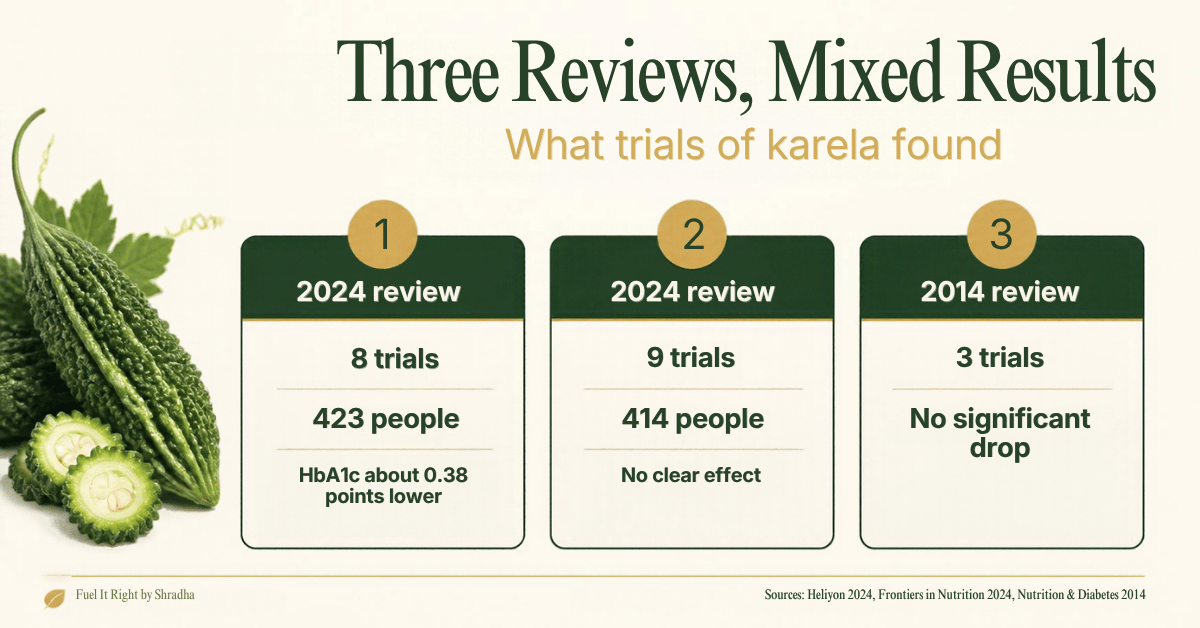
A 2024 review pooled 8 trials with 423 adults who had type 2 diabetes. People taking karela supplements had an HbA1c about 0.38 points lower than the comparison groups. HbA1c is your three-month average sugar.
Fasting sugar was down as well, 0.85 mmol/L, or about 15 mg/dL. After-meal sugar and total cholesterol were down as well. These are real numbers, and they look promising for a vegetable-based remedy.
But I could only read the summary of this paper, not the full text. So I cannot tell you how strong the authors rated the evidence, or how many side effects were recorded. The authors called karela a potential alternative and asked for better trials.
The Reviews That Found No Clear Effect
A 2024 review in Frontiers in Nutrition looked at karela for diabetes and prediabetes across 9 placebo-controlled trials with 414 people. Some had prediabetes and some had type 2 diabetes. The trials ran from 4 to 16 weeks.
When the authors compared the change in each group, HbA1c was only 0.12 points lower with karela, and fasting sugar was almost the same as placebo. The ranges were wide enough that karela may have done nothing at all.
“Evidence does not support the use of karela for metabolic health and the title of their paper says its effect ‘cannot be determined’,” the authors concluded. An older review from 2014 reviewed just three small trials and found no significant drop in HbA1c or fasting sugar.
Why the Reviews Disagree
Reviews can look at the same topic and reach different answers. Here the trials were small, short and very different from each other. They used different karela products, from dried powder to capsules and extracts, in doses from about 0.3 g to 6 g a day.
Karela is also not a standardized product. One capsule may have a lot more of the active compounds than another. This makes it difficult to say that karela for diabetes works or does not work because “karela” means a lot of different things in these trials.
So my honest reading is this. The signal is small at best, and it is not reliable. It is nowhere near the strength of the evidence for medicines, or for habits like walking after meals.
Shradha's Tip If a remedy has mixed evidence, judge it by your own numbers. Track your fasting sugar and your HbA1c, and do not rely on how bitter it tastes. |
What No Trial Has Tested
Here is the gap that matters for most Indian homes. Almost nobody takes karela capsules. People drink fresh juice or cook karela as a sabzi.
I never saw a trial of fresh karela juice and I never saw a trial of cooked karela. So, when someone says that karela juice lowers sugar, the honest answer is nobody has properly tested it. I would rather say that than make up a number.
Is Karela Safe for Diabetes?
Karela is a normal vegetable, and most people eat it without trouble. The risks grow when you move from the vegetable to juice, seeds, extracts or large amounts. Safety is the first question I ask about karela for diabetes, so let me go through it.
Is Karela Good for Diabetic Patients?
Karela is a good choice as a cooked vegetable for many diabetic patients. It is low in calories and adds variety to the diet. Research does not show any harm in eating it in normal food portions.
The question is whether karela for diabetes will lower your sugar, and the honest answer is that it might, a little. Please do not stop or reduce any medicine because you started karela.
Low Blood Sugar and Medicines
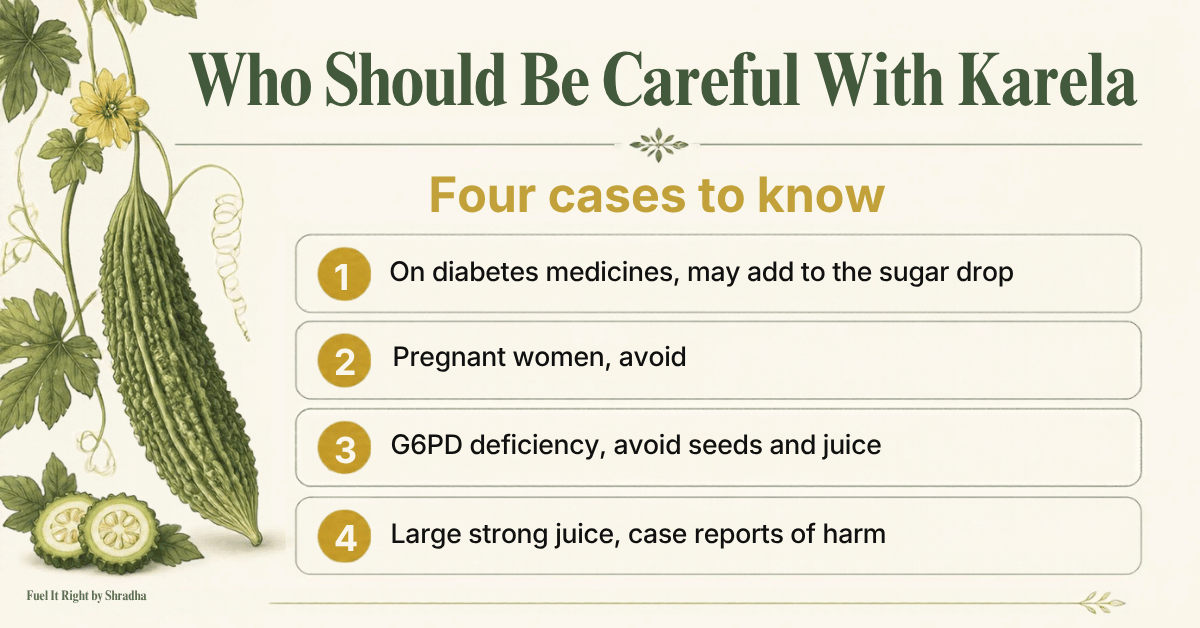
Karela may have blood sugar lowering effects. While this sounds helpful, if you already take insulin or tablets, the effects may add up. That's why I want you to tell your doctor before you start using karela for diabetes in juice or capsule form.
Know the signs of a low: shakiness, sweating, sudden hunger, a pounding heart or feeling confused. If you notice them, check your sugar and tell your doctor.
Stomach Trouble and Juice Risks
In the trials, no serious side effects showed up. Headache and stomach complaints were the most common. In one trial, a 6 g daily dose of dried pulp caused more diarrhea and gas than placebo.
I grow more wary of juice. A herbal guide from a cancer center includes case reports of an irregular heartbeat after drinking bitter melon juice in a young man, and a stomach ulcer after drinking half a liter of a homemade extract. Two people had kidney injury.
These are single case reports, so they do not tell us how common the problems are. But they are a good reason not to drink large glasses of strong karela juice every day.
Seeds and Favism
Karela seeds contain a compound called vicine. The same herb guide says it can cause favism, which brings headache, fever, stomach pain and, in severe cases, coma. People with G6PD deficiency, an enzyme problem in the blood, are the ones at risk. That link is standard medical knowledge, not from these trials.
If you have G6PD deficiency, talk to your doctor before eating karela, and do not eat the seeds or drink juice made with them.
Who Should Avoid Karela
The herb guide states that karela should be avoided in pregnancy, as animal studies suggest it may cause birth defects. I would also exercise caution if you are breastfeeding or taking medication for other health conditions. The guide mentions that karela may change how some medications work, but the clinical significance in humans is unknown.
The trials ran for about four months at most. So the long-term safety of daily juice or supplements is unknown.
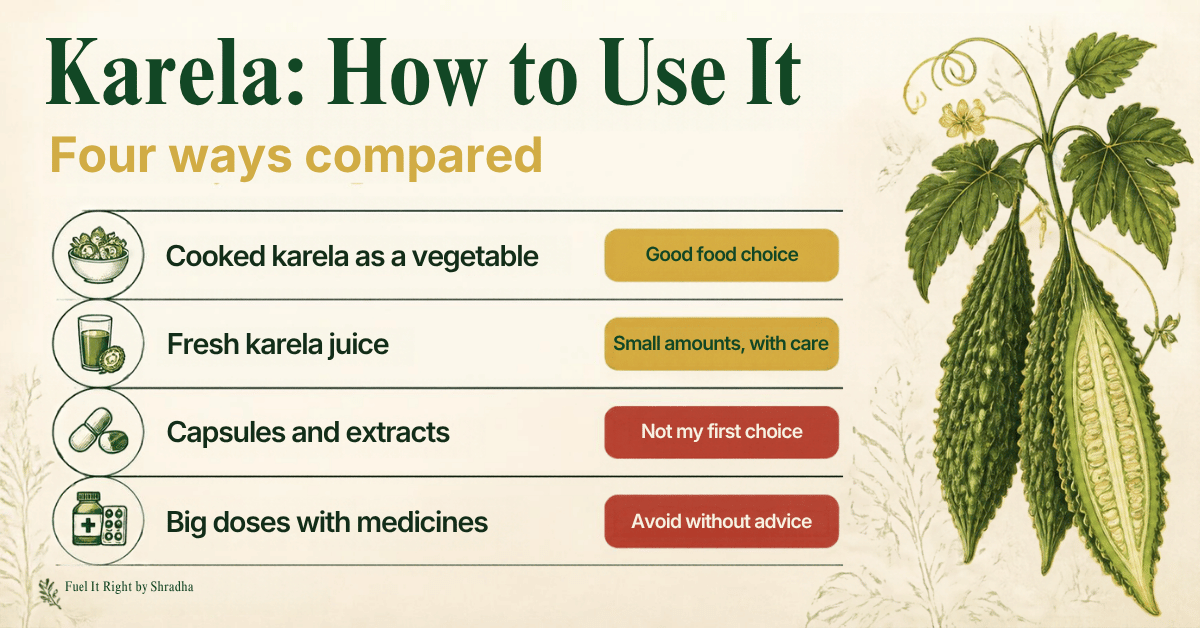
Karela as a Cooked Vegetable Good food choice |
A normal vegetable portion adds fibre and variety. I found no trial of cooked karela, so I cannot promise it lowers sugar. How to make it work: Cook it with dal or sabzi, and treat it as food, not as treatment. |
Fresh Karela Juice Small amounts, with care |
No trial has tested juice, and case reports link large strong glasses with problems. How to make it work: If you try it, start with a few sips mixed with water, and tell your doctor. |
Capsules and Extracts Not my first choice |
The trials used many different products, and quality varies. Results were mixed. How to make it work: I prefer food-first options, as with all my clients. |
Big Doses With Medicines Avoid without advice |
Karela may add to the sugar-lowering effect of your tablets or insulin. How to make it work: Talk to your doctor before you change anything. |
WHAT YOU'VE HEARD Karela juice every morning can cure diabetes. |
WHAT'S ACTUALLY TRUE No trial shows that karela cures diabetes. The reviews found a small effect at best, and none of the trials tested fresh juice. |
How to Eat Karela for Diabetes at Home
If your doctor is fine with it, here is how I suggest my clients include karela for diabetes in a regular meal. None of this needs a special product, and all of it fits normal Indian cooking.
Karela as a Vegetable
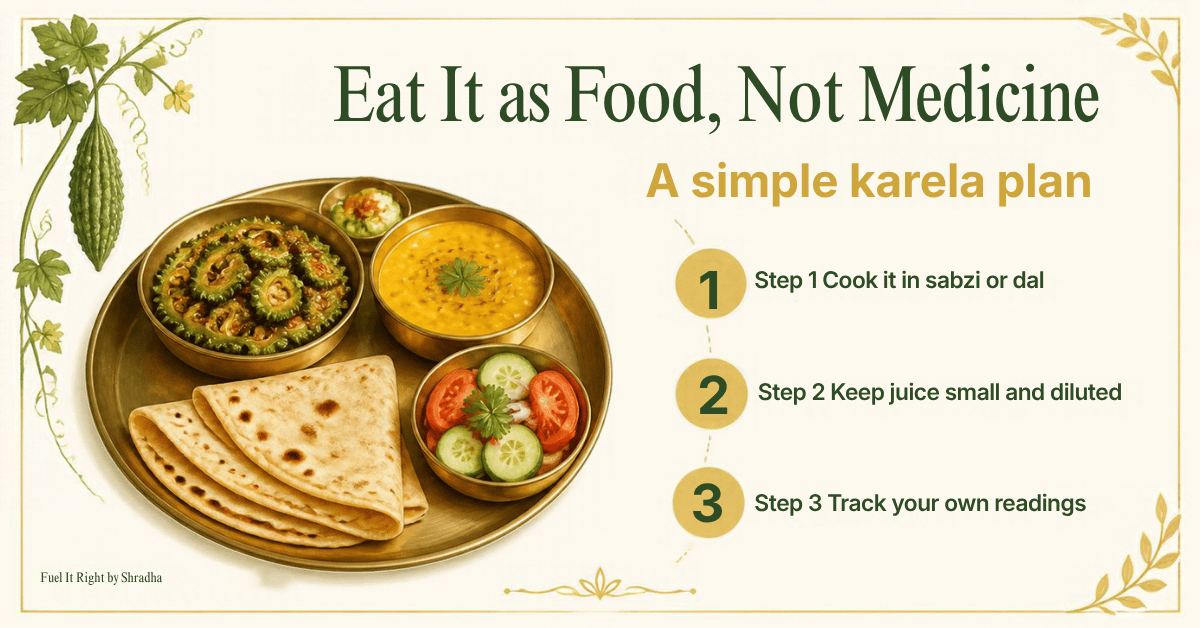
You can make karela like any other sabzi. Fry it with onion and a little oil, add it to a dal, or stuff it and fry it in shallow oil. A small bowl with your meal is enough.
Pair it with protein and fibre, such as dal, curd or sprouts. That matters more for your sugar than the karela itself. A balanced plate keeps your after-meal sugar steadier, with or without karela.
Taking the Edge Off the Bitterness
Many people give up on karela because it is too bitter. Slicing it thin and rubbing a little salt on it for 15 to 20 minutes, then squeezing out the water, takes away some of the bite. That is a kitchen tip, not something from these studies.
Cooking it with onion, tomato or a little jaggery is common, but go easy on the jaggery if you are watching your sugar. A small amount of sour ingredient, such as amchur or lemon, also helps the taste.
What About Karela Juice?
I would not call karela juice dangerous in small amounts, but I would not make it a daily ritual either. There is no trial behind it, and the case reports involved large strong glasses.
If you really want to try it, start with a few sips diluted with water, not on an empty stomach, and stop if you feel unwell. Tell your doctor, and check your sugar. Never swap it for a medicine.
A Simple Day With Karela
This is how it can be incorporated into a regular day. Breakfast can be besan chilla or eggs with a cup of tea. Lunch can be a tiny bowl of karela sabzi along with dal, one roti and a salad.
In the evening, keep dinner light, with vegetables, protein and a small portion of rice or roti. You do not need karela every day. Two or three times a week as part of a normal meal is enough for most families, and it keeps the taste from becoming a chore.
Check Your Own Response
If you test at home, write down your fasting sugar for two weeks before you start, then track it for a few months, and check your HbA1c at your next test. This is how you will know if karela for diabetes does anything for you.
Keep everything else the same during that time, so you can see what is causing the change. Share your numbers with your doctor, so they can adjust your plan if needed.
What Matters More Than Karela
If karela for diabetes works for you, it's a small helper at best. The big levers are your plate, your movement and your medicines. Eating vegetables and protein before carbs, walking after meals and choosing whole grains do more than any one vegetable.
If you want to start there, read the post on walking after meals and the post on fruit. If you like kitchen remedies, I also covered methi seeds.
Shradha's Tip Change one thing at a time. If you add karela, keep your medicines, meals and walking the same for a few weeks so you can see what the karela is doing. |
The Bottom Line on Karela for Diabetes
Karela for diabetes has mixed evidence. One review found a small drop in HbA1c and fasting sugar. Two others found no clear effect. The trials were small and short and none tested fresh juice or cooked karela.
My view on karela for diabetes is simple. It is a fine vegetable and a poor cure. Eat it if you enjoy it, be careful with juice and extracts, tell your doctor if you take diabetes medicines, and track your own readings.
If you are following this series, you may also like sweeteners and Diwali sweets.
Want a plan that fits karela, your medicines and your own blood sugar readings?
Book a consultation:
Call or WhatsApp: +91 70570 63984 Or
Frequently Asked Questions About Karela for Diabetes
Does Karela Really Lower Blood Sugar?
Maybe, a little, but karela for diabetes is not proven. One review found HbA1c about 0.38 points lower, while two others found no clear effect. The trials were small and used capsules or powder, not juice.
Is Karela Good for Diabetic Patients?
As a cooked vegetable, yes, it is a reasonable choice. Do not use it as a replacement for medicines, and tell your doctor if you plan to take juice or capsules.
Can I Drink Karela Juice Every Day?
I would not drink it every day as a habit. No trial has tested fresh juice and case reports link large strong glasses with problems. If you try it, keep it small and dilute.
How Much Karela Should I Eat?
A small bowl of cooked karela with a meal is plenty. The trial doses were dried pulp or extracts and do not translate to fresh karela, so I cannot give you a number.
Can I Take Karela With Diabetes Medicines?
Many people eat it as a vegetable without trouble. Juice or capsules may add to the sugar-lowering effect of your medicines, so ask your doctor first.
Is Karela Safe in Pregnancy?
I advise against it. A cancer centre's herb guide says pregnant women should not use it, because animal studies suggest a risk of birth defects.
Should I Eat Karela Seeds?
I would recommend removing them. They contain vicine which can cause favism in people with G6PD deficiency. If you are not sure ask your doctor.
How Long Before Karela Works?
The trials ran from 4 to 16 weeks, and the results were mixed. Judge it by your HbA1c after about three months, and do not expect changes in a week.
Shradha | Nutritionist & Dietitian | Fuel It Right