
An Honest Letter to Every Woman With PCOS and PMOS
An honest letter to every Indian woman with PCOS and PMOS. It is not your fault. Not your lack of discipline. Not your diet. Here is what was actually happening, and what you can do now.
Dear reader,
If you have PCOS or PMOS, there is a very good chance that at some point in the last few years, maybe last week, maybe this morning, you blamed yourself for it.
You told yourself you were not disciplined enough. That you should have eaten better. That if you had just tried harder with the diet, the exercise, the supplements, you would not be dealing with the acne, the hair fall, the irregular cycles, the weight that will not shift, the exhaustion that no amount of sleep fixes.
You are not alone in that. Almost every woman I see in clinical practice with PCOS and PMOS has some version of this story. The condition is so visible, it shows up on your skin, in your hair, on the scale, in the mirror, that it is almost impossible not to personalise it. To make it about something you did or did not do.
You did not cause this. You were born with a genetic predisposition to insulin resistance that no amount of willpower was ever going to override on its own.
I am writing this because after building this entire series of 84 blogs explaining the science, the mechanisms, and the food protocols, I want to step back from the clinical voice for a moment and say something more directly.
PCOS and PMOS is not a character flaw. It is not a punishment. It is not evidence of poor choices or insufficient effort. It is a metabolic condition with a specific biological root — and the reason you have struggled with it is not because you lacked discipline. It is because nobody told you what was actually happening.
What Was Actually Happening
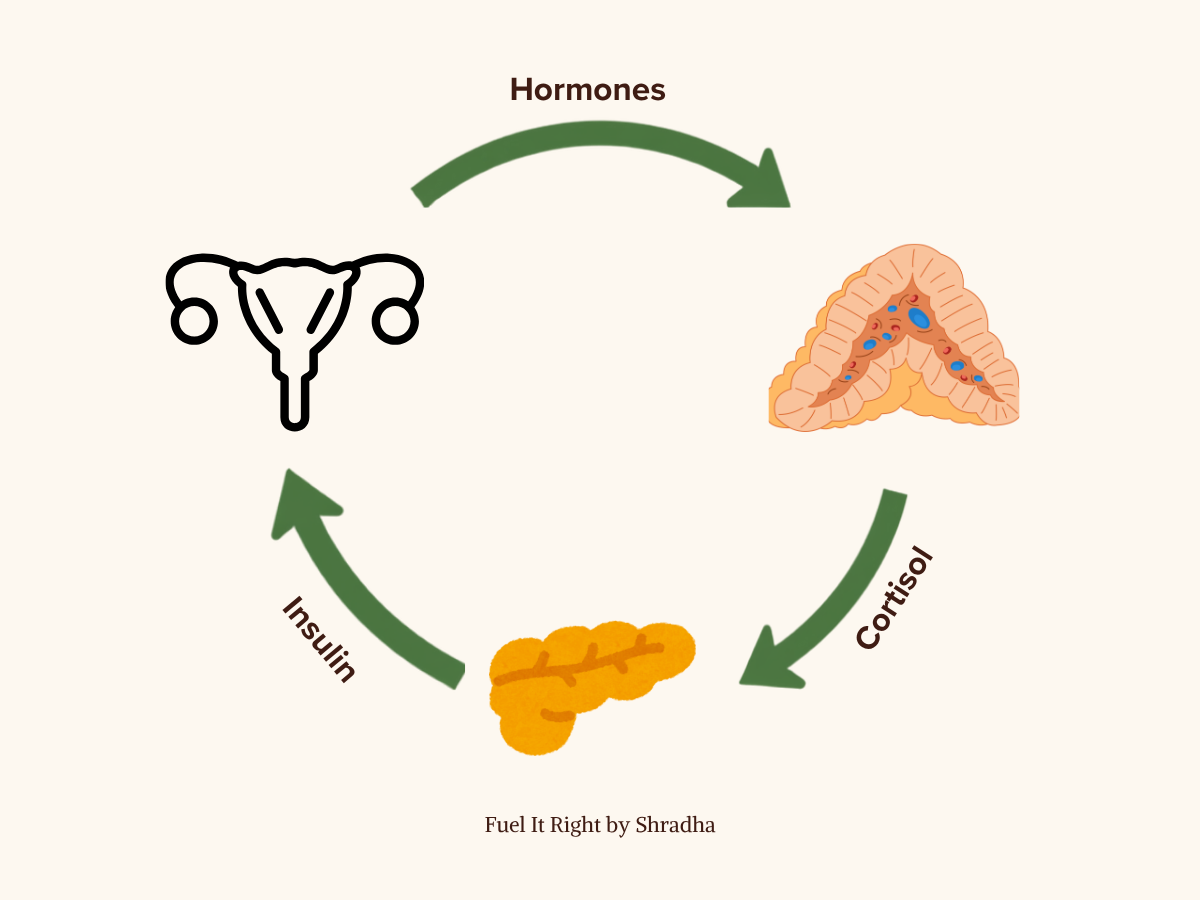
From the moment insulin resistance began developing, probably in your teens, possibly earlier, your body was working harder than it should have had to. Your pancreas was producing more insulin than it should have needed. Your ovaries were receiving signals they were never designed to receive at that volume. Your adrenal glands were responding to a stress pattern that was biological, not emotional.
Every piece of advice you received that did not acknowledge this made your situation harder. Every person who told you to just eat less was giving you advice that does not work for a metabolically disrupted system. Every crash diet you tried that made you more exhausted than before was not a failure of your resolve. It was a physiological response, cortisol rising, insulin deepening, the cycle tightening.
The reason the standard advice did not work is not because you did not follow it correctly. It is because the standard advice was not designed for the metabolic reality of PCOS and PMOS. It was designed for a metabolically healthy body with normal insulin sensitivity. That is not the body you have. That is not anyone's fault. It just requires a different approach.
The Things You Were Told That Were Not True
You were probably told some version of the following. Each one deserves an honest response.
"You just need to lose weight." Weight and PCOS/PMOS have a bidirectional relationship that nobody explains. Insulin resistance, the root of the condition, makes weight gain more likely and weight loss harder. Telling a woman with insulin resistance to simply lose weight is like telling someone with a broken leg to just walk it off. The metabolic environment must be addressed first. Weight normalisation follows from that — it does not precede it. |
"Your cycles will regulate once you lose weight / get married / have a baby." Cycle regulation in PCOS/PMOS comes from restoring the LH/FSH ratio that drives ovulation — which requires reducing the hyperinsulinaemia that disrupts it. This has nothing to do with marital status or pregnancy. And while pregnancy temporarily alters the hormonal picture, it does not resolve the underlying insulin resistance. The condition continues after pregnancy. It requires its own management. |
"There is nothing you can do. Just manage the symptoms." This is the most damaging thing a clinician can say to a woman with PCOS/PMOS. The insulin resistance that drives the condition is directly and measurably responsive to food. A clinical study found that 95% of women on a low-GI diet reported menstrual cycle regularity — compared to 63% on a conventional diet. The condition responds to the right intervention. The right intervention just requires understanding the root. |
"It is just stress. You need to relax." Stress does worsen PCOS/PMOS, through cortisol, which raises blood sugar, which raises insulin, which worsens androgen excess. This is real and documented. But stress is not the cause of the condition, and telling someone to relax is not a treatment plan.Cortisol management is part of the protocol, addressed through consistent meal timing, protein at breakfast, and gut health. Not through being told to stress less. |
The Weight of Years Without the Right Information
I want to acknowledge something that the clinical voice in the rest of this series does not fully capture.
Years of not knowing what was wrong. Years of being dismissed or given advice that did not help. Years of watching your body behave in ways that felt out of your control while being implicitly told it was a result of insufficient effort. That accumulates. It creates a specific kind of exhaustion that is not just physical.
The research confirms this. Women with PCOS/PMOS have significantly higher rates of anxiety and depression than the general population, not only as a reaction to the visible symptoms, but as a direct biological consequence of the same hormonal and metabolic disruption that causes everything else. The mood symptoms are not a sign of weakness. They are part of the condition. The blog on PCOS/PMOS and mental health covers the biological mechanisms in full.
If you have spent years feeling like you were failing at managing your own body, I want you to understand that you were not failing. You were trying to manage a metabolic condition with tools that were not designed for it. That is not a personal failure. That is a gap in clinical information.
Want to know how your gut health is affecting your PCOS/PMOS?
Take the free Gut Health Quiz. 2 minutes.
Get a personalised read and receive the free 3-Day Indian Gut Reset straight to your inbox.
What You Can Actually Do
The reason this entire series exists is the same reason I am writing this letter. The food-first approach to PCOS and PMOS is not a wellness trend. It is a clinically grounded protocol that addresses the root of the condition through the most accessible intervention available: what you eat, in what order, at what time.
It does not require expensive supplements. It does not require giving up rice or roti or dal. It does not require a separate cooking routine from your household. It does not require perfection.
What it requires • Protein at breakfast, within one hour of waking, before anything else • Dal at lunch and dinner. The single most powerful daily food • Vegetables before carbohydrates at every meal. The sequence • Curd twice daily. For the gut bacteria that manage hormones • Consistency over perfection. 80% of the time, applied for months, |
That is the foundation. The full protocol is in the blog on PCOS and PMOS, what to eat, when, and why. Everything else builds on this.
A Note on What This Journey Actually Looks Like
Managing PCOS and PMOS through food is not linear. There will be months where your cycle improves and months where it does not. There will be weeks where you follow the protocol consistently and weeks where life makes that harder. There will be days when you look in the mirror and the progress feels too slow.
Progress in PCOS/PMOS management is measured in blood markers, not just in mirrors. HOMA-IR declining from 3.8 to 2.1. Fasting insulin dropping from 18 to 9. hsCRP moving from 2.4 to 0.8. These numbers represent real metabolic improvement that often precedes the visible changes. Ask for them. Track them. They tell you a more accurate story than the scale.
And when it is hard, when the cravings are intense, when the fatigue is significant, when the protocol feels like too much, remember that those experiences are not signs of weakness. Intense sugar cravings are a cortisol-insulin signal. Significant fatigue is often iron deficiency compounded by hormonal disruption. These are metabolic events, not character deficits.
Ready to start from where you are right now?
Book a free 30-minute discovery call. Bring your most recent blood report. We will tell you exactly where your metabolic picture stands and what food protocol makes sense for you specifically.
To Close
PCOS and PMOS is a lifelong metabolic condition. It will not disappear. But it is also one of the most responsive conditions to the right dietary intervention. The research on this is not tentative. It is consistent, repeated, and documented in clinical guidelines.
You did not cause this. You did not fail to manage it. You were managing a complex metabolic condition with incomplete information and tools that were not fit for purpose.
Now you have better information. The rest of this series, 84 blogs covering every dimension of PCOS and PMOS through food, is the clinical foundation. This letter is the human one.
Start with breakfast tomorrow. Eat something with protein before anything else. That single habit, applied consistently, is the beginning of addressing the root of everything else.
You can do this. Not because it is easy. But because the biology is on your side when you work with it rather than against it.
With respect and honesty,
Shradha | Nutritionist and Dietitian | Fuel It Right
Book a Free 30-Minute Discovery Call
Bring your blood report. We will start where you are, not where you think you should be.
https://calendly.com/shradhajp/30min
Or call us: +91 7057063984
Questions From Readers
I have had PCOS for 10 years. Is it too late to start the food protocol?
No. The metabolic changes from consistent dietary intervention occur regardless of how long the condition has been present. The protocol is as relevant at 40 as it is at 22. What changes with a longer history of insulin resistance is that the baseline is more established and the improvement takes longer to show in blood markers, but it shows. Start now.
I followed a strict diet for three months and nothing changed. Why?
Three months is the minimum timeframe to see meaningful change in blood markers and often the changes are happening before they are visible. The more important question is what specifically was in the diet. A strict low-calorie diet without addressing the composition, sequence, and gut health components does not address the root of PCOS/PMOS effectively. The protocol in this series is not about restriction. It is about insulin stability, gut support, and anti-inflammatory eating.
My family does not take my PCOS/PMOS seriously. How do I manage this?
This is one of the most common challenges in Indian households. The most effective approach is not to argue the clinical case but to change what is on the plate without drawing attention to it. Serve sabzi before rice. Add dal to every meal. Switch to parboiled rice. Use haldi and jeera in every dal. None of these changes require explaining PCOS to anyone. They are all normal parts of Indian cooking.
Is it possible to manage PCOS/PMOS without any medication?
For many women with mild to moderate insulin resistance, dietary intervention alone produces significant improvement in cycle regularity, androgen levels, and metabolic markers. The 2023 International PCOS Guidelines confirm lifestyle intervention as the recommended first-line treatment. Medication is appropriate when dietary intervention alone is insufficient, not as a replacement for it, but as an adjunct. The food protocol is not an alternative to medical care. It is the foundation on which medical care works more effectively.
I feel like I am doing everything right but still not seeing results. What am I missing?
The most common gaps are: skipping breakfast or eating only carbohydrates at breakfast, not applying the sequence rule consistently, insufficient dal and curd, and not getting the blood markers tested to know what specifically needs addressing. The protocol works when applied consistently and completely, partial application produces partial results. The second most common gap is an undetected thyroid condition. Get TSH, free T4, free T3, and anti-TPO antibodies if not already tested.
Do I need to follow this protocol forever?
The habits at the core of the protocol, protein at breakfast, dal daily, curd daily, the sequence rule, are simply good eating for anyone with insulin resistance. They do not feel like a medical intervention once they are established. They feel like normal eating. The question is not whether to follow them forever. It is whether to build them into your daily pattern permanently. The answer is yes, because the metabolic tendency that underpins PCOS/PMOS does not go away, and consistent food choices are the most available daily tool to manage it.
Where should I start if I have just been diagnosed?
Start with three things this week. Eat protein at breakfast every morning within one hour of waking. Add one cup of dal to lunch. Eat your sabzi before your rice. That is enough for the first week. Add curd twice daily in week two. Apply the sequence rule consistently in week three. Build the protocol one habit at a time. It becomes sustainable that way.
I feel very alone managing this. Is that normal?
Yes, and it should not be. PCOS and PMOS affects approximately 1 in 5 Indian women. In a country of 700 million women, that is an enormous number of people managing the same condition, often in silence, often without adequate clinical support. You are not alone in the experience. The condition is common, manageable, and deserving of the same clinical seriousness as any other metabolic condition. If you need support beyond the food protocol, please seek it. A nutritionist, a gynaecologist who takes the condition seriously, and where needed, a mental health professional are all appropriate parts of the support system.
About the Author
Shradha | Nutritionist and Dietitian | Fuel It Right. Practising out of Goa, India, with a focus on gut health, PMOS/PCOS, thyroid disorders, and weight management using real Indian food. No supplements. No machines. Just food, and the science behind it.
fuel-it-right.com | @fuelitright