
PMOS vs PCOS vs PCOD: The Difference Explained for Indian Women
Table of Contents
1. Why Three Terms Exist for the Same Condition
2. The Timeline: How the Name Evolved
3. What PCOD Means and Why India Uses It
4. What PCOS Means and How It Differs From PCOD
5. What PMOS Means and Why It Changes Everything
6. PMOS vs PCOS vs PCOD: The Complete Comparison
7. What This Means for Your Diagnosis
8. What to Do Now
9. Conclusion
10. FAQs
Why Three Terms Exist for the Same Condition
PMOS, PCOS, and PCOD all refer to the same underlying hormonal and metabolic condition. But they are not interchangeable. Each term reflects a different era of medical understanding, a different level of severity framing, and a different cultural context. The confusion is not accidental. It is the result of a condition that has been renamed twice in less than a century.
Why Indian Women Use PCOD
India adopted the term PCOD, Polycystic Ovarian Disease, decades before the global medical community moved to PCOS. It became embedded in how Indian doctors communicated the diagnosis to patients, how pathology labs labelled their reports, and how women searched for information. Today, millions of Indian women know they have PCOD but have never heard of PCOS or PMOS.
This linguistic lag has real consequences. PCOD carries a milder connotation, many women are told it is manageable with lifestyle changes and nothing to worry about. The metabolic seriousness of the condition gets lost in translation.
The one-line summary PCOD is an Indian informal term. PCOS was the global medical standard until May 2026. PMOS is the new global standard from May 2026 onwards. All three describe the same condition, but PMOS describes it most accurately. |
The Timeline: How the Name Evolved
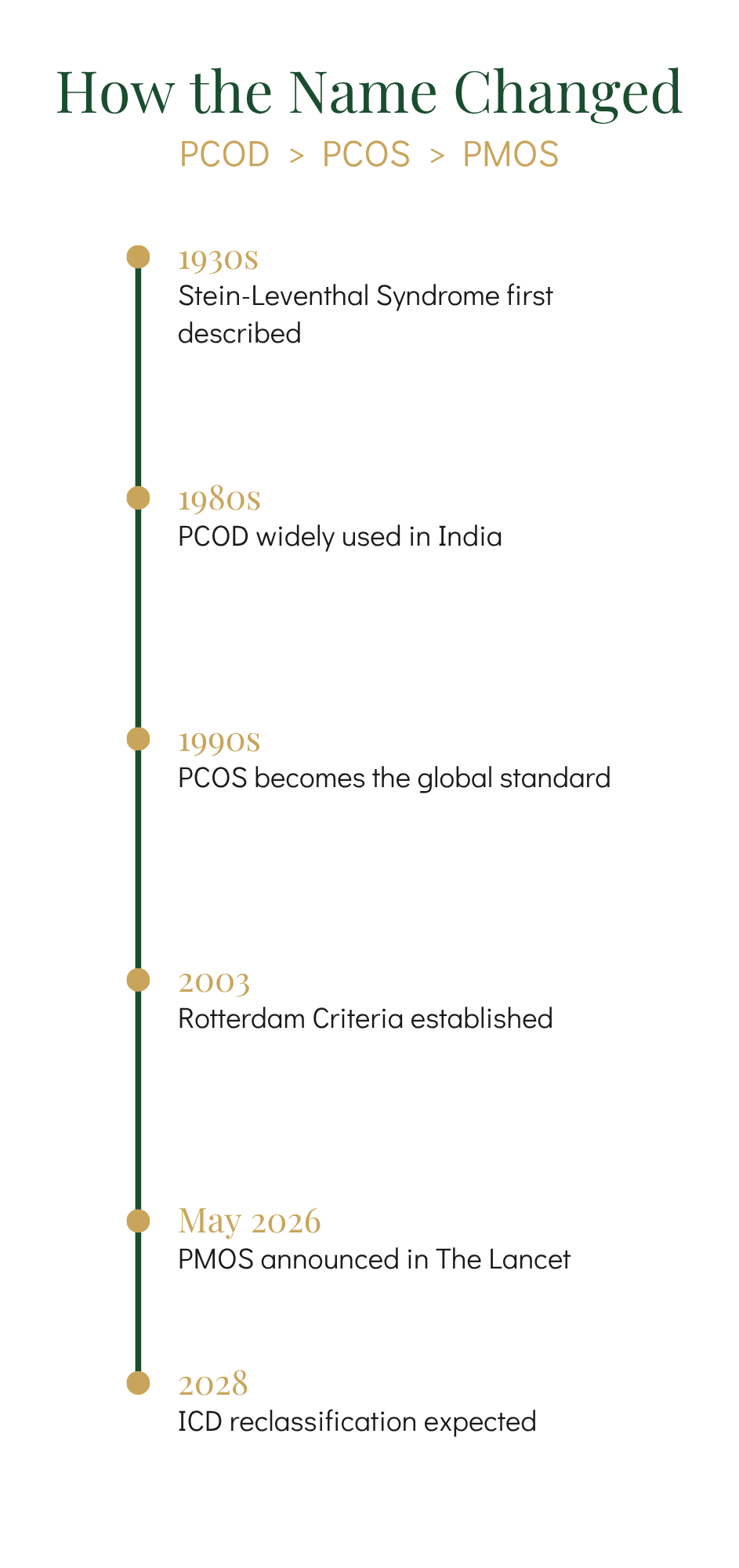
Understanding the difference between PMOS, PCOS, and PCOD is easiest when you see how the name changed as medical understanding deepened.
When | Name | What changed |
1930s | Stein-Leventhal Syndrome | First identified by Dr Irving Stein and Dr Michael Leventhal. Described as ovarian and reproductive disorder with irregular periods and enlarged ovaries. |
1960s–80s | PCOD gains use in India | Polycystic Ovarian Disease becomes the commonly used term in India. Focus remains on ovarian cysts seen on ultrasound. |
1980s–90s | PCOS becomes global standard | Hormonal imbalances, insulin resistance, and multi-system impact recognised. 'Syndrome' replaces 'Disease' to reflect complexity. PCOS adopted globally. |
2003 | Rotterdam Criteria | International consensus establishes diagnostic criteria: 2 of 3 irregular periods, elevated androgens, polycystic ovaries on ultrasound. |
2023 | International Guidelines | 2023 global PCOS guidelines explicitly recommend metabolic screening at diagnosis, fasting insulin, HOMA-IR, for the first time. |
May 2026 | PMOS: The Lancet | 11-year global consensus. 22,000 participants. 56 organisations. PCOS officially renamed PMOS to reflect metabolic and endocrine reality. |
2028 | ICD reclassification | World Health Organization updates International Classification of Diseases. PMOS becomes the official global medical term. |
As noted in The Lancet paper announcing the rename, the preferred approach was evolution to a new accurate name that retained some similarity to PCOS to enable implementation. The name PMOS was chosen because it keeps the familiar letters while replacing the misleading focus on cysts with the accurate focus on metabolism and endocrine function.
What PCOD Means and Why India Uses It
PCOD stands for Polycystic Ovarian Disease. It is not an internationally recognised medical term in the strict sense, it does not appear in the ICD and was never formally adopted in global clinical guidelines. It is a widely used informal term in India that describes the presence of multiple follicles on the ovaries, often seen on ultrasound.
How PCOD Is Typically Framed in India
When Indian doctors use the term PCOD, they typically mean a milder presentation of the condition like irregular periods, some ovarian follicles on ultrasound, hormonal imbalance without the full metabolic severity associated with a PCOS or PMOS diagnosis. Some doctors use PCOD to describe cases where lifestyle intervention alone is sufficient, and PCOS when the condition is more severe or requires medical management.
This distinction is not consistent across practitioners. One doctor's PCOD is another's PCOS. The absence of a formal definition for PCOD in global medical literature means the term is applied differently across India, leading to women with significant metabolic conditions being dismissed with a mild PCOD label.
The Risk With the PCOD Label
The word Disease implies a localised, specific pathology, something in the ovaries. Combined with the perception that PCOD is milder, many women with PCOD diagnoses never receive metabolic screening. Their insulin resistance goes untested. Their cardiovascular risk is never discussed. They are managed symptomatically and told to exercise more.
What PCOS Means and How It Differs From PCOD
PCOS, Polycystic Ovary Syndrome, was the globally accepted medical standard from the 1980s until May 2026. Unlike PCOD, it is formally defined, appears in clinical guidelines, and is used in medical literature worldwide.
What Made PCOS Different From PCOD
The shift from PCOD to PCOS in global medicine reflected a growing recognition that the condition involved much more than ovarian cysts. The word Syndrome replaced Disease to acknowledge that this was a collection of related symptoms affecting multiple body systems, not a single localised ovarian problem.
PCOS brought insulin resistance into the conversation. The metabolic connection between insulin, androgens, weight, and ovarian function began to be taken seriously in clinical practice. Metformin, an insulin-sensitising drug, was increasingly used. Dietary management was recognised as central to treatment.
What PCOS Still Got Wrong
Despite the improvement over PCOD, PCOS still named the condition after something that is not consistently present - polycystic ovaries. Research published alongside the 2026 PMOS rename confirmed there is no increase in abnormal ovarian cysts in the condition. The name continued to direct attention toward the reproductive system rather than the metabolic root.
And it allowed the milder PCOD framing to persist in India alongside it, because the two terms sounded similar enough that the distinction was never clear to patients or many practitioners.
What PMOS Means and Why It Changes Everything
PMOS, Polyendocrine Metabolic Ovarian Syndrome, is the new globally agreed name for the condition, announced in The Lancet on 12 May 2026. It was the result of an 11-year global consensus process involving 22,000 participants from 56 organisations.
What Each Word in PMOS Means
Polyendocrine | Multiple hormonal systems are involved. Insulin, androgens, LH, cortisol, and thyroid hormones all play a role. This is not a single-hormone problem. |
Metabolic | Insulin resistance, blood sugar dysregulation, weight, inflammation, and cardiovascular health are all central to the condition, not peripheral. |
Ovarian | The ovaries are involved, but as a site of impact, not the source of the problem. Androgen excess from insulin-driven ovarian stimulation affects follicle development. |
Syndrome | A collection of signs and symptoms, not a single disease. Two women with PMOS can present very differently, both are valid. |
What PMOS Changes Clinically
As noted in commentary from Gini Hospital's clinical team, 70% of their patients with PMOS conceive naturally within 6 months without IVF because they treat the insulin resistance preventing ovulation. This is what the metabolic framing enables: treating the root, not the downstream symptom.
PMOS vs PCOS vs PCOD: The Complete Comparison
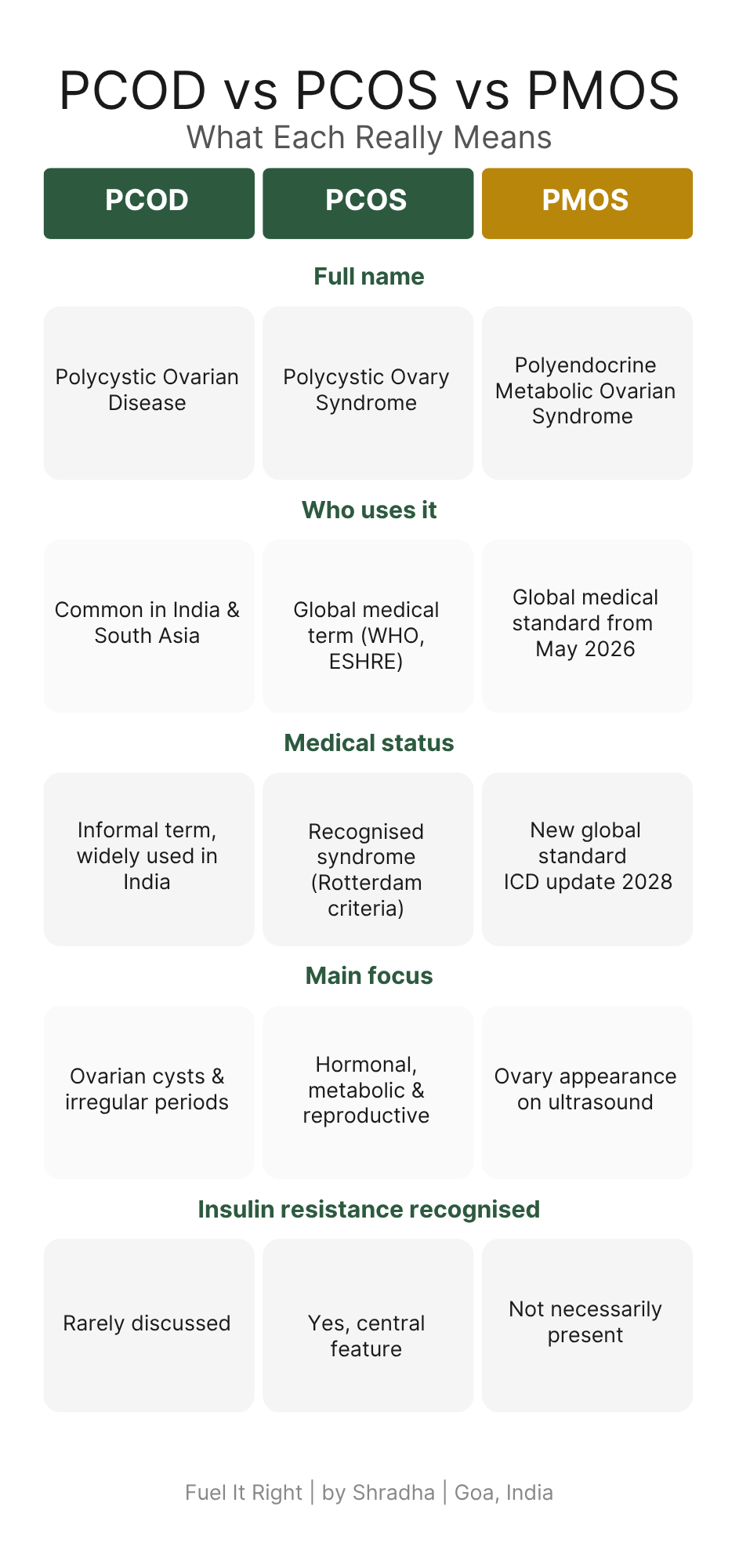
Here is the full side-by-side breakdown of PMOS vs PCOS vs PCOD print this and keep it.
PCOD | PCOS | PMOS | |
Full name | Polycystic Ovarian Disease | Polycystic Ovary Syndrome | Polyendocrine Metabolic Ovarian Syndrome |
When used | India informal, widely used | Global standard until May 2026 | New global standard from May 2026 |
Medical status | Informal term, not in ICD | Being phased out by 2028 | Official ICD update 2028 |
Focus | Ovarian cysts, immature eggs | Hormonal syndrome, multi-system | Metabolic, endocrine, and ovarian |
Severity framing | Considered milder by some doctors | More severe, multi-system | Whole-body metabolic condition |
Insulin resistance | Sometimes mentioned | Recognised but often not prioritised | Central mandatory in workup |
Who uses it | Indian patients and doctors | Global medical literature | Global medical literature from 2026 |
Your diagnosis | Still valid | Still valid | What your condition is now called |
What This Means for Your Diagnosis
PMOS, PCOS, and PCOD, whichever term you were given, all refer to the same condition. Your existing diagnosis is valid. You do not need to be retested or re-evaluated.
If You Were Diagnosed With PCOD
Ask your doctor whether a full metabolic workup was done — fasting insulin, HOMA-IR, lipid panel, free testosterone. If not, request it. The PCOD label may have undersold the metabolic seriousness of your condition. The treatment approach under PMOS is more comprehensive — and more effective.
If You Were Diagnosed With PCOS
Your diagnosis maps directly to PMOS. The condition is the same. What changes is the mandate for metabolic screening and treatment. If your PCOS management was limited to the pill, Metformin without dietary guidance, or weight loss advice without addressing insulin resistance directly — ask for a comprehensive metabolic review.
If You Are Newly Diagnosed or Undiagnosed
Use the PMOS diagnosis checklist [internal link] to go into your next consultation prepared. Ask for every test on the list. Bring this comparison table if it helps explain what you are asking for and why.