
PCOS and PMOS Fertility: What Food Can Do
PCOS and PMOS affect 1 in 10 Indian women of reproductive age and is a leading cause of infertility. The honest evidence on what food can and cannot do to restore ovulation and support conception.
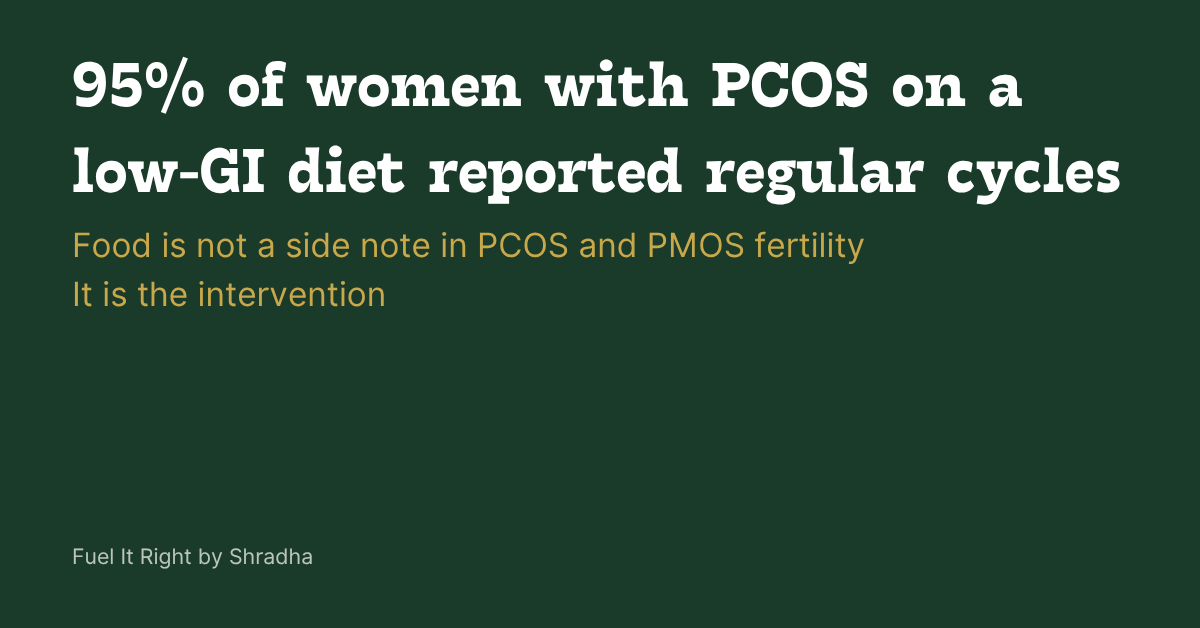
Table of Contents
1. What PCOS/PMOS Does to Fertility and Why
2. The Evidence: What Food Has Actually Achieved
3. What to Test Before You Start Trying to Conceive
4. The Three Things Food Must Do for Fertility in PCOS/PMOS
5. The Specific Foods and Why Each One Matters
6. The Gut-Fertility Connection
7. What Food Cannot Do, The Honest Limits
8. A Fertility-Focused Day on the Protocol
9. Conclusion
10. FAQs
What PCOS/PMOS Does to Fertility and Why
PCOS and PMOS are the leading cause of infertility in Indian women of reproductive age. Approximately 1 in 10 women of reproductive age is affected, and infertility is often the symptom that brings women to diagnosis for the first time, years after the metabolic and hormonal disruption has been building.
The mechanism is direct. Hyperinsulinaemia, which is chronically elevated insulin, signals the ovaries to produce excess androgens. Elevated androgens disrupt the delicate LH/FSH ratio that governs the follicle maturation cycle. When this ratio is disrupted, follicles begin to develop but do not mature to the point of ovulation. The result is anovulation, cycles without egg release, which is the primary driver of PCOS/PMOS-related infertility.
PCOS and PMOS infertility is almost always about ovulation, not about the eggs themselves. Restore ovulation and fertility is restored with it.
This matters because it means the path to fertility runs directly through insulin resistance. Address the insulin resistance, reduce the androgen excess, restore the LH/FSH ratio, restore ovulation. Food is not a peripheral support in this process, it is the primary intervention. Understanding insulin resistance and PCOS/PMOS is the starting point for understanding why food has such a significant impact on fertility in this condition.
What to Test Before You Start Trying to Conceive
Before building a fertility-focused food protocol, know your starting metabolic picture. These tests are non-negotiable if you have PCOS/PMOS and are planning to conceive. For the complete panel, see the PCOS/PMOS diagnosis checklist.
The Most Important Tests for Fertility Planning
• HOMA-IR and fasting insulin, the primary driver of anovulation. HOMA-IR above 2.5 requires immediate dietary intervention before or alongside any fertility treatment
• LH/FSH ratio. Elevated LH relative to FSH is the hormonal signature of anovulation in PCOS/PMOS. A ratio above 2.5 indicates the ovulatory mechanism is disrupted
• AMH (anti-Mullerian hormone) indicates ovarian reserve. Women with PCOS/PMOS typically have high AMH due to the large number of small follicles
• TSH, free T4, free T3, and anti-TPO antibodies. Thyroid conditions present in 1 in 5 women with PCOS/PMOS directly impair fertility. Subclinical hypothyroidism in pregnancy carries significant risks. See the blog on PCOS/PMOS and thyroid.
• Vitamin D deficiency is extremely common in Indian women and directly impairs follicle development and endometrial receptivity. Optimal range is 50 to 80 ng/mL for fertility.
• Serum ferritin. Iron deficiency compromises egg quality and implantation. Below 30 ng/mL requires correction before conception.
The most common missed test in fertility planning Fasting insulin and HOMA-IR. Most fertility workups test LH, FSH, AMH, and thyroid. Fasting insulin is frequently omitted. But it is the single most actionable number for PCOS/PMOS fertility, because it directly tells you how severe the anovulation driver is, and how urgently the dietary intervention needs to work. Ask for it by name. |
The Three Things Food Must Do for Fertility in PCOS/PMOS
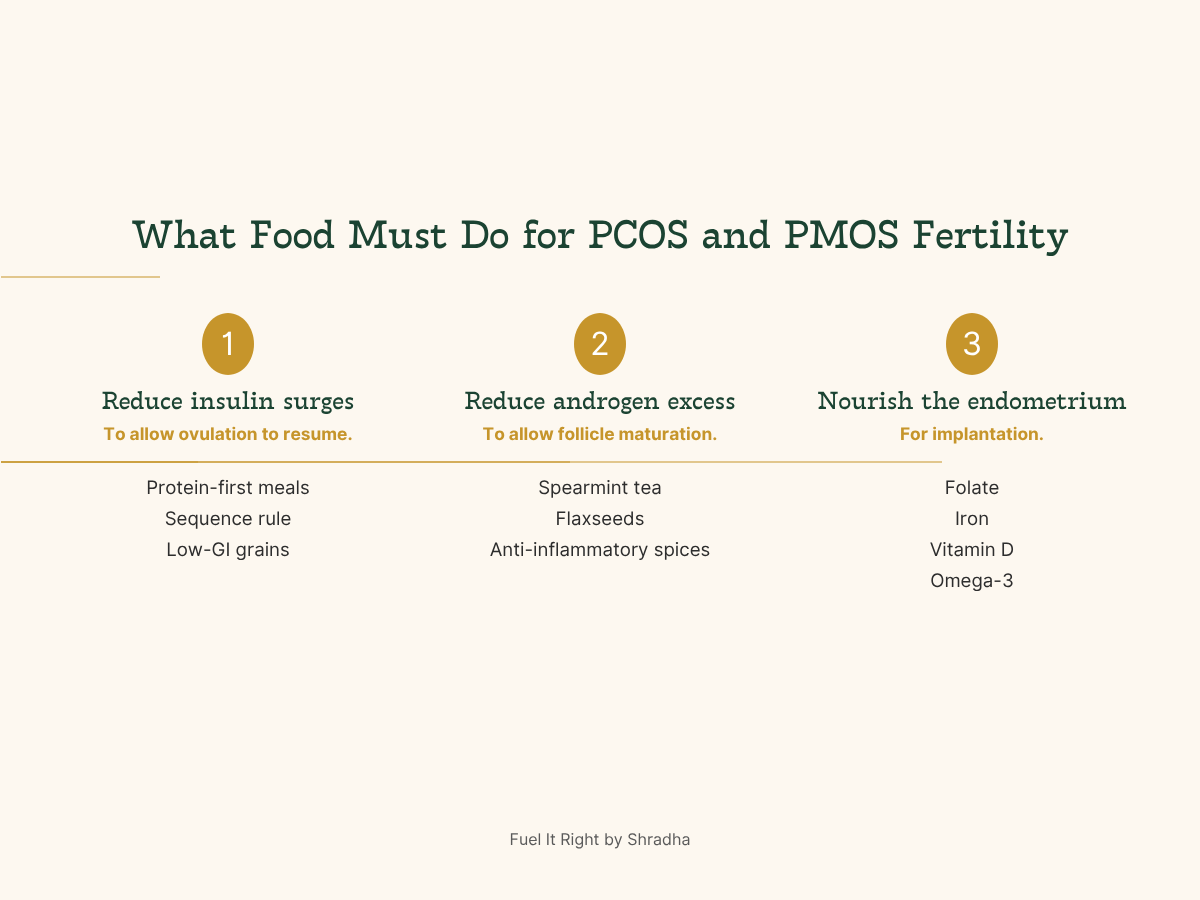
Every food choice in the PCOS/PMOS fertility protocol must serve at least one of three functions:
1. Reduce insulin surges to allow ovulation to resume
Chronically elevated insulin is the primary suppressor of ovulation in PCOS/PMOS. Every meal that produces a large glucose spike worsens insulin resistance and deepens the anovulatory state. Every meal that keeps glucose stable reduces the insulin load and creates the conditions under which the HPO axis can restore normal LH/FSH pulsatility and trigger ovulation. Protein-first meals, the sequence rule, and low-GI grains are the tools.
2. Reduce androgen excess to allow follicle maturation
Hyperinsulinaemia stimulates ovarian androgen production. Lower insulin means lower androgens. Lower androgens restore the LH/FSH ratio that governs follicle maturation. Spearmint tea reduces free testosterone directly. Flaxseeds contain lignans that reduce androgen bioavailability. The anti-inflammatory spice protocol reduces the inflammatory load that independently stimulates androgen production.
3. Prepare the endometrium and egg quality for conception
Even when ovulation is restored, implantation requires a well-nourished endometrium and good egg quality. Folate, iron, Vitamin D, omega-3, and antioxidants from whole foods support both. These are not supplements, they are available in Indian food in meaningful quantities when the protocol is followed.
The Specific Foods and Why Each One Matters
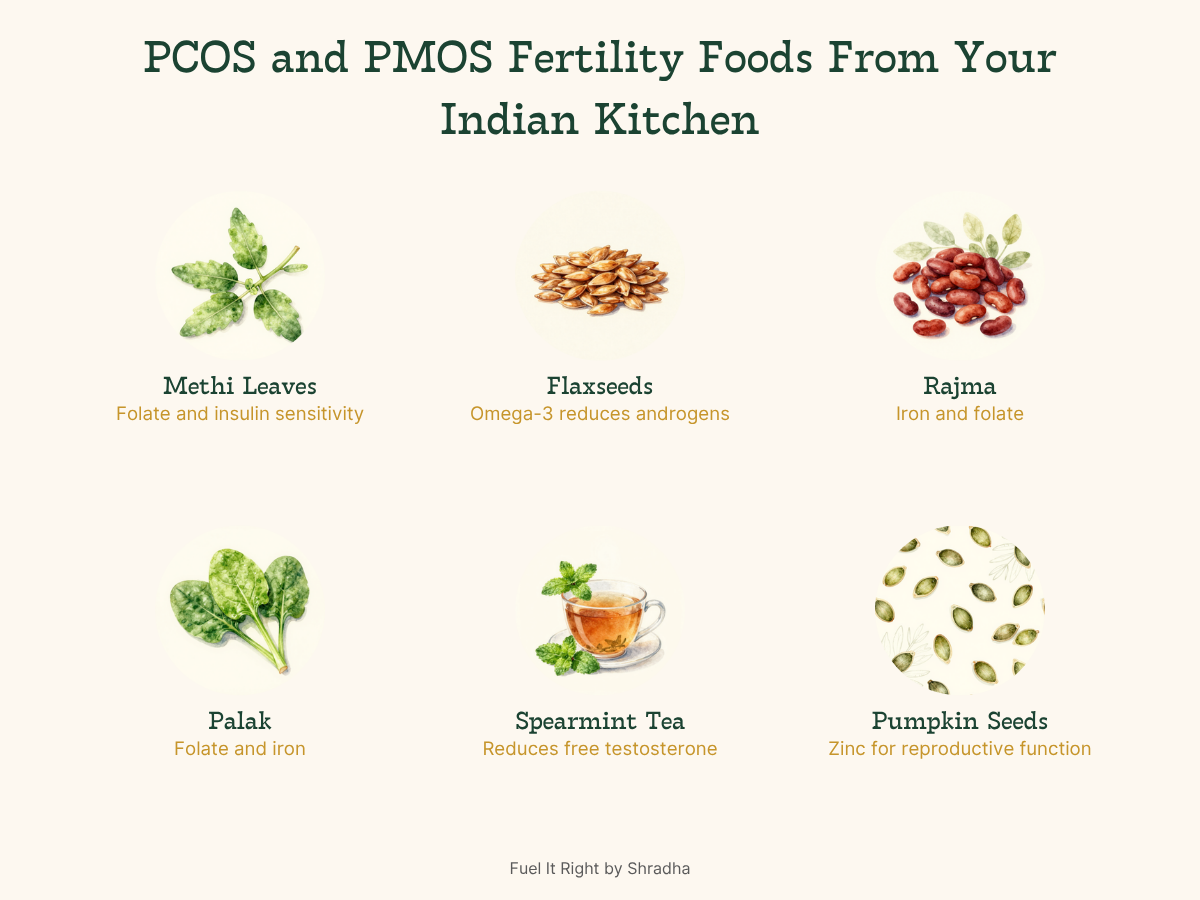
Here is the PCOS/PMOS fertility food list with the specific mechanism behind each recommendation.
Folate for egg quality and neural tube protection
Folate is required for DNA synthesis in developing eggs and for neural tube formation in early pregnancy. Deficiency significantly impairs egg quality and early embryonic development. Indian sources: methi leaves, palak, rajma, moong dal, sprouts, drumstick leaves. Start building folate stores at least three months before attempting conception.
Iron for implantation and early pregnancy
Iron deficiency impairs the endometrial lining's receptivity to implantation. Heavy periods from PCOS/PMOS compound the iron deficit further. Indian sources: rajma, chana, palak, til, moringa, jaggery with til. Always eat with Vitamin C from lemon or guava for maximum absorption.
Omega-3 for egg quality and anti-androgenic effect
Omega-3 fatty acids support follicle membrane quality and have direct anti-androgenic properties reducing free testosterone through the same arachidonic acid pathway. Flaxseeds are the most accessible Indian omega-3 source. One tablespoon of ground flaxseeds daily in curd or roti dough. Walnuts provide a secondary source.
Vitamin D for follicle development and insulin sensitivity
Vitamin D receptors are present in ovarian tissue. Deficiency, present in the majority of Indian women due to indoor lifestyles and sun avoidance, directly impairs follicle development. Optimal Vitamin D for fertility is 50 to 80 ng/mL, most women are far below this. Dietary sources like eggs, fatty fish, fortified dairy contribute but are insufficient for correction from deficiency. If your Vitamin D is below 30 ng/mL, this requires supplementation alongside food.
Spearmint tea for androgen reduction
Two cups of spearmint tea daily reduces free testosterone within 30 days with direct clinical evidence from RCTs in women with PCOS. Lower free testosterone means a better LH/FSH ratio and improved follicle maturation. Continue through the pre-conception period.
Dal and legumes daily for the gut-hormone axis
Dal provides folate, iron, fibre for gut bacteria, and protein for blood sugar stability. Dal at every lunch is the most nutritionally efficient single meal change for PCOS/PMOS fertility, it addresses four fertility-relevant nutritional gaps simultaneously.
Methi leaves and seeds for insulin sensitivity and folate
Fresh methi leaves provide significant folate alongside the galactomannan fibre that reduces fasting glucose. Half a teaspoon of soaked methi seeds on waking is the most impactful single morning habit for insulin-mediated fertility restoration.
The Gut-Fertility Connection
The relationship between gut health and fertility in PCOS/PMOS is one of the most clinically significant and least discussed aspects of the condition's impact on conception.
The gut microbiome regulates estrogen metabolism through the estrobolome, the community of gut bacteria that process and clear hormones. A disrupted gut microbiome in PCOS/PMOS reduces androgen clearance, keeping more testosterone circulating and active in the tissues that govern ovulation. Rebuilding gut health through consistent dal, curd, and fermented foods is a direct fertility intervention, not just a general wellness recommendation. See the blog on the gut-PCOS/PMOS connection for the full mechanism.
Curd twice daily, chaas in the afternoon, and dal at every meal feeds the specific gut bacteria that clear androgens and produce short-chain fatty acids that support insulin sensitivity. The same practices that improve gut health improve the hormonal environment for ovulation.
Is your gut health affecting your hormonal balance and fertility?
Take the free Gut Health Quiz. 2 minutes. Get a personalised read and receive the free 3-Day Indian Gut Reset straight to your inbox.
What Food Cannot Do, The Honest Limits
The evidence for dietary intervention in PCOS/PMOS fertility is strong. Being honest about what food cannot do is equally important.
• Food cannot replace structural barriers, tubal blockage uterine abnormalities male factor require medical intervention
• Food works most powerfully in mild to moderate insulin resistance, severe IR may need Metformin alongside
• Ovulation restoration takes 3 to 6 months of consistent application not 2 weeks
• Advanced maternal age compounds the picture. Food improves egg quality but cannot reverse ovarian reserve decline
The fertility timeline honest assessment If you have been trying to conceive for more than 12 months (or 6 months if you are above 35) without success despite dietary changes, seek a fertility specialist consultation alongside your dietary protocol. Food and medical intervention are not either/or. The most effective fertility outcomes in women with PCOS/PMOS come from combining dietary optimisation with appropriate medical management, not from choosing between them. |
A Fertility-Focused Day on the Protocol
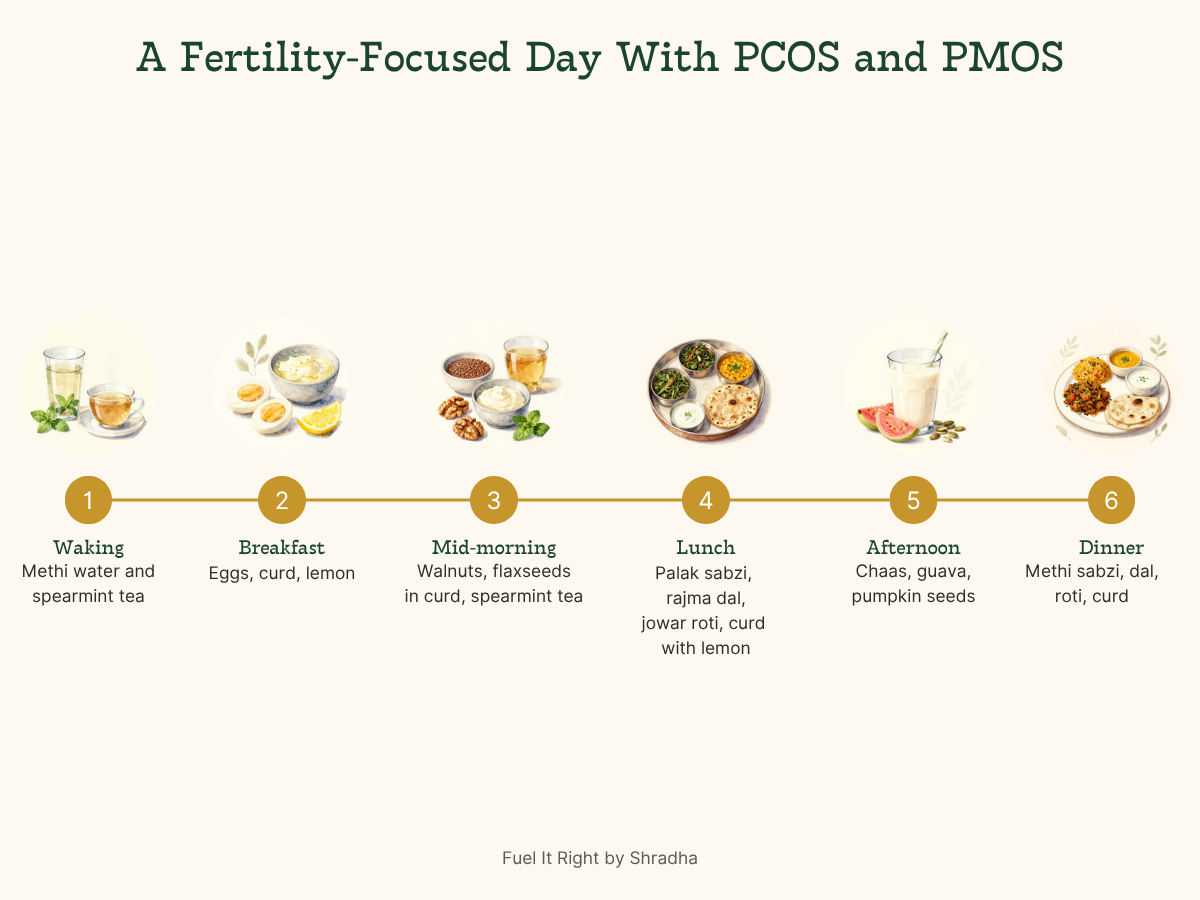
Here is what the PCOS/PMOS fertility food protocol looks like as a complete day. Specifically optimised for ovulation restoration and conception preparation.
On waking Half teaspoon methi seeds soaked overnight, then drink the water. This is the most impactful morning habit for insulin-mediated fertility. Spearmint tea after. Breakfast (within 1 hour) Two eggs any style, or moong dal chilla. A small bowl of curd. A squeeze of lemon over whatever you eat. The lemon matters as it doubles iron absorption from everything you eat with it. This is the highest-folate and highest-iron breakfast combination available in an Indian kitchen without supplements. Mid-morning A handful of walnuts and a tablespoon of ground flaxseeds stirred into a small bowl of curd. Spearmint tea (second cup). This combination provides omega-3, lignans for androgen reduction, and probiotic support for the estrobolome. Lunch Palak sabzi eaten first which gives iron and folate. Rajma or moong dal eaten second, more iron and folate plus protein. One jowar or bajra roti eaten last. Curd on the side. A pinch of haldi in the dal. Squeeze of lemon over the palak sabzi. This meal provides the highest single-meal fertility nutrient density of any Indian meal combination. Afternoon Chaas with curry leaves. A small piece of guava or amla, Vitamin C, to amplify the iron absorbed at lunch. A few pumpkin seeds, zinc for reproductive function and magnesium for the progesterone pathway. Dinner Methi leaves sabzi or drumstick sabzi (fresh moringa), both are extremely high in folate. Dal with haldi and jeera. One roti. Curd. Small portion only. Consistent meal timing matters. Dinner before 8pm. |
Want a fertility protocol built around your specific blood work?
Book a free 30-minute discovery call. Bring your HOMA-IR, LH/FSH ratio, AMH, Vitamin D, and ferritin. We will build your PCOS/PMOS fertility food protocol from your actual metabolic starting point.
Conclusion: Food Is the First Fertility Intervention
PCOS and PMOS fertility is primarily a function of insulin resistance and the androgen excess it drives. The food protocol that addresses insulin resistance directly restores the hormonal conditions required for ovulation. The evidence for this is not speculative, it is documented in controlled studies showing 95% cycle regularity on a low-GI diet and ovulation restoration in the majority of women who follow the protocol consistently.
The protocol is not exotic. Methi seeds on waking. Protein and lemon at breakfast. Palak and rajma with dal at lunch. Flaxseeds and walnuts as a daily snack. Spearmint tea twice daily. Curd at every meal. This is the fertility food protocol and every ingredient is already in an Indian kitchen.
Start with your blood work. Know your HOMA-IR, your Vitamin D, your ferritin, and your LH/FSH ratio. Build the protocol around what your specific numbers tell you. And give it three months of consistency before assessing results. For the full food framework, see the blog on PCOS and PMOS: what to eat, when, and why.
Book a Free 30-Minute Discovery Call
Bring your fertility blood panel. We will build your PCOS/PMOS fertility food protocol from your metabolic starting point.
https://calendly.com/shradhajp/30min
Or call us: +91 7057063984
FAQs: PCOS, PMOS and Fertility
Q1. Can food alone restore ovulation in PCOS/PMOS?
For women with mild to moderate insulin resistance and HOMA-IR below 3.5, dietary intervention alone has a strong evidence base for restoring cycle regularity and ovulation. A clinical study found 95% of women on a low-GI diet reported menstrual cycle regularity, compared to 63% on a conventional diet. For severe insulin resistance, food combined with Metformin produces better outcomes than either alone.
Q2. How long does it take for the food protocol to restore ovulation?
Most women following the low-GI, protein-first, anti-inflammatory protocol consistently see cycle improvement within 3 to 6 months. Blood sugar stability improvements come within 2 to 4 weeks. Hormonal changes, LH/FSH ratio improvement and androgen reduction, take 3 to 6 months. Egg quality improvement requires approximately 3 months because that is the time it takes for a follicle to mature from primordial stage to ovulation.
Q3. I have been told I cannot conceive naturally with PCOS/PMOS. Is that accurate?
For most women with PCOS/PMOS-related infertility, this is an overstatement. Ovulation restoration through dietary intervention or Metformin is achievable in the majority of women. An observational study of women with PCOS above 35 found that 95% of those seeking fertility treatment conceived successfully with management. Natural conception is possible for many women with PCOS/PMOS, it requires addressing the insulin resistance that is suppressing ovulation.
Q4. Is IVF necessary if I have PCOS/PMOS?
Not as a first step in most cases. Lifestyle intervention and Metformin are the recommended first-line treatments for PCOS/PMOS-related infertility before progressing to ovulation induction (Clomid or Letrozole), and then IUI, and then IVF. The sequence matters, each step has significant success rates in PCOS/PMOS when the underlying insulin resistance is also being addressed. IVF has specific risks in PCOS/PMOS, particularly ovarian hyperstimulation syndrome, which is managed but not eliminated.
Q5. Can I follow the fertility food protocol alongside Metformin?
Yes. The food protocol and Metformin work through complementary mechanisms. Metformin reduces hepatic glucose production. The food protocol reduces the glucose being produced at each meal and the insulin demand it creates. Combined, they produce better hormonal outcomes than either alone. The food protocol also reduces the gastrointestinal side effects of Metformin by stabilising blood sugar and gut environment.
Q6. I am vegetarian. Can I meet all the fertility nutrient requirements through food?
Yes, with deliberate choices. Folate: methi leaves, palak, rajma, sprouted moong which are abundant in Indian vegetarian food. Iron: rajma, chana, til, moringa, jaggery to be consumed with lemon. Omega-3: flaxseeds and walnuts daily. Vitamin D: eggs if you eat them; fortified dairy; sunlight exposure before 10am. Zinc: pumpkin seeds, til, rajma. Protein: dal at every meal, paneer, curd, sprouted legumes. The only gap that is genuinely difficult to fill through Indian vegetarian food is Vitamin B12. Testing and supplementation is appropriate if deficient.
Q7. Does body weight affect PCOS/PMOS fertility?
Yes, significantly for overweight women. Research confirms that a 5 to 10% reduction in body weight through dietary changes restores ovulation in 50 to 75% of overweight women with PCOS/PMOS. However, the composition of the diet matters as much as the weight lost. A low-GI, protein-first diet produces fertility outcomes superior to a calorie-restricted conventional diet even at similar weight loss. For lean women with PCOS/PMOS, the fertility focus is on hormonal optimisation and nutritional preparation rather than weight reduction.
Q8. What supplements are evidence-based for PCOS/PMOS fertility?
The evidence-based supplements for PCOS/PMOS fertility are: Inositol (myo-inositol and D-chiro-inositol combination). Most evidence-based supplement for PCOS fertility, improves insulin sensitivity and egg quality; Vitamin D if deficient below 30 ng/mL; Folate or methylfolate 400 to 800 mcg daily from 3 months before conception; Omega-3 when dietary intake is insufficient. Supplements are adjuncts to the food protocol, not replacements. The food protocol must be in place for supplements to work optimally.
About the Author
Shradha | Nutritionist and Dietitian | Fuel It Right. Practising out of Goa, India, with a focus on gut health, PMOS/PCOS, thyroid disorders, and weight management using real Indian food. No supplements. No machines. Just food, and the science behind it.
fuel-it-right.com | @fuelitright