
Fasting and PCOS/PMOS: Does It Help or Hurt?
Intermittent fasting for PCOS and PMOS is one of the most searched dietary questions and one of the most misunderstood. The honest answer is it depends entirely on your metabolic profile.
Table of Contents
1. Why Intermittent Fasting Such a Contested Topic in PCOS/PMOS
2. What Fasting Actually Does to Insulin in PCOS/PMOS
3. The Cortisol Problem: When Fasting Makes Things Worse
4. The Lean Women Problem: Why the Risk Is Higher
5. Who Fasting Is Likely to Help
6. Who Fasting Is Likely to Harm
7. What to Do Instead: The PCOS/PMOS Alternative
8. If You Still Want to Try Fasting: The Safer Approach
9. Conclusion
10. FAQs
Why Intermittent Fasting Is Such a Contested Topic in PCOS/PMOS
Intermittent fasting and PCOS/PMOS produce a genuinely mixed evidence base, which is why anyone who gives you a simple yes or no answer is either oversimplifying or has a product to sell.
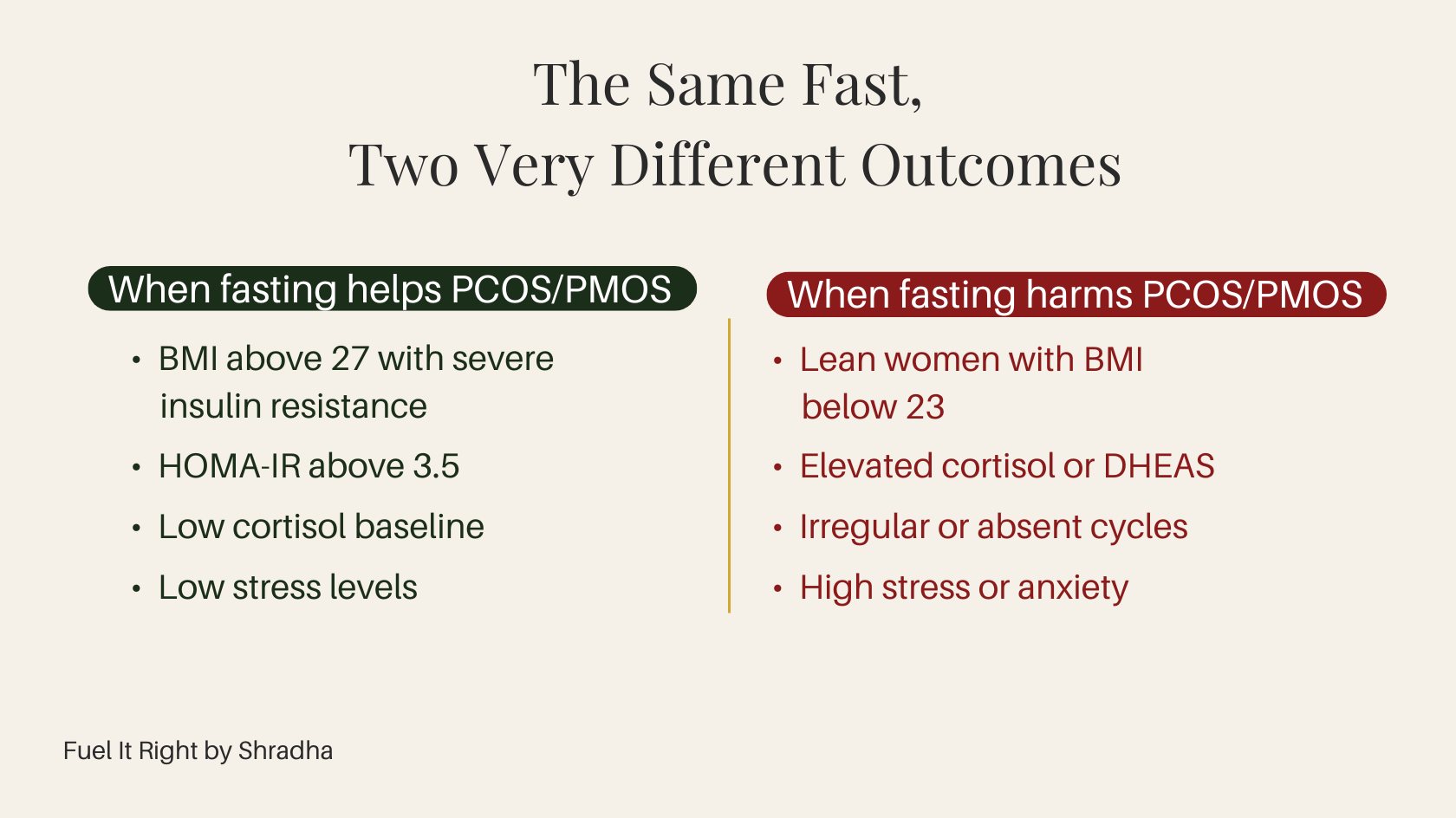
The truth is that intermittent fasting produces measurably positive metabolic outcomes for some women with PCOS/PMOS, specifically those with significant obesity, severe insulin resistance, and a stress-stable hormonal profile. For others, particularly lean women, women with elevated cortisol, adrenal-driven PCOS/PMOS, or irregular cycles, fasting can worsen insulin resistance, disrupt ovulation, and amplify the very hormonal imbalance it was supposed to address.
Intermittent fasting for PCOS and PMOS. It depends. The most honest answer in nutrition is also the most useful one, when you know what it depends on.
This blog covers what fasting does in the body of a woman with PCOS/PMOS, who it is likely to help, who it is likely to harm, what the evidence actually shows, and what the alternative is if fasting is not appropriate for you. Hopkins Medicine confirmed in May 2026 that intermittent fasting could raise cortisol levels in women with PCOS/PMOS, exacerbating symptoms and causing destabilising blood sugar dips. That is the starting point.
What Fasting Actually Does to Insulin in PCOS/PMOS
The theoretical case for intermittent fasting in PCOS/PMOS is straightforward. Insulin resistance is the root of the condition. Extended periods without food reduce total daily insulin exposure. Lower insulin reduces the signal for androgen production. Lower androgens improve ovulation, reduce acne and hair fall, and improve the metabolic picture. For more on how insulin resistance drives PCOS/PMOS, see the blog on insulin resistance and PCOS/PMOS .
This mechanism is real. A systematic review and meta-analysis published in 2025 in a peer-reviewed journal found that intermittent fasting improved fasting insulin, HOMA-IR, total testosterone, and LH/FSH ratio in women with PCOS compared to control conditions. The effect was most pronounced in overweight and obese women.
But the Mechanism Has Three Important Limits
• The benefit is greatest in women with significant obesity. BMI above 27 and HOMA-IR above 3.5 show most consistent improvement.
• The benefit requires not triggering the stress response. Fasting triggers cortisol which raises blood sugar defeating the purpose.
• The benefit requires no reproductive suppression. Extended fasting can suppress LH and FSH reducing ovulation.
The Cortisol Problem: When Fasting Makes Things Worse
The cortisol risk of fasting in PCOS/PMOS is the most important factor that most fasting advice ignores.
Fasting raises cortisol. This is a normal adaptive response, cortisol signals the liver to release stored glucose to maintain blood sugar during the fasting period. For women without PCOS/PMOS whose cortisol baseline is normal, this is manageable. For women with PCOS/PMOS, whose cortisol is already 54% higher on average than healthy women, fasting adds cortisol to an already elevated baseline.
What Elevated Cortisol During Fasting Does
• Cortisol stimulates gluconeogenesis. The liver produces glucose even without food intake. Blood sugar rises. The insulin response that follows paradoxically worsens insulin resistance.
• Cortisol stimulates adrenal androgen production. DHEA and DHEAS rise alongside cortisol. For lean women with PCOS/PMOS where adrenal androgens are often the primary driver, fasting can directly worsen the condition.
• Cortisol promotes visceral fat storage. Women who fast and feel stressed by it often gain abdominal fat rather than losing it, because cortisol directs calorie storage toward visceral depots.
• Cortisol disrupts sleep architecture, further worsening insulin sensitivity the following day.
The blog on PCOS/PMOS and cortisol covers the cortisol mechanism in detail. The short version: if fasting makes you more stressed rather than less, the metabolic equation is negative regardless of what the theory says about insulin reduction.
The Lean Women Problem: Why the Risk Is Higher
The evidence for harm from intermittent fasting is most pronounced in lean women with PCOS/PMOS and this is the population for whom the fasting advice is most frequently dangerous.
Extended fasting or severe caloric restriction suppresses LH and FSH, the pituitary hormones that drive ovulation. When the body detects energy scarcity, reproductive function is downregulated as a survival mechanism. For a lean woman with PCOS/PMOS who is already anovulatory or has irregular cycles, fasting can push ovulation further toward absent or irregular, the opposite of the therapeutic goal.
Lean women with PCOS/PMOS are also more likely to have adrenal-driven androgen excess, elevated DHEAS rather than elevated ovarian testosterone, which is worsened by cortisol. The fasting-cortisol-DHEAS triad is a specific risk for this population. For more on the lean PCOS/PMOS picture, see the blog on lean PCOS/PMOS.
The most commonly missed risk factor Many Indian women with PCOS/PMOS who try intermittent fasting are not overweight. They skip breakfast because they have been told it will help their insulin resistance. Instead, they elevate cortisol, worsen adrenal androgen production, and disrupt what ovulatory function they had. Skipping breakfast is not intermittent fasting done safely. It is the highest-cortisol version of fasting applied to the time of day when cortisol is already at its peak. |
Who Fasting Is Likely to Help
Being honest about when fasting works for PCOS/PMOS requires being specific about the profile of the woman it works for.
Factor | Profile likely to benefit | Why |
BMI | Above 27 | Visceral fat produces inflammatory cytokines that worsen insulin resistance. Fasting reduces visceral fat more effectively than calorie restriction in this group. |
Insulin resistance | HOMA-IR above 3.5 | Severe insulin resistance benefits most from extended fasting windows because the daily insulin reduction is large enough to shift the metabolic picture. |
Cortisol baseline | Normal or low cortisol | Women who do not find fasting psychologically or physically stressful experience the metabolic benefits without the cortisol penalty. |
Androgen source | Ovarian androgens (high LH, normal DHEAS) | Fasting reduces insulin which reduces ovarian androgen production. Works best when the androgen source is ovarian rather than adrenal. |
Cycle status | Irregular but present | Some evidence for cycle improvement with time-restricted eating in overweight women with PCOS/PMOS. Less evidence in anovulatory women. |
Stress levels | Low chronic stress | The cortisol benefit of fasting only materialises when baseline stress is manageable. High-stress lifestyles negate the benefit. |
Want to know whether fasting is appropriate for your specific PCOS/PMOS profile?
Book a free 30-minute discovery call. Bring your HOMA-IR, cortisol, and DHEAS. We will tell you whether fasting helps or hurts your specific metabolic picture.
Who Fasting Is Likely to Harm
The evidence is clear that certain women with PCOS/PMOS should not fast, and that for these women, fasting will worsen rather than improve their condition.
• Lean women with PCOS/PMOS (BMI below 23): elevated cortisol from fasting worsens adrenal androgen production, and reproductive suppression risks pushing an ovulation further.
• Women with elevated DHEAS: adrenal androgens are the primary driver, and fasting raises cortisol which directly raises DHEAS.
• Women with irregular or absent cycles who are trying to restore ovulation: reproductive suppression from energy scarcity is the opposite of the therapeutic goal.
• Women with high baseline cortisol: already at 54% above normal, fasting adds to an already dysfunctional HPA axis.
• Women who feel anxious, tired, or unwell when they skip breakfast: these subjective signals are reliable indicators that the cortisol response to fasting is significant.
• Women who are under significant occupational or domestic stress: fasting adds physiological stress to an already-stressed system.
• Women currently managing thyroid conditions alongside PCOS/PMOS: fasting can further suppress T3 conversion and worsen thyroid function.
The sign that fasting is harming you If your PCOS/PMOS symptoms worsen when you skip breakfast you get more acne, more hair fall, worsened cycle irregularity, increased anxiety, more afternoon cravings, you will know that fasting is raising your cortisol and worsening your condition. |
What to Do Instead: The PCOS/PMOS Alternative
For the majority of Indian women with PCOS/PMOS, particularly those who are lean, have elevated cortisol or DHEAS, or who experience stress as a significant driver of their symptoms, the alternative to fasting produces better metabolic outcomes without the cortisol risk.
Consistent Meal Timing Over Restriction
Eating within a consistent 10 to 12 hour window, breakfast by 8am, dinner by 7pm, without skipping meals reduces insulin exposure meaningfully, maintains blood sugar stability, and does not trigger the cortisol response of extended fasting. This is time-restricted eating without the stress of skipping breakfast, and it is what the research shows is most appropriate for the majority of Indian women with PCOS/PMOS.
Protein-First Meals Over Calorie Restriction
Protein at every meal, particularly at breakfast, reduces the insulin surge from subsequent carbohydrates, maintains satiety, and reduces total daily insulin exposure without fasting. The PCOS and PMOS: what to eat, when, and why blog covers the full protocol. The PCOS/PMOS plate method gives the visual framework.
Meal Sequencing Over Extended Fasting Windows
Eating vegetables and protein before carbohydrates at every meal reduces the post-meal glucose spike by up to 30%. This achieves a meaningful reduction in daily insulin exposure without any fasting period, and without any cortisol activation.
Is your gut health affecting your PCOS/PMOS?
Take the free Gut Health Quiz. 2 minutes.
Get a personalised read and receive the free 3-Day Indian Gut Reset straight to your inbox.
If You Still Want to Try Fasting: The Safer Approach
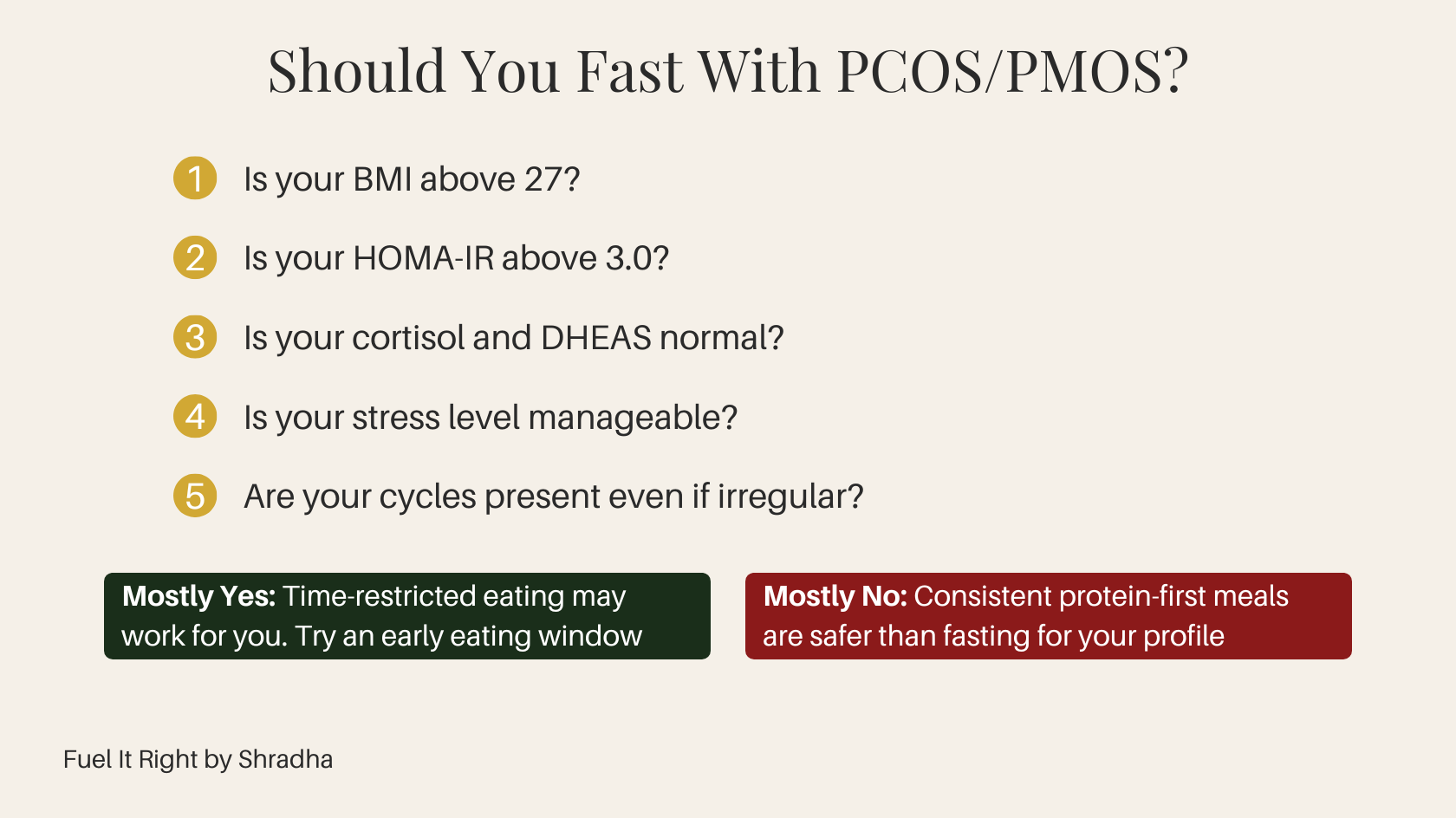
If you have assessed your profile, significant obesity, high HOMA-IR, low cortisol baseline, normal DHEAS, low stress, and fasting appears appropriate, here is the safest fasting approach for PCOS/PMOS.
Early Time-Restricted Eating. Not Skipping Breakfast
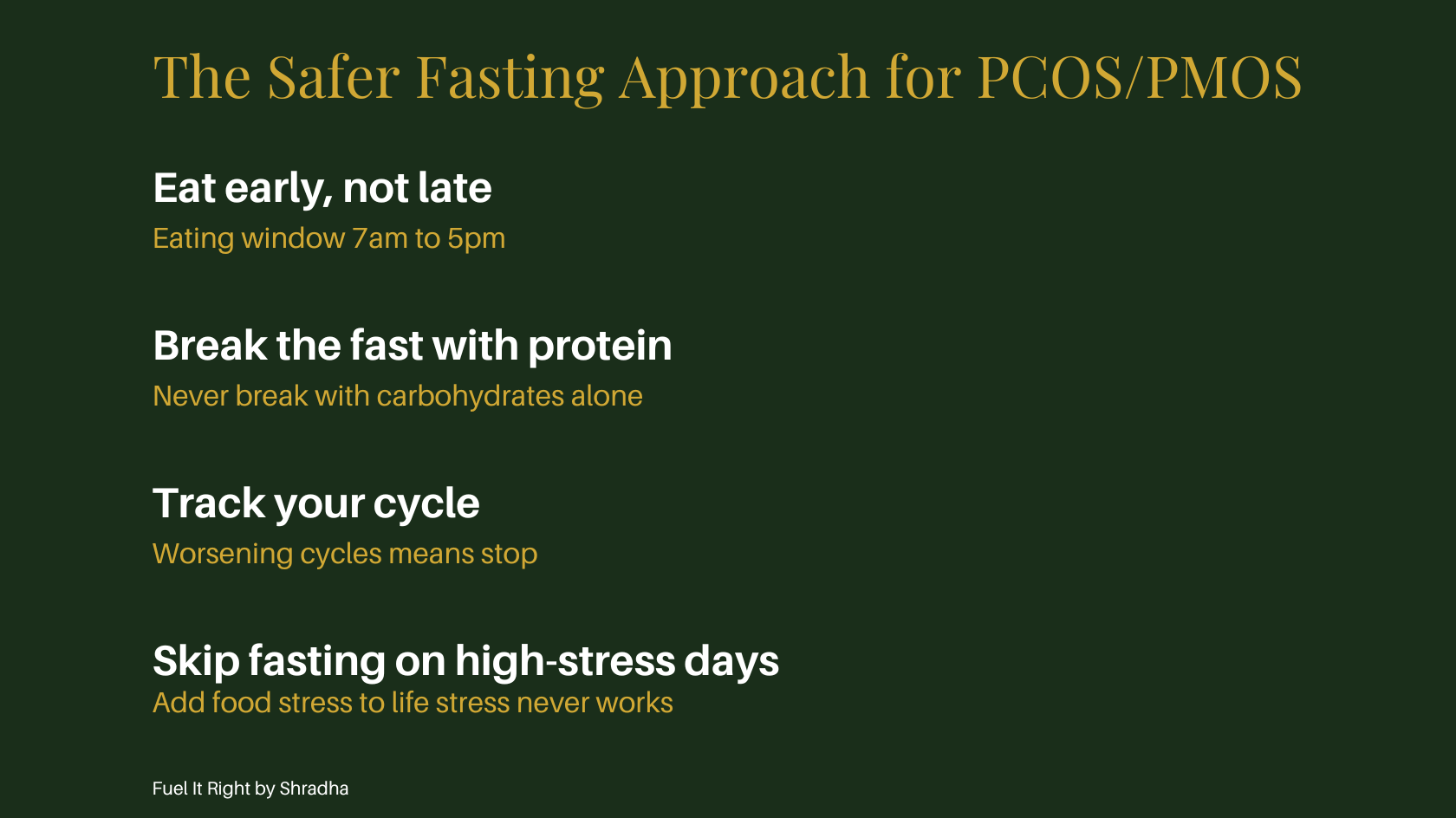
Eat between 7am and 5pm or 8am and 6pm. This provides a 14 to 16 hour fasting window that does not require skipping breakfast. Breakfast is the most cortisol-sensitive meal of the day. Skipping it maximises the cortisol spike. Eating early and stopping early captures the metabolic benefit of the fasting window while protecting the morning cortisol pattern.
Break the Fast With Protein
The first meal of a fasting window should always be protein-led like moong dal chilla, eggs, sprouts with curd. Breaking a fast with carbohydrates produces the largest insulin spike of any meal pattern. Protein first, always.
Monitor Your Cycle and Symptoms
Track your cycle for three months when starting any fasting protocol. If cycles become less regular, if acne worsens, if fatigue increases, or if mood deteriorates, then stop. These are reliable signals that the cortisol cost of fasting exceeds the insulin benefit in your specific case.
Do Not Fast on High-Stress Days
If you know a day will be significantly stressful, a difficult deadline, an emotionally demanding event, a poor night's sleep, eat consistently that day. Adding fasting stress to life stress is never a good metabolic equation in PCOS/PMOS.
The one rule that covers all fasting decisions in PCOS/PMOS If fasting makes you feel worse, it is making you worse. The metabolic benefit of any dietary approach is conditional on not triggering a compensatory cortisol response that negates it. Trust your body's signals. They are more accurate than any protocol. |
Managing PCOS or PMOS and want to know the right approach for your lifestyle?
My team works with clients across all PCOS/PMOS profiles. We will tell you honestly whether fasting, time-restricted eating, or consistent meal timing is right for your specific situation.
+91 7057063984
Conclusion: Intermittent Fasting Is a Tool, Not a Universal Protocol
Fasting and PCOS/PMOS do not have a simple relationship. The evidence supports fasting as a useful metabolic tool for a specific subset of women with the condition like overweight, severely insulin-resistant, low-cortisol, low-stress. For the majority of Indian women with PCOS/PMOS, many of whom are lean, have elevated cortisol, and live under significant occupational and domestic pressure, fasting raises cortisol, worsens androgen production, and disrupts the ovulatory function they are trying to restore.
The alternative, consistent meal timing, protein-first eating, meal sequencing, and gut-supportive foods, addresses the same metabolic root through mechanisms that do not carry the cortisol risk. It is less dramatic than fasting. It does not come with a compelling social media narrative. And for most Indian women with PCOS/PMOS, it is significantly more effective.
Know your profile before you fast. Check your HOMA-IR, your cortisol, your DHEAS, and your stress level. Then make the decision based on evidence, not trend.
Book a Free 30-Minute Discovery Call
Bring your HOMA-IR, cortisol, and DHEAS. We will tell you whether fasting helps or hurts your specific metabolic profile.
Or call us: +91 7057063984
FAQs: Fasting and PCOS/PMOS
Q1. Can I do 16:8 intermittent fasting with PCOS/PMOS?
It depends on which 8 hours you eat in. 16:8 with a breakfast-skipping window, eating from 12pm to 8pm, is the highest-cortisol version of fasting for women with PCOS/PMOS because it extends the morning fasting period through the peak cortisol hours. 16:8 with an early eating window like 7am to 3pm or 8am to 4pm is significantly safer because it does not extend fasting through the morning cortisol peak. If you are going to try 16:8, eat early, not late.
Q2. I have been doing intermittent fasting for 3 months and my periods have become more irregular. Should I stop?
Yes. Worsening cycle irregularity during fasting is a reliable signal that the reproductive suppression mechanism is active. Your body is detecting energy scarcity and reducing LH and FSH output, pushing ovulation further toward absent. Stop fasting and rebuild consistent meal timing with protein at breakfast. Allow 2 to 3 months of consistent eating before assessing whether cycle regularity improves.
Q3. Will intermittent fasting help me lose weight with PCOS/PMOS?
For overweight women with severe insulin resistance and a stress-stable cortisol profile. Yes, intermittent fasting consistently produces greater weight loss than continuous calorie restriction. For lean women, women with elevated cortisol, and women under significant stress, fasting often produces little to no weight loss because the cortisol-driven visceral fat accumulation offsets the caloric reduction. The metabolic profile determines the outcome far more than the fasting protocol itself.
Q4. What about the 5:2 diet for PCOS/PMOS?
The 5:2 diet which is two days of severe caloric restriction per week produces a more pronounced cortisol spike than time-restricted eating because the restriction is more severe. It is generally not the best fasting approach for women with PCOS/PMOS who have elevated baseline cortisol. Time-restricted eating with early eating windows is better-tolerated and produces similar or better metabolic outcomes with less cortisol activation.
Q5. I feel fine when I fast. Does that mean it is safe for my PCOS/PMOS?
Feeling fine subjectively is a positive signal but not a complete safety assessment. Check your cycle regularity over 3 months. Get your cortisol and DHEAS retested after 8 to 12 weeks of consistent fasting. If your cycles are maintaining or improving regularity and your DHEAS and cortisol are not rising, fasting is likely working for you. If cycles worsen or blood markers move in the wrong direction, stop regardless of how you feel subjectively.
Q6. Can I fast during Navratri, Ramadan, or other religious fasting periods with PCOS/PMOS?
Religious fasting presents different challenges depending on the fasting pattern. Navratri fasting that allows fruits, dairy, and specific foods can be nutritionally supported by ensuring adequate protein from curd, paneer, and nuts within the allowed foods. Ramadan fasting, a long daily fast with two meals, requires careful management of the Suhoor meal to include significant protein and fat to buffer the long fasting window. Both are manageable with planning. The key in both cases is ensuring the breaking of the fast is protein-led and not carbohydrate-first.
Q7. My nutritionist told me fasting is good for PCOS. My gynaecologist told me to avoid it. Who is right?
Both may be right for different subsets of women with PCOS/PMOS. The nutritionist's experience may be with overweight, severely insulin-resistant women where fasting produces consistent improvement. The gynaecologist's caution may be based on clinical experience with lean women or women with irregular cycles where fasting worsened the condition. Your specific metabolic profile like HOMA-IR, cortisol, DHEAS, BMI, cycle status, stress level determines which answer applies to you.
Q8. Is there any research specifically on Indian women and fasting for PCOS/PMOS?
The specific evidence base for Indian women with PCOS/PMOS and fasting is limited. Most fasting studies in PCOS are conducted in Western populations with higher average BMI than the Indian PCOS/PMOS population. This matters because the metabolic profile of Indian women with PCOS/PMOS like lower BMI, higher insulin resistance, higher adrenal androgen component may make them more susceptible to the cortisol risks and less likely to achieve the weight-loss-dependent benefits seen in Western trials. Until India-specific trial data is available, applying the profile-based framework in this blog is the most evidence-informed approach.
About the Author
Shradha | Nutritionist and Dietitian | Fuel It Right. Practising out of Goa, India, with a focus on gut health, PMOS/PCOS, thyroid disorders, and weight management using real Indian food. No supplements. No machines. Just food, and the science behind it.
fuel-it-right.com | @fuelitright