
PCOS and PMOS: How to Build a Balanced Plate
The PCOS and PMOS plate method: a simple visual framework for building every meal around the three drivers of the condition — insulin resistance, inflammation, and gut health.
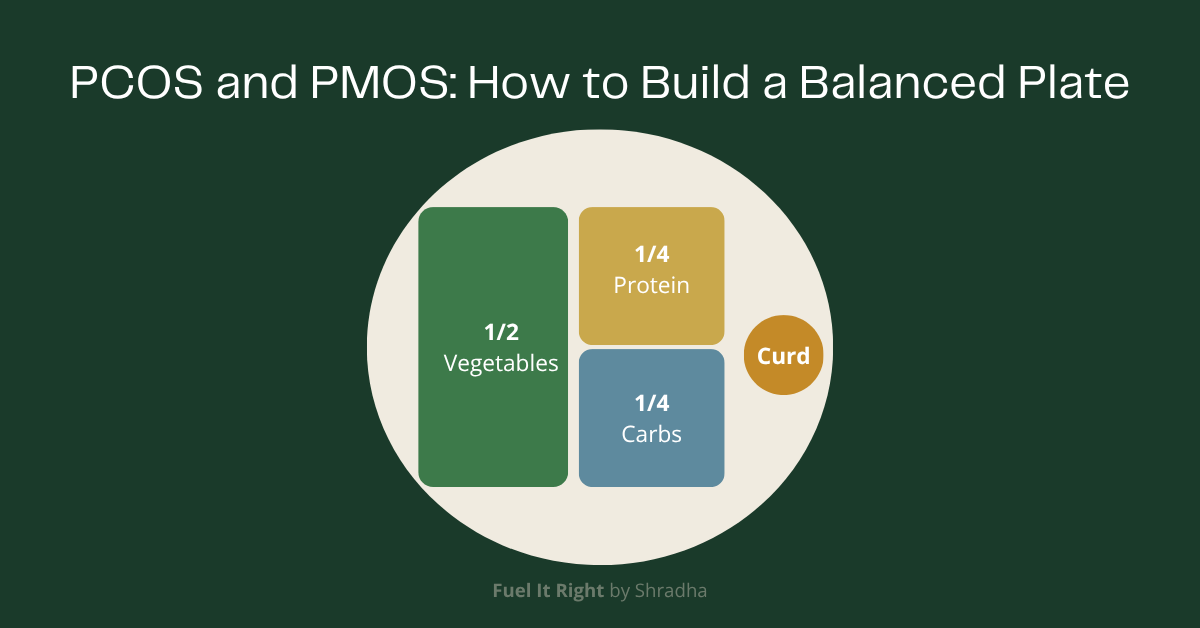
Table of Contents
1. Why Counting Calories Does Not Work for PCOS/PMOS
2. The Three Principles Behind the Plate Method
3. The PCOS/PMOS Plate: The Four Sections
4. What Goes in Each Section
5. The Sequence Rule: How to Eat the Plate
6. The Plate at Every Meal: Real Indian Examples
7. What the Plate Does Not Restrict
8. Conclusion
9. FAQs
Why Counting Calories Does Not Work for PCOS/PMOS
Women with PCOS and PMOS are routinely told to eat less and move more. Count calories. Track macros. Reduce portion sizes. This advice is not just unhelpful, for many women with PCOS/PMOS, it is actively counterproductive.
Here is why. PCOS/PMOS is driven by insulin resistance, not by calorie surplus. A woman can eat 1,400 calories per day of high-glycaemic, low-fibre food and worsen her insulin resistance. The same woman eating 1,800 calories of protein-first, fibre-rich, anti-inflammatory food will improve it. The quantity matters far less than the composition, the sequence, and the gut impact of what she eats.
Calorie restriction without addressing composition drives cortisol elevation, the hormone that worsens insulin resistance further. For the full explanation of how insulin resistance works in PCOS/PMOS, see the blog on insulin resistance and PCOS/PMOS.
Stop counting calories. Start building plates. The composition of what you eat matters more than the quantity.
The plate method replaces calorie tracking with a simple visual framework. You look at your plate before eating and ask one question: does this plate follow the structure? If yes, eat it. No numbers required.
The Three Principles Behind the Plate Method
Every element of the PCOS/PMOS plate serves at least one of three purposes:
• Reduce the insulin spike. Fibre, protein, and sequence determine glucose entry speed.
• Feed the gut bacteria that manage hormones. Dal vegetables and curd are gut interventions.
• Reduce inflammatory load. Anti-inflammatory spices and seasonal vegetables reduce inflammation at every meal.
The PCOS/PMOS Plate: The Four Sections
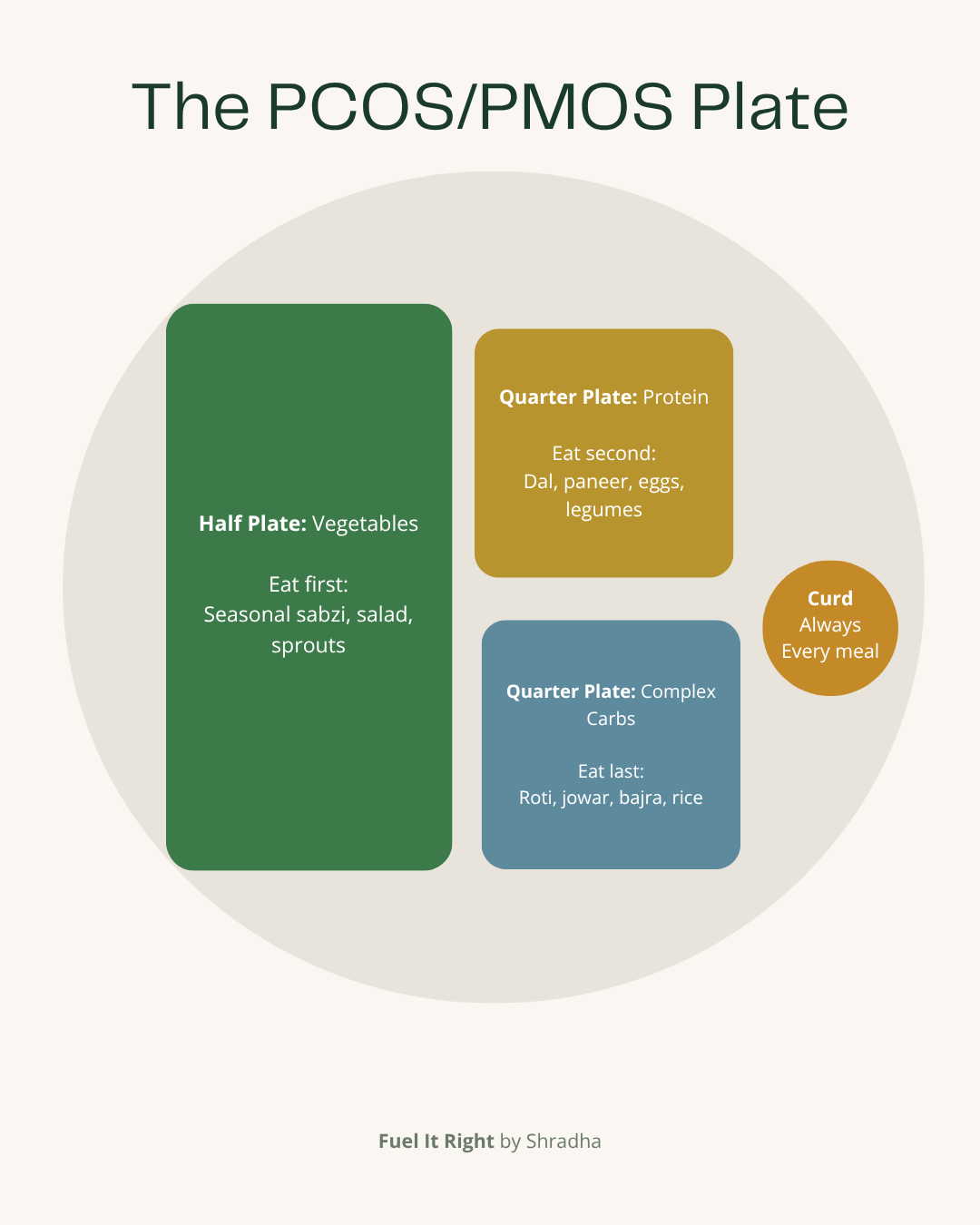
The PCOS/PMOS plate is divided into four sections. Think of a standard dinner plate and divide it visually before you serve yourself.
HALF THE PLATE 1/2 | Non-starchy vegetables The largest portion of every meal. Seasonal sabzi, salad, cucumber, spinach, bhindi, capsicum, lauki, turai, drumstick. The fibre from vegetables slows glucose absorption from everything else on the plate. Eaten first, they set the metabolic tone for the entire meal. |
QUARTER PLATE 1/4 | Protein Dal, legumes, paneer, eggs, fish, chicken, sprouts, tofu. Protein triggers GLP-1 and GIP secretion, directly blunting the insulin response to carbohydrates. Eaten second, after vegetables. Minimum one full serving, one cup of cooked dal, two eggs, or 100g of paneer. |
QUARTER PLATE 1/4 | Complex carbohydrates One small serving of roti, rice, jowar, bajra, or millet. Eaten last. The fibre and protein already in the stomach from vegetables and dal significantly reduce the glucose spike from this carbohydrate. One serving is sufficient, the plate method naturally limits carbohydrates without restriction. |
SIDE Add | Curd or fermented food One small bowl of fresh homemade curd or chaas at every meal. Not optional. Curd provides live cultures for gut health, protein for additional satiety, and calcium. This is the gut intervention built into every plate. |
What Goes in Each Section
Here is what specifically belongs in each section of the PCOS/PMOS plate, with Indian food examples for each category.
Half the Plate: Non-starchy Vegetables
These are the foods that provide fibre for the gut, micronutrients for hormone production, and antioxidants for inflammation. Eaten first, before anything else on the plate.
• Seasonal sabzi cooked in ghee or coconut oil with anti-inflammatory spices like bhindi, lauki, turai, palak, methi, capsicum, brinjal, drumstick.
• Raw salad alongside the cooked sabzi like cucumber, tomato, onion, grated carrot, lemon.
• Sprouts as a side like moong sprouts, matki sprouts, chana sprouts.
• Soups as a starter likr dal soup, tomato soup, vegetable soup without cream.
Quarter Plate: Protein
The protein that comes second, after the vegetables. This is the insulin-blunting component of the plate.
• Dal: moong, masoor, toor, chana, urad. One full cup of cooked dal minimum.
• Legumes as substitutes or additions: rajma, chana, lobia, black-eyed peas.
• Paneer: 80 to 100g, cooked in minimal oil with spices.
• Eggs: two eggs any style.
• Fish or chicken for non-vegetarians: one medium serving, cooked without deep frying.
• Tofu or soya chunks as plant-based alternatives.
Quarter Plate: Complex Carbohydrates
The carbohydrate that comes last. One serving, not two. The smaller this portion, the better, but it does not need to be eliminated.
• One or two rotis of jowar, bajra, ragi, or whole wheat.
• One small bowl of parboiled or basmati rice, eaten after sabzi and dal.
• One small bowl of millet khichdi.
• One serving of cooked sweet potato as a lower-GI alternative to rice.
The Side: Curd or Fermented Food
This is the gut component of every plate. It is not optional and it is not dessert, it is medicine.
• One small bowl of fresh homemade curd. Set at home from a starter culture, not packaged flavoured yogurt.
• Chaas as an alternative. Plain, with curry leaves and jeera.
• Idli-dosa batter used for one component of the meal provides fermented benefit.
Want to know how your gut health is affecting your PCOS/PMOS?
Take the free Gut Health Quiz. 2 minutes.
Get a personalised read and receive the free 3-Day Indian Gut Reset straight to your inbox.
https://www.fuel-it-right.com/gut-quiz/
The Sequence Rule: How to Eat the Plate
Building the right plate is half the work. Eating it in the right order is the other half.
Step 1: Eat the vegetables first. Finish the sabzi or salad before anything else. This sets the gut environment for the glucose to follow.
Step 2: Eat the protein second. Dal or the protein component after the vegetables. This triggers the GLP-1 response that blunts the subsequent insulin surge.
Step 3: Eat the carbohydrate last. Rice or roti only after the protein. By the time the carbohydrate arrives, the stomach already contains fibre and protein that significantly slow its absorption.
Step 4: Eat the curd alongside or after. Curd does not need a specific position. Alongside the main meal or immediately after works well.
The single most impactful change at lunch and dinner Serve your sabzi into your bowl first and eat it before touching the roti or rice. This single habit, applied at every lunch and dinner, reduces the post-meal glucose spike from that meal by up to 30%. The food is the same. The metabolic outcome is completely different. |
For more on the sequence rule, see the blog on PCOS and PMOS what to eat, when, and why.
The Plate at Every Meal: Real Indian Examples
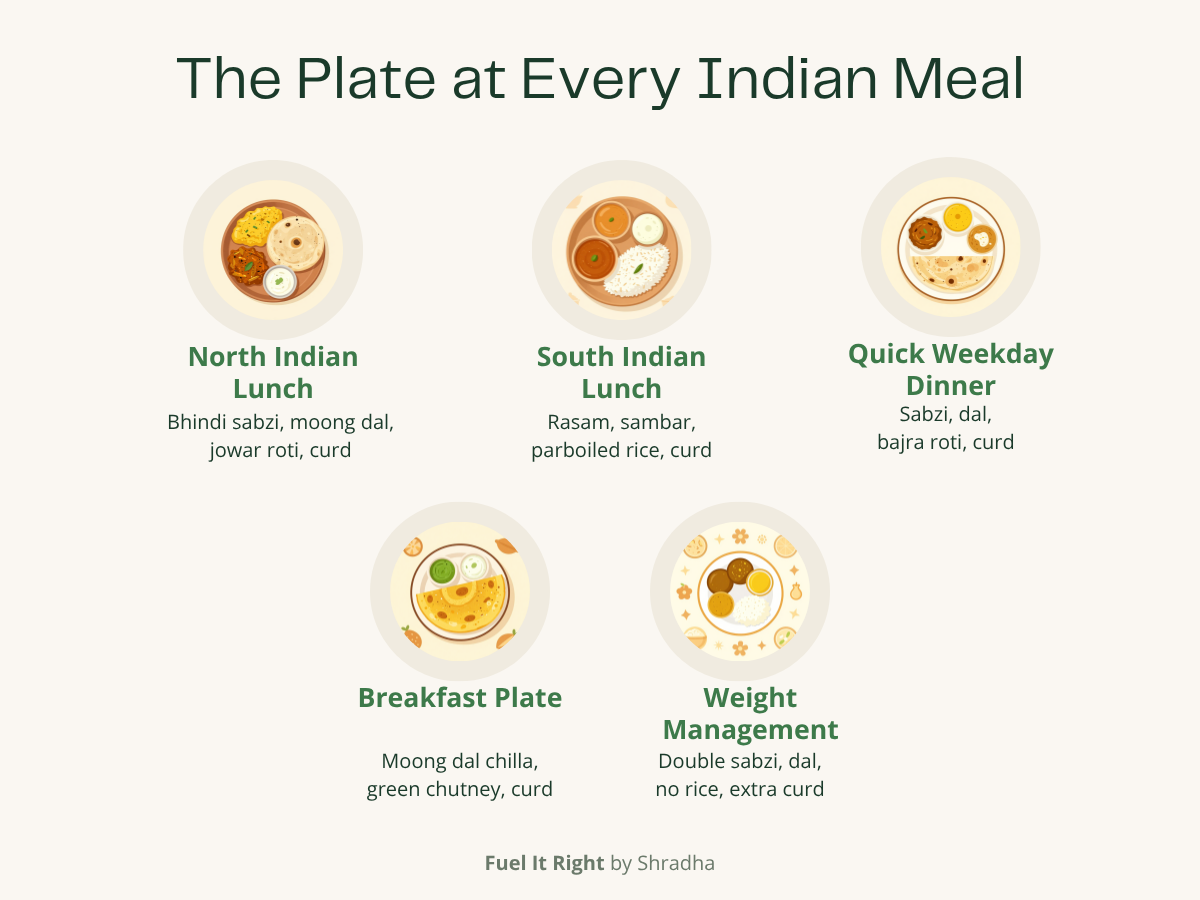
Here is what the PCOS/PMOS plate looks like across different Indian meal traditions, North Indian, South Indian, and quick weekday versions.
Standard North Indian lunch | Sabzi first (bhindi masala or palak). Then one cup of moong dal. Then one roti (jowar preferred). Small bowl of curd on the side. One teaspoon ghee on the roti. |
Standard South Indian lunch | Start with rasam soup. Then a serving of sambar with vegetables. Then one cup of rice (parboiled). Small bowl of curd. The sequence follows naturally in a traditional South Indian thali. |
Quick weekday dinner | Leftover sabzi from lunch. Moong dal quickly made with haldi, jeera, and tomato. One bajra roti or jowar roti. Curd from the fridge. Ready in 15 minutes. |
Breakfast plate | Moong dal chilla (the protein). Green chutney and one small bowl of sabzi as the vegetable component. Curd on the side. No separate carbohydrate needed — the chilla provides it within the protein base. |
Dinner for weight management | Two large servings of sabzi. One cup of dal. No roti or rice. Extra curd. When the vegetables and dal fill most of the plate, the carbohydrate portion can be reduced or skipped entirely at dinner without feeling deprived. |
Want your specific plate built around your blood work?
Book a free 30-minute discovery call. Bring your HOMA-IR and your typical daily meals. We will adjust the plate for your specific insulin resistance level and cooking style.
What the Plate Does Not Restrict
The PCOS/PMOS plate method is a framework for structure, not restriction. Here is what it does not ask you to do:
• It does not ask you to eliminate rice. One small serving of rice, eaten last, after sabzi and dal, is built into the plate.
• It does not ask you to avoid roti. One or two rotis of any flour is the carbohydrate component.
• It does not ask you to count calories, weigh food, or track macros.
• It does not ask you to buy imported ingredients or superfoods.
• It does not ask you to cook separate meals from your household.
• It does not ask you to eat the same thing every day.
What the plate does ask It asks you to put the right things on the plate in the right proportions, and to eat them in the right order. That is all. The variety within each section, which vegetable, which dal, which grain, is entirely your choice based on what your household cooks, what is in season, and what you enjoy eating. |
Following the plate in Goa and want practical support?
My team builds food protocols around the meals you already cook. Real Indian food. No supplements. No elimination diets. Call or WhatsApp us.
+91 7057063984
Conclusion: One Framework. Every Meal.
The PCOS/PMOS plate method is the simplest possible translation of everything the research says about insulin resistance, gut health, and inflammation into something you can apply at every meal, in every kitchen, with food you already cook.
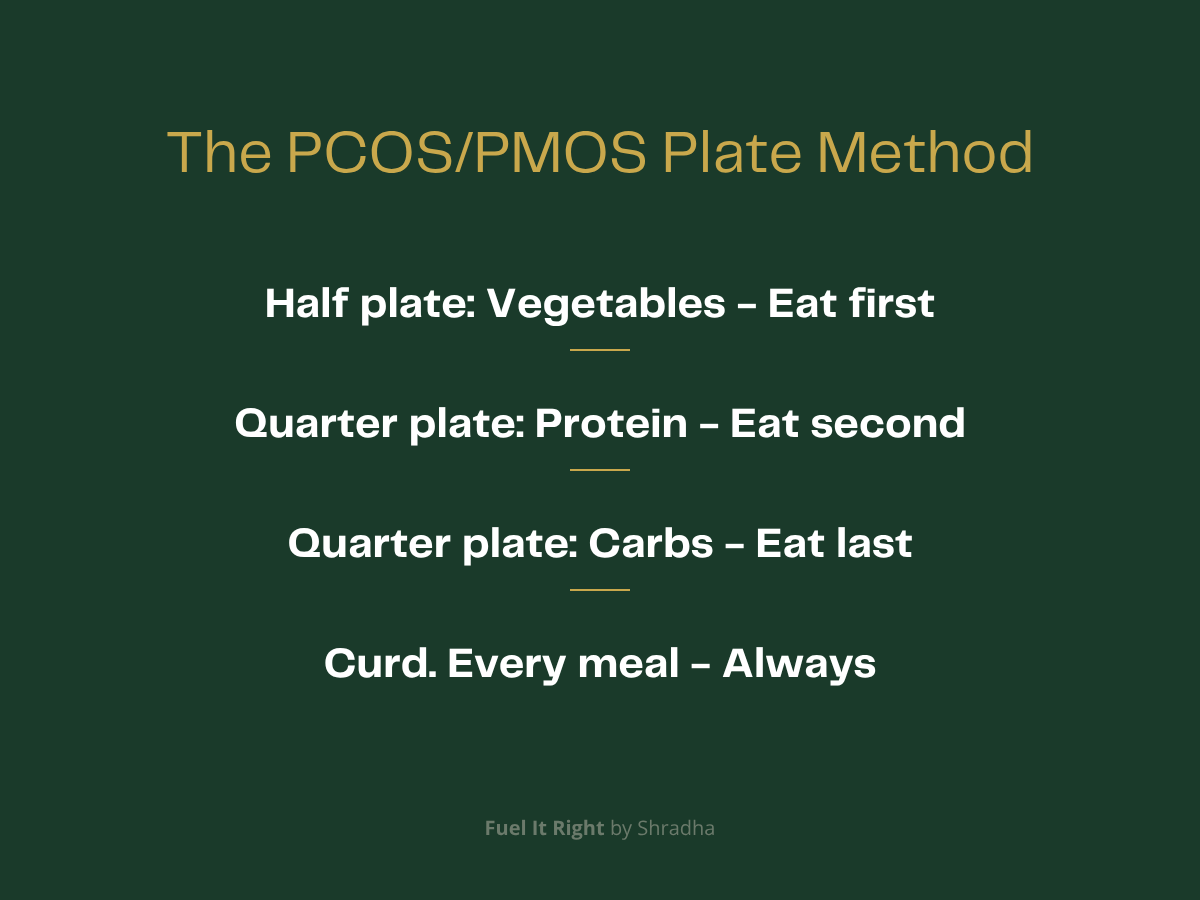
Half the plate in vegetables, eaten first. A quarter in protein, eaten second. A quarter in complex carbohydrates, eaten last. Curd on the side, always. That is the method. Four components, one sequence, three meals.
It does not require perfection. A plate that gets the proportions roughly right and follows the sequence consistently will produce measurably better insulin, androgen, and inflammatory outcomes over weeks and months than a perfect plate followed intermittently. Consistency beats precision in PCOS/PMOS management. Start with lunch today.
Book a Free 30-Minute Discovery Call
Bring your blood report and your typical daily menu. We will adjust the plate method for your specific metabolic picture.
calendly.com/shradhajp/30min
Or call us: +91 7057063984
FAQs: PCOS and PMOS Plate Method
Q1. Is the plate method the same as macro tracking?
No. Macro tracking assigns precise gram targets for protein, carbohydrates, and fat and requires you to weigh or measure every food. The plate method uses visual proportion, half, quarter, quarter, without any numbers. It is designed to be sustainable at every meal without a kitchen scale or tracking app.
Q2. What if I am still hungry after following the plate?
Increase the vegetable portion first. It is the most metabolically neutral way to add volume. More sabzi or salad on the same plate does not significantly affect insulin response. If hunger persists after that, add a second serving of dal or protein. Do not increase the carbohydrate portion as the solution to hunger.
Q3. Can I follow this plate if I am vegetarian?
Yes. The protein quarter of the plate like dal, legumes, paneer, tofu, sprouts, eggs for those who eat them, is entirely achievable on a vegetarian diet. The most common gap in vegetarian PCOS/PMOS eating is insufficient dal. One full cup of cooked dal at lunch and another at dinner provides approximately 16 to 18 grams of protein across two meals. Add paneer or curd to bring the total to an adequate level.
Q4. Does every meal need to follow the plate exactly?
No. The plate method is a framework for the majority of meals, not a rule for every bite. Applying it at 80% of meals consistently produces better outcomes than applying it perfectly for two weeks and abandoning it. Social meals, travel, and occasional deviations do not undermine the metabolic benefit of consistent application at regular meals.
Q5. How is the PCOS/PMOS plate different from a standard healthy eating plate?
Standard healthy eating plates typically show equal portions of vegetables, protein, and grains. The PCOS/PMOS plate gives half the plate to vegetables rather than a third because fibre quantity matters significantly more in insulin-resistant conditions. It also specifies a sequence for eating the plate rather than just proportions, and it includes curd as a non-optional gut-health component rather than as an optional dairy serving.
Q6. What if I cannot always eat a full plate with four components?
Use the priority order. If you can only manage two components, choose vegetables and protein. If you can only manage three, add the curd. The carbohydrate component is the most flexible, it can be skipped at dinner or reduced to a smaller portion without disrupting the core metabolic benefit of the plate. Never skip the vegetables in favour of a larger carbohydrate portion.
Q7. I eat out often. Can I apply the plate method at restaurants?
Yes. At any Indian restaurant, order one vegetable dish, one dal or protein dish, and one small carbohydrate. Eat in the same sequence like vegetable first, dal second, roti or rice last. Order curd or chaas as a side. The proportions may not be perfect but the sequence and components can be maintained at most Indian restaurants.
Q8. Does the plate method help with weight loss as well as PCOS/PMOS management?
Weight loss is a common secondary outcome of the plate method when applied consistently because the high vegetable and protein content naturally increases satiety, reduces total carbohydrate intake, and stabilises blood sugar in ways that reduce cravings. However, weight loss is not the primary goal of the method. The primary goal is metabolic improvement: reduced insulin resistance, better gut health, and lower inflammation. Weight normalisation often follows from these improvements.
About the Author
Shradha | Nutritionist and Dietitian | Fuel It Right. Practising out of Goa, India, with a focus on gut health, PMOS/PCOS, thyroid disorders, and weight management using real Indian food. No supplements. No machines. Just food, and the science behind it.
fuel-it-right.com | @fuelitright