
Lean PMOS: Why Thin Indian Women Get Overlooked and Under treated
Lean PMOS affects Indian women at healthy BMI who are routinely dismissed. 75% of lean women with PMOS have insulin resistance. Here is why thin does not mean healthy, and what to do about it.
Table of Contents:
1. The Dismissal That Millions of Indian Women Know
2. What Lean PMOS Actually Is
3. Why the South Asian Body Makes Lean PMOS More Common
4. The Symptoms of Lean PMOS That Go Unconnected
5. Why Doctors Miss It
6. The Metabolic Damage Happening Beneath a Healthy BMI
7. What to Eat When You Have Lean PMOS
8. What to Do at Your Next Doctor's Appointment
9. Conclusion
10. FAQs
The Dismissal That Millions of Indian Women Know
Lean PMOS has a signature moment that almost every woman who has it remembers. You go to a doctor with irregular periods, unexplained fatigue, acne along the jaw, hair falling out in the shower. The doctor looks at you, slim, visibly healthy, BMI of 21, and says: you cannot have PCOS. You are not overweight.
That sentence, or some version of it, has been spoken to an enormous number of Indian women. It is wrong. It has always been wrong. And the PMOS rename, which correctly identifies this condition as metabolic and endocrine rather than ovarian, is the clearest medical repudiation of that dismissal yet.
The number that ends the argument Insulin resistance is present in 75% of lean women with PMOS, women with a BMI below 25 who appear to be at a healthy weight by every standard measure. This is not a rare variant. Lean PMOS is not an exception. It is one of the most common presentations of the condition in Indian women. |
What Lean PMOS Actually Is
The term lean PMOS describes the condition in women who have normal or low body weight, typically a BMI below 25, but carry the full metabolic and hormonal profile of PMOS. They have insulin resistance, elevated androgens, disrupted ovulation, and all the downstream symptoms. The only thing they do not have is excess weight.
The Cellular Reality
Insulin resistance is fundamentally a cellular problem, not a weight problem. As noted by diabetes.co.in in May 2026, the root pathology is a defect in how insulin signals inside cells, specifically an abnormality in serine phosphorylation at the insulin receptor level, that makes muscle and fat tissue resistant to insulin's effects. This defect has nothing to do with body weight. It can be present in a woman who weighs 50kg just as readily as one who weighs 80kg.
The reason lean women are missed is not because they have a milder version of the condition. It is because the entire diagnostic framework was built around the assumption that PMOS was driven by obesity and lean women did not fit the expected picture.
How Lean PMOS Differs Metabolically From Weight-Related PMOS
In women whose PMOS is compounded by excess weight, visceral fat creates an additional inflammatory load that worsens insulin resistance further. In lean women, the insulin resistance is driven more directly by the cellular signalling defect and, in many cases, by chronic cortisol elevation from stress. The hormonal cascade, excess insulin driving androgen production, is the same. The downstream symptoms are the same. The treatment approach through food is the same.
Why the South Asian Body Makes Lean PMOS More Common
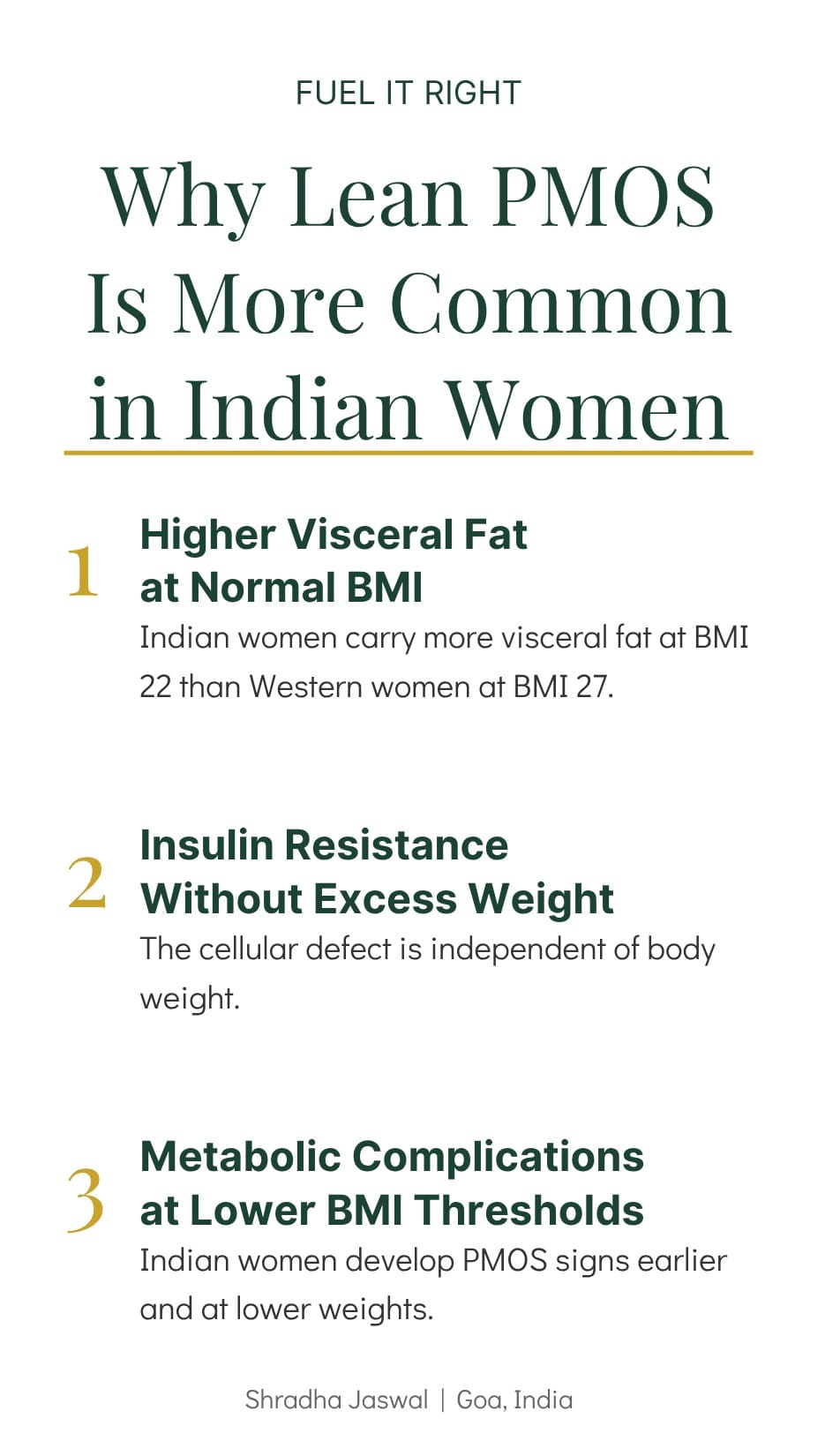
Indian women are uniquely predisposed to lean PMOS because of a well-documented characteristic of the South Asian body: disproportionately high visceral fat at normal BMI.
The BMI Paradox in Indian Women
As Dr Torsha Chatterjee, endocrinologist, noted in Down To Earth: Indian women develop metabolic complications at younger ages and often at lower BMI thresholds compared to Western populations. A woman with a BMI of 22 may carry the visceral fat and metabolic risk profile of a European woman at BMI 27. By the time her BMI triggers clinical concern, metabolic damage has often been present for years.
This is why the BMI cutoff of 25 that defines lean PMOS in Western literature may not be the appropriate threshold for Indian women. Some endocrinologists working with Indian patients apply a cutoff of 23 or even lower when screening for metabolic risk in normal-weight women with PMOS symptoms.
The Role of Cortisol in Lean PMOS
Lean women with PMOS often have significantly elevated cortisol from chronic stress, the HPA axis dysregulation that is common in urban Indian professional women. Cortisol directly worsens insulin resistance independent of body weight. It also elevates LH, which drives androgen production. The result is a lean woman with all the hormonal markers of PMOS and no excess weight to signal the problem to her doctor.
The Symptoms of Lean PMOS That Go Unconnected
The symptoms of lean PMOS are the same as weight-related PMOS, but they are more likely to be attributed to unrelated causes when the woman is visibly slim.
Irregular periods | Attributed to stress, travel, or underweight. The metabolic root is rarely investigated in lean women. |
Acne along the jaw and chin | Dismissed as diet-related or hormonal in an unspecific sense. The androgen excess driving it is not investigated. |
Scalp hair thinning | Attributed to water quality, shampoo, iron deficiency, or stress. Rarely connected to elevated androgens in a lean woman. |
Excess facial or body hair | More commonly investigated, but still often attributed to ethnic hair patterns in Indian women rather than androgen excess. |
Fatigue and afternoon energy crashes | Attributed to poor sleep, iron deficiency, or overwork. The post-meal insulin dysregulation causing them is not considered. |
Difficulty losing weight despite low calorie intake | This is the most dissonant symptom for lean women, they are not trying to lose weight, but they notice that their body composition shifts toward more fat and less muscle over time. This is a direct metabolic signal. |
Brain fog and poor concentration | Insulin resistance affects brain glucose metabolism. This symptom is almost never connected to PMOS in lean women. |
Mood changes tied to cycle | Dismissed as PMS. The hormonal disruption of PMOS is not considered when the woman does not fit the expected profile. |
Why Doctors Miss It
The diagnostic failure in lean PMOS is systemic, not individual. It is built into how the condition has been framed and taught for decades.
The Weight Assumption Is Embedded in Training
Medical education on PCOS has historically presented the typical patient as overweight, with acanthosis nigricans, a high BMI, and visible signs of metabolic syndrome. Lean women presenting with subtle symptoms like irregular cycles, mild acne, moderate hair fall do not match this picture. Without matching the picture, investigations are not triggered.
The most common dismissal, word for word "You don't look like you have PCOS." | "You're too thin for PCOS." | "Come back if your periods are still irregular in six months." | "Your BMI is normal, so it's probably just stress." Every one of these statements has been said to women who, on testing, had significant insulin resistance, elevated androgens, and a full PMOS profile. The weight assumption is the single most dangerous clinical bias in PMOS management. |
The Rotterdam Criteria Gap
The Rotterdam diagnostic criteria require two of three: irregular periods, elevated androgens or symptoms, polycystic ovarian morphology on ultrasound. A lean woman with irregular periods and acne, but no ovarian cysts on ultrasound, may not meet the threshold. And if fasting insulin is not ordered, her insulin resistance goes entirely undetected. She leaves the consultation with nothing.
The Ultrasound Overreliance
Many Indian doctors use ultrasound as the primary or sole diagnostic tool for PMOS. A lean woman with PMOS may have no ovarian cysts on ultrasound. The absence of cysts does not mean the absence of PMOS. Research published alongside the 2026 PMOS rename explicitly confirmed there is no increase in abnormal ovarian cysts in the condition. Ultrasound alone is insufficient
The Metabolic Damage Happening Beneath a Healthy BMI
The most dangerous aspect of lean PMOS is the false reassurance of a healthy weight. The metabolic damage is the same regardless of BMI, it is just invisible without the right tests.
• Insulin resistance is driving androgen excess, disrupting ovulation, and building cardiovascular risk, all while fasting glucose looks normal.
• Visceral fat, even in small quantities in lean women, is producing inflammatory cytokines that worsen insulin sensitivity.
• The risk of type 2 diabetes in lean women with PMOS is significantly elevated over the long term, the cellular insulin signalling defect does not resolve with weight management because weight is not the driver.
• Bone density may be lower in lean women with PMOS due to hormonal disruption, a consequence rarely discussed in consultations.
• Cardiovascular risk accumulates silently, dyslipidemia is common in lean PMOS and is rarely screened for when the woman appears metabolically healthy.
The key clinical insight from 2026 Dr Chatterjee, commenting on the PMOS rename, noted that insulin resistance may be present in nearly 70 to 80 percent of women with PMOS, including many who are not overweight. This is not a new finding. It has been in the literature for years. What the PMOS rename does is make ignoring it no longer clinically defensible. |
What to Eat When You Have Lean PMOS
The food protocol for lean PMOS addresses the same root as weight-related PMOS which is insulin resistance, but with different emphasis. The goal is not weight loss. The goal is metabolic repair: reducing insulin spikes, rebuilding gut bacteria, lowering inflammation, and restoring androgen balance through food.
What Changes for Lean Women
Lean women with PMOS often eat relatively little, skip meals to manage busy schedules, and may already avoid high-calorie foods. The problem is not quantity, it is composition and sequence. A lean woman eating a small breakfast of only fruit and chai is creating a glucose spike with no protein to buffer it, which drives the insulin-androgen cascade just as effectively as a large high-carbohydrate meal.
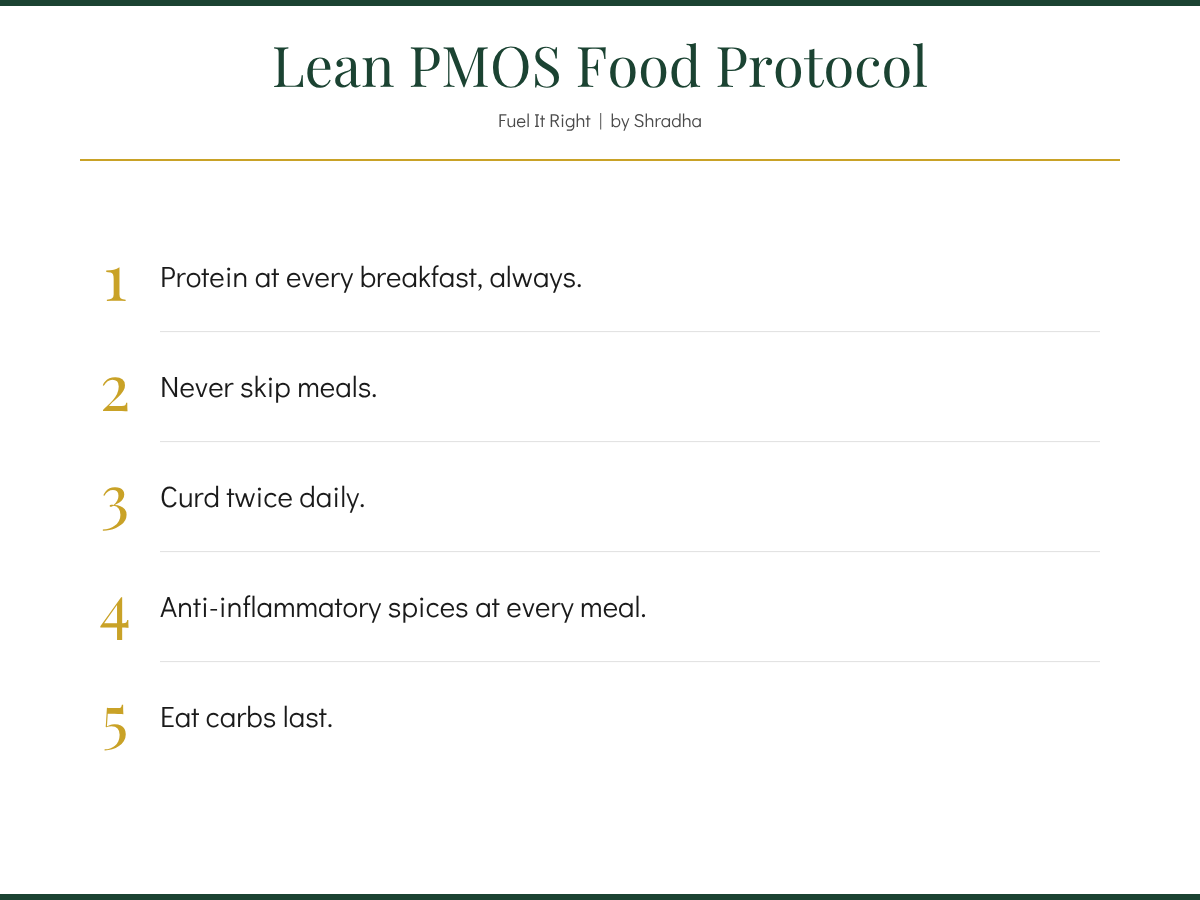
The Non-Negotiables for Lean PMOS
1 | Protein at breakfast, always The most important single change. A protein-first breakfast stabilises cortisol and insulin for the entire day. Moong dal chilla, eggs, sprout salad, paneer before any carbohydrate. This is not about calories. It is about the hormonal signal sent in the first meal of the day. |
2 | Never skip meals In lean women with PMOS, meal skipping elevates cortisol, which directly worsens insulin resistance and raises LH. Three meals with protein at each is more important than the total calorie intake. |
3 | Curd daily, for gut and hormones The gut-hormone connection is especially important in lean PMOS where gut microbiome disruption often precedes visible metabolic changes. Two servings of fresh curd or chaas per day supports both gut lining repair and androgen clearance. |
4 | Anti-inflammatory spices at every meal Haldi, jeera, methi, ajwain. Each one reduces the chronic low-grade inflammation that drives insulin resistance in lean women. These are not additions to a protocol. They are the foundation of it. |
5 | Eat carbs last at every meal Vegetables and protein first. Dal second. Rice or roti last. This sequence reduces post-meal glucose response by up to 30% without changing what or how much is eaten. |
What to Do at Your Next Doctor's Appointment
If you suspect lean PMOS and have been dismissed because of your weight, here is exactly what to say and ask for at your next appointment.
Script for your appointment "I have regular symptoms of PMOS, irregular periods, acne, hair fall, fatigue, and I would like a full metabolic workup. I understand that lean women with PMOS have significant insulin resistance and I want to rule this out properly. I am asking for:" • Fasting insulin and HOMA-IR • Free testosterone and SHBG • LH/FSH ratio • TSH and free T4 • hsCRP • Lipid panel "I would like my exact numerical values, not just a normal or abnormal result. If you are not able to order these, I would like a referral to an endocrinologist." |
For the complete test list with optimal ranges, see the PMOS diagnosis checklist.
Conclusion: Thin Does Not Mean Healthy When It Comes to PMOS
Lean PMOS is not rare. It is not mild. It is not something that will resolve on its own. It is one of the most systematically missed presentations of the most common endocrine condition in Indian women and it is missed specifically because doctors look at a woman's weight and stop there.
The 2026 PMOS rename is the clearest possible medical statement that weight is not the defining feature of this condition. Insulin resistance is. And insulin resistance does not require excess weight to be present, to cause damage, or to respond to food.
If you are a lean Indian woman who has been told you cannot have PMOS, ask for fasting insulin and HOMA-IR. Read your numbers. Do not accept normal or abnormal without seeing the values. And if you want help understanding what those numbers mean and how to begin addressing them through food, book a free 30-minute discovery call.
Book a Free 30-Minute Discovery Call
Bring your blood reports. If you have been dismissed because of your weight, we will tell you what the numbers actually show.
FAQs: Lean PMOS in Indian Women
Q1. Can I have PMOS if I am underweight?
Yes. PMOS is defined by insulin resistance and hormonal dysregulation, not by weight. Underweight women can have significant insulin resistance, particularly when it is driven by cortisol elevation from chronic stress or restriction. If you are underweight and have irregular periods, acne, or hair fall, ask for a fasting insulin test.
Q2. My doctor said my BMI is fine so I do not need to be tested for PMOS. What should I do?
Ask specifically for fasting insulin and HOMA-IR by name. Explain that you are aware insulin resistance is present in up to 75% of lean women with PMOS and that BMI does not screen for this. If your doctor will not order the tests, ask for a referral to an endocrinologist. A gynaecologist managing PMOS without metabolic investigation is treating downstream symptoms, not the condition.
Q3. I am lean with PMOS. Should I still change my diet?
Especially so. The food protocol for lean PMOS is not about reducing calories or losing weight, it is about metabolic repair. Protein-first meals, meal sequencing, curd daily, anti-inflammatory spices, and consistent meal timing directly address the insulin resistance and inflammation driving your symptoms. These changes work independently of body weight.
Q4. Will losing weight help lean PMOS?
Weight loss is not the goal for lean women with PMOS, and restricting food intake can worsen the condition by elevating cortisol, which further disrupts insulin sensitivity and the LH-FSH ratio. The goal is metabolic repair through food quality and meal sequencing, not calorie reduction.
Q5. Can lean PMOS affect fertility?
Yes. The ovulatory disruption in PMOS is driven by insulin resistance and androgen excess — both of which are present in lean PMOS. Many lean women with PMOS ovulate infrequently or have irregular cycles that affect conception. Addressing insulin resistance through food significantly improves ovulation regularity.
Q6. I have a normal ultrasound. Can I still have lean PMOS?
Yes. Polycystic ovarian morphology is one of three diagnostic criteria, not a requirement. A 2026 review confirmed there is no increase in abnormal ovarian cysts in PMOS. You can have lean PMOS with a completely normal ultrasound. The metabolic and hormonal blood markers are more diagnostically significant than the ultrasound.
Q7. Is lean PMOS more common in Indian women than in Western women?
Yes. Indian women carry disproportionately higher visceral fat at normal BMI compared to Western populations, and develop metabolic complications at lower BMI thresholds and younger ages. This means lean PMOS, where insulin resistance is present without excess weight, is more common and more clinically significant in Indian women than global literature, which is predominantly based on Western populations, suggests.
Q8. What is the single most important test to get if I suspect lean PMOS?
Fasting insulin. It is not part of a standard panel and must be requested by name. Combined with fasting glucose, it allows your HOMA-IR to be calculated, which is the most direct measure of insulin resistance available in standard clinical practice. A normal fasting glucose does not rule out insulin resistance. Fasting insulin does.
About the Author
Shradha | Nutritionist & Dietitian | Fuel It Right. Practising out of Goa, India, with a focus on gut health, PMOS/PCOS, thyroid disorders, and weight management using real Indian food. No supplements. No machines. Just food, and the science behind it.
fuel-it-right.com | @fuelitright