
Eating Order for Diabetes: What the Research Shows
What trials found when people with diabetes ate vegetables and protein before carbs, how big the effect really is, and how to do it on an Indian plate.
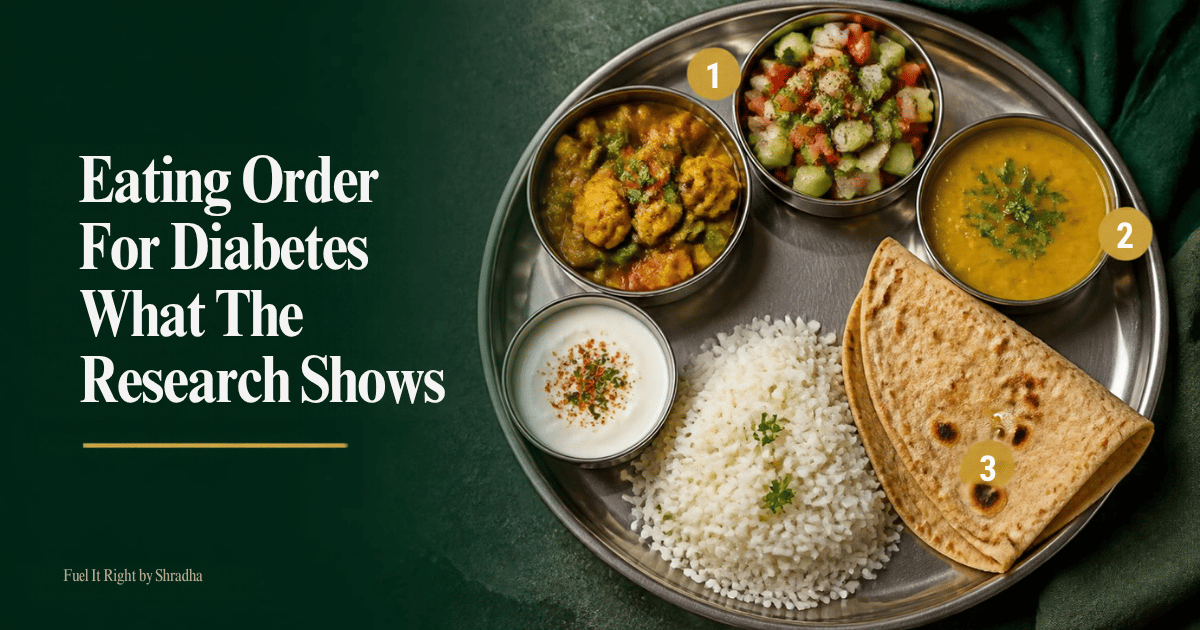
Table of Contents
• What the Research on Eating Order for Diabetes Shows
• Why the After-Meal Peak Matters
• The Study That Started the Conversation
• What Larger Reviews Found
• What Real Days Looked Like
• What Happens in Your Body
• What Eating Order Looks Like on an Indian Plate
• A Simple Order for Your Thali
• What a Day of Eating in This Order Looks Like
• What Indian Research Found
• Where Eating Order Falls Short
• How to Start Eating in This Order
• Start With One Meal a Day
• Handle the Awkward Meals
• Keep the Bigger Habits in Place
• The Bottom Line on Eating Order for Diabetes
• Frequently Asked Questions About Eating Order for Diabetes
Eating order for diabetes is one of the simplest changes I suggest, and one of the least talked about. It costs nothing, needs no special food, and takes no extra time. All it asks is that you eat the same meal in a different order.
The concept is to eat the vegetables and protein first and then end with the roti or rice. Same plate, same portions. The only thing is what goes into your stomach first.
This tip is blowing up on social media, and some posts claim it's a miracle cure. The research is real, but it's smaller and shorter than what the videos make it out to be. I'd rather tell you what the trials actually said.
This post covers what studies show on eating order for diabetes, what it looks like on an Indian plate, where it falls short, and how to start at your next meal.
Key Takeaways • In a small trial of people with type 2 diabetes, blood sugar one hour after a meal was about 37 percent lower when vegetables and protein came before carbs. • A 2025 review of 17 trials found blood sugar at one hour was about 43 mg/dL lower with carbs last, but the long-term HbA1c gain was small, just 0.16 points. • The likely reason is that your stomach empties more slowly, so carbs reach your blood more gradually. • An Indian trial in women with gestational diabetes found a smaller but real drop of about 6 percent in after-meal blood sugar. • Eating order is a helper, not a licence to eat more rice or roti. Portions still matter most. |
What the Research on Eating Order for Diabetes Shows
Most of the evidence is from small trials where people ate the same meal twice, once with carbs first, and once with carbs last. That design is helpful because each person is their own comparison. The catch is that the trials are small and short, so I will point out the limits as we go.
Why the After-Meal Peak Matters
Most people with diabetes check their fasting sugar and stop there. But the rise after meals matters too. Big swings after eating are thought to add strain on your blood vessels over time.
That is where the food order for diabetes gets research attention. It is about lowering the peak without changing what is on your plate. Many diet changes ask you to give things up. This one asks you to rearrange.
The Study That Started the Conversation
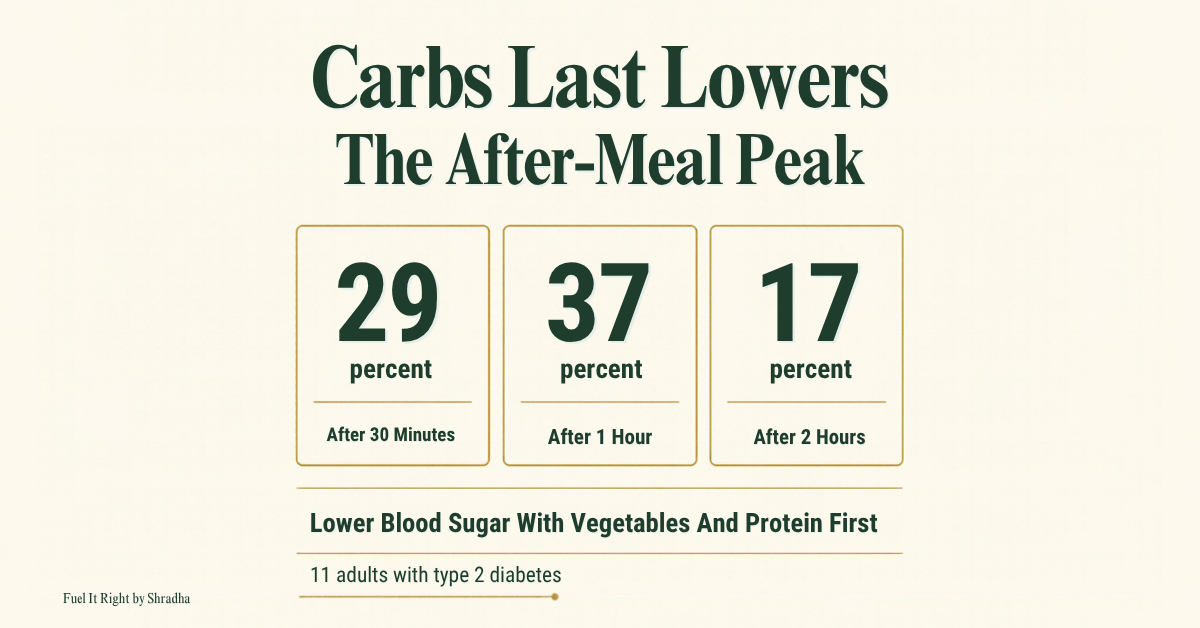
In 2015, researchers tested 11 people with type 2 diabetes who took metformin. Each person ate the same 628-calorie meal twice, a week apart.
The meal had vegetables, protein, bread, and orange juice. One week, people ate the bread and juice first. The other week, they ate the vegetables and protein first and the carbs last.
Carbs last lowered blood sugar by about 29 percent after 30 minutes, 37 percent after an hour and 17 percent after two hours. Insulin was lower as well, by 31, 50 and 40 percent.
That is a big effect from one change. But it was 11 people, one meal, and a test meal of bread and orange juice. Treat it as a strong first signal, not the final word on eating order for diabetes.
What Larger Reviews Found
A review published in October 2025 pooled 17 trials with 389 people with type 2 diabetes. It confirmed the pattern, with a smaller effect than the first study.
One hour after eating, blood sugar was about 43 mg/dL lower when carbs came last. After two hours, it was about 13 mg/dL lower. The gap shrinks as time passes.
Over the longer term, the news is modest. HbA1c, your three-month average, came down by only about 0.16 percentage points. That is a small gain, but the habit is free.
These are averages. Some people in the trials had big drops, others had small ones. The only way to know how the eating order for diabetes works for you is to try it at your own meals.
What Real Days Looked Like
A 2025 crossover trial in Diabetes Care followed 20 adults with type 2 diabetes using glucose sensors. They ate carbs last for six days and carbs first for six days.
On carbs-last days, people spent about 85 percent of the day in their target range, compared with about 79 percent on carbs-first days. Their sugar also swung up and down less.
Under controlled conditions, the after-meal peak was about 48 mg/dL with carbs last, against about 86 with carbs first. That is a clear difference, even in a small group.
What Happens in Your Body
The reason is probably simple. Fiber and protein slow emptying of your stomach. When carbs come later, they go into your blood more slowly, so the rise is lower.
The 2025 review backs this up. Stomach emptying took about 28 minutes longer with carbs last. Levels of GLP-1, a gut hormone that helps your body release insulin and feel full, were also higher.
Starting with fiber and protein may also fill you up sooner, so you eat a little less rice or roti without trying. The trials didn't measure this, so I count it as a possible bonus, not a promise.
Shradha's Tip You do not need a perfect order at every meal. Start with a bowl of salad or sabzi before the roti or rice, and build from there. |
What Eating Order Looks Like on an Indian Plate
Indian meals make this easy, because most plates already have everything on them. A thali holds vegetables, dal, curd, and a carb, all at once. The only job is to decide where to begin.
A Simple Order for Your Thali
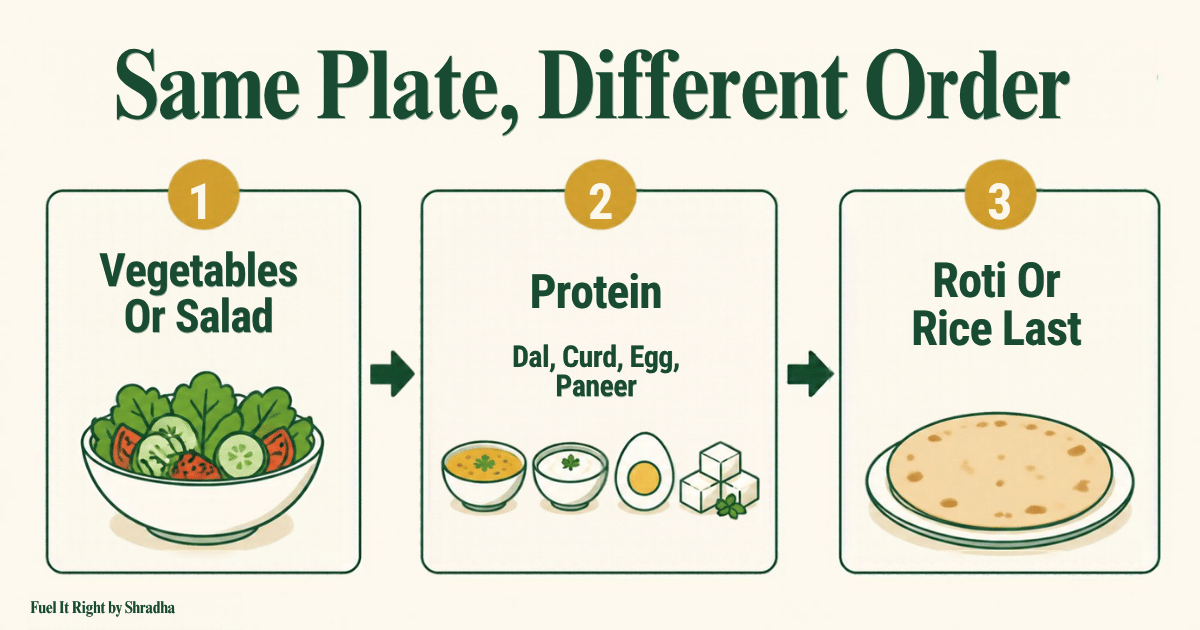
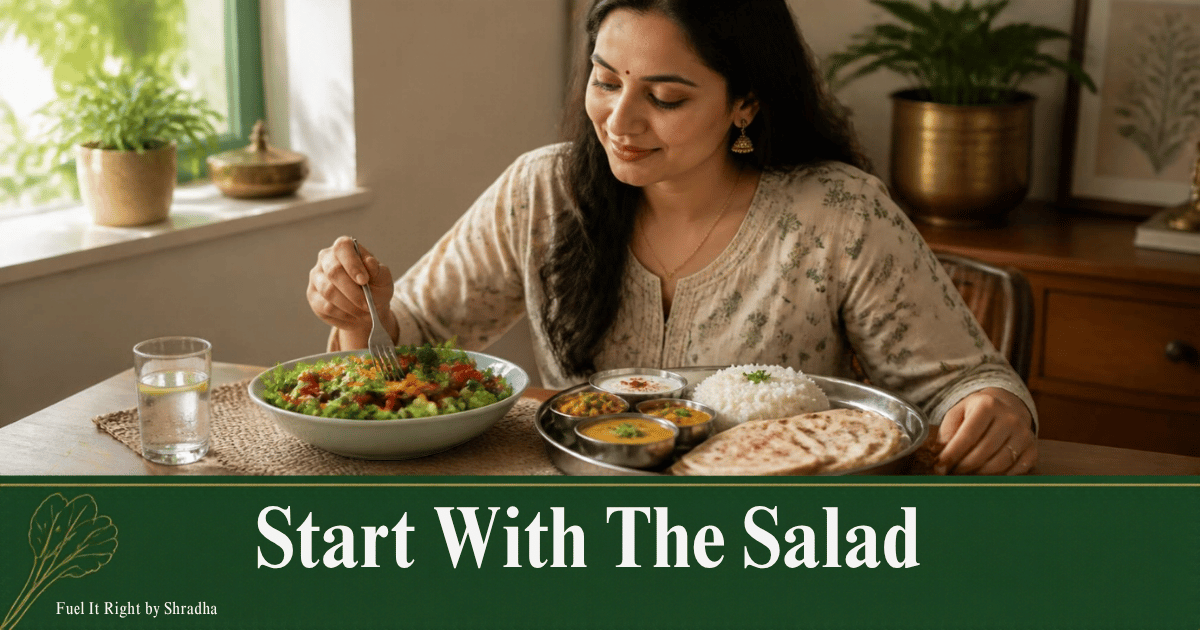
Begin with salad or vegetable sabzi. Next, have your protein such as dal, curd, paneer, egg, fish or chicken. End with roti or rice. Keep your portion sizes the same.
Water or buttermilk with the meal is fine. Fruit juice and sweet drinks are another matter. In the first study, the orange juice counted as a carb, and it was eaten last in the better sequence.
Cooking style matters too. The trials used plain vegetables and protein, so a lightly cooked sabzi suits this habit better than one swimming in oil.
Vegetables or Salad First Strong habit |
Fibre arrives first and slows digestion. Vegetables were part of the first course in the trials. How to make it work: Eat at least half your sabzi or salad before touching the roti or rice. |
Protein Before Carbs Strong habit |
Protein helps slow stomach emptying and keeps you full. Dal, curd, egg, paneer, fish, and chicken all count. How to make it work: Take a few spoons of dal, or a bite of egg or paneer, before the first roti. |
Roti or Rice Last Worth trying |
This is the core of the habit. Carbs arriving last is what lowers the after-meal peak in the trials. How to make it work: Serve the roti or rice after your first helping of sabzi and dal. |
What a Day of Eating in This Order Looks Like
Here is a simple eating order pattern for diabetes across the day. Breakfast: Egg or a bowl of sprouts first and then a small portion of poha or upma.
For lunch, start with salad and sabzi, then dal and curd, then one katori of rice or two rotis. For dinner, begin with soup or salad, then paneer, fish, or chicken with sabzi, and finish with one or two rotis.
This is a pattern, not a prescription. Your portions depend on your medicines, your activity, and your blood sugar numbers.
What Indian Research Found
An Indian trial at SRM Medical College Hospital tested the same idea in 25 women with gestational diabetes.
The women ate their usual meals for two weeks. Then they ate vegetables for two weeks, then protein, then carbs. Blood sugar after meals was about 6 percent lower at one and two hours. Insulin was 8 to 11 percent lower.
The effect is smaller than in the Western studies, and the trial was small, short, and had no comparison group. Gestational diabetes is also not the same as type 2. Still, it shows that eating order for diabetes has an effect on Indian meals too.
WHAT YOU'VE HEARD If I eat my carbs last, I can eat as much rice or roti as I like. |
WHAT'S ACTUALLY TRUE Eating order lowers the peak after a meal, but the studies kept portions the same. It is a helper, not a licence to eat more. |
Where Eating Order Falls Short
The trials are small, and most lasted days or weeks, not years. Many used test meals such as bread and juice, which look different from a full Indian thali.
The long term gain is small. A 0.16 reduction in HbA1c will not replace the bigger levers, like portion size, how much rice you eat, and how much protein you get. Eating order is on top of those, not instead of them.
Some people with long-standing diabetes also have slow stomach emptying from nerve damage. If you feel full for hours after small meals, ask your doctor before leaning on eating order for diabetes.
If you take insulin or tablets that can cause low blood sugar, speak to your doctor before changing how you eat. Your dose is matched to your usual meals.
How to Start Eating in This Order
You don’t need a new plan, you need one small rule you can repeat. Here is how I set up eating order for diabetes with clients.
Start With One Meal a Day
Pick your biggest meal, usually lunch. Eat in the new order for a week. Once it feels normal, add dinner. Breakfast comes last, because it is the hardest to reorder.
Small wins create the habit. One week at one meal is enough to know if eating order for diabetes fits into your routine. Most of my clients find lunch the easiest as it is usually the most carb-heavy meal.
Many people try to cut carbs hard and give up within weeks. Eating order keeps your food the same, which makes it easier to stick to. A habit you keep beats a rule you break.
Handle the Awkward Meals
No study has tested these meals so this is my application of the idea, not proven advice. With idli and sambar, eat the sambar vegetables first and then the idli. With poha, add a boiled egg or sprouts and eat that first.
With biryani, start with raita, salad, and the chicken or paneer, and leave the rice for last. If roti and sabzi come together, finish a good part of the sabzi and dal before the first bite of roti. It will not be perfect, and that is fine.
Keep the Bigger Habits in Place
The eating order is best applied to sensible portions. One katori of rice, never alone, still holds true, as I covered in the post on rice. Cutting back on sweet drinks and desserts matters too. Eating order for diabetes is the finishing touch, not the foundation.
Shradha's Tip Put your roti or rice on a separate plate, or serve it after the first helping of sabzi and dal. If it is not in front of you, you reach it last without needing willpower. |
Vegetables first can feel heavy if your gut is sensitive, especially with raw salad. If you bloat easily, the Gut Health Quiz is a good place to start.
The Bottom Line on Eating Order for Diabetes
The eating order for diabetes is a small, free habit that has real, but modest, benefits. Vegetables and protein first, carbs last, and the meal itself stays the same. It won’t replace portion control or a good overall plate, but it helps both work a little better.
If you are following this series, the earlier posts on millets, intermittent fasting, jaggery vs sugar, and sweeteners cover the other pieces of eating well with diabetes.
I like this habit because it respects how people really eat. Nobody has to give up roti or rice, and nobody needs a special product. It fits family meals and restaurant meals alike, which is why clients tend to keep it.
My advice is easy. Try it for two weeks at your biggest meal. If you check your sugar at home, compare your readings after meals before and after. Tell your doctor what you find.
Want a meal plan built around your own thali, your medicines, and your blood sugar numbers?
Book a consultation
Frequently Asked Questions About Eating Order for Diabetes
Does the Order I Eat in Really Matter for Blood Sugar?
In the trials, yes. Eating veggies and protein before carbs lowered the blood sugar spike after a meal. The effect is clearest in the first one to two hours, and smaller over the long term. Eating order for diabetes is best viewed as a helpful add-on.
Should I Eat Carbs Last if I Have Diabetes?
It is worth trying. Most trials were in type 2 diabetes, and carbs last gave lower after-meal readings. Keep your portions the same, and treat it as an add-on to your overall plan.
What Should I Eat First?
Start with salad or a vegetable sabzi. Then have your protein, such as dal, curd, paneer, egg, fish, or chicken. Roti or rice comes last.
Does Eating Order Work for Prediabetes?
Most trials were in type 2 diabetes, so prediabetes is less studied. The habit is harmless and costs nothing, so many of my clients with prediabetes try it too.
Can I Eat Roti and Sabzi Together?
Yes, in real life most meals are mixed. Try to finish a good part of the sabzi and dal before the first bite of roti. A rough order still beats no order. The trials used a clear sequence, but your daily meals do not need to be that tidy.
How Long Does It Take to See a Difference?
The after-meal effect shows up in the same meal. If you check your sugar at home, compare readings one to two hours after eating, before and after you change the order.
Is Eating Order Safe if I Take Diabetes Medicines?
Speak to your doctor first, especially if you take insulin or tablets that can cause low blood sugar. Your dose is matched to your usual meals, and any change in pattern should be planned.
Will Eating Order Help Me Lose Weight?
It hasn't been shown to do that directly. A 2025 trial showed a small weight loss, but it wasn't designed as a weight loss study. Think of it as a blood sugar habit first, and keep your eye on portions and overall food quality for weight.
Shradha | Nutritionist & Dietitian | Fuel It Right