
Sweeteners for Diabetes: What the Research Shows
What WHO, Cochrane and 2023 studies say about stevia, monk fruit, aspartame and erythritol for people with diabetes, and how to use them sensibly.
Table of Contents
• What the Research on Sweeteners for Diabetes Shows
• What the WHO Warning Actually Covers
• What Studies in People With Diabetes Found
• Blood Sugar Is Only Half the Story
• Stevia, Monk Fruit, Aspartame and Erythritol Compared
• Stevia
• Monk Fruit
• Aspartame
• Erythritol and Other Sugar Alcohols
• Who Should Be Most Careful
• How to Use Sweeteners if You Have Diabetes
• Read the Label on Tablets and Sachets
• Keep Track of How Much You Use
• Cut Down Sweetness Slowly
• What a Real Day Looks Like
• The Bottom Line on Sweeteners for Diabetes
• Frequently Asked Questions About Sweeteners for Diabetes
Sweeteners for diabetes is the question I hear right after someone gives up sugar. Jaggery, honey, and white sugar are all off the list, so what is left? Stevia, monk fruit, and aspartame come up most, and everyone online seems to have a strong opinion about them.
One camp says they are a free pass. The other says they are poison. Neither is quite right. The real answer is more mixed, and it depends on which sweetener you mean.
In 2023 the World Health Organization advised against the use of sweeteners for weight control. That headline spread fast. What many people missed is that the advice was not directed at people that already have diabetes.
Here is what the research actually says about sweeteners for diabetes, how the four common options compare, and how to use them in real life without going overboard.
Key Takeaways • The 2023 WHO advice on sweeteners was not written for people who already have diabetes, so it does not directly answer your question. • A major review of trials in people with diabetes found no clear effect on blood sugar control, but the evidence is weak because the trials were few and small. • Stevia and aspartame do not raise blood sugar directly, and neither is proven harmful at normal amounts. • Erythritol, found in many “sugar-free” products, was linked to heart problems in one 2023 study. It cannot prove cause, but it is worth watching. • Sachets and tablets often contain fillers that add a little carbohydrate, so the label matters more than the brand. |
What the Research on Sweeteners for Diabetes Shows
Most discussions about sweeteners for diabetes confuse two separate questions. Does it raise your blood sugar? And is it safe to take for years? The answers are different, so let’s tackle them one at a time.
What the WHO Warning Actually Covers
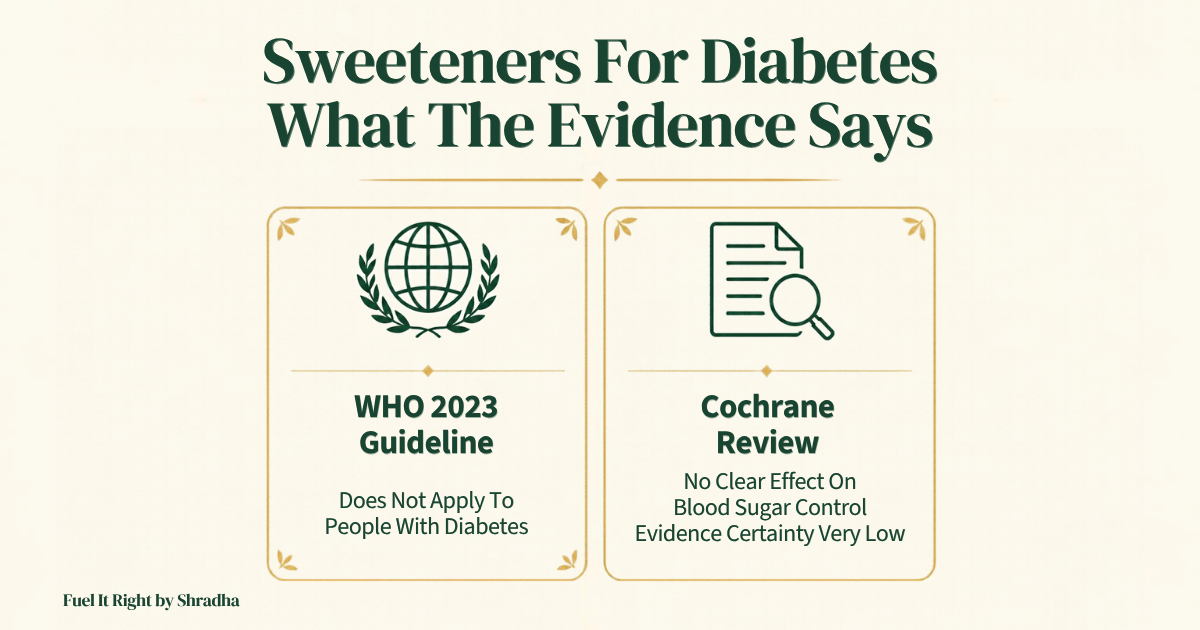
In May 2023, WHO published advice on sweeteners. It suggested not using them to manage weight or to lower the risk of long-term diseases. It was a cautious recommendation, based on weak evidence, mostly from studies that only observe people.
The same guideline said it does not apply to people who already have diabetes. That is a big detail for sweeteners for diabetes, and most headlines left it out. If you stop sweeteners out of fear and go back to sugar, you may end up worse off.
What Studies in People With Diabetes Found
A Cochrane review pooled the trials in people with diabetes. It found no clear effect on long-term blood sugar control, the number your doctor calls HbA1c. The trials were few, small and short, so the reviewers rated the evidence as very low certainty.
That sounds scary, but it is not a warning. It simply means nobody has tested this properly in people with diabetes yet. Think of it as a gap in the research, not a red flag.
A Cochrane review is useful because it combines many trials and tells you how far to trust the result. A very low rating means the answer could change when better studies arrive. Until then, I treat the evidence as neutral. It is neither reassuring nor alarming.
In everyday terms, sweeteners for diabetes work as a swap. If you replace a spoon of sugar in your chai with a zero-calorie sweetener, that sugar is simply gone from your day.
Blood Sugar Is Only Half the Story
First people look at blood sugar and the news on stevia and aspartame is good. Neither one raises blood sugar directly. The tougher questions are about using them over years, how they affect your gut and what they do to your heart.
Your heart matters more than usual here, because diabetes already raises heart risk. Your gut matters because many sweeteners reach the large intestine, where they may affect your gut bacteria. This research is early, so I see it as a reason to go easy, not a reason to panic.
That is why I look at each sweetener separately. A plant extract, a lab-made compound, and a sugar alcohol are very different things, and lumping all sweeteners for diabetes together hides that.
Key Takeaways • The 2023 WHO advice on sweeteners was not written for people who already have diabetes, so it does not directly answer your question. • A major review of trials in people with diabetes found no clear effect on blood sugar control, but the evidence is weak because the trials were few and small. • Stevia and aspartame do not raise blood sugar directly, and neither is proven harmful at normal amounts. • Erythritol, found in many “sugar-free” products, was linked to heart problems in one 2023 study. It cannot prove cause, but it is worth watching. • Sachets and tablets often contain fillers that add a little carbohydrate, so the label matters more than the brand. |
What the Research on Sweeteners for Diabetes Shows
Most discussions about sweeteners for diabetes confuse two separate questions. Does it raise your blood sugar? And is it safe to take for years? The answers are different, so let’s tackle them one at a time.
What the WHO Warning Actually Covers
In May 2023, WHO published advice on sweeteners. It suggested not using them to manage weight or to lower the risk of long-term diseases. It was a cautious recommendation, based on weak evidence, mostly from studies that only observe people.
The same guideline said it does not apply to people who already have diabetes. That is a big detail for sweeteners for diabetes, and most headlines left it out. If you stop sweeteners out of fear and go back to sugar, you may end up worse off.
What Studies in People With Diabetes Found
A Cochrane review pooled the trials in people with diabetes. It found no clear effect on long-term blood sugar control, the number your doctor calls HbA1c. The trials were few, small and short, so the reviewers rated the evidence as very low certainty.
That sounds scary, but it is not a warning. It simply means nobody has tested this properly in people with diabetes yet. Think of it as a gap in the research, not a red flag.
A Cochrane review is useful because it combines many trials and tells you how far to trust the result. A very low rating means the answer could change when better studies arrive. Until then, I treat the evidence as neutral. It is neither reassuring nor alarming.
In everyday terms, sweeteners for diabetes work as a swap. If you replace a spoon of sugar in your chai with a zero-calorie sweetener, that sugar is simply gone from your day.
Blood Sugar Is Only Half the Story
First people look at blood sugar and the news on stevia and aspartame is good. Neither one raises blood sugar directly. The tougher questions are about using them over years, how they affect your gut and what they do to your heart.
Your heart matters more than usual here, because diabetes already raises heart risk. Your gut matters because many sweeteners reach the large intestine, where they may affect your gut bacteria. This research is early, so I see it as a reason to go easy, not a reason to panic.
That is why I look at each sweetener separately. A plant extract, a lab-made compound, and a sugar alcohol are very different things, and lumping all sweeteners for diabetes together hides that.
Shradha's Tip Ignore the front of the packet and read the ingredients list. The sweetener is often a tiny part of the product, and the other ingredients decide what it does to your blood sugar. |
Stevia, Monk Fruit, Aspartame and Erythritol Compared
Here’s how the four most common options stack up. Each card includes my verdict and a simple way to use it. These are practical judgments on sweeteners for diabetes, not guaranties, as long-term research in people is limited for all of them.
Stevia
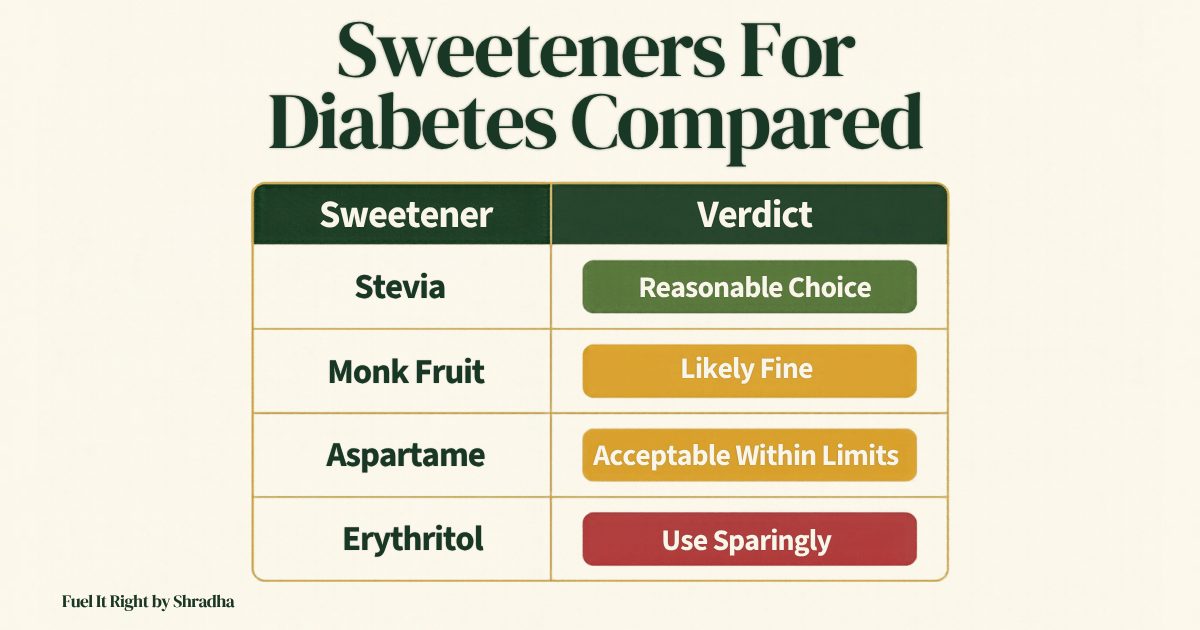
Among sweeteners for diabetes, stevia is the one clients ask about first. It comes from the leaves of the stevia plant, tastes very sweet, and has no calories. Food safety experts have set a safe daily limit of 4 mg for every kg you weigh, for the purified extract used in products.
Some people find it bitter or a bit like licorice. The purified forms taste cleaner than the green leaf powders. It's available in drops, tablets and more and more sugar free foods and drinks.
In the US and Europe, only the purified extract has been approved, not crude leaf extracts. So a pack that says stevia leaf powder is not the product that safe limit was set for.
Stevia Reasonable choice, moderate use |
It does not raise blood sugar directly. Long-term studies in people with diabetes are limited, and some products mix it with other ingredients. How to make it work: Pick plain stevia products and check the label for added dextrose or maltodextrin. |
Monk Fruit
Monk fruit is a small fruit that has long been used in Chinese cooking and traditional remedies. The sweetness of monk fruit comes from natural compounds in the fruit. The honest summary is that human research is thin. It looks safe at normal amounts, but I can not point to strong diabetes studies.
It is also expensive, so it often appears as a small part of a blend. The main ingredient may be a filler or erythritol. Ingredients are listed from most to least, so the order on the pack shows what you are really buying.
Monk Fruit Likely fine, thin evidence |
It does not seem to raise blood sugar, but few human studies exist. Some products are blended with erythritol. How to make it work: Check whether erythritol is on the label, because that changes the picture. |
Aspartame
Of all sweeteners for diabetes, aspartame is the most studied and the most feared. In 2023, a cancer research agency called IARC listed it as possibly cancer-causing, in a group named 2B. At the same time, the expert committee that advises WHO and FAO kept the safe daily limit unchanged at 40 mg per kg of body weight.
Group 2B means limited evidence, not proven harm. For a 70 kg adult, the limit is about 2,800 mg a day. A can of diet cola has about 200 mg, so normal use is well below the limit.
You will find aspartame in diet colas, sugar-free desserts, and many tablets. It breaks down with heat, so it is rarely used in baking. Some people get headaches from it, though studies have not consistently confirmed this.
Aspartame Acceptable within limits |
It does not raise blood sugar. The cancer listing reflects limited evidence, and regulators kept the daily limit as it was. How to make it work: Keep it to a few servings a day, and avoid it completely if you have phenylketonuria (PKU), a rare inherited condition. |
Erythritol and Other Sugar Alcohols
Erythritol is a sugar alcohol that’s in a ton of sugar-free candies, protein bars and keto products. It deserves the closest look of the four. A 2023 study in Nature Medicine found that higher levels of erythritol in the blood were associated with heart attacks and strokes among people already at high heart risk.
That study only observed people, and the body makes small amounts of erythritol on its own. So it does not prove erythritol causes harm. But people with diabetes already face higher heart risk, so I would not use it daily until better trials arrive.
Most erythritol is absorbed and leaves the body in urine, so it is gentler on the stomach than other sugar alcohols such as sorbitol and maltitol. Those two can cause bloating and loose stools. Some people cope with small amounts, and others do not.
Erythritol Use sparingly |
It barely raises blood sugar. One 2023 study raised a possible heart concern, though it cannot prove cause. How to make it work: Check labels on sugar-free and keto products, because erythritol hides in them. |
WHAT YOU'VE HEARD Artificial sweeteners are poison, so people with diabetes are better off with plain sugar. |
WHAT'S ACTUALLY TRUE Plain sugar raises blood sugar directly. Studies of sweeteners show no clear harm to blood sugar control, and regulators consider stevia and aspartame safe within daily limits. |
Who Should Be Most Careful
Some require extra care with sweeteners for diabetes. If you have phenylketonuria, you must not have aspartame at all. If you have irritable bowel syndrome, sugar alcohols often upset your gut.
If you already have heart disease, go slowly with erythritol until the research settles. Children, and anyone who is pregnant, should talk to their doctor before using sweeteners regularly.
If your use keeps creeping up, with more diet drinks and sugar-free sweets each month, bring it up with your dietitian. It usually means the craving needs attention, not a new product.
How to Use Sweeteners if You Have Diabetes
How you use a sweetener matters more than which one you pick. Three habits do most of the work for sweeteners for diabetes, and none needs a special product.
Read the Label on Tablets and Sachets
Tablets and sachets are seldom pure sweetener. They usually contain fillers like maltodextrin or lactose to give them bulk, and that adds a little carbohydrate. Liquid drops and pure powders tend to have less filler but only the label will tell you for sure.
One sachet will not matter. Four or five a day across chai and coffee can add up. For sweeteners for diabetes, the ingredients list tells you more than the brand name.
Keep Track of How Much You Use
There are safe daily limits and normal use is well below these. The more useful limit is your own habit. If you still have the same sweet drinks and desserts you have merely changed what you sweeten with not how much sweetness you need.
Try counting for two weeks. Note every sachet, diet drink, and sugar-free sweet. Most people are surprised by the total. That number tells you more than any brand does.
Cut Down Sweetness Slowly
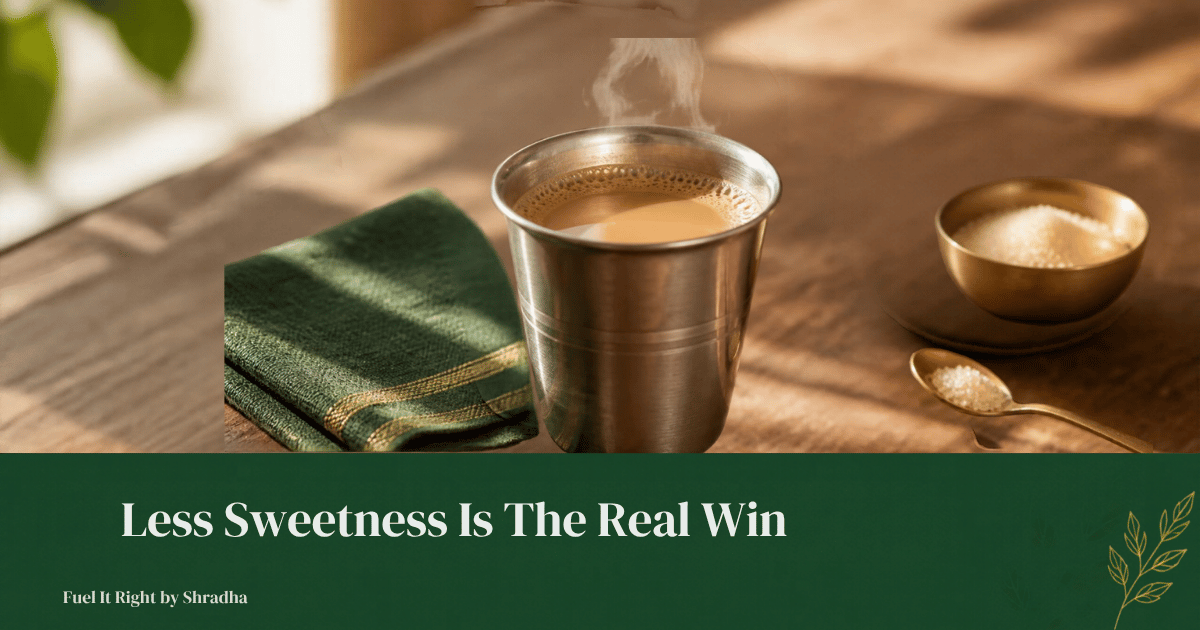
I recommend to cut sweetness in baby steps. Half a spoon less sugar in your chai this fortnight, a little less next. Taste tends to adjust in a few weeks. The goal is not to find a perfect substitute but to need less sweetness.
This follows on from the post on jaggery vs sugar. Swapping one sweetener for another is a small win. Needing less sweetness is the bigger one.
What a Real Day Looks Like
Picture a client who has three cups of chai with two teaspoons of sugar each. That is six teaspoons, about 24 grams of sugar, before a single meal.
Switching all three cups to a sweetener removes that sugar overnight. A slower plan often lasts longer. Go to one teaspoon per cup, then half, then use a sweetener only in the evening cup.
Desserts work the same way. A small serving of the real thing after a protein-rich meal is usually better than a big serving of sugar-free mithai made with sugar alcohols. Sugar-free does not mean carbohydrate-free.
If you check your sugar at home, watch your readings after trying any new product. A rise usually points to the filler or other ingredients, not the sweetener itself. Share the pattern with your doctor.
Shradha's Tip Pair sweet foods with protein or fibre, whichever sweetener you use. A small portion of fruit with a handful of nuts is gentler on your blood sugar than the same fruit alone. |
If you are not sure how your stomach handles sweeteners, especially sugar alcohols that can cause bloating, the Gut Health Quiz is a good place to start.
The Bottom Line on Sweeteners for Diabetes
Sweeteners for diabetes are a tool, not a treatment. Stevia and aspartame are reasonable in moderate amounts. Monk fruit probably is too, though the evidence is thinner. Erythritol deserves more caution. None of them replaces the bigger work on your overall plate.
If you are following this series, the earlier posts on rice, millets, and intermittent fasting cover the other pieces of eating well with diabetes.
Here’s my general preference order for most clients: Lower your overall sweetness. Use stevia or aspartame in small amounts. Keep erythritol-heavy products occasional. After any big change, review your long-term blood sugar and home readings with your doctor.
Want a clear plan for sweetness that fits your blood sugar numbers and the way you actually eat?
Book a consultation
Frequently Asked Questions About Sweeteners for Diabetes
Which Sweetener Is Best for Diabetes?
There is no best. Stevia and aspartame do not raise blood sugar and are considered safe in daily amounts. Monk fruit is probably fine but less is known. Pick one you can use and use it sparingly and look for extra carbs in the ingredient list.
Do Sweeteners Raise Blood Sugar?
Stevia, aspartame, and monk fruit do not raise blood sugar directly. Some tablets and sachets contain fillers that add a little carbohydrate. Sugar alcohols such as maltitol can raise blood sugar a bit, so check labels on sugar-free sweets.
Is Aspartame Safe for People With Diabetes?
Within the daily limit of 40 mg per kg of body weight, regulators consider it safe. The 2023 cancer listing reflects limited evidence, not proven harm. People with phenylketonuria must avoid it completely.
Is Stevia Better Than Aspartame?
Neither is clearly better. Stevia comes from a plant, which appeals to many people, while aspartame has far more safety research behind it. Both leave blood sugar unchanged. Taste and comfort usually decide, since some people find stevia bitter.
Is Monk Fruit Safe for Diabetes?
It seems safe at normal doses and doesn't seem to spike blood sugar. But there are few studies in people with diabetes. See if product is cut with erythritol or other fillers.
Should I Avoid Erythritol if I Have Diabetes?
I would limit it. A 2023 study linked higher erythritol levels in the blood to heart problems in people at high heart risk. It only observed people, so it is not proof. Because diabetes already raises heart risk, I prefer cautious use until better trials arrive.
Can Sweeteners Make Me Crave More Sugar?
The evidence is mixed. Some researchers think that constant sweetness keeps your taste for it high, but studies have not settled this. Slowly lowering sweetness overall is a safer plan than relying on substitutes.
Can I Use Sweeteners in Cooking and Baking?
It is dependent on the sweetener. Stevia holds up pretty well to heat, aspartame loses its sweetness when heated. Sugar also lends structure to baked goods, so the results would be different. Try replacing just part of the sugar at first and see how the recipe responds.
Shradha | Nutritionist & Dietitian | Fuel It Right