
Intermittent Fasting and Diabetes: What Research Shows
What recent trials on intermittent fasting and diabetes actually found, including a trial built for people on insulin, and who should not attempt fasting without medical supervision.
Table of Contents
• What the Research on Intermittent Fasting and Diabetes Actually Shows
• The Real Numbers From Recent Trials
• What Changes When Insulin Is Involved
• Why Intermittent Fasting Is Not the Same Risk for Everyone With Diabetes
• The Catch Most Online Content Skips
• Who Should Not Try This Without Medical Supervision
• The Risk Framework Doctors Actually Use
• How to Fast Safely During Navratri or Any Religious Fast With Diabetes
• What to Change on a Fasting Day If You Have Diabetes
• Warning Signs to Stop a Fast Immediately
• A Realistic Way to Start If You've Never Fasted With Diabetes
• The Bottom Line
• FAQ's: Intermittent Fasting and Diabetes
Intermittent fasting and diabetes has become one of the most urgent questions I get asked right now. Navratri fasting is underway across India, with Diwali season close behind. Clients want to know if skipping meals for a festival is safe. That question gets sharper once blood sugar medication is already part of daily life.
Social media presents intermittent fasting as a blood sugar fix for everyone, just like any other diet trend. But the real research paints a more complex picture. It really depends on what medications someone is on and what fasting protocol they select.
This post looks at what recent trials on intermittent fasting and diabetes actually found. One trial was built specifically for people on insulin. It also lays out who can try fasting safely, and who genuinely should not without their doctor first.
Key Takeaways • A 2024 RCT (99 people, 12 weeks) found time-restricted eating (16:8) cut fasting blood sugar by 30.91 mg/dL and body weight by 4.02%, with zero hypoglycaemic events across all three trial arms. • A 2023 JAMA Network Open trial found intermittent fasting and plain calorie counting improved HbA1c by about the same amount (roughly 0.9%), though fasting produced more weight loss. • A trial in insulin-treated type 2 diabetes (INTERFAST-2) only proved safe because of a strict protocol: 20% lower basal insulin on fasting days plus continuous glucose monitoring throughout. • A 2025 review found the metabolic benefits fade once fasting stops, so this works through consistency, not a one-time reset. • The International Diabetes Federation says fasting is not recommended for everyone with diabetes, especially on insulin, in pregnancy, or with a history of severe hypoglycaemia. |
What the Research on Intermittent Fasting and Diabetes Actually Shows
Most research on intermittent fasting had, until recently, excluded people with diabetes altogether, for fear of hypoglycaemia. Now this has changed. Between 2023 and 2025, several trials were published testing real intermittent fasting and diabetes protocols in people with type 2 diabetes, some of whom were already on medication.
The Real Numbers From Recent Trials
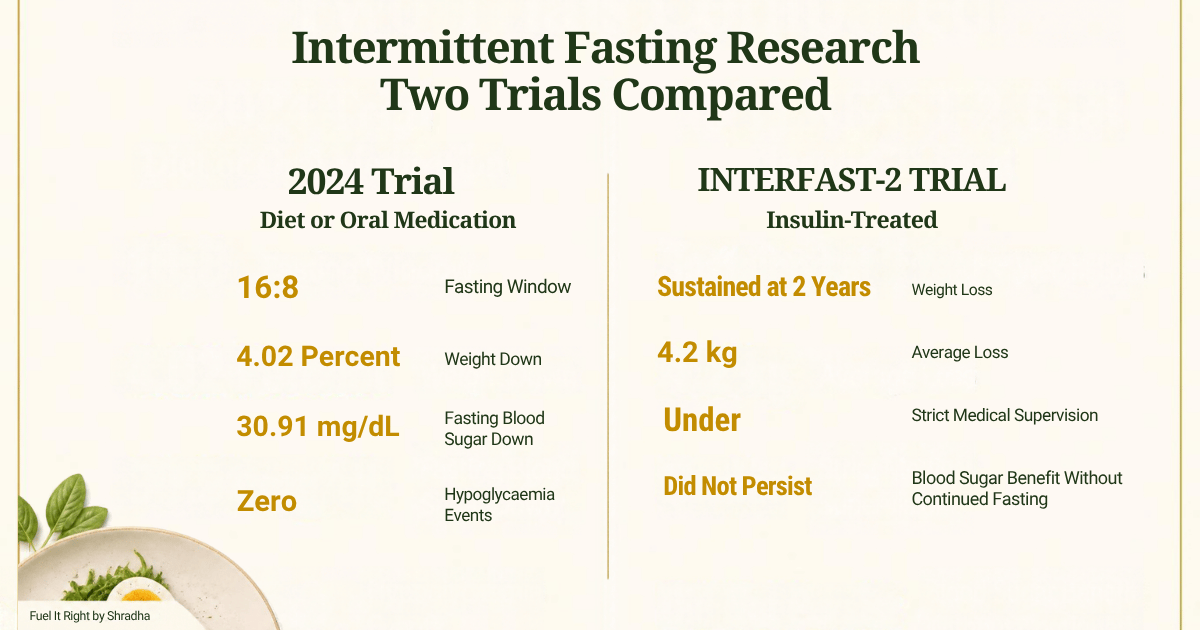
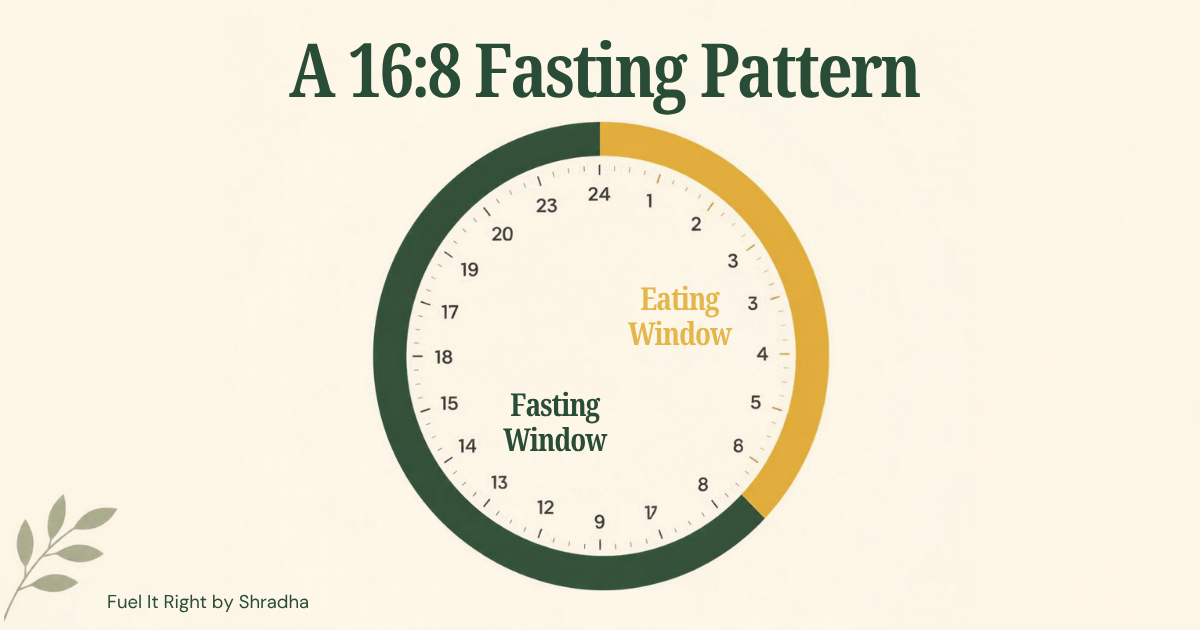
A 2024 trial in Thailand's Journal of Diabetes Investigation randomly assigned 99 people with type 2 diabetes to one of three groups. They followed a 16:8 fasting window, a 14:10 window, or no fasting, three days a week for twelve weeks.
The 16:8 group lost 4.02 percent of body weight and dropped fasting blood sugar by 30.91 mg/dL. The 14:10 group lost 3.15 percent and dropped fasting blood sugar by 28.06 mg/dL. The control group barely moved on either measure.
HbA1c also dropped – by about half a percentage point in both fasting groups. The control group dropped by about 0.2 percent. There were no hypoglycaemic events in any of the three groups. That’s a reassuring safety signal for intermittent fasting and diabetes management on oral medication.
A separate 2023 trial published in JAMA Network Open compared an eight-hour eating window against plain calorie counting. The trial followed 75 people with type 2 diabetes over six months. The fasting group lost more weight, 3.56 percent versus 1.78 percent.
But HbA1c improved by roughly the same amount in both groups, about 0.9 percent. Intermittent fasting and diabetes control, in other words, is not automatically better than counting calories for blood sugar itself. It does beat calorie counting for weight and consistency, though.
Some of this effect might be circadian, not just caloric. Insulin sensitivity is generally better earlier in the day, so if you eat all your meals earlier in the day your blood sugar may be better controlled even before weight is lost, but this has yet to be studied directly in diabetes trials, and I will say it’s promising, not proven.
What Changes When Insulin Is Involved
Every trial on intermittent fasting and diabetes above studied people managing the condition with diet or oral medication, not insulin. Insulin changes the risk profile completely. A fasting stomach and a fixed insulin dose is a recipe for a genuine low.
A German trial called INTERFAST-2 tested this directly, in people with insulin-treated type 2 diabetes, over twelve weeks. It only worked because of a strict safety protocol most home attempts never build in.
On days when participants were due to fast, their basal insulin was reduced by 20 percent even before the fast began. Glucose monitors were used to continuously monitor all participants throughout the day. If a reading fell below 3.9 mmol/L the fast was stopped immediately.
Under that supervision, fasting proved safe over 12 weeks, with no severe hypoglycaemia in either group. HbA1c fell significantly more in the fasting group than in the control group, and eight people hit a stricter combined target of weight loss, insulin-dose reduction, and HbA1c improvement together, compared to none in the control group.
A two-year follow-up told a more complicated story. The weight loss held, a significant 4.2 kg average loss compared to 0.4 kg in the control group. But the blood sugar improvement seen at 12 weeks did not last once supervision ended, and almost half the fasting group had stopped fasting altogether by then.
That result is genuinely encouraging for intermittent fasting and diabetes management on insulin specifically, at least for weight. But it depends entirely on the medication adjustments and monitoring that made it safe, not on the fasting alone, and the glucose benefit needs continued practice to stick.
Shradha's Tip If you're on insulin or a sulfonylurea and want to fast for a festival, talk to your doctor about adjusting your dose first. Do it before the fast, not after a low blood sugar episode during it. |
Why Intermittent Fasting Is Not the Same Risk for Everyone With Diabetes
None of this means intermittent fasting is safe when blood sugar is under control. Two things are missing from most social media coverage of intermittent fasting and diabetes. Both are important to anyone deciding whether to try it.
The Catch Most Online Content Skips
The first is durability. A 2025 systematic review found that the metabolic benefits of intermittent fasting in type 2 diabetes were real in the short term. They tended to fade once people stopped fasting.
That does not make the earlier results fake. It means fasting works like most dietary changes do, through consistency. It is not a permanent metabolic reset achieved once and kept forever without further effort.
Another 2025 meta-analysis, pooling data from more than 1,100 participants, found an average decrease in HbA1c of 0.81 percent and an average weight loss of 4.56 kilograms. Those numbers are broadly in line with the individual trials on intermittent fasting and diabetes above.
That durability question is also a fair reason to start now rather than wait. A festival built around one meal a day already resembles a real fasting protocol. Tracking your own numbers through it can double as a genuine trial, not just a religious observance.
WHAT YOU'VE HEARD Skipping a meal or two is basically the same as a supervised fasting trial, so it should be safe for anyone with diabetes. |
WHAT'S ACTUALLY TRUE The safe results above came from structured protocols with medication adjustments and glucose monitoring built in. Fasting without that supervision, especially on insulin or a sulfonylurea, carries a real hypoglycaemia risk the research doesn't erase. |
Who Should Not Try This Without Medical Supervision
The second gap is who was actually studied in these trials on intermittent fasting and diabetes. Every safe outcome above was found in adults with type 2 diabetes, under a doctor’s care. It was not found in people managing type 1 diabetes, pregnancy, or a history of severe hypoglycaemia.
The International Diabetes Federation is explicit that fasting is not recommended for everyone with diabetes. It lists chronic complications, pregnancy, and poorly controlled blood sugar as reasons to sit a fast out entirely.
A history of disordered eating is another reason to be cautious with structured fasting protocols, and worth raising directly with your doctor before Navratri rather than treating it as a separate, unrelated conversation.
The Risk Framework Doctors Actually Use
The IDF-DAR risk calculator was updated for 2026. It’s the go-to tool doctors use to sort who can safely mix intermittent fasting and diabetes management, and how. The tool is based largely on decades of Ramadan fasting research.
Navratri, Ekadashi, and other Hindu fasting traditions have not been studied anywhere near as extensively as Ramadan fasting has. That makes this a reasonable place to extend the Ramadan evidence carefully, not a like-for-like substitute for it.
The underlying physiology does not change based on which religious calendar a fast belongs to. What happens to blood sugar and medication when food intake stops for hours is the same either way. The caution the research supports does carry across.
How to Fast Safely During Navratri or Any Religious Fast With Diabetes
With Navratri fasting approaching, the question is not whether to fast, but how to fast without an emergency. Intermittent fasting and diabetes can coexist for many people, if the right adjustments are made in advance, not in the middle of the fast.
Here is how the three approaches people actually ask about compare, based on how much supervision and adjustment each one realistically needs.
Time-Restricted Eating (12-16 Hour Window) GOOD (diet or oral medication) |
Matches the best-studied protocols above; a near-normal eating window still allows steady, meal-timed medication dosing. How to make it work: Keep your usual medication timing, just compress the window, and check your glucose before extending the fast further. |
One Full Meal a Day (Typical Navratri Pattern) MODERATE (needs a medication check first) |
A longer gap between food and any insulin or sulfonylurea dose raises real hypoglycaemia risk without an adjustment. How to make it work: Get your dose adjusted with your doctor before the fast starts, and break the fast with protein and fibre, not fruit juice alone. |
Full Day, Water-Only Fast on Insulin HIGH CAUTION (medical clearance required) |
No trial reviewed here tested a full water-only day in insulin-treated diabetes; the unsupervised hypoglycaemia window is long. How to make it work: Do not attempt this without your doctor's explicit sign-off and a clear glucose-monitoring plan for the day. |
What to Change on a Fasting Day If You Have Diabetes
You'll often need to adjust when you take your medication and not just the fasting hours. This is the very conversation you need to have with your doctor before the Navratri starts and not on the first morning of fasting. Intermittent fasting and managing diabetes both depend on getting that timing right.
When you do eat, choose protein, fibre, and a little fat over a fruit-only or fully liquid meal, the same reasoning behind why meal timing matters independent of what you eat. That combination slows the glucose rise far more effectively.
Water and electrolytes matter more than most fasting guides admit. Dehydration on top of a fasting blood sugar swing is what usually turns a manageable day into an emergency room visit.
Warning Signs to Stop a Fast Immediately
Shakiness, sweating, sudden confusion, or a fast heartbeat during a fast are signs of low blood sugar. They are not a sign to push through for the sake of finishing the day.
Should this happen, end the fast immediately with a fast-acting sugar source and check your glucose. This is not a time for willpower and it is not a failure of the fast.
Quick Check Keep a fast-acting glucose source within reach on every fasting day: glucose tablets, a small juice box, or plain sugar. Don't leave it buried at the bottom of a bag you're not carrying that day. |
A Realistic Way to Start If You've Never Fasted With Diabetes
If you’re fasting for the first time with diabetes, try a shorter fast first – one meal missed rather than a full day. Save the whole festival stretch for when you know how your body reacts.
Check your blood sugar before, during, and after that first attempt. Intermittent fasting and diabetes management is genuinely individual, and one person's safe protocol is another person's emergency.
Curious how your own eating pattern affects your blood sugar day to day? Take the free Gut Health Quiz for a personalised starting point rooted in your actual routine.
The Bottom Line on Intermittent Fasting and Diabetes
Intermittent fasting and diabetes can be a safe combination for many people. That conclusion is supported by actual trial data, not just social media anecdotes. The catch is that every safe result included medication adjustment and monitoring, not left to chance.
Used carelessly on insulin or a sulfonylurea, without a doctor's input, that same fasting window can put someone in the emergency room instead. It helped a supervised trial participant only because the supervision was there. That is not a reason to avoid fasting. It is a reason to plan it properly.
If you want a fasting plan built around your specific medications and your actual festival calendar, book a consultation below.
This is the third post in an ongoing series on Indian diets and diabetes, following the first post on rice and the previous post on millets. If there is a specific food, habit, or myth you want examined next with this same level of scrutiny, that is exactly what this series is for.
Want a fasting plan built around your specific medications and your actual festival calendar?
Book a consultation:
Frequently Asked Questions: Intermittent Fasting and Diabetes
Is Intermittent Fasting Safe for People With Type 2 Diabetes?
Yes, for many people on diet or oral medication alone, under supervision. A 2024 trial of 99 people found meaningful weight loss and HbA1c improvement with zero hypoglycaemic events. Safety with intermittent fasting and diabetes depends heavily on which medications you take, so check with your doctor first.
Can I Fast With Diabetes If I'm on Insulin?
Only with medical supervision built in. The INTERFAST-2 trial tested this in insulin-treated type 2 diabetes. It cut basal insulin by 20 percent on fasting days and used continuous glucose monitoring throughout. Attempting the same fast without those adjustments is not the same protocol.
Does Intermittent Fasting Work Better Than Counting Calories for Diabetes?
Not for HbA1c specifically. A 2023 trial found intermittent fasting and plain calorie counting improved HbA1c by roughly the same amount, about 0.9 percent. The fasting group did lose more weight, though, and adhered to the plan more consistently.
How Long Do the Blood Sugar Benefits of Intermittent Fasting Last?
A 2025 review found the benefits were real short-term but tended to fade once people stopped fasting, similar to most dietary interventions. A two-year follow-up of an insulin-treated trial confirmed this exactly: weight loss held, but the blood sugar improvement itself did not, once supervision ended.
Is It Safe to Fast for Navratri If I Have Diabetes?
It relies on your medication and control, not the festival. The clinical risk framework doctors use, the IDF-DAR tool, was developed mainly on Ramadan fasting research. The same medication and hypoglycaemia risks apply to any extended religious fast, including Navratri.
What Should I Eat When I Break a Fast With Diabetes?
Protein, fibre, and a little healthy fat first, not fruit juice or plain carbohydrates on an empty stomach. That combination slows the glucose rise far more than a sugary or liquid-only meal after hours without food.
What Are Warning Signs I Should Stop Fasting Immediately?
If you feel shaky, sweaty, confused or have a racing heart then your blood sugar is probably too low. Break your fast immediately with a fast acting source of sugar and check your glucose. Don't try to make it to the end of the day.
Who Should Not Attempt Intermittent Fasting With Diabetes at All?
Four groups should not attempt intermittent fasting with diabetes without explicit medical clearance: anyone with type 1 diabetes, anyone pregnant, anyone with a recent history of severe hypoglycaemia, and anyone with poorly controlled blood sugar. That is the standing guidance from the International Diabetes Federation.
Shradha | Nutritionist & Dietitian | Fuel It Right