
Jaggery vs Sugar for Diabetes: What the Research Shows
What two real studies found when they tested jaggery against sugar in people with diabetes, what jaggery's minerals actually add up to, and what that means for festival season.
Table of Contents
• What the Research on Jaggery and Blood Sugar Actually Shows
• The Real Numbers From a Direct Trial
• Why the Glycaemic Index Numbers Don't Always Agree
• Why the Belief About Jaggery Persists
• What Jaggery Actually Offers, and What It Doesn't
• The Real Mineral Content, Per Realistic Serving
• Why Natural Doesn't Change How Your Body Processes It
• What This Means for Your Plate This Festival Season
• If You Still Want to Use Jaggery Occasionally
• What About Honey or Coconut Sugar Instead?
• The Festival Trap Worth Naming
• The Bottom Line on Jaggery vs Sugar for Diabetes
• Frequently Asked Questions
Jaggery vs sugar for diabetes is one of the most common questions I get every festival season. Diwali sweets are already on the horizon. The belief that jaggery is natural, and therefore safer, is everywhere, on packaging, in family kitchens, and across wellness content. Real research tells a different story.
Social media treats jaggery as an instant upgrade to white sugar, something you can just switch out without a second thought. That narrative ignores the real chemistry. Jaggery is unrefined sugarcane or palm juice. Sugar is refined. But both are concentrated sources of glucose and fructose that your body processes nearly identically.
The claim shows up beyond the sweet itself, too. Packaged snacks, ladoos, and even some traditional remedies get labelled diabetic-friendly specifically because they use jaggery instead of white sugar, not because anyone actually tested the blood sugar response.
In this post we look at what recent studies found when they tested jaggery versus sugar in real diabetes patients. It covers what jaggery’s mineral content amounts to at a realistic serving size, and what jaggery versus sugar for diabetes actually means for your plate this festival season.
Key Takeaways • A 2022 randomised trial in 43 people with type 2 diabetes found no significant difference between cane sugar and coconut jaggery in blood glucose response. • A 2025 review found jaggery's glycaemic index (84 to 84.4) higher than white sugar's (roughly 65), the opposite of its “safer” reputation. • A realistic teaspoon of jaggery supplies under 4% of daily iron needs, its main nutritional selling point is smaller than it looks. • Both studies agree on the bottom line: jaggery is not a meaningfully safer sweetener for diabetes, whichever specific number you trust. • Portion and pairing with protein or fibre matter more than which sugar sits in your kitchen this festival season. |
What the Research on Jaggery and Blood Sugar Actually Shows
Most of what circulates about jaggery vs sugar for diabetes traces back to processing, not to an actual blood sugar test. Two separate lines of research have measured this directly. Neither supports the idea that jaggery is the safer swap.
That is where scale matters. India has over 101 million people living with diabetes, according to the ICMR-INDIAB data cited earlier in this series. For a large share of them, jaggery is a normal part of the diet, not an occasional indulgence. For jaggery vs sugar for diabetes, that scale is precisely why the specific evidence matters more than a general food philosophy.
The Real Numbers From a Direct Trial
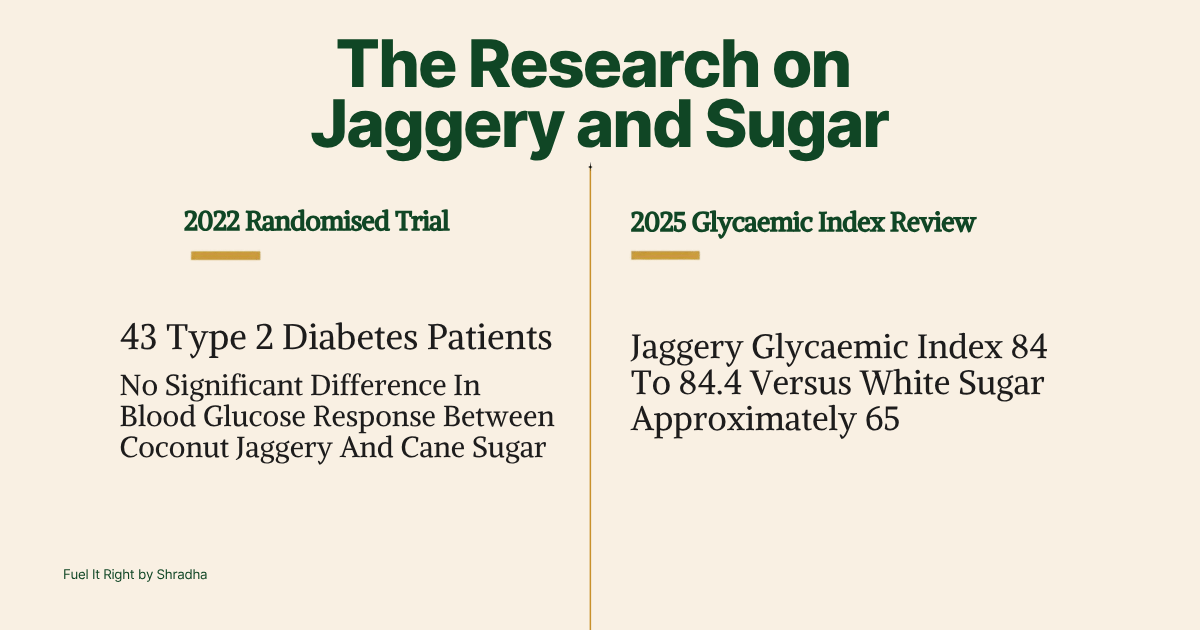
A 2022 study in the Journal of Future Foods tested 43 people with type 2 diabetes. It used a randomised crossover design, following the FAO's standard glycaemic index protocol. Each person consumed 50 grams of digestible carbohydrate from glucose, cane sugar, and coconut jaggery, on separate days.
Blood was drawn at baseline and at set intervals afterward, tracking exactly how each sweetener moved blood glucose over two hours. That design lets researchers compare the sweeteners directly, in the same people, rather than across different study populations.
The results showed there was no statistically significant difference between cane sugar and coconut jaggery. This was true for both peak blood glucose and the total area under the glucose curve. The study's own conclusion was simple: Coconut jaggery cannot be considered a healthy substitute for cane sugar in people with type 2 diabetes.
Why the Glycaemic Index Numbers Don't Always Agree
A separate 2025 review compared glycaemic index data across studies. It put jaggery even higher than sugar, at 84 to 84.4, compared to roughly 65 for white sugar. That review's own conclusion was blunt: the belief that jaggery is inherently safer for people with diabetes is not scientifically supported.
The two findings do not perfectly match each other. One found no real difference. The other found jaggery scoring worse. Jaggery's glycaemic index varies by source, sugarcane versus palm versus coconut, and by how it is processed afterward.
What both agree on is the conclusion that matters most. Jaggery vs sugar for diabetes is not a meaningfully safer trade, whichever specific number you trust.
Reported glycemic index values for plain white sugar also vary a little from paper to paper, from the high 50s to the mid 60s, depending on the reference food and testing protocol used. That range is itself a reason to be wary of any single confident number thrown around online, jaggery's included.
Why the Belief About Jaggery Persists
Jaggery vs sugar for diabetes gets asked so often partly because Ayurvedic tradition credits jaggery with aiding digestion after a meal. That is a claim about digestion, not about blood sugar. The distinction gets lost by the time the idea reaches a shop shelf or a family WhatsApp forward.
Packaging is also a factor. Jaggery-sweetened snacks, ladoos and some remedies are sold as diabetic-friendly or no added sugar precisely because jaggery is not white sugar. Nobody tested actual glycemic response before printing that claim. Closing that exact gap is what the two studies above were designed to do.
Shradha's Tip Read the ingredients list on anything labelled jaggery-sweetened or no added sugar, not just the front label. Jaggery syrup, jaggery powder, and cane sugar often sit on the same ingredient line under different names. |
What Jaggery Actually Offers, and What It Doesn't
Jaggery does contain minerals that refined white sugar has almost none of. That real difference is the strongest part of jaggery's case. The question worth asking, for jaggery vs sugar for diabetes specifically, is whether that difference matters at the amount anyone actually eats.
The Real Mineral Content, Per Realistic Serving
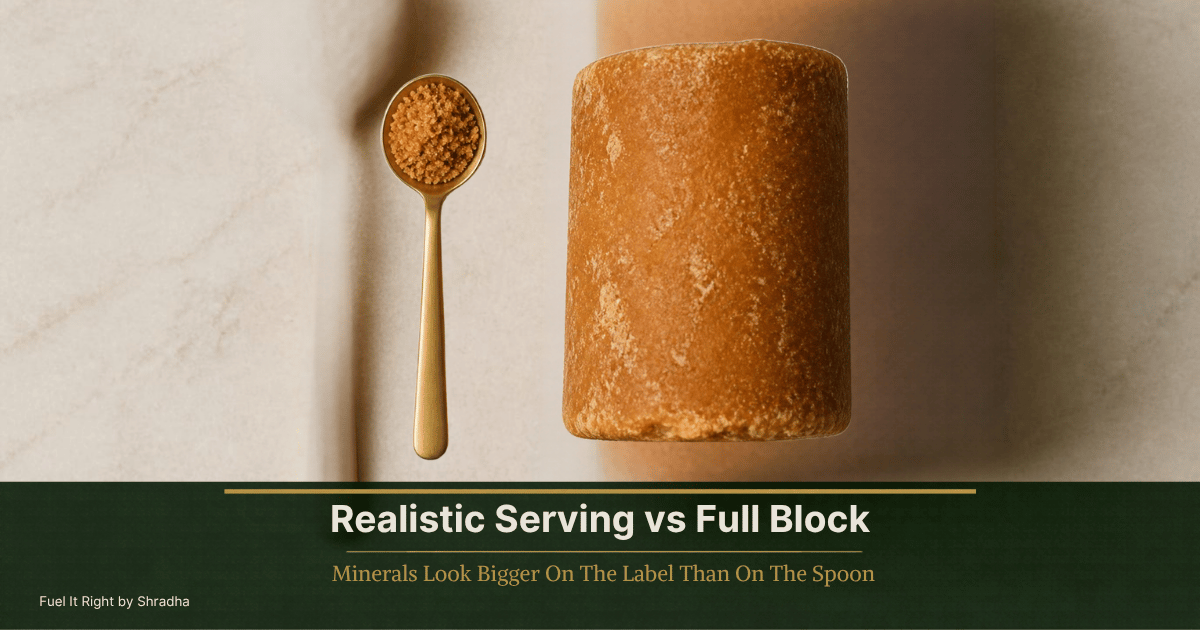
Jaggery has around 10 to 13 mg of iron, around 1,056 mg of potassium and 70 to 90 mg of magnesium per 100 grams. That sounds significant on paper. But nobody eats 100 grams of jaggery in one sitting, that is close to seven tablespoons of solid jaggery.
A single teaspoon, closer to how jaggery actually gets used, works out to roughly 0.5 to 0.65 mg of iron and about 53 mg of potassium. Against a daily iron requirement of 18 mg for most adult women, that is under 4 percent from one teaspoon. It is not a meaningful contribution to your day.
A usual serving of cooked spinach or chana will provide you several times the amount of iron in a teaspoon of jaggery, from a source that your body can absorb more efficiently. If iron is the real aim, jaggery is a really inefficient way to get there.
The iron in jaggery is also non-heme iron, the plant-based form your body absorbs far less efficiently than the iron in meat, fish, or eggs. Tea or coffee near a meal blocks much of it further, the same absorption problem covered in an earlier post on iron and chai timing.
Why Natural Doesn't Change How Your Body Processes It
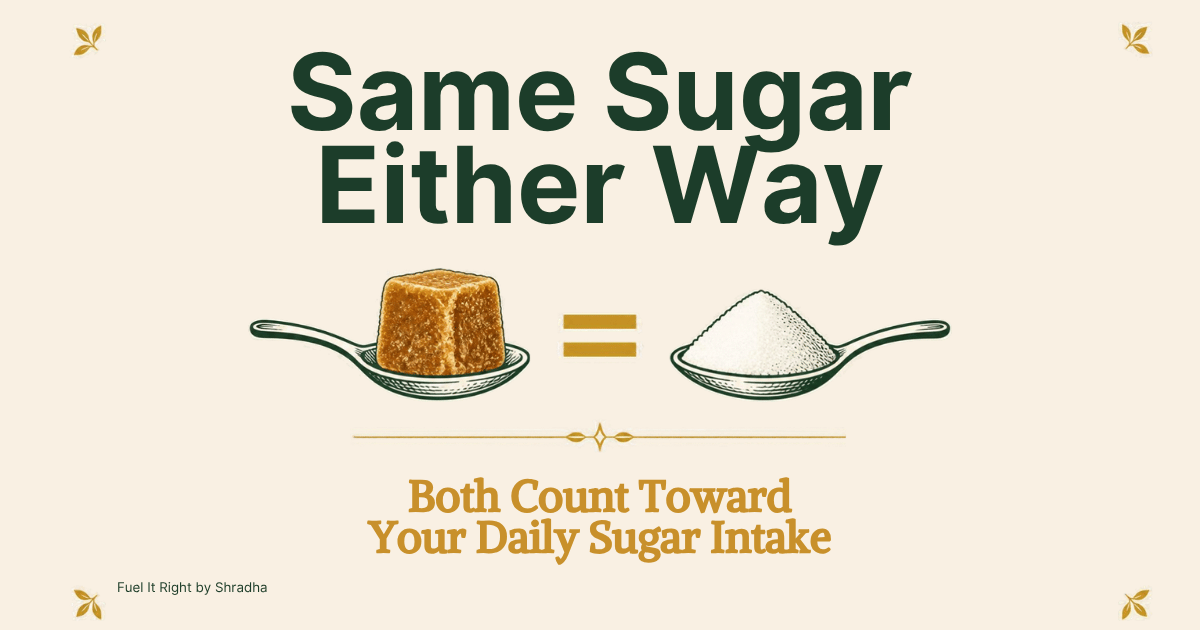
Jaggery and white sugar are both mostly sucrose. Either way, your gut breaks that down into equal parts glucose and fructose. Less processing does not create a different metabolic pathway. For jaggery vs sugar for diabetes, your pancreas and liver respond to the sugar molecule itself, not whether it arrived wrapped in molasses or bleached white.
WHAT YOU'VE HEARD Jaggery is unprocessed and natural, so it doesn't spike blood sugar the way white sugar does, and people with diabetes can use it freely instead of sugar. |
WHAT'S ACTUALLY TRUE A 2022 randomised trial found no meaningful blood sugar difference between cane sugar and coconut jaggery in people with type 2 diabetes, and a 2025 review put jaggery's glycaemic index higher than sugar's, not lower. |
What This Means for Your Plate This Festival Season
Diwali mithai made with jaggery gets marketed as the health-conscious choice at nearly every sweet shop this time of year. If you have diabetes or prediabetes, that label deserves the same scrutiny as any other sugar on the shelf.
If You Still Want to Use Jaggery Occasionally
A small amount of jaggery used occasionally is not dangerous in itself, just as a small amount of sugar is not. The problem is treating it as a free pass. That mindset allows you to have larger portions, or more frequent servings, than you would ever allow yourself with plain sugar.
If you do use jaggery, treat the portion exactly as you would treat sugar. Count it into your total carbohydrate intake for that meal. Pair it with protein or fibre to slow the glucose rise, rather than eating mithai on an empty stomach.
A realistic example: half a teaspoon of jaggery stirred into your evening chai, once in a while, fits inside an occasional treat. A jaggery-based ladoo the size of a golf ball at a wedding does not, regardless of which sweetener the shop used.
Foods with jaggery have to be treated with the same scrutiny as any other foods that are labeled no added sugar. Look at the total carbohydrate count and not just what sweetener they used instead of sugar. For jaggery vs sugar for diabetes, the total is the number that actually affects your blood glucose and not the marketing language on the front.
Whichever sweetener you use, current guidance caps free sugar at under 10 percent of daily calories, roughly 6 teaspoons for a typical adult. Jaggery counts toward that limit exactly like sugar does. It is not exempt from it just because it is less processed.
Quick Check A realistic jaggery serving is about a teaspoon, roughly the size of one sugar cube. If your family's usual serving looks bigger than that, that is the actual habit worth adjusting, not the ingredient. |
What About Honey or Coconut Sugar Instead?
Honey and coconut sugar are asked about for the same reasons as jaggery. The data on both are less settled than the jaggery-specific research above. Some studies put coconut sugar's glycemic index lower than table sugar. Others find close to no real difference at all.
The honest answer is that the exact number matters less than the pattern here. Every one of these is still a concentrated sugar. For jaggery vs sugar for diabetes and its cousins, the research gap around honey and coconut sugar is a reason for caution, not a reason to assume they are automatically safer.
The Festival Trap Worth Naming
The actual danger in Diwali is not the one sweet you eat mindfully. It is the health halo around jaggery-based mithai that makes the second and third helping feel justified in a way that plain sugar mithai won’t. The sugar that enters your bloodstream doesn’t know what version you picked. That is the real stakes in jaggery vs sugar for diabetes: not the ingredient, but the portion it excuses.
Here is how the common choices actually compare, based on what the research above supports rather than on marketing.
Jaggery Swapped One-for-One for Sugar NO ADVANTAGE (GI ~84 vs sugar's ~65) |
Direct trials and glycaemic index reviews both found jaggery raises blood glucose at least as much as sugar, sometimes more, despite its unprocessed reputation. How to make it work: Treat jaggery exactly like sugar in your carbohydrate count, not as a lower-risk substitute. |
Occasional Festival Mithai (Jaggery-Based) MODERATE (fine in small, planned portions) |
A small, occasional portion is not dangerous in isolation, but the health halo around jaggery mithai tends to make second and third helpings feel justified. How to make it work: Keep the portion to what you'd allow yourself with any sugar-based sweet, and pair it with protein or fibre. |
Jaggery as a Daily “Health” Habit HIGH CAUTION (mineral content too small to offset the sugar load) |
A realistic teaspoon supplies under 4 percent of daily iron needs, absorbed poorly at that, while still counting fully toward your sugar intake every single day. How to make it work: Get your iron and magnesium from food sources you'd eat anyway, like dals, greens, and nuts, not from jaggery. |
Whole Fruit for Everyday Sweetness GOOD (fibre slows the sugar release naturally) |
Whole fruit brings its sugar packaged with fibre and water, which slows absorption in a way no amount of jaggery's trace minerals can replicate. How to make it work: Reach for a piece of fruit first when a sugar craving hits, and save jaggery or sugar for genuinely occasional use. |
Curious about the impact of your daily food choices, including sugar, on your gut and blood sugar? Get a personalized starting point based on your real-life habits with the free Gut Health Quiz.
The Bottom Line on Jaggery vs Sugar for Diabetes
Jaggery vs sugar for diabetes comes down to this. The research does not support treating jaggery as the safer sweetener. A direct trial in people with type 2 diabetes found no real advantage. A separate review found jaggery's glycaemic index higher than sugar's. Its mineral content is real but too small at typical servings to change that picture.
None of this means jaggery is banned. It means portion and pairing matter more than what sugar is in the bowl, especially with festival season and its jaggery-laden sweets arriving. Treat every sweetener the same way: in small doses, with protein or fiber, and counted in your daily total.
If you want a plate built around your specific numbers and your actual festival calendar, book a consultation below.
This is the fourth post in an ongoing series on Indian diets and diabetes, following the post on rice, millets, and intermittent fasting (Blog 121). If there is a specific food, habit, or myth you want examined next with this same level of scrutiny, let me know.
Want a festival eating plan that accounts for your actual sugar and carbohydrate budget, not guesswork?
Book a consultation:
Frequently Asked Questions About Jaggery vs Sugar for Diabetes
Is Jaggery Really Worse Than Sugar for Diabetes?
None of the studies reviewed here found jaggery to be better. A 2022 randomized trial found no significant difference between cane sugar and coconut jaggery in terms of blood glucose response. A 2025 review found jaggery’s glycemic index was higher than that of white sugar. Jaggery vs sugar for diabetes isn’t the clear win jaggery is marketed to be.
Can I Use Jaggery in My Tea or Coffee If I Have Diabetes?
Only in the same small amounts, and with the same caution, you would use with sugar. Count it into your carbohydrate total for that meal rather than treating it as a free addition, since it affects blood glucose in a very similar way.
Does Jaggery Have Any Real Health Benefit Over Sugar?
It does contain iron, potassium, and magnesium that white sugar lacks. But a realistic serving, closer to a teaspoon than a handful, supplies under 4 percent of daily iron needs. That iron is also poorly absorbed. It is not a meaningful nutritional advantage at the amounts people actually eat.
Is Coconut Jaggery Different From Cane Jaggery for Blood Sugar?
Both raised blood glucose similarly in the direct trial above, which specifically tested coconut jaggery against cane sugar. Glycemic index does vary somewhat between cane, palm and coconut jaggery, depending on source and processing. No type has been shown to be genuinely safer for diabetes.
What About Honey or Coconut Sugar, Are Those Safer?
The research on both is less settled than the jaggery-specific studies above, with mixed findings depending on the study. Treat them with the same caution as jaggery, rather than assuming a lower reported number makes them automatically safe to use freely.
How Much Jaggery Is Safe During Festivals If I Have Diabetes?
In small, infrequent servings, counted in your total carbohydrate intake for that meal, ideally with protein or fiber rather than on an empty stomach. The bigger risk during festivals is portion creep, not the specific sweetener used in the mithai.
Why Does Jaggery Have a Diabetic-Friendly Reputation If the Research Disagrees?
Jaggery's reputation rests heavily on being unrefined and containing trace minerals, which gets marketed as inherently healthier without a blood sugar test behind it. That halo effect is strong enough that even some clinicians repeat it without checking the actual glycaemic data.
What Should I Actually Use Instead of Sugar or Jaggery?
Just like any other sugar: keep portions tight, pair with protein or fiber and count it into your overall daily carb budget. Whole fruit is a better everyday source of sweetness because the fiber comes along for the ride. Work with your doctor or dietitian on what your individual carb budget will allow.
Shradha | Nutritionist & Dietitian | Fuel It Right