
Methi, Jeera, Cinnamon: The PCOS/PMOS Spice Protocol
Methi, jeera, and cinnamon are not just spices. For women with PCOS and PMOS, they are clinical tools with RCT evidence for reducing insulin resistance, fasting glucose, and androgen levels.
Table of Contents
1. Why Your Spice Cabinet Is a Clinical Tool
2. What Makes a Spice Clinically Relevant for PCOS/PMOS
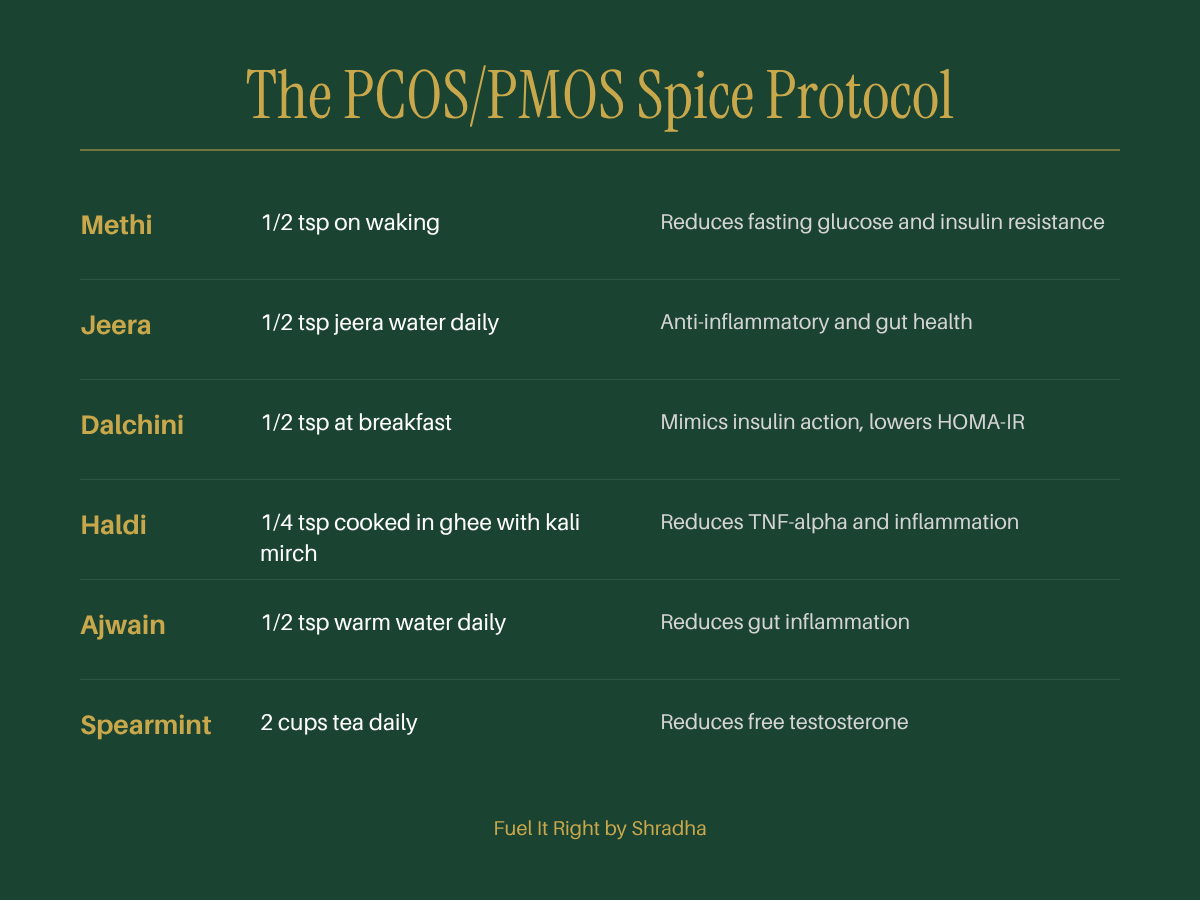
3. The 6-Spice Protocol: Full Evidence and How to Use Each
4. The Daily Spice Routine: How to Fit All 6 Into One Day
5. What Not to Expect: Honest Caveats
6. Conclusion
7. FAQs
Why Your Spice Cabinet Is a Clinical Tool
For women with PCOS and PMOS, the Indian spice cabinet is one of the most pharmacologically active parts of the kitchen, and the most underutilised as a therapeutic resource.
The spices covered in this blog are not flavour additions to a treatment plan. They have specific, well-mapped mechanisms for reducing insulin resistance, lowering fasting glucose, reducing androgen levels, decreasing systemic inflammation, and improving gut microbiome composition, all of which are directly relevant to the metabolic root of PCOS/PMOS. For the full picture of how insulin resistance drives the condition, see the blog on insulin resistance and PCOS/PMOS. For the inflammation side, see the blog on PCOS/PMOS and inflammation.
Your grandmother was doing metabolic medicine every morning. She just did not call it that.
The difference between using spices therapeutically and using them decoratively is dose, consistency, and preparation method. This blog covers all three for each spice. What the clinical evidence shows, exactly how to use it, and what the realistic daily dose looks like in an Indian kitchen.
What Makes a Spice Clinically Relevant for PCOS/PMOS
Not all spices with anti-inflammatory properties are clinically relevant for PCOS/PMOS. The six in this protocol were selected on three criteria: evidence from randomised controlled trials or high-quality clinical studies, a specific mechanism relevant to PCOS/PMOS pathways, and practical daily usability in an Indian kitchen.
A spice that reduces blood sugar in vitro, in a laboratory dish, is not the same as one that has been tested in women with PCOS and shown results. The protocol below uses only spices that meet the clinical evidence bar.
One important clarification before the protocol These spices work as adjuncts to a food-first protocol, not as replacements for it. Methi water without changing your breakfast pattern produces modest results. Methi water alongside protein-first meals, the meal sequence rule, and consistent curd produces synergistic results. The spices amplify the dietary protocol, they do not replace it. |
1. Methi (Fenugreek seeds) Mechanism: Galactomannan fibre slows gastric emptying and reduces the rate of glucose absorption from the gut, directly reducing post-meal insulin surges. The amino acid 4-hydroxyisoleucine directly stimulates insulin secretion from pancreatic beta cells and improves insulin receptor sensitivity. Galactomannan also acts as a prebiotic, feeding the gut bacteria that produce butyrate and improve insulin sensitivity through the gut-hormone axis. Clinical evidence: Multiple Indian RCTs confirm measurable reductions in fasting glucose and post-meal glucose. Methi supplementation for 8 to 12 weeks consistently reduces HOMA-IR in women with PCOS. One study showed a 46% reduction in fasting glucose with consistent methi seed use over 10 days. How to use: Half a teaspoon soaked overnight in a small glass of water. Drink the water on waking. Alternatively add sprouted methi seeds to paratha dough, dal, or salad. Add methi powder to sabzi or dal for cooking. Daily dose: Half teaspoon daily on waking |
2. Jeera (Cumin seeds) Mechanism: Cuminaldehyde and thymoquinone inhibit COX-1 and COX-2 inflammatory enzymes - the same enzymes targeted by anti-inflammatory drugs. Jeera improves bile secretion and gut motility, addressing the bloating and digestive irregularity common in PCOS/PMOS gut dysbiosis. Jeera water stimulates the release of digestive enzymes from the pancreas, improving the breakdown of proteins and fats at every meal. Clinical evidence: Research shows jeera improves markers of glycaemic control and reduces inflammatory markers. A clinical study found daily jeera water supplementation significantly reduced fasting blood sugar and LDL cholesterol. The anti-inflammatory mechanism is well-mapped in peer-reviewed literature. How to use: Half a teaspoon in 400ml of water, boiled for 5 minutes or soaked overnight, drunk in the morning. Add whole jeera to the tadka for every dal and sabzi. Jeera water with a pinch of lemon is the most accessible daily preparation. Daily dose: Half teaspoon in jeera water daily, plus use in cooking |
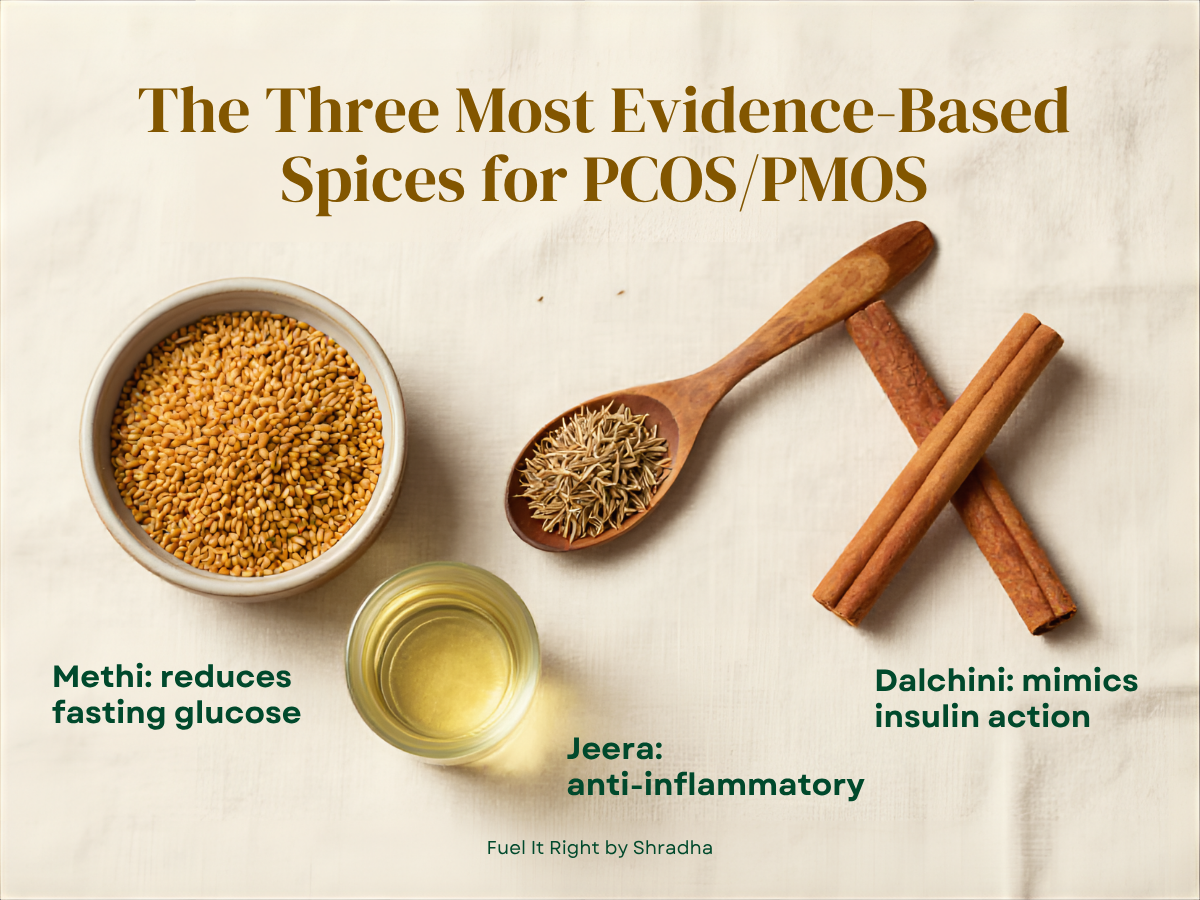
3. Dalchini (Cinnamon) Mechanism: Cinnamaldehyde activates insulin receptor tyrosine kinase and inhibits insulin receptor phosphatase - in simple terms, it mimics and amplifies insulin's action at the cellular level. Cinnamon also reduces hepatic glucose production, directly lowering fasting blood sugar independent of meals. A 2024 systematic review and meta-analysis confirmed cinnamon improves insulin resistance as measured by decreased HOMA-IR scores in women with PCOS. Clinical evidence: A double-blind RCT in 66 women with PCOS found cinnamon powder capsules at 1.5g/day for 12 weeks significantly reduced fasting insulin and HOMA-IR compared to placebo (p = 0.024 and p = 0.014 respectively). A separate RCT found menstrual cycles were significantly more frequent in women with PCOS taking cinnamon over 6 months compared to placebo. Multiple studies confirm reductions in fasting blood sugar, LDL cholesterol, and weight. How to use: Half teaspoon of cinnamon powder in chai (without sugar), oats with curd, or any cooked dish at breakfast. Use Ceylon cinnamon where available - it has lower coumarin content than cassia cinnamon for long-term daily use. Cassia cinnamon (the variety most commonly available in Indian markets) also has significant clinical activity. Daily dose: Half teaspoon daily - in breakfast or chai |
4. Haldi (Turmeric) Mechanism: Curcumin inhibits NF-kB, the master transcription factor that controls the production of pro-inflammatory cytokines including TNF-alpha, IL-6, and IL-1beta. All three are significantly elevated in Indian women with PCOS/PMOS. Curcumin also crosses the blood-brain barrier and reduces neuroinflammation, directly relevant to the mood and cognitive symptoms of PCOS/PMOS. Critical preparation note: curcumin is poorly bioavailable alone, it requires piperine from black pepper (increases absorption up to 2000%) and fat for absorption. Clinical evidence: Indian research published in Frontiers in Endocrinology confirmed significantly elevated TNF-alpha, IL-6, and IL-1beta in women with PCOS compared to healthy controls. Curcumin supplementation consistently reduces these markers. Always with black pepper and fat - without this combination, the clinical benefit is minimal. How to use: Cook haldi in a teaspoon of ghee or coconut oil before adding to dal or sabzi. Always add a pinch of kali mirch alongside. Haldi in warm water without black pepper or fat has very limited bioavailability. Daily dose: Quarter teaspoon daily cooked in ghee with kali mirch |
5. Ajwain (Carom seeds) Mechanism: Thymol in ajwain has antimicrobial and anti-inflammatory properties. Ajwain reduces gram-negative bacterial overgrowth in the gut, directly addressing one of the primary sources of the LPS-driven inflammation found in PCOS/PMOS. Ajwain also stimulates digestive enzyme secretion and reduces intestinal spasm, addressing the bloating, acidity, and irregular digestion common in PCOS/PMOS gut dysbiosis. Clinical evidence: Well-documented antimicrobial and anti-inflammatory properties in peer-reviewed literature. Particularly relevant for women with PCOS/PMOS who experience significant digestive symptoms like bloating, acidity, irregular bowel movements as these are often the first signs of gut dysbiosis driving the inflammatory load of the condition. How to use: Half teaspoon in a glass of warm water with a pinch of salt, drunk on an empty stomach or after meals. Add to roti dough, dal, or sabzi. Ajwain paratha in small amounts is a legitimate therapeutic food. Daily dose: Half teaspoon in warm water daily or in cooking |
6. Spearmint (Spearmint leaves) Mechanism: Spearmint contains rosmarinic acid which inhibits the enzyme 5-alpha reductase, reducing the conversion of testosterone to the more potent DHT that drives acne, hair fall, and hirsutism in PCOS/PMOS. Spearmint also has anti-androgen effects at the hypothalamic-pituitary level, reducing LH and therefore reducing the signal for ovarian androgen production. Clinical evidence: A peer-reviewed RCT found that two cups of spearmint tea daily for 30 days produced significant reductions in free testosterone and LH in women with PCOS. A longer 30-day study confirmed these results with further reductions at 30 days. This is the most evidence-based food-based androgen intervention available for PCOS/PMOS. For the full skin connection, see the blog on PCOS/PMOS and skin [internal link]. How to use: Two cups of spearmint tea daily - steep 4 to 5 fresh or dried spearmint leaves in hot water for 5 minutes. Morning and evening. Available at most Indian grocery stores and online. Daily dose: Two cups of spearmint tea daily |
The Daily Spice Routine: How to Fit All 6 Into One Day
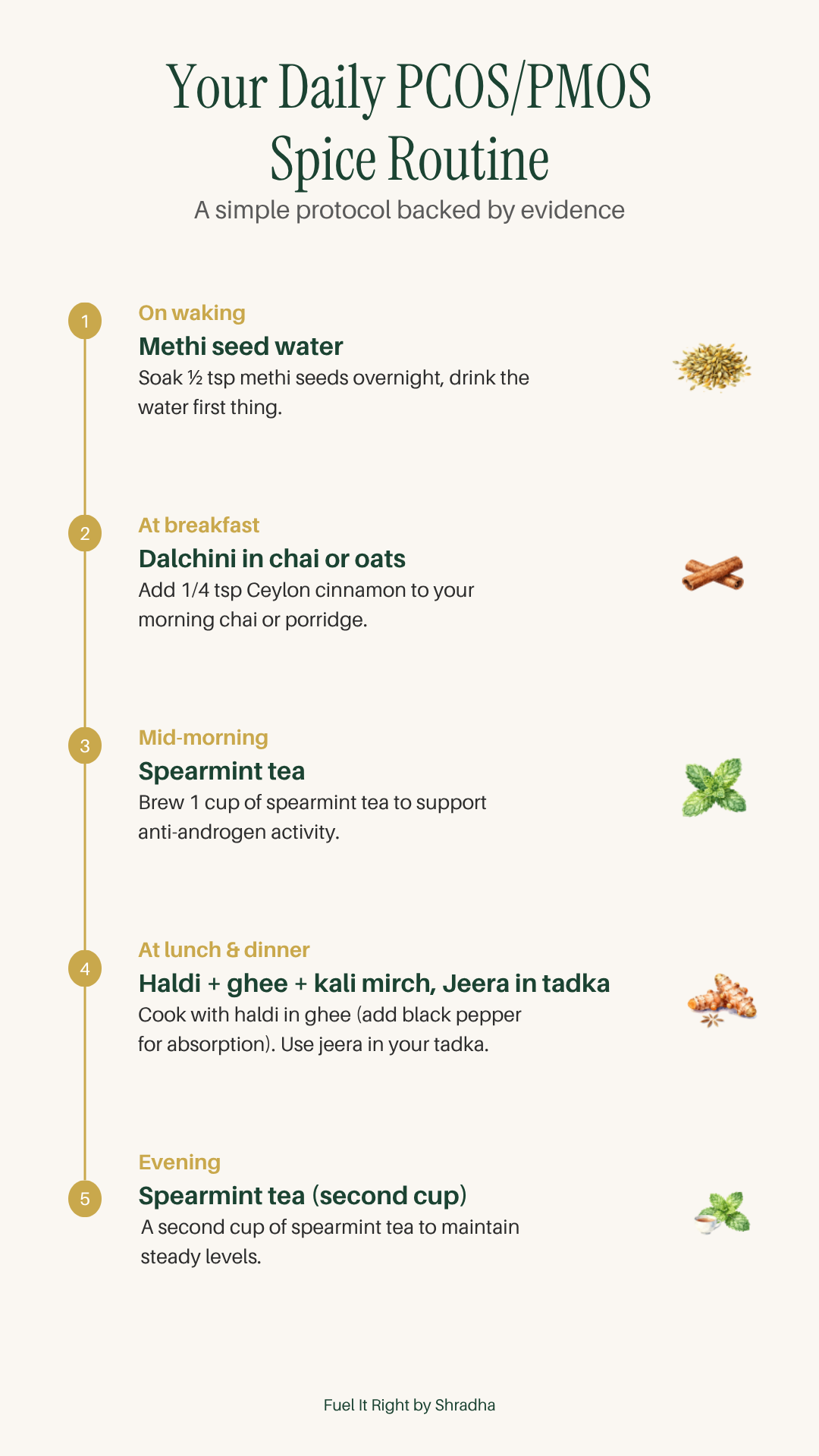
The most common question after reading a spice protocol is: how do I actually use all of these? The answer is that three of the six are part of normal Indian cooking and require no extra effort. The other three require a simple daily habit each. Here is how a day looks:
On waking (5 minutes) Methi seed water, half teaspoon soaked overnight. Drink the water. Ajwain water alternatively on days with bloating or acidity. At breakfast Half teaspoon dalchini in chai (brewed without sugar), or stirred into oats with curd. This is the most consistent way to achieve the clinical dose. At every lunch and dinner (in the cooking) Haldi cooked in ghee before the dal or sabzi, quarter teaspoon with a pinch of kali mirch. Jeera in the tadka for every dal. This requires no change to existing cooking habits. These are already standard Indian cooking practices. Mid-morning or evening One cup of spearmint tea. Steep for 5 minutes. The second cup at the opposite time of day. Weekly Ajwain in roti dough once or twice a week. Methi leaves (fresh methi) as a sabzi or added to dal when in season. Tthis doubles the daily methi dose in a whole-food form. |
What Not to Expect: Honest Caveats
The clinical evidence for these spices is real. The limitations of the evidence deserve equal attention.
• Most RCTs use supplemental doses, capsules or extracts, at consistent daily amounts. The clinical doses translated to food use in this blog are realistic approximations, not identical to the trial conditions. Cooking with haldi and jeera daily produces a lower but still meaningful cumulative effect compared to standardised capsule doses.
• Cinnamon studies use 1 to 1.5g daily, approximately half a teaspoon. This is a consistent, specific dose. Casually adding a sprinkle to chai occasionally does not achieve this.
• Results take time. Methi seed water for 3 days does not reduce HOMA-IR. Consistent daily use for 8 to 12 weeks is the timeframe in which clinical studies show measurable results. Patience is not optional.
• Spearmint tea is the most specific androgen intervention in the protocol. Two cups daily is the dose used in clinical trials. One cup occasionally does not produce the same results.
• These spices work best as part of the complete food protocol. The plate method, the sequence rule, and the gut health foundation. As standalone interventions without the broader dietary changes, they produce partial results.
Want to know which spice interventions are most relevant for your specific PCOS/PMOS picture?
Book a free 30-minute discovery call. Bring your blood report. We will tell you which pathways are most active in your case and which spices to prioritise.
Conclusion: The Protocol Your Kitchen Already Has
The PCOS/PMOS spice protocol does not require anything your Indian kitchen does not already have. Methi seeds, jeera, dalchini, haldi, ajwain, and spearmint are standard items in most Indian homes. The difference between using them decoratively and using them therapeutically is dose, preparation, and consistency.
Half a teaspoon of methi seeds soaked overnight. Half a teaspoon of dalchini in breakfast chai. Haldi cooked in ghee with kali mirch at every meal. Jeera in every tadka. Two cups of spearmint tea daily. Ajwain water when needed. This is not a new protocol. It is a structured application of what Indian cooking has always known, backed by what clinical research has now confirmed.
These spices amplify the food protocol. They do not replace it. Build the plate method first, apply the sequence rule, add curd daily, and then layer the spice protocol on top. That is the complete approach. For the full food protocol, see the blog on PCOS and PMOS: what to eat, when, and why.
Book a Free 30-Minute Discovery Call
Bring your blood report. We will build your personalised spice and food protocol from your metabolic picture.
Or call us: +91 7057063984
FAQs: Methi, Jeera, Cinnamon and PCOS/PMOS
Q1. Can I take methi seeds as a supplement instead of food?
Yes. Methi seed capsules at 1 to 5g daily are used in clinical studies and are available in Indian pharmacies and health stores. The food form soaked seeds or seeds cooked into food is preferred because it provides the galactomannan fibre intact and delivers the prebiotic benefit to the gut. Supplemental forms are appropriate when consistent food use is not practical.
Q2. Which type of cinnamon should I use for PCOS/PMOS?
Ceylon cinnamon (true cinnamon) has lower coumarin content than cassia cinnamon and is preferred for long-term daily use above half a teaspoon. Cassia cinnamon, the variety most commonly available in Indian markets and known as dalchini, has been used in most Indian PCOS clinical studies and has significant clinical activity. If you are using it at half a teaspoon daily in cooking or chai, cassia is appropriate. If you plan to use higher doses for extended periods, source Ceylon cinnamon.
Q3. How long before I see results from the spice protocol?
The evidence base shows results at 8 to 12 weeks of consistent daily use. Blood markers like fasting glucose, fasting insulin, HOMA-IR, free testosterone begin to shift within this timeframe. Subjective changes like reduced bloating, better digestion, slightly improved energy and cycle regularity, often appear earlier, within 3 to 4 weeks. Acne and hair fall changes from spearmint tea take longer, as the androgenic signalling changes at the follicle level require one complete hair growth cycle to manifest.
Q4. Can I use all 6 spices at the same time?
Yes. There are no known adverse interactions between these six spices at the recommended daily doses. Using all six simultaneously is the complete protocol. If you are starting from nothing, introduce one at a time over 2 weeks to identify whether any individual spice causes digestive sensitivity. Methi seeds can cause digestive discomfort at higher doses in some people, but the half-teaspoon dose is well-tolerated by most.
Q5. I already cook with these spices. Why is my PCOS/PMOS not improving?
Cooking with spices provides a lower, less consistent dose than the therapeutic protocol described here. The clinical difference is in consistency and preparation. Haldi in cooking without black pepper and fat has very limited curcumin bioavailability. Dalchini in a dish eaten twice weekly does not achieve the daily half-teaspoon target. Spearmint in occasional food use does not reach the two-cups-daily threshold for androgen reduction. The protocol requires intentional daily application at specific doses.
Q6. Is spearmint tea safe to drink every day?
Yes, at two cups daily. Spearmint has a very strong safety profile. The concern about herbs and hormones is largely about high-dose extracts, not food-form consumption. Two cups of spearmint tea daily is the dose used in clinical trials with no adverse effects reported. It should be avoided during pregnancy.
Q7. Can I use these spices alongside Metformin?
Yes. These spices work through mechanisms that complement rather than duplicate Metformin's action. Metformin reduces hepatic glucose production. Methi seeds reduce gut glucose absorption. Cinnamon improves cellular insulin signalling. They operate at different points in the insulin resistance cascade and are safe to use together. Inform your doctor of consistent high-dose spice use if you are monitoring blood glucose regularly, as combined effects may require dose adjustments in some cases.
Q8. Where can I source spearmint for making the tea in India?
Fresh spearmint (pudina) is widely available in Indian vegetable markets. It is the mint with the distinctively sweet, non-menthol smell compared to regular pudina used in chutneys - though many Indian markets carry it as a single variety. Dried spearmint is available at organic stores, online (Amazon India, Flipkart), and at Ayurvedic medicine shops. Check the label specifically for Mentha spicate, that is spearmint. Regular mint (Mentha piperita) does not have the same androgenic evidence.
About the Author
Shradha | Nutritionist and Dietitian | Fuel It Right. Practising out of Goa, India, with a focus on gut health, PMOS/PCOS, thyroid disorders, and weight management using real Indian food. No supplements. No machines. Just food, and the science behind it.
fuel-it-right.com | @fuelitright