
Iron Deficiency in India: Fix the Chai Timing First
57% of Indian women are anaemic, and the single biggest fixable factor might be when you drink your chai, not what you eat. Here's what the absorption research actually shows.
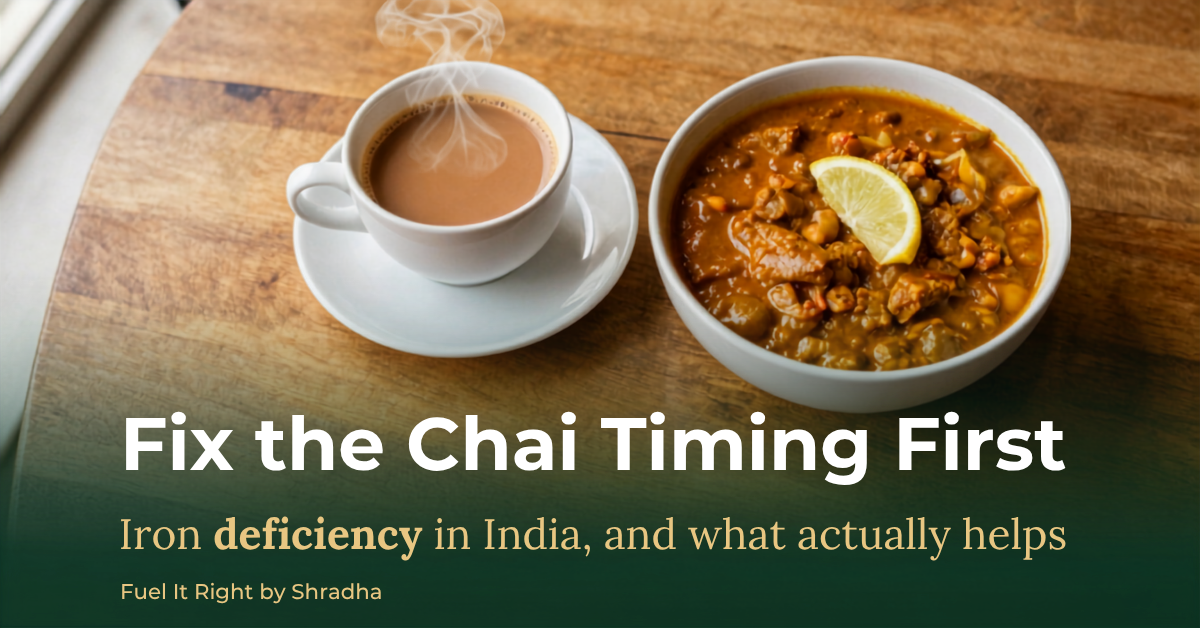
Table of Contents
1. Iron Deficiency in India: The Numbers Are Worse Than Most Assume
2. The Vegetarian Iron Problem: Heme vs Non-Heme
3. The Chai Problem Nobody Talks About
4. Does Vitamin C Actually Help? The Honest Answer
5. What Actually Moves Ferritin: The Dish-by-Dish Verdict
6. Building an Iron-Smart Day: Three Real Meals, Fully Assembled
Conclusion
FAQs
1. Iron Deficiency in India: The Numbers Are Worse Than Most Assume
Iron deficiency in India isn't a minor gap, it's the norm. NFHS-5 (2019-21), India's national health survey, found 57% of women aged 15 to 49 are anaemic, up from 53% in the previous round. Among children aged 6 to 59 months, the figure is 67.1%. This has been rising, not falling, across successive surveys.
For women with PMOS, this compounds further. Heavy or prolonged periods, common in PMOS, increase iron loss beyond what an already iron-poor diet needs to replace. If you're managing both, it's worth reviewing the PMOS diagnosis checklist alongside your iron numbers, since the two often need addressing together.
The good news: unlike some deficiencies, iron deficiency responds clearly and measurably to specific, evidence-backed changes. The less good news: most of the popular advice, more spinach, more jaggery, more supplements, targets the wrong lever.
2. The Vegetarian Iron Problem: Heme vs Non-Heme
Dietary iron comes in two forms. Heme iron, from meat, fish, and poultry, is absorbed efficiently and isn't much affected by what else is on the plate. Non-heme iron, from lentils, grains, and vegetables, the only source available in a vegetarian diet, is absorbed far less efficiently, and its absorption swings widely depending on what's eaten alongside it.
This isn't just theory. Multiple controlled studies using labelled iron isotopes confirm non-heme absorption from a single meal can vary several-fold based on the rest of the plate, while heme absorption barely moves. For a largely vegetarian population, that variability is the entire game.
Being vegetarian doesn't doom you to deficiency. It means the details of how you eat matter more than they would on a meat-inclusive diet.
There's a genuine silver lining here. A controlled trial comparing vegans and omnivores found vegans actually absorbed non-heme iron more efficiently, likely a physiological adaptation to a lifetime of lower dietary intake. The body adapts. It just needs the right conditions to work with.
3. The Chai Problem Nobody Talks About
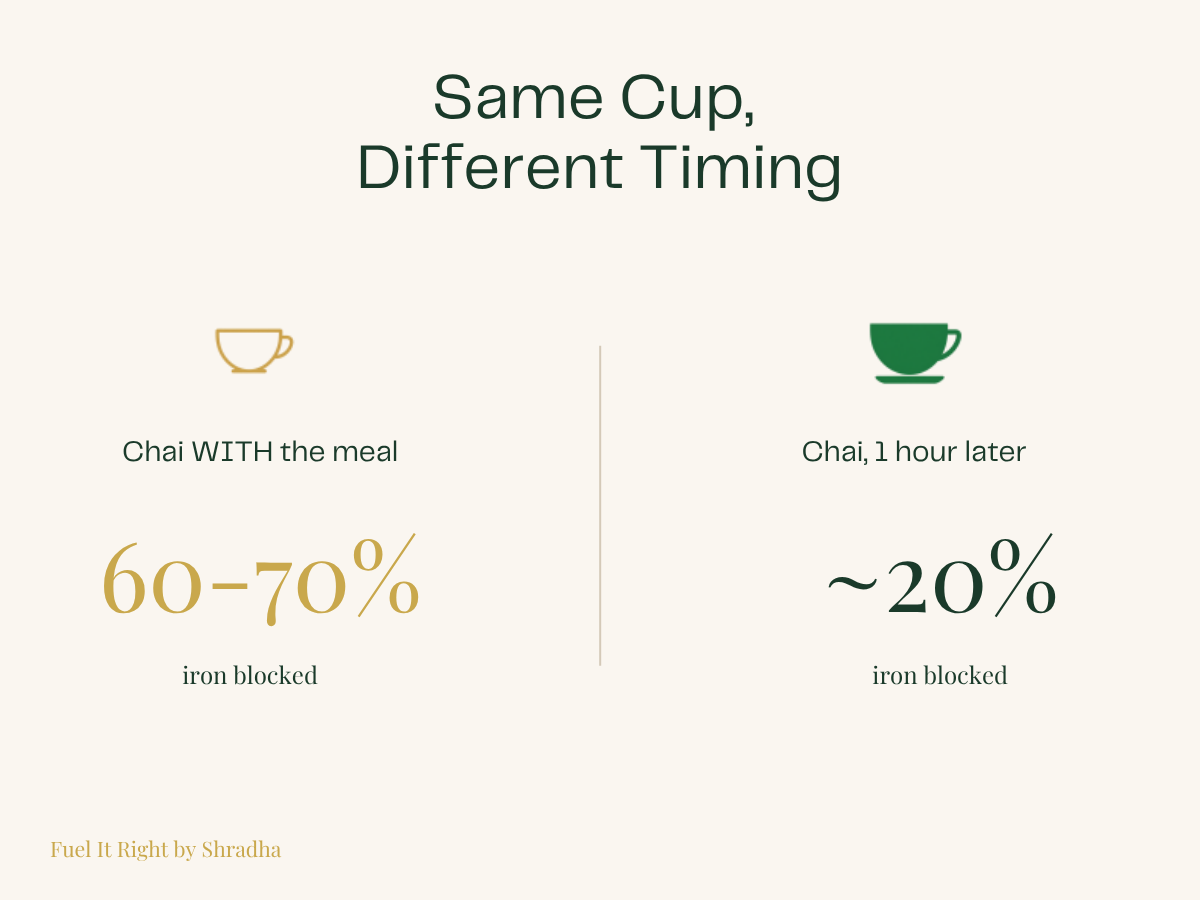
Tea tannins bind non-heme iron in the gut, forming a compound the body can't absorb. This isn't a minor effect. Controlled studies show black tea taken with a meal reduces non-heme iron absorption by 60 to 70%, regardless of how strong the tea is brewed. A separate isotope study found tea reduced absorption by at least 37% even under more moderate conditions.
The timing matters enormously. The same research shows that spacing tea by roughly one hour from an iron-containing meal cuts the inhibitory effect down to about 20%. For a country where chai is often poured within minutes of finishing a meal, this single habit may be doing more damage to iron status than any single food choice.
The Most Common Iron Mistake |
Having chai immediately after an iron-rich lunch or dinner, often within minutes of the last bite |
This can block 60 to 70% of the non-heme iron absorbed from that meal, regardless of how good the meal itself was |
Waiting roughly one hour before or after tea cuts this effect down to about 20%, without giving up chai at all |
4. Does Vitamin C Actually Help? The Honest Answer
Vitamin C is the most consistently recommended pairing for non-heme iron, and the mechanism is real: ascorbic acid converts iron into a form the gut absorbs more easily, and this effect is well documented in single-meal absorption studies.
But a randomised clinical trial testing vitamin C added to therapeutic iron supplements, not food, found no significant difference in ferritin recovery over 8 weeks compared to iron supplements alone. The takeaway isn't that vitamin C doesn't matter. It's that its benefit shows up most clearly at the meal level, boosting how much iron a given meal delivers, rather than meaningfully changing outcomes once you're already taking a therapeutic iron dose.
Practically: a squeeze of lemon over dal or rajma is still a reasonable habit for maximising a meal's iron yield. It's not, on its own, a substitute for addressing bigger levers like chai timing or actual iron intake.
Wondering what else your gut might be quietly working against?
Take the free Gut Health Quiz:
5. What Actually Moves Ferritin: The Dish-by-Dish Verdict
Not all Indian iron sources are equal, and some popular ones are weaker than their reputation suggests.
WHAT YOU'VE HEARD: Palak (spinach) is one of the best iron sources for vegetarians. |
WHAT'S ACTUALLY TRUE: Palak does contain iron, but it's also high in oxalates, compounds that bind iron in the gut and sharply limit how much is actually absorbed. It's a reasonable side vegetable, not a primary iron strategy. Rajma, chana, and moong sprouts do more practical work. |
WHAT YOU'VE HEARD: Jaggery is a powerful natural iron booster. |
WHAT'S ACTUALLY TRUE: Jaggery contains some iron, but the amount per typical serving is modest, and it's mostly relevant nutritionally as a less-refined alternative to white sugar. Relying on jaggery as an anaemia fix, a common home remedy, isn't well supported by how much iron it actually delivers per gram. |
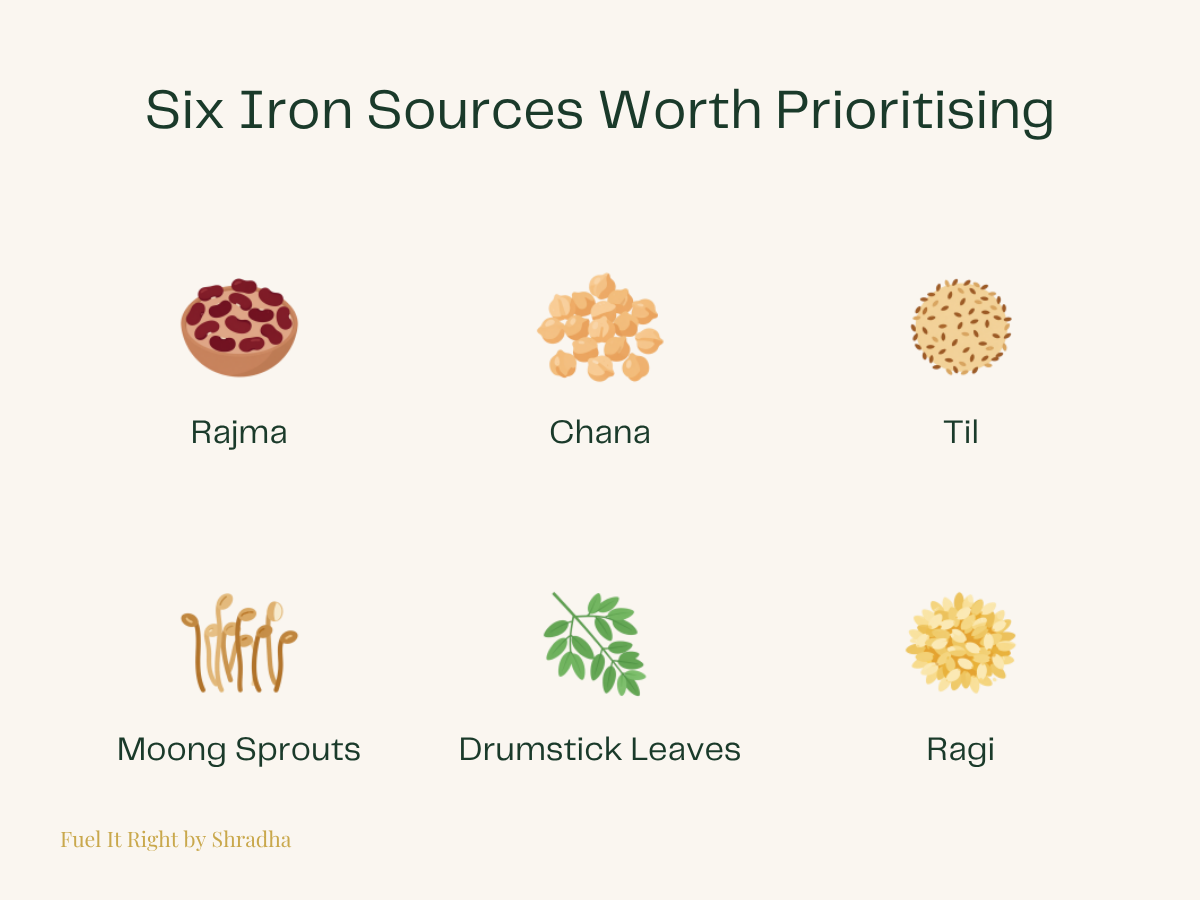
Rajma (Kidney Beans) STRONG CHOICE |
Combines iron with fibre and protein, and is traditionally cooked in a tomato-onion gravy, adding natural vitamin C to the same meal. How to make it work: Finish with a squeeze of lemon just before eating, not while cooking, since vitamin C degrades with heat. |
Chana (Chickpeas) STRONG, NEEDS PREP |
Iron-dense, but carries meaningful phytates that blunt absorption in their raw, unsoaked form. How to make it work: Soak for at least 8 hours and discard the soaking water before cooking; sprouting reduces phytates further. |
Til (Sesame Seeds) STRONG CHOICE |
Small quantity, concentrated iron content, easy to add daily without changing a full meal. How to make it work: A tablespoon of til chutney or a til-jaggery ladoo most days adds up more than an occasional large serving. |
Moong Sprouts STRONG CHOICE |
Sprouting measurably reduces the phytates that block non-heme absorption, on top of moong's existing iron and protein content. How to make it work: Sprout for 24 to 48 hours before eating raw or lightly cooked; a lemon-dressed sprout salad is a strong lunch side. |
Drumstick Leaves (Moringa) STRONG CHOICE |
Among the more iron-dense leafy greens in Indian cooking, without palak's heavy oxalate load. How to make it work: Add to dal or as a simple sabzi 2 to 3 times a week; fresh or dried both retain meaningful iron content. |
Ragi (Finger Millet) STRONG CHOICE |
A solid non-heme source that also fits naturally into a lower-GI breakfast rotation. How to make it work: Ragi dosa or ragi porridge for breakfast is a practical, repeatable iron source, not just an occasional health-food swap. |
6. Building an Iron-Smart Day: Three Real Meals, Fully Assembled
This is a starting structure, not a rule that chai or palak are off-limits. The goal is shifting what surrounds your iron sources, not eliminating anything.
Your Iron-Smart Checklist, At a Glance |
Move chai to at least one hour away from your main iron-containing meals |
Soak or sprout chana, rajma, and moong before cooking to reduce phytates |
Add a squeeze of lemon to dal, rajma, or chana just before eating, not during cooking |
Don't rely on palak or jaggery as your primary iron source |
Rotate rajma, chana, moong sprouts, til, drumstick leaves, and ragi through the week rather than eating one large iron-rich meal occasionally |
Three Real Meals, Fully Assembled
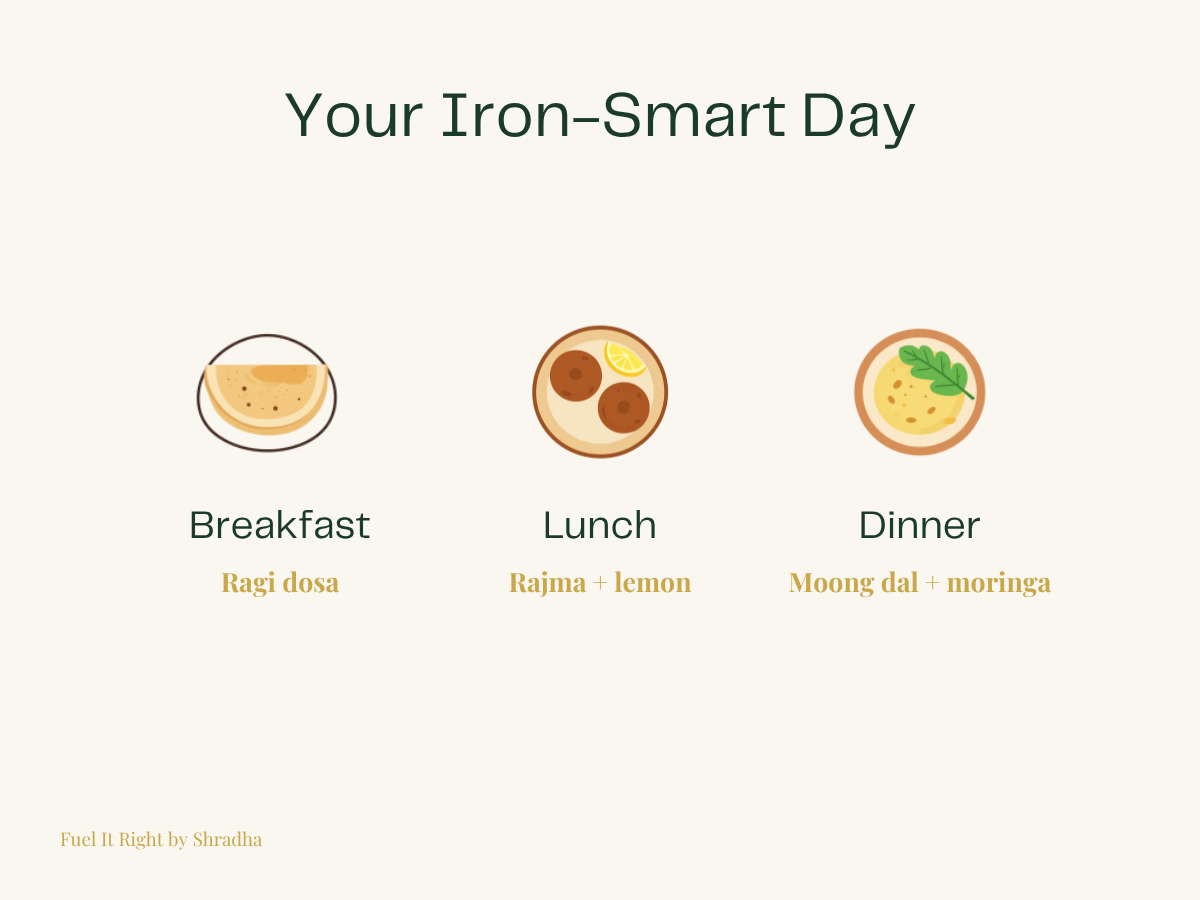
Breakfast | Ragi dosa or moong dal chilla, with a tomato-onion chutney on the side. Chai only after a one-hour gap, not alongside. |
Lunch | Rajma or chana curry in a tomato-onion gravy, a squeeze of lemon added just before eating. A small side of palak or any seasonal sabzi. One roti or a small bowl of rice. |
Dinner | Moong dal with drumstick leaves (moringa) sabzi, a spoon of til chutney on the side, curd. Keep tea or coffee at least an hour away from this meal too. |
Bring your last ferritin and haemoglobin report.
We'll build your iron plan around your actual numbers:
Conclusion
Iron deficiency in India is common enough, 57% of women per the latest national survey, that it deserves more than a spinach recommendation. The evidence points to a few specific, high-leverage changes: soaking and sprouting legumes, pairing iron sources with vitamin C at the meal itself, rotating genuinely strong sources like rajma, chana, moong sprouts, til, drumstick leaves, and ragi, and, most underrated of all, moving chai at least an hour away from your main meals. None of it requires giving up chai, palak, or jaggery. It requires knowing which lever actually moves the number.
FAQs
1. Why is iron deficiency so common in Indian women specifically?
A largely vegetarian diet relying on harder-to-absorb non-heme iron, heavy menstrual blood loss, and near-universal chai consumption close to meals combine to make India's anemia rates among the highest globally. NFHS-5 puts the figure at 57% of women aged 15 to 49.
2. Does drinking chai really block iron absorption that much?
Yes. Controlled studies show black tea taken with a meal can reduce non-heme iron absorption by 60 to 70%. Spacing tea roughly one hour away from meals cuts that inhibition down to about 20%.
3. Should I stop drinking chai altogether?
No. The fix is timing, not elimination. Keep your usual chai, just move it to at least an hour before or after your main meals rather than drinking it immediately alongside or after eating.
4. Is spinach (palak) not a good iron source then?
It contains iron, but its oxalate content limits how much is actually absorbed. Treat it as a beneficial vegetable for other reasons, not your main strategy for correcting iron deficiency. Rajma, chana, moong sprouts, til, and drumstick leaves do more practical work.
5. Does adding lemon to my dal actually make a difference?
At the meal level, yes, vitamin C measurably improves non-heme iron absorption from that specific meal. It's a habit worth keeping. It's just not, on its own, going to fix a significant deficiency the way addressing chai timing and food choice will.
6. What's a normal ferritin level?
Guidelines vary, with diagnostic cutoffs for iron deficiency ranging from about 12 to 50 ng/mL depending on the source; a ferritin below 30 ng/mL is commonly used as a practical threshold in women without other complicating conditions. Ask your doctor which cutoff they're applying to your report.
7. Can vegetarians get enough iron without supplements?
Many can, with deliberate food choices and correct chai timing. If ferritin is already significantly low, food changes alone may not be enough to rebuild stores quickly, and supplementation alongside food is often appropriate, worth discussing with your doctor based on your actual numbers.
8. How long does it take to see ferritin improve with dietary changes alone?
Measurable improvement in ferritin from dietary changes alone typically takes 2 to 3 months of consistent change, since building iron stores is slower than correcting a single lab value. Recheck rather than judging progress by symptoms alone.
About the Author
Shradha | Nutritionist & Dietitian | Fuel It Right. Food-first, evidence-based nutrition for real, sustainable results.