
Can Women With PCOS and PMOS Eat Rice? The Honest Answer
Women with PCOS and PMOS are told to avoid rice. Most of this advice is wrong. Rice is not the problem. Here is what the science actually says.
Table of Contents
1. The Advice Most Indian Women With PCOS Have Heard
2. Why Rice Got Blamed and Why That Is Only Half the Story
3. What Glycaemic Index Actually Means for PCOS/PMOS
4. Not All Rice Is Equal: The GI Comparison
5. The Context Rule
6. Resistant Starch: The Rice Hack Most People Do Not Know About
7. What to Do If You Cannot Imagine a Meal Without Rice
8. Conclusion
9. FAQs
The Advice Most Indian Women With PCOS Have Heard
Women with PCOS and PMOS are routinely told to avoid rice. It comes from doctors, from nutritionists, from well-meaning relatives, and from every PCOS diet article they find online. Cut the rice. Switch to brown rice. Eat millets instead. Never eat white rice again.
For most Indian women, this advice lands as an ultimatum between managing their condition and eating the food that has been central to their meals, their culture, and their family cooking for their entire life. And it is delivered without explanation, without telling them why rice is supposed to be the problem or under what conditions it actually is.
Rice is not the enemy in PCOS and PMOS. Insulin resistance is. The problem is not what you eat. It is how, when, and with what.
This blog gives you the honest, evidence-based answer. Yes, women with PCOS and PMOS can eat rice. With specific conditions that make the difference between rice being a problem and rice being metabolically neutral or even beneficial. Those conditions are manageable, practical, and completely compatible with Indian cooking as it actually happens in Indian homes.
Why Rice Got Blamed, and Why That Is Only Half the Story
White rice has a high glycaemic index, a measure of how quickly it raises blood sugar after eating. For women with PCOS/PMOS, whose insulin sensitivity is already compromised, foods that raise blood sugar quickly drive a larger and more prolonged insulin response. Chronically elevated insulin drives androgen excess, disrupts ovulation, worsens acne and hair fall, and promotes visceral fat accumulation. This is the mechanism behind PCOS/PMOS insulin resistance. For more detail on how this works, see the blog on insulin resistance and PCOS/PMOS.
So rice got blamed because it raises blood sugar quickly. That part is true. What the advice misses is that the glycaemic response to any food is not fixed, it changes dramatically based on what else is eaten with it, in what order, and how the rice itself has been prepared.
The Key Variable: Glycaemic Load, Not Just Glycaemic Index
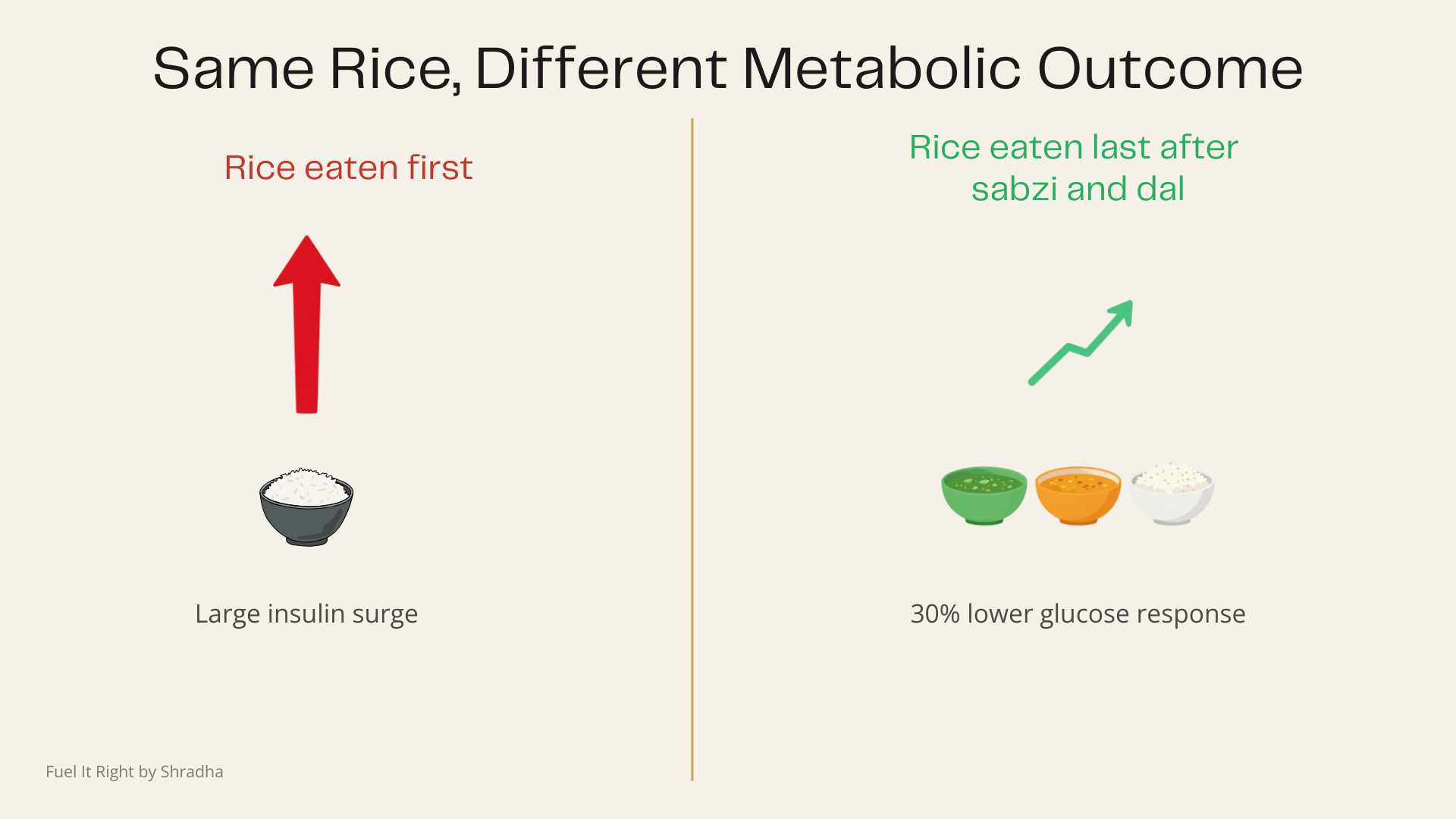
Glycaemic index measures how fast a food raises blood sugar in isolation. Glycaemic load accounts for the actual quantity eaten and the food combination, which is what actually happens at a meal. A small portion of white rice eaten after a full serving of sabzi and dal produces a completely different insulin response than the same rice eaten on an empty plate as the first thing at a meal. The GI of rice does not change. The glycaemic load of the meal does.
This distinction is the most important thing to understand about rice and PCOS/PMOS. The food science community has known this for years. The clinical advice given to Indian women with PCOS has not caught up.
What Glycaemic Index Actually Means for PCOS/PMOS
Before applying GI to your food choices, it helps to understand what the numbers actually mean and where rice sits in the glycaemic index compared to other common Indian foods.
The GI Scale
Glycaemic index is measured on a scale of 0 to 100. Pure glucose is set at 100. Foods above 70 are considered high GI. Foods between 55 and 70 are medium GI. Foods below 55 are low GI.
The critical insight for PCOS/PMOS management is not to avoid all high-GI foods but to ensure that high-GI foods are never eaten alone or first in a meal. When protein, fat, and fibre are present in the same meal, they slow gastric emptying and reduce the glucose absorption rate from any carbohydrate in the meal, including high-GI ones.
Know Your Own Metabolic Baseline First
Before deciding how much rice is appropriate for you specifically, know your HOMA-IR. A woman with a HOMA-IR of 1.2 has very different rice tolerance than a woman with HOMA-IR of 4.5. The PCOS/PMOS diagnosis checklist covers how to get this tested and what the numbers mean. The protocol below is appropriate for mild to moderate insulin resistance. Severe insulin resistance may require more aggressive carbohydrate management alongside medical support.
Want to know how your gut is affecting your PCOS/PMOS?
Take the free Gut Health Quiz. 2 minutes. Get a personalised read on your gut pattern and receive the free 3-Day Indian Gut Reset straight to your inbox.
Not All Rice Is Equal: The GI Comparison
Different types of rice have significantly different glycaemic responses. The type of rice you choose, how it is cooked, and how it is cooled all affect how much your blood sugar rises after eating it.
Type of rice | GI (approx) | Glycaemic load | PCOS/PMOS verdict |
White rice (freshly cooked, eaten alone) | 72 to 83 | High | Avoid eating alone or first. Fine as part of a full meal eaten last. |
White rice (cooked, cooled, then reheated) | 35 to 50 | Medium | Cooling converts starch to resistant starch. Significantly better glycaemic response. |
Brown rice | 50 to 55 | Medium | Better fibre content slows absorption. Good substitute but not essential if white rice is eaten in sequence. |
Basmati rice (aged) | 50 to 58 | Medium to low | Lower GI than standard white rice due to amylose content. Better option within the white rice category. |
Parboiled rice (ukda chawal) | 38 to 48 | Low to medium | Parboiling drives nutrients into the grain and creates more resistant starch. The best white rice option for PCOS/PMOS. |
Red rice / black rice | 42 to 55 | Medium | Higher antioxidant content alongside lower GI. Increasingly available in Indian markets. |
Millets (jowar, bajra, ragi) — for comparison | 25 to 50 | Low | Lower GI than all rice varieties with higher fibre and mineral content. Ideal for replacing one rice serving daily. |
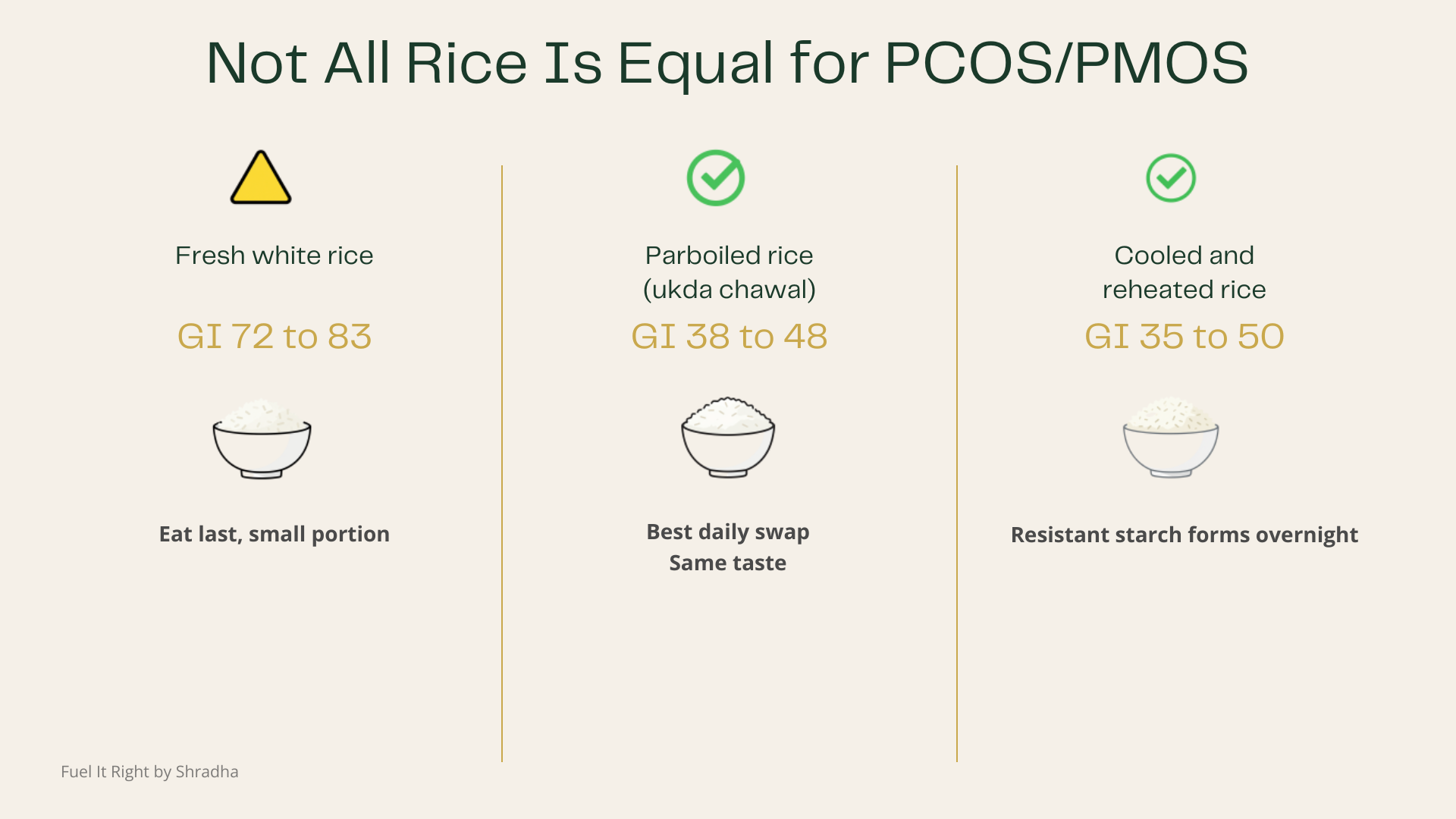
The most practical rice upgrade for Indian women with PCOS/PMOS Switch to parboiled rice (ukda chawal) for daily cooking. It is widely available across India, tastes nearly identical to standard white rice, fits into all standard Indian recipes, and has a glycaemic index of 38 to 48, less than half the GI of freshly cooked white rice. This single swap requires no change in cooking method, no change in recipes, and no change in the flavour of your meals. It is the highest-leverage rice upgrade available. |
The Context Rule: Why How You Eat Rice Matters More Than Whether You Eat It
This is the most important section in this blog. The glycaemic response to rice is not a fixed property of the food. It changes, dramatically, based on what you eat with it, in what order, and at what time of day.
The Sequence Rule
Eating rice last in a meal, after sabzi and dal, reduces the post-meal glucose spike from that rice by a clinically meaningful amount. Research shows that eating vegetables before carbohydrates reduces post-meal glucose by up to 30%. This applies to rice. The same cup of rice produces a fundamentally different insulin response depending on whether it is the first thing on your plate or the last.
The complete protocol is covered in the blog on PCOS and PMOS, what to eat, when, and why. The rice-specific rule is: always eat sabzi first, dal second, and rice last at every meal.
Portion Size
One small bowl of cooked rice, approximately 150 to 180 grams, is appropriate at one meal per day for most women with PCOS/PMOS with mild to moderate insulin resistance. This is not elimination. It is calibration. Two large servings of rice at both lunch and dinner, eaten first, with no protein or vegetable before them, is what creates the metabolic problem. One small serving eaten last is metabolically very different.
Time of Day
Lunch is the better time for rice than dinner. Insulin sensitivity is highest at midday. The same quantity of rice produces a smaller insulin response at lunch than at dinner. If you eat rice once daily, make it at lunch, eaten last in the meal sequence.
What to Eat With Rice
• Always with dal: the protein and fibre in dal blunts the glucose spike from rice eaten together.
• Always with sabzi: the fibre from vegetables eaten before or alongside rice slows absorption.
• A spoonful of ghee on rice is appropriate: fat slows gastric emptying and reduces the glycaemic response.
• Never rice with only papad or pickle: this is the highest-GI meal pattern in the Indian kitchen.
Want a rice protocol built around your specific HOMA-IR?
Book a free 30-minute discovery call. Bring your blood report. We will tell you exactly how much rice, what type, and when based on your metabolic picture.
Resistant Starch: The Rice Hack Most People Do Not Know About
Resistant starch is one of the most powerful and underused tools for managing the glycaemic impact of rice in PCOS/PMOS, and almost no one mentions it.
What Resistant Starch Is
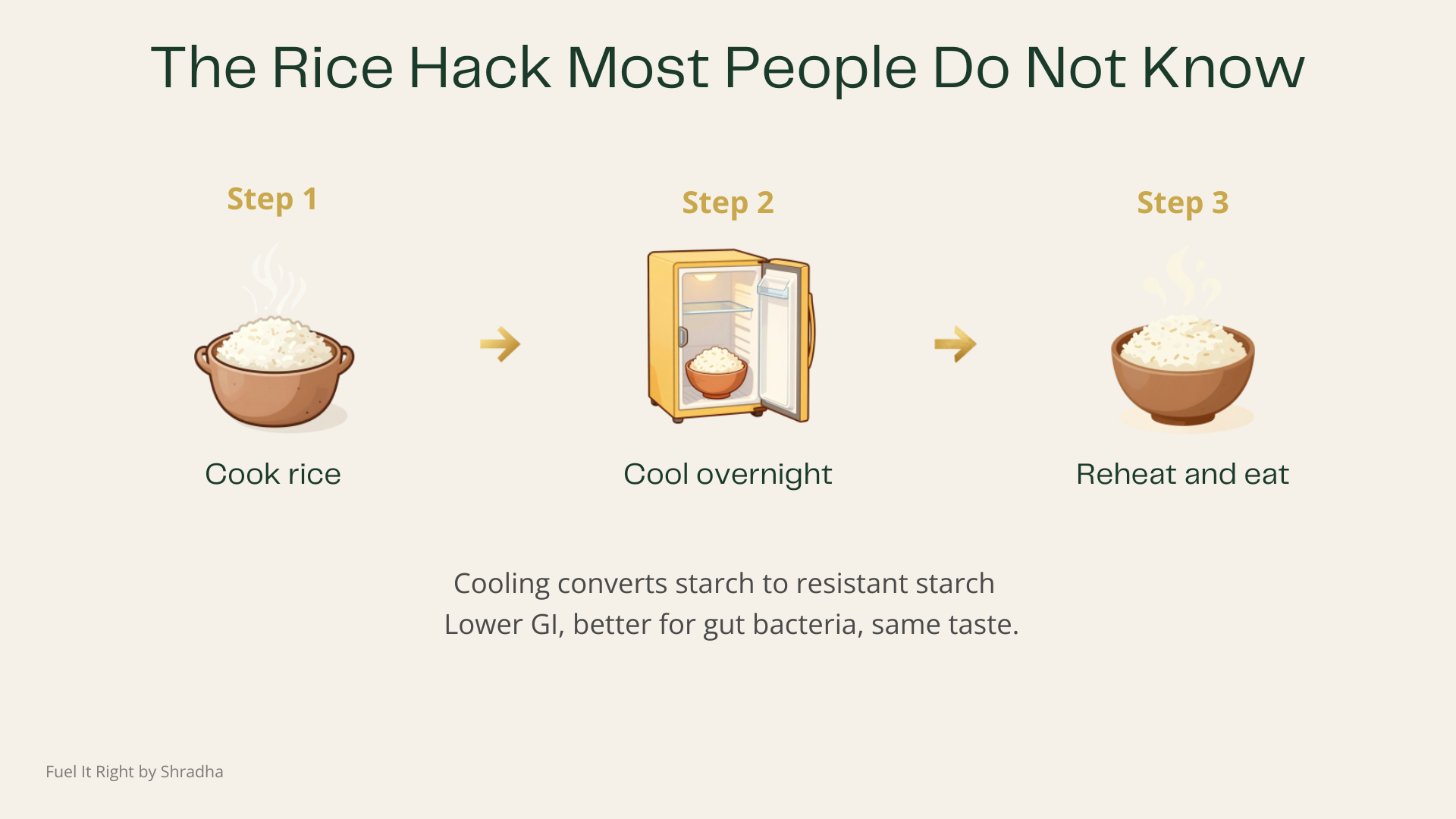
When cooked rice is cooled, either in the refrigerator overnight or at room temperature for several hours, the starch undergoes a process called retrogradation. The starches rearrange into a form that is resistant to digestion, bypassing the small intestine and behaving more like dietary fibre in the body. This dramatically reduces the glycaemic response.
A 2015 study found that cooking rice with coconut oil, then refrigerating it for 12 hours, reduced the calorie content by up to 60% and significantly increased resistant starch content. Reheating the rice does not reverse this process, the resistant starch remains.
How to Use This in Indian Cooking
• Cook rice for lunch, refrigerate leftovers, and use reheated rice for the following day's meal.
• Rice cooked in the morning and eaten at dinner has already partially retrograded at room temperature.
• Traditional Indian practices of eating day-old rice (panta bhat in Bengali tradition, or overnight-soaked rice in South India) were nutritionally superior to freshly cooked rice for metabolic health, this was understood intuitively before the science existed.
• Adding a small amount of coconut oil to the cooking water before boiling rice increases resistant starch formation.
The gut connection Resistant starch is a powerful prebiotic, it feeds the specific gut bacteria that produce butyrate and improve insulin sensitivity. For women with PCOS/PMOS, whose gut microbiome is consistently depleted of these bacteria, cooled-and-reheated rice is not just lower-GI. It is actively beneficial for the gut-hormone connection. The blog on the gut-PCOS/PMOS connection [internal link] covers why this matters. |
What to Do If You Cannot Imagine a Meal Without Rice
You do not need to imagine it. The goal is not to eliminate rice from Indian cooking. The goal is to reduce the metabolic cost of the rice you already eat by changing three things: the type, the sequence, and the quantity.
The Three-Step Rice Protocol for PCOS/PMOS
1 | Step 1: Switch the type Replace standard white rice with parboiled rice (ukda chawal) or aged basmati rice for daily cooking. This alone reduces the GI by 30 to 50% without changing any recipe, cooking method, or eating pattern. |
2 | Step 2: Eat it last At every meal, finish your sabzi and dal before touching the rice. Make this a non-negotiable habit. The same rice eaten last produces a fundamentally lower insulin response than rice eaten first. |
3 | Step 3: One serving at lunch Keep the portion to one small bowl. Eat it at lunch rather than dinner where possible. Cook extra and refrigerate for the next day to build in resistant starch. |
Managing PCOS or PMOS in Goa and want practical guidance?
My team builds food protocols around the meals you already cook. No elimination diets. No imported ingredients. Call or WhatsApp us.
+91 7057063984
Conclusion: Rice Is Not the Villain in Your PCOS/PMOS Story
Women with PCOS and PMOS can eat rice. The blanket advice to eliminate it is not evidence-based, not necessary, and for most Indian women not sustainable. It creates anxiety around food, splits households over cooking, and does not address the actual metabolic root of the condition.
What matters is the type of rice, the sequence in which it is eaten, the portion size, and what it is eaten with. Parboiled or aged basmati rice, eaten last in a meal after sabzi and dal, in a single small bowl at lunch, is metabolically very different from two servings of freshly cooked white rice eaten first, without protein or vegetables.
The same food. Different metabolic outcome. The difference is not in the rice. It is in the context.
If you want a complete food protocol built around your specific insulin resistance levels and the food your household already cooks, the PCOS and PMOS, what to eat, when, and why blog covers the full framework. And if you want it personalised to your blood work, book a free 30-minute discovery call.
Book a Free 30-Minute Discovery Call
Bring your blood report and your food diary. We will tell you exactly how much rice, what type, and when.
Call us: +91 7057063984
Or
FAQs: Can Women With PCOS and PMOS Eat Rice?
Q1. Should I completely avoid white rice if I have PCOS or PMOS?
No. Complete avoidance is not necessary for most women with PCOS/PMOS and mild to moderate insulin resistance. The metabolic impact of white rice depends on how it is eaten, not whether it is eaten. Parboiled rice eaten last in a meal after sabzi and dal, in a single small bowl, is metabolically appropriate. Women with severe insulin resistance (HOMA-IR above 3.5) may benefit from temporarily limiting all rice while actively working to improve insulin sensitivity.
Q2. Is brown rice much better than white rice for PCOS/PMOS?
Brown rice has a GI of approximately 50 to 55 compared to 72 to 83 for freshly cooked white rice. It is meaningfully better. However, parboiled white rice has a GI of 38 to 48, comparable to or lower than brown rice, and is far more compatible with standard Indian cooking methods and flavours. Switching to parboiled rice is a more practical and sustainable upgrade than switching to brown rice for most Indian households.
Q3. What is resistant starch and does it really help with PCOS/PMOS?
Resistant starch forms when cooked rice is cooled, the starch rearranges into a form that resists digestion in the small intestine, reducing the glycaemic response and acting as a prebiotic for gut bacteria. For women with PCOS/PMOS, whose gut microbiome is consistently depleted of butyrate-producing bacteria, cooled-and-reheated rice provides both a lower glycaemic response and a prebiotic benefit for the gut bacteria that manage insulin sensitivity and hormone clearance.
Q4. Can I eat rice at night if I have PCOS or PMOS?
Insulin sensitivity is lower in the evening than at midday. The same quantity of rice produces a larger insulin response at dinner than at lunch. This does not mean rice at dinner is forbidden, it means that if you eat rice once daily, lunch is the better choice. If you eat rice at dinner, keep the portion smaller than at lunch, and ensure it is eaten last after a full serving of sabzi and protein.
Q5. What about rice-based dishes like idli, dosa, and khichdi?
Fermented rice dishes like idli and dosa have a significantly lower glycaemic response than plain rice. The fermentation process partially breaks down the starch and increases the resistant starch content. Dosa is also typically eaten with sambar (protein and fibre) and chutney, naturally following the sequence rule. Khichdi, rice cooked with moong dal, has a lower GI than plain rice because the protein and fibre from dal modify the overall glycaemic response. These are PCOS/PMOS-appropriate options.
Q6. My whole family eats the same food. How do I follow the rice protocol without cooking separately?
You do not need to cook separately. The protocol is not about different food, it is about sequence and portion. Eat from the same pots. Just eat your sabzi and dal first, before your rice. Take a smaller portion of rice than you normally would. Use parboiled rice for daily cooking, it looks and tastes nearly identical to standard white rice and fits all the same recipes. No separate meal required.
Q7. I have been told millets are better than rice for PCOS. Is that true?
Millets have a lower GI than most rice varieties and higher fibre, magnesium, and mineral content. They are excellent for PCOS/PMOS management and worth incorporating. The recommendation to replace one rice serving per day with millet, ragi dosa at breakfast, jowar roti at lunch, or bajra khichdi at dinner, is well-supported. But this is an addition and a partial replacement, not an elimination. Millets alongside rice, rather than instead of all rice, is the more sustainable and nutritionally complete approach.
Q8. How do I know if I am eating too much rice for my specific PCOS/PMOS?
The most reliable signal is your energy and hunger pattern after meals. If you feel tired, foggy, or hungry within 2 hours of eating, the meal contained too much carbohydrate relative to protein and fibre — regardless of whether rice was the cause. Blood markers are more definitive: if HOMA-IR is above 2.5 despite dietary changes, the carbohydrate load may need further reduction. Start with the sequence and type upgrades first. Most women see meaningful improvement without further restriction.
About the Author
Shradha | Nutritionist and Dietitian | Fuel It Right. Practising out of Goa, India, with a focus on gut health, PMOS/PCOS, thyroid disorders, and weight management using real Indian food. No supplements. No machines. Just food, and the science behind it.
fuel-it-right.com | @fuelitright