
Why 1 in 5 Indian Women Has PMOS and Most Don't Know It Yet
1 in 5 Indian women has PMOS, yet most are never diagnosed. Here is why India carries the highest burden in South Asia, what makes Indian women more vulnerable, and the signs that are being missed every day.
Table of Contents
1. India's PMOS Burden: The Numbers That Should Alarm Woman
2. Why Indian Women Are More Vulnerable Than the Global Average
3. The Insulin Resistance Connection
4. Why Most Indian Women With PMOS Are Never Diagnosed
5. The Comorbidities Nobody Talks About
6. The Missed Diagnoses: Lean Women, Adolescents, and Professionals
7. What You Can Do Right Now
8. Conclusion
9. FAQs
India's PMOS Burden: The Numbers That Should Alarm Every Woman
1 in 5 Indian women has PMOS and up to 70% of them have never been diagnosed. These are not estimates from a small study. They come from a nationwide cross-sectional study of 9,824 Indian women aged 18 to 40, published in JAMA Network Open, which found prevalence as high as 19.6% using Rotterdam diagnostic criteria.
India Leads South Asia in PMOS Burden
India recorded the steepest rise in PMOS burden across all of South Asia between 1990 and 2021. The global prevalence sits at 1 in 8 women. India's sits at 1 in 5. That gap is not explained by genetics alone. It is the product of a specific set of dietary, lifestyle, and metabolic factors that are uniquely concentrated in the Indian population.
The same nationwide study found that among Indian women with PMOS, 91.9% had dyslipidemia, 43.2% had obesity, 32.9% had non-alcoholic fatty liver disease, and 24.9% had metabolic syndrome. These are not reproductive statistics. These are metabolic ones.
1 in 5 Indian women | Has PMOS which is nearly double the global average of 1 in 8. Nationwide study of 9,824 women, JAMA Network Open. |
70% go undiagnosed | Up to 70% of women with PMOS worldwide are never diagnosed. In India, awareness and diagnostic access make this worse. |
91.9% have dyslipidemia | Among Indian women with PMOS making cardiovascular risk a central concern, not a secondary one. |
Why This Number Is Almost Certainly an Undercount
The 19.6% figure uses Rotterdam criteria, the broadest diagnostic standard. Many Indian doctors still use the stricter NIH 1990 criteria, which gives a lower prevalence figure of 7.2%. The true number sits somewhere between the two. But whichever figure you use, PMOS is the most common endocrine disorder in Indian women of reproductive age. It is not a niche condition.
Why Indian Women Are More Vulnerable Than the Global Average
1 in 5 Indian women has PMOS not by coincidence, but because of a specific combination of genetic predisposition, dietary patterns, and lifestyle factors that interact to create one of the highest-risk environments for this condition in the world.
The South Asian Metabolic Phenotype
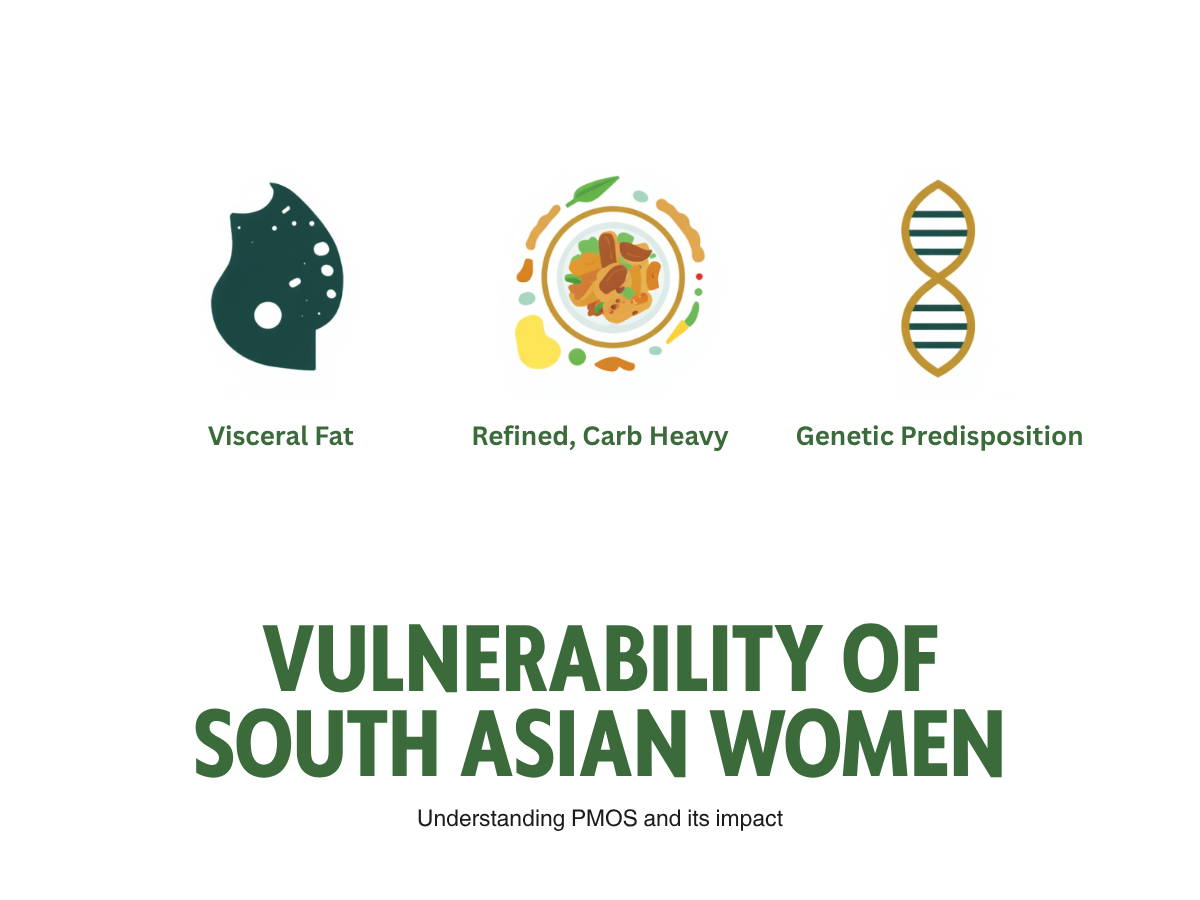
South Asian women carry significantly more visceral fat which is fat stored around internal organs, at the same BMI as women of European descent. A woman with a BMI of 22 may carry the metabolic fat load of a European woman at BMI 27. This visceral fat produces inflammatory signals that directly worsen insulin resistance, which is the metabolic root of PMOS.
This means the standard BMI cutoffs used to flag metabolic risk in clinical settings were never calibrated for Indian bodies. A woman can look lean, have a normal BMI, and carry significant metabolic risk and every standard screening tool will miss her.
The Diet Factor
The everyday Indian diet, like white rice, maida rotis, sweetened chai, biscuits, packaged snacks, is predominantly high-glycaemic and low-fibre. Every meal built around refined carbohydrates drives a glucose spike and a corresponding insulin surge. Over years, this pattern depletes insulin sensitivity and creates the chronic hyperinsulinaemia that drives PMOS.
This is not about eating unhealthily by choice. It is about a food culture that was built before the metabolic consequences were understood. The same foods that sustained previous generations now interact with modern sedentary lifestyles to create a metabolic environment that PMOS thrives in.
Genetic Predisposition
A global survey of 4,409 ethnic Indian women with PMOS found that 43% had a family history of type 2 diabetes and 18% had a family history of PMOS itself. The condition runs in families, and the metabolic vulnerability is inherited. If your mother has type 2 diabetes or your sister has PMOS, your own risk is significantly higher than the population average.
The Insulin Resistance Connection
Understanding why 1 in 5 Indian women has PMOS requires understanding insulin resistance. It is present in up to 85% of women with PMOS globally, and the Indian dietary pattern accelerates its development faster than almost any other.
When cells stop responding to insulin, the body compensates by producing more. Excess insulin signals the ovaries to produce more androgens. High androgens disrupt ovulation, drive acne and hair fall, and cause the weight gain that many women experience despite not eating more than before.
The cycle that keeps women stuck High insulin drives androgen production. High androgens drive more fat storage. More fat storage worsens insulin resistance. Worse insulin resistance drives more androgen production. This loop continues indefinitely without a metabolic intervention. The pill manages the periods. Metformin blunts the insulin. But food, specifically, the right food in the right order, is the only intervention that addresses the loop at every point simultaneously. |
For a detailed breakdown of this mechanism, read PMOS is a metabolism problem.
Why Most Indian Women With PMOS Are Never Diagnosed
1 in 5 Indian women has PMOS, yet up to 70% are never diagnosed. This is not primarily a problem of access to healthcare. It is a problem of how the condition is recognised, communicated, and acted upon, by both doctors and patients.
The Symptoms Are Normalised
Irregular periods are routinely dismissed as stress. Acne is attributed to diet or skin type. Hair fall is blamed on water quality or shampoo. Fatigue is put down to overwork. Weight gain is explained by lifestyle. Each symptom, viewed in isolation, sounds manageable. Together, they are a diagnostic picture that should trigger immediate investigation, but they rarely do.
The Diagnostic Criteria Create Gaps
PMOS is diagnosed when a woman has at least two of three features: irregular periods, high androgen levels or symptoms (acne, hair fall, excess facial hair), or polycystic ovarian morphology on ultrasound. A woman can have severe insulin resistance, significant metabolic disruption, and all the downstream consequences, and still not meet the diagnostic threshold if she only ticks one box.
The Weight Bias
The most damaging diagnostic failure is the assumption that PMOS only affects overweight women. A lean woman presenting with acne and irregular periods is rarely asked about insulin resistance. Yet 75% of lean women with PMOS have significant insulin resistance. The condition has no weight requirement. The diagnostic bias does.
The Fertility Framing
Many women are told to come back when they want to conceive. As if PMOS is only relevant when pregnancy is the goal. This framing leaves millions of women managing symptoms for years without understanding the metabolic damage accumulating in the background, the rising cardiovascular risk, the worsening insulin resistance, the developing thyroid dysfunction.
The Comorbidities Nobody Talks About
When 1 in 5 Indian women has PMOS and 91.9% of them have dyslipidemia, this is not a reproductive health crisis. It is a metabolic health crisis. The comorbidities that accompany PMOS in Indian women are severe, common, and under-recognised.
Non-alcoholic fatty liver disease (NAFLD) | 32.9% of Indian women with PMOS have NAFLD, a condition where fat accumulates in the liver, driving inflammation and worsening insulin resistance further. Most women with PMOS-related NAFLD have no symptoms until the liver damage is significant. |
Metabolic syndrome | 24.9% have metabolic syndrome which is the cluster of high blood pressure, high blood sugar, excess waist fat, and abnormal cholesterol that dramatically increases cardiovascular disease risk. Metabolic syndrome in a woman in her 20s or 30s is a serious long-term health concern. |
Anxiety and depression | A global survey of Indian women with PMOS found 64% were diagnosed with one or more comorbidities, with anxiety and depression being the most common. The hormonal and inflammatory disruption of PMOS directly affects neurotransmitter production. Mental health in PMOS is not a secondary concern. |
Thyroid dysfunction | The co-occurrence of PMOS and hypothyroidism is significantly higher in Indian women than the global average. Both conditions affect weight, cycles, energy, and mood. Each one worsens the other if left untreated simultaneously. |
Type 2 diabetes risk | 43% of Indian women with PMOS have a family history of type 2 diabetes, and 3.4% already have diabetes at the time of PMOS diagnosis. Women with PMOS have a 4-fold higher lifetime risk of developing type 2 diabetes. Managing insulin resistance now is the primary prevention strategy. |
The Missed Diagnoses: Lean Women, Adolescents, and Urban Professionals
1 in 5 Indian women has PMOS, but certain groups are being missed more systematically than others. Three profiles are consistently underdiagnosed in India.
Lean Women
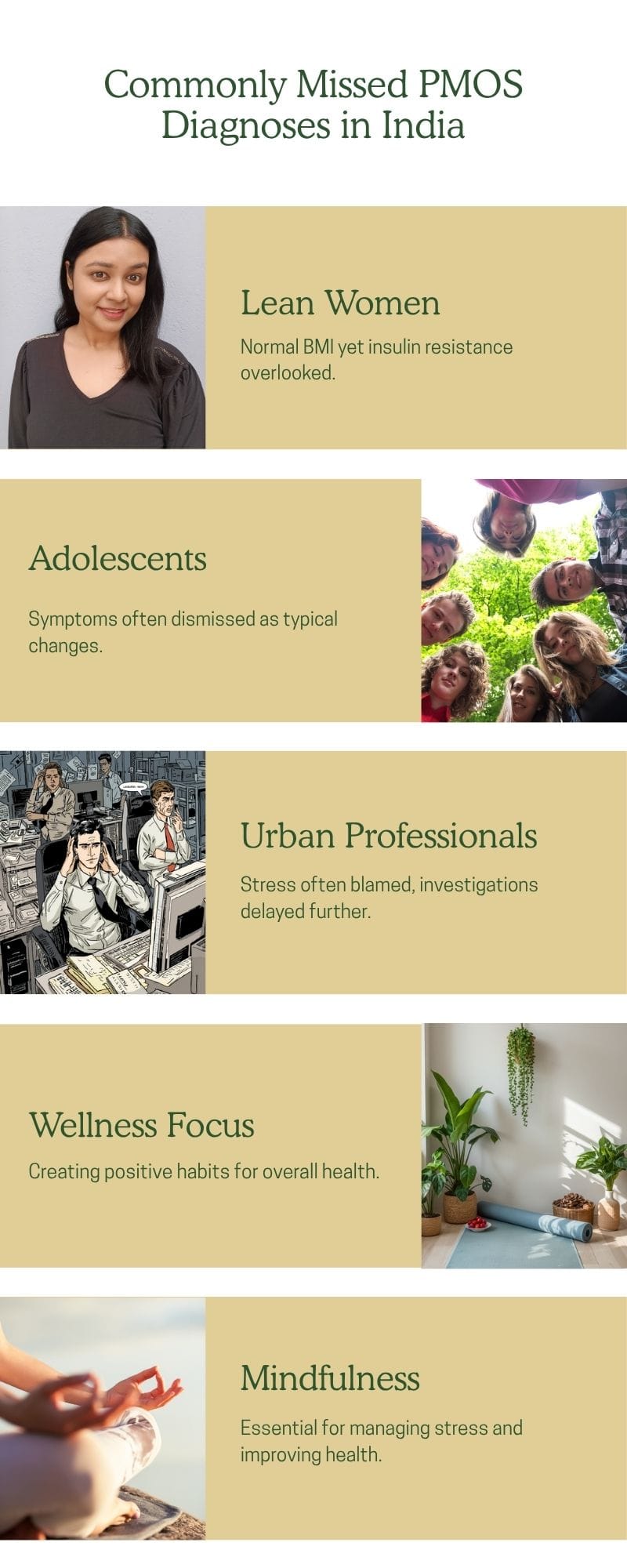
Because PMOS has historically been associated with weight gain, lean women are routinely dismissed. A woman with a BMI of 21 presenting with irregular periods and acne is far less likely to be investigated for PMOS than her heavier counterpart. Yet she is just as likely to have insulin resistance and just as likely to develop the same long-term metabolic complications.
Adolescents
A systematic review and meta-analysis found PMOS prevalence among Indian adolescent girls aged 14 to 19 at approximately 1 in 5 the same as adult women. Irregular periods in teenage girls are almost universally dismissed as normal hormonal adjustment. Many women trace their PMOS symptoms back to their teens, but were not investigated or diagnosed until their mid-20s or later. Early intervention in adolescence would change long-term outcomes significantly.
Urban Professional Women
High cortisol from chronic work stress directly worsens insulin resistance and disrupts the LH-FSH ratio that governs ovulation. Urban professional women often eat erratically, sleep poorly, and exercise infrequently, all of which compound insulin resistance. They are also more likely to attribute their symptoms to stress and delay investigation.
What You Can Do Right Now
If 1 in 5 Indian women has PMOS and 70% are undiagnosed, the most important thing you can do is not wait for a diagnosis to start addressing the metabolic root. Here is where to start:
1 | Know your numbers, not just your symptoms Ask your doctor for fasting insulin, HOMA-IR, HbA1c, total and free testosterone, LH/FSH ratio, and TSH. These are the metabolic markers that tell the real story. Periods alone do not. |
2 | Do not accept weight as the gating criterion If you are told you cannot have PMOS because you are not overweight, ask for a fasting insulin test by name. Insulin resistance does not require excess weight to be present. |
3 | Start with the gut Gut microbiome disruption is a consistent finding in PMOS and directly affects hormone processing, inflammation, and insulin sensitivity. Addressing gut health is not separate from PMOS management, it is central to it. |
4 | Change meal sequencing before you change what you eat Eating vegetables and protein before carbohydrates at every meal reduces post-meal glucose spikes significantly. This is the single most accessible metabolic intervention available, no prescription required. |
5 | Track patterns, not perfection Notice your energy after meals, your cravings in the afternoon, your sleep quality, your cycle regularity. These are metabolic signals. A food diary for two weeks reveals patterns that no blood test can show. |
Conclusion: The Diagnosis You Were Never Given
1 in 5 Indian women has PMOS. Most were never told. Many were dismissed. Some were told to lose weight and come back when they wanted children. The condition was always metabolic, always whole-body, and always addressable through food, long before a prescription was needed.
The PMOS rename changes the clinical conversation. But it does not change what has always been true: the earlier you address insulin resistance, the less damage accumulates. The gut heals. The hormones rebalance. The cycles regulate. Not always perfectly. Not always quickly. But consistently, when the metabolic root is addressed through real food.
At Fuel It Right, every protocol starts at the root — insulin resistance, gut health, inflammation — using real Indian food. If you want to understand your specific picture and where to start, book a free 30-minute discovery call.
Book a Free 30-Minute Discovery Call Bring your blood reports. We will tell you what the numbers mean and exactly where to start. +91 7057063984 |
FAQs: Why 1 in 5 Indian Women Has PMOS
Q1. How do I know if I have PMOS if I have never been diagnosed?
The most reliable starting point is a blood test panel: fasting insulin, HOMA-IR, HbA1c, total and free testosterone, LH/FSH ratio, and TSH. If your doctor has not ordered these alongside a standard hormonal panel, ask for them by name. Symptoms alone like irregular periods, acne, hair fall, fatigue are strong signals but not sufficient for diagnosis.
Q2. Can PMOS develop even if my periods are regular?
Yes. Regular periods do not rule out PMOS. Some women with PMOS ovulate regularly but still have significant insulin resistance, elevated androgens, and metabolic comorbidities. The condition is diagnosed on a combination of criteria, not periods alone.
Q3. Is PMOS hereditary?
There is a strong genetic component. If your mother has type 2 diabetes or your sister has PMOS, your risk is significantly higher. A global survey of Indian women with PMOS found 43% had a family history of type 2 diabetes and 18% had a family history of the condition itself. Genetics load the gun, but diet and lifestyle pull the trigger.
Q4. Why do Indian women have higher rates of PMOS than Western women?
Three factors interact: a genetic predisposition to higher visceral fat at lower BMI, a daily diet predominantly built around refined carbohydrates, and increasingly sedentary urban lifestyles. All three drive insulin resistance, which is the metabolic root of PMOS. India's food culture and South Asian body phenotype create a uniquely high-risk environment.
Q5. My ultrasound showed no cysts. Can I still have PMOS?
Yes. Research published alongside the PMOS rename confirmed there is no increase in abnormal ovarian cysts in the condition. Cysts on ultrasound are one of three diagnostic criteria, not all three need to be present. You can have PMOS without cysts on ultrasound.
Q6. What age does PMOS typically start in Indian women?
A global survey of Indian women with PMOS found they first experienced symptoms at an average age of 19 and received a diagnosis at around 20 to 21. However, many women reported symptoms beginning earlier in adolescence that were dismissed. The condition often begins in the teenage years and goes unaddressed for a decade or more.
Q7. If I manage my diet, do I still need medication?
This depends on the severity of your condition and your specific blood markers. For many women with mild to moderate insulin resistance, food-first management, protein sequencing, fibre, anti-inflammatory spices, curd, meal timing, produces measurable improvements in insulin sensitivity, androgen levels, and cycle regularity within 3 to 6 months. For others, medication alongside dietary change is appropriate. This is a conversation to have with your doctor armed with your metabolic blood panel.
Q8. Why was PMOS not diagnosed earlier if it is so common?
Because the name PCOS directed clinical attention toward ovaries and cysts, rather than the metabolic and endocrine system. Without cysts on ultrasound, many women were dismissed. Without weight gain, lean women were not investigated. Without a fertility concern, the condition was deprioritised. The PMOS rename is intended to correct this framing and ensure metabolic screening becomes standard from first presentation.
About the Author
Shradha | Nutritionist & Dietitian | Fuel It Right. Practising out of Goa, India, with a focus on gut health, PMOS/PCOS, thyroid disorders, and weight management using real Indian food. No supplements. No machines. Just food, and the science behind it.
fuel-it-right.com | @fuelitright