
PCOS is now PMOS: What Every Woman Must Know
Scientists are renaming PCOS to PMOS Polyendocrine Metabolic Ovarian Syndrome. For the 1 in 5 Indian women living with this condition, this isn't just a name change. It's the first time medicine is seeing the whole picture.
Table of Contents
1. Why PCOS change to PMOS?
2. Why Was PCOS Renamed PMOS?
3. What Does PMOS Stand For?
4. How PMOS Affects the Whole Body — Not Just Ovaries
5. Why Indian Women Are Hit Harder by PMOS
6. What Actually Helps: Food as the First Medicine
7. What Has NOT Changed With the Rename
8. The New Tests You Should Be Asking For
9. Conclusion
10. FAQs
Why PCOS change to PMOS?
PCOS is now PMOS and if you have been living with this condition, this is one of the most important updates in women's health in decades. On 12 May 2026, a landmark study published in The Lancet officially announced the rename. Over 56 global organisations, including the Endocrine Society, backed this change.
A Name Decided by 22,000 People
This was not a decision made in a boardroom. More than 22,000 patients, doctors, and researchers across the world were consulted over 11 years. The result: a name that finally matches what science has known for decades.
PCOS stood for Polycystic Ovary Syndrome. PMOS stands for Polyendocrine Metabolic Ovarian Syndrome. One letter changed in the abbreviation. But the meaning changed entirely.
What the Old Name Got Wrong
The word "polycystic" implied the problem was ovarian cysts. But many women with this condition have no cysts at all. Many women with cysts have no symptoms. The name caused decades of confusion, misdiagnosis, and delayed treatment.
The PCOS is now PMOS rename corrects this. It places the condition where it belongs, in the endocrine and metabolic system, not just the ovaries.
Why Was PCOS Renamed PMOS?
Language shapes how doctors treat and how patients understand. When a condition is named after cysts on ovaries, both doctor and patient focus there. The metabolic damage happening elsewhere goes unnoticed, sometimes for years.
The Real Driver: Insulin Resistance
The true engine behind PCOS, now PMOS, is insulin resistance. When cells stop responding properly to insulin, blood sugar rises. The body produces more insulin. That excess insulin signals the ovaries to produce more androgens (male hormones). This cascade drives most of the symptoms you experience.
Irregular periods, weight gain, acne, hair fall, fatigue, all trace back to this one metabolic root. Not to cysts. Treating only the cysts or the periods was always treating the branches, not the root.
The Stigma the Old Name Created
Many women were told PCOS was "just a fertility issue." Others were dismissed unless they were overweight. Thin women with PMOS went undiagnosed for years. The old name allowed doctors to reduce a whole-body condition to a reproductive footnote.
PCOS is now PMOS, and with that change comes a mandate: treat this as the complex, multi system condition it is.
What Does PMOS Stand For?
P — Polyendocrine: Multiple hormonal systems are involved. Insulin, androgens, LH, cortisol, thyroid. This is not a single-hormone problem.
M — Metabolic: Insulin resistance, blood sugar dysregulation, weight, inflammation, and heart health are all part of the picture.
O — Ovarian: Yes, the ovaries are involved. But they are a site of impact, not the source of the problem.
S — Syndrome: A collection of signs and symptoms, not a single disease. Two women with PCOS / PMOScan present very differently.
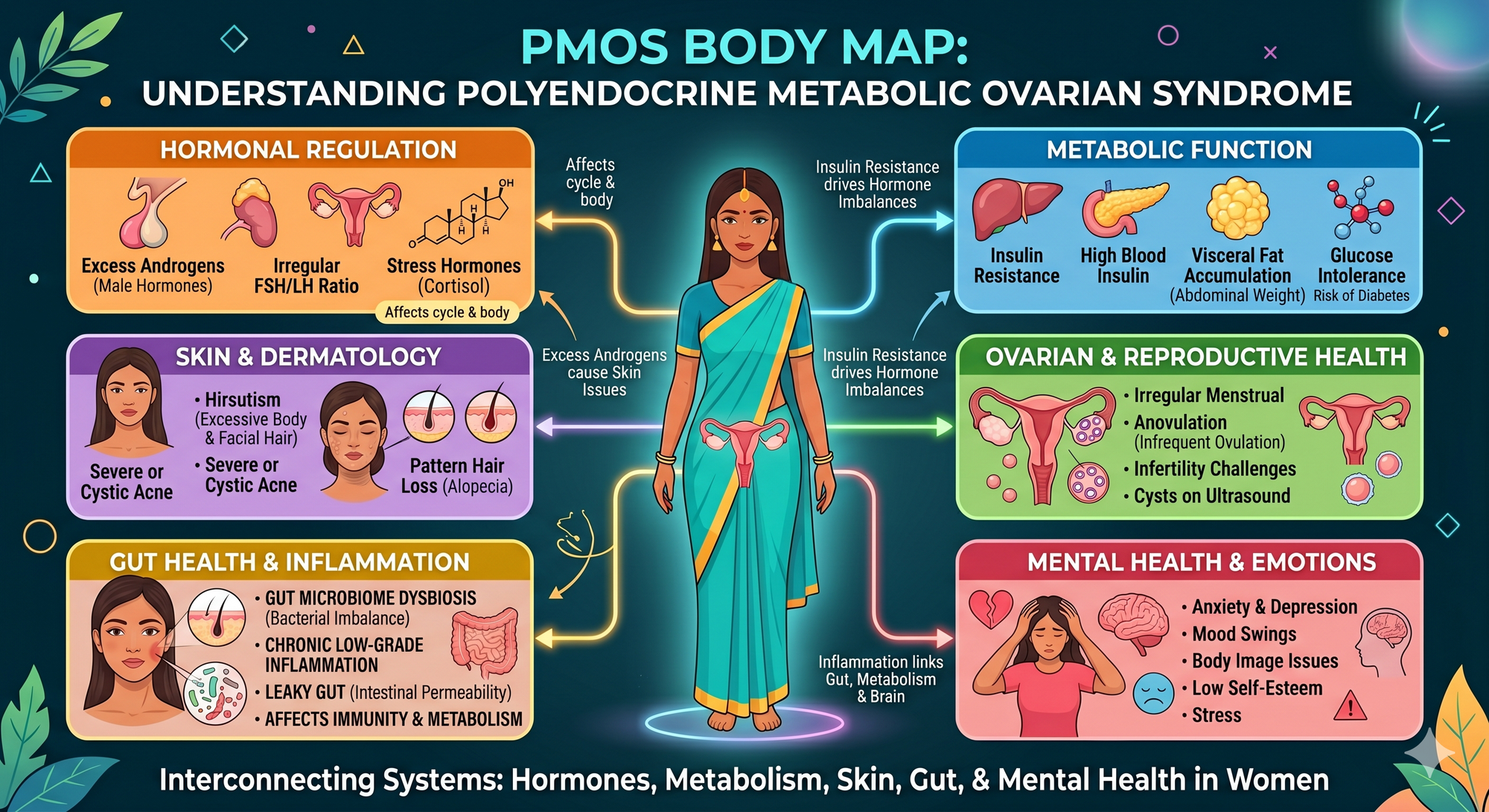
How PMOS Differs From the Old PCOS Framing
Under the old framing, most women were given the pill to regulate periods, or told to lose weight. The metabolic panel fasting like insulin, HOMA-IR, HbA1c was rarely ordered. The gut was never considered. Cortisol was ignored.
The PCOS to PMOS rename now makes metabolic screening mandatory in the diagnostic process, not optional.
How PMOS Affects the Whole Body Not Just Ovaries
Because PCOS is now PMOS, the treatment framework must expand. Here is what this condition does across your body:
• Hormonal system: elevated androgens cause acne, unwanted facial hair, scalp hair thinning.
• Metabolic system: insulin resistance drives weight gain, fatigue, and sugar cravings.
• Gut: microbiome imbalance worsens inflammation and hormone clearance.
• Skin: androgen excess shows up as acne and darkening of the neck and underarms.
• Mental health: anxiety and depression are significantly higher in women with PMOS.
• Heart: elevated cholesterol, triglycerides, and blood pressure risk increases over time.
• Thyroid: co-occurrence with hypothyroidism is very common, especially in Indian women.
The Gut-Hormone Link You Were Never Told About
Your gut microbiome affects how oestrogen is processed and how much inflammation circulates in the body. A disrupted gut makes PMOS symptoms significantly worse. This is why a food-first approach, one that heals the gut while managing insulin, works where pills alone do not. Read more on the gut-hormone connection.
Why Indian Women Are Hit Harder by PMOS
India has one of the highest rates of PMOS / PCOS in the world. Roughly 1 in 5 Indian women of reproductive age lives with this condition. That is more than double the global average.
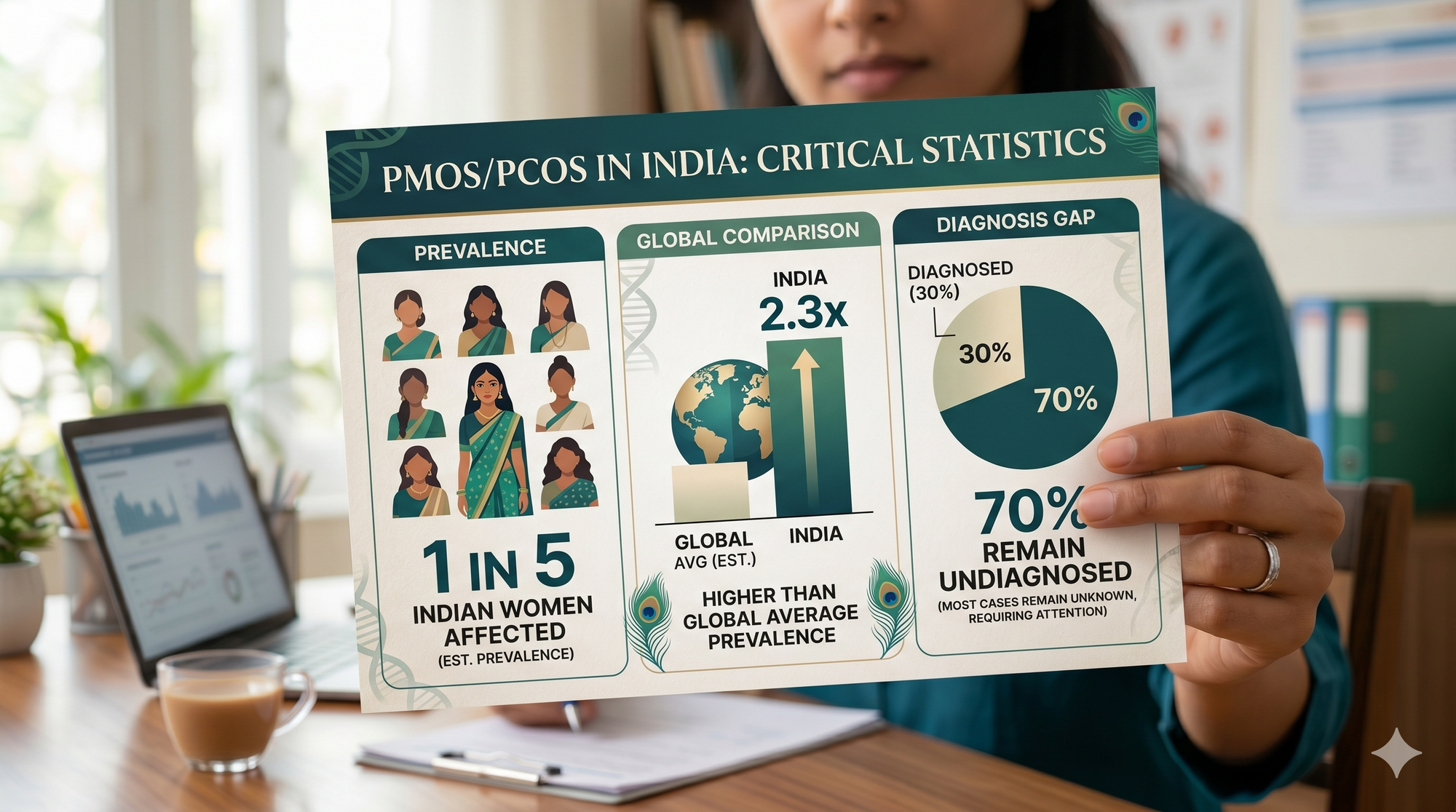
The South Asian Body and Visceral Fat
Research consistently shows that South Asian women store more visceral fat, which is fat around the organs, at the same BMI as women of other ethnicities. An Indian woman at a "healthy" BMI of 23 can carry the metabolic fat profile of a European woman at BMI 27.
That visceral fat produces inflammatory signals that drive insulin resistance. Layer this on top of a daily diet of white rice, maida rotis, biscuits, and sweetened chai, and you have a recipe for PMOS to develop early and progress fast.
Why Thin Indian Women Are Overlooked
Because the old PCOS framing linked the condition to weight, thin women were frequently told they could not have it. But lean PMOS, where insulin resistance exists at a normal body weight, is extremely common in India. If you were dismissed because you are not overweight, ask for a fasting insulin test.
What Actually Helps: Food as the First Medicine
Here is the most important thing to understand about PCOS / PMOS treatment: insulin resistance responds powerfully to food. Not supplements. Not just medication. Real food, prepared in your kitchen, in the right combination.
The Indian Kitchen Has Everything You Need
Methi (fenugreek) improves insulin sensitivity. Jeera (cumin) reduces inflammation. Haldi (turmeric) lowers inflammatory markers. Dal and sabzi provide slow-digesting protein and fibre that flatten blood sugar curves. Curd supports the gut microbiome.
You do not need a Western diet plan to manage PMOS. You need to understand how to use your existing kitchen intelligently. That is the entire premise of Fuel It Right.
What to Eat and What to Rethink
The goal is not elimination. It is sequencing. Eating protein and vegetables before your rice changes how your body responds to that rice. A protein-first breakfast stabilises cortisol and insulin for the entire day. These are practical, sustainable shifts, not a diet.
See how real Indian food drove a 15 kg transformation: Samantha lost 15 kg healing her gut first
What Has NOT Changed With the Rename
The PCOS is now PMOS rename is a shift in understanding, not a new disease. If you were diagnosed with PCOS or PCOD, your diagnosis is still valid. Your symptoms are still real. Your treatment plan does not need to be thrown out.
What changes: how comprehensively your doctor investigates the condition, which tests you can now ask for, and how the condition is classified in medical records globally, the ICD update comes in 2028.
PCOD, PCOS, PMOS - Are They the Same Thing?
In India, PCOD (Polycystic Ovarian Disease) is commonly used. PCOS and PCOD describe essentially the same condition, the difference is one of severity framing, not pathology. PMOS is now the globally agreed scientific name. All three refer to the same hormonal and metabolic reality.
The New Tests You Should Be Asking For
The PMOS diagnosis framework now includes metabolic screening as standard. When you visit your doctor, ask for these:
• Fasting insulin and HOMA-IR (measures insulin resistance directly)
• HbA1c (3-month blood sugar average)
• Fasting glucose and lipid panel
• Total and free testosterone, DHEAS, SHBG
• LH/FSH ratio
• AMH (if fertility is a concern)
• TSH and free T4 (thyroid which co-occurs frequently)
• Pelvic ultrasound
• Body composition scan of visceral fat, not just BMI

Why BMI Is the Wrong Measure for PMOS
BMI does not measure visceral fat. It does not measure insulin resistance. It does not tell you anything about what is happening hormonally. Two women can have the same BMI and completely different PMOS severity. Ask for a body composition assessment, not just a weight check.
Conclusion: A New Name, A Better Understanding
PCOS is now PMOS and that change matters more than it might seem. For the millions of Indian women who were told "it is just PCOS, manage your weight" and sent home, this rename is a validation. Your condition is complex. It involves your hormones, your metabolism, your gut, your skin, your mental health, and your long-term heart health.
The good news is that this complexity is also an opportunity. Because insulin resistance, the core driver, responds directly to food. Not supplements. Not extreme diets. Real food, cooked in your kitchen, informed by how your body works.
At Fuel It Right, we have helped clients reverse insulin resistance, restore cycles, and lose weight sustainably, using the dal, sabzi, curd, and rice already in their kitchens. If you want to understand what PMOS means for your specific body and how to start addressing it through food, book a free discovery call with us.
Book a Free 30-Minute Discovery Call
FAQs — PCOS Is Now PMOS: Your Questions Answered
Q1. Is PCOS the same as PMOS?
Yes. PMOS is the new official name for the condition previously known as PCOS (and PCOD in India). The science has not changed — only the name, to better reflect that this is a metabolic and hormonal condition, not primarily an ovarian one.
Q2. Do I need to get re-diagnosed now that PCOS is called PMOS?
No. Your existing PCOS or PCOD diagnosis remains valid. The ICD reclassification updates in 2028. What you can do now is ask your doctor to add metabolic screening — fasting insulin, HOMA-IR, HbA1c, if it was not done before.
Q3. Why does the PCOS to PMOS rename matter for Indian women specifically?
India has one of the highest rates of this condition globally, affecting roughly 1 in 5 women of reproductive age. The South Asian body type stores more visceral fat at healthy BMI, increasing insulin resistance risk. The PMOS framing means better, more complete diagnosis and treatment for Indian women.
Q4. Can PMOS be managed with food alone?
Food is the most powerful lever for managing insulin resistance, the root cause of PMOS. Many women see significant improvement in cycles, weight, skin, and energy through dietary changes alone. Food cannot replace medical care, but it is the foundation everything else builds on.
Q5. What Indian foods help manage PMOS?
Methi seeds, jeera, haldi, dal, seasonal vegetables, curd, and protein-rich sabzis all support insulin sensitivity and reduce inflammation. The key is not which specific food, it is how you combine them. Protein before carbs, fibre with every meal, and avoiding high-glycaemic combinations.
Q6. I am thin and was told I cannot have PCOS. Should I get tested for PMOS?
Yes. Lean PMOS is real and common, especially in Indian women. If you have irregular periods, acne, hair fall, or fatigue, regardless of your weight, ask your doctor for a fasting insulin test and a hormonal panel. The old 'you don't look like you have PCOS' dismissal was a product of the outdated framing.
Q7. Will my medications change because of the PMOS rename?
Not immediately. Current medications remain the same. What may change over time is the type of treatment your doctor prioritises, with greater emphasis on insulin-sensitising approaches and metabolic management, rather than symptom-only management like the pill.
Q8. How is PMOS different from thyroid disorder?
They are separate conditions, but they frequently co-occur, especially in Indian women. PMOS is driven by insulin resistance and androgen excess. Hypothyroidism involves low thyroid hormone. Both affect weight, energy, and cycles. If you have PMOS, always ask for a full thyroid panel.
About the Author
Shradha | Nutritionist & Dietitian | Fuel It Right. Practising out of Goa, India, specialising in gut health, PMOS/PCOS, thyroid disorders, and weight management using real Indian food. No supplements. No machines. Just food, and the science behind it.
fuel-it-right.com | @fuelitright