
Vitamin D Deficiency in India: What the Numbers Miss
70 to 90% of Indians are labelled vitamin D deficient, but researchers are now questioning whether the thresholds used even fit Indian bodies. Here's the real picture, and a genuinely useful food-first fix most people haven't tried.

Table of Contents:
1. Vitamin D Deficiency in India: The Numbers Everyone Quotes
2. Is India's "Deficiency" Partly a Measurement Problem?
3. Why Sunlight Alone Doesn't Fix It Here
4. What Actually Works: Food-First Sources, Verdict by Verdict
5. Common Mistakes That Waste Sun Exposure
6. Building a Vitamin D-Smart Day: Three Real Moments, Fully Assembled
Conclusion
FAQs
1. Vitamin D Deficiency in India: The Numbers Everyone Quotes
Vitamin D deficiency headlines in India tend to cite the same alarming range: 70 to 90% of the population deficient, despite a country with abundant year-round sunlight. A large diagnostics-lab dataset tracking results from 2019-20 to 2023-24 found deficiency rates falling from roughly 51% to 43% nationally, real improvement, but still describing nearly half the population as deficient by the thresholds in use.
Before accepting that number at face value, it's worth asking a question most coverage skips: deficient according to what standard, and does that standard actually fit Indian physiology?
2. Is India's "Deficiency" Partly a Measurement Problem?
A 2026 systematic review from researchers at Tata Main Hospital and Manipal Tata Medical College, published in the journal Cureus, raised exactly this question. Their review found that India reports very high biochemical vitamin D deficiency when global cut-offs are applied, yet the corresponding disease burden, rickets, fractures, the outcomes these thresholds exist to predict, appears comparatively low. The mismatch raises a real question about whether imported reference ranges fit Indian bodies.
This isn't a fringe concern. Different health bodies worldwide already use meaningfully different thresholds for the same underlying measurement: the UK's SACN sets its floor at 25 nmol/L, the WHO at 27 nmol/L, the US IOM and the Global Consensus on Rickets at 30 nmol/L, Nordic and European bodies at 50 nmol/L. Converted to the units Indian labs report in, that's roughly a 10 to 20 ng/mL spread in where "deficient" starts, depending entirely on which country wrote the guideline.
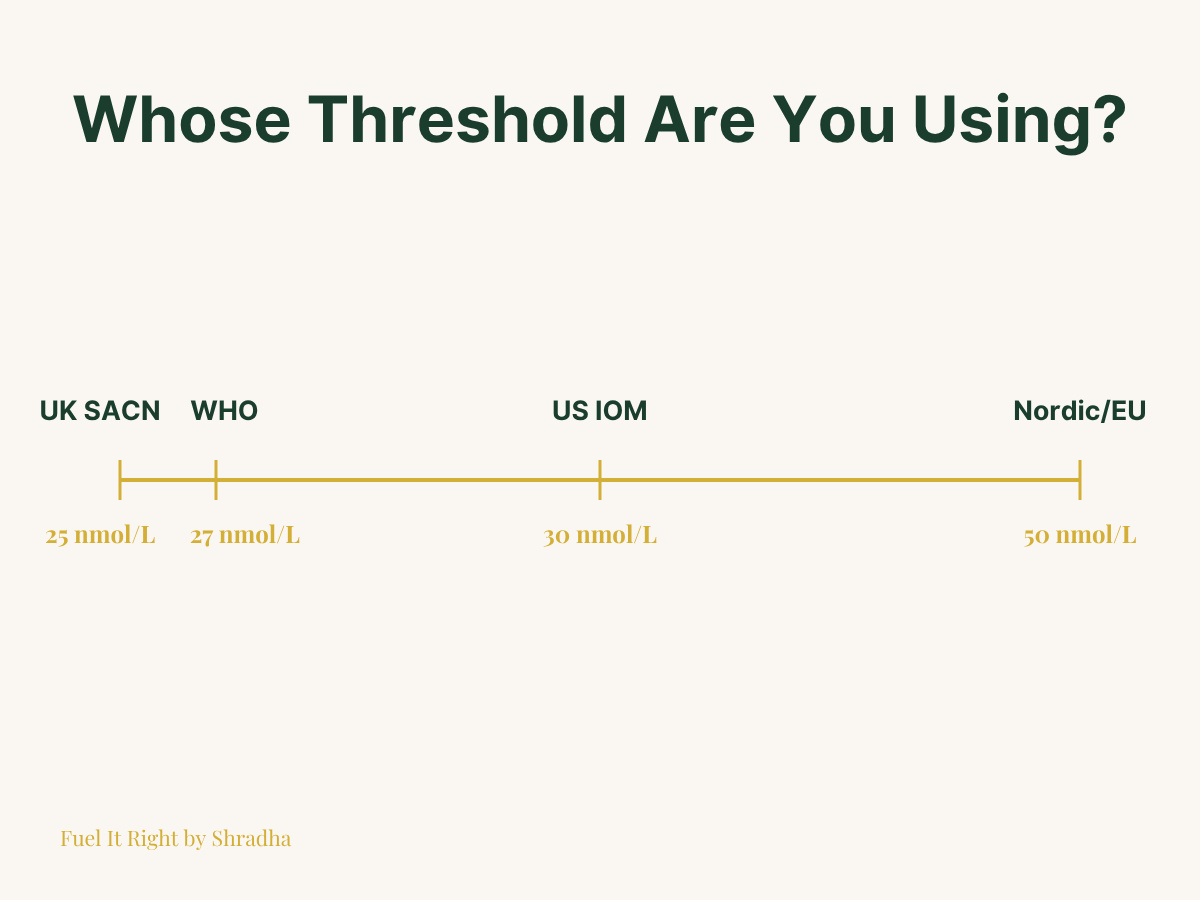
A community study in Guwahati illustrates why this matters in practice. Using standard cutoffs, only 15% of adults were truly deficient (under 20 ng/mL). Another 48.3% fell into the "insufficient" band (20 to 30 ng/mL), a category with a considerably weaker evidence base linking it to actual health outcomes. The alarming 70 to 90% figures quoted nationally are usually combining both groups into one number.
A biochemical number below a line isn't automatically a health crisis. It depends heavily on where that line was drawn, and for whom.
3. Why Sunlight Alone Doesn't Fix It Here
None of this means Indian vitamin D deficiency is imaginary; even accounting for threshold debates, genuine deficiency is common and worth addressing. The reasons are specific to how modern urban India actually lives, not a lack of sunlight itself.
Melanin, more abundant in darker skin, absorbs UVB radiation and competes directly with the skin's vitamin D synthesis pathway, meaning the same sun exposure produces less vitamin D in darker skin than in lighter skin. Add urban pollution that scatters UVB before it reaches skin, glass windows and windshields that block it almost entirely, and indoor-first office and school schedules, and abundant sunlight outside stops translating into vitamin D synthesis inside the body.
One finding turns the usual assumption backwards. An Indian study on adolescents found higher socioeconomic status was associated with more vitamin D deficiency, not less, driven by more time indoors, more air conditioning, and less outdoor manual activity. Sunlight access was never the constraint for this group. Lifestyle was.
Curious what else your gut and metabolic picture might be missing?
Take the free Gut Health Quiz:
4. What Actually Works: Food-First Sources, Verdict by Verdict
Regardless of where the exact threshold sits, food and sensible sun exposure remain the lowest-risk ways to move your actual number.
Direct Midday Sun (11am-1pm) STRONG, FREE |
Arms and legs exposed to direct sunlight for 15 to 20 minutes during peak UVB hours produces meaningfully more vitamin D synthesis than longer exposure at other times of day. How to make it work: Skip sunscreen for this short window specifically; apply it afterward if staying out longer. This isn't a case for unprotected all-day sun exposure. |
Fortified Milk or Curd STRONG CHOICE |
An Indian randomised trial fortifying 200ml of milk with roughly 240 IU of vitamin D2 for three months showed measurable improvement in blood levels. How to make it work: Check the label for added vitamin D specifically; not all packaged dairy in India is fortified by default. |
Egg Yolk MODEST BUT USEFUL |
Contains meaningful but comparatively small amounts of vitamin D per egg; useful as a contributor, not a standalone fix. How to make it work: Eat the whole egg, not just the white; the vitamin D is entirely in the yolk. |
Fatty Fish (for non-vegetarians) STRONG CHOICE |
Among the most naturally concentrated dietary sources of vitamin D3 available. How to make it work: Two to three servings a week of fish like mackerel or sardines meaningfully contributes toward the ICMR-NIN recommended intake. |
The Mushroom Hack Nobody Uses
Fresh mushrooms straight off the shelf contain almost no vitamin D, typically under 1 microgram per 100 grams. But mushrooms are unusually rich in ergosterol, the same precursor compound your own skin uses to make vitamin D from sunlight. Slice ordinary button or oyster mushrooms, lay them gill-side up in direct sunlight, and the ergosterol converts to vitamin D2 within minutes.
A controlled study found just 15 minutes of midday sun exposure raised mushroom vitamin D2 content to roughly 704 IU per 100 grams, comparable to a serving of fatty fish like salmon. An hour of exposure pushed levels even higher before plateauing.
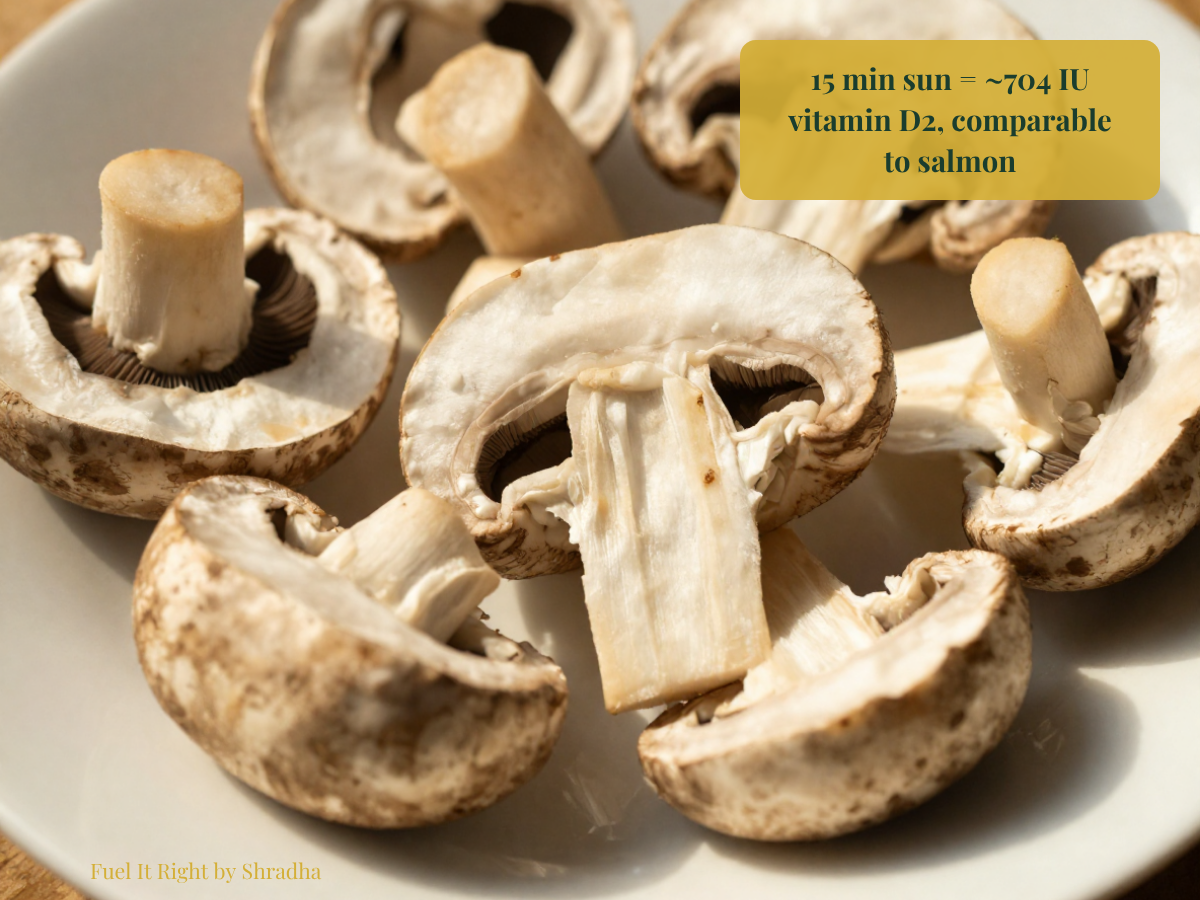
This isn't a wellness myth, it's measurable, repeatable, and the vitamin D2 survives cooking reasonably well, with more than half typically retained through most cooking methods. Twenty minutes of balcony sun on sliced mushrooms before they go into your sabzi is a genuinely free, food-first addition, not a replacement for medical supplementation when that's actually needed.
5. Common Mistakes That Waste Sun Exposure
WHAT YOU'VE HEARD: Sitting near a sunny window gives you vitamin D. |
WHAT'S ACTUALLY TRUE: Ordinary window glass blocks almost all UVB radiation, the specific wavelength needed for skin synthesis, while still letting UVA and visible light through. Warmth on your skin through a window is not the same as vitamin D synthesis. Only direct, unfiltered outdoor exposure works. |
WHAT YOU'VE HEARD: Ten minutes of sun at any time of day is enough. |
WHAT'S ACTUALLY TRUE: UVB intensity varies enormously across the day. Roughly 11am to 1pm delivers the most usable UVB for most of India; the same ten minutes at 8am or 5pm contributes far less regardless of how sunny it looks outside. |
WHAT YOU'VE HEARD: If you have naturally darker skin, you don't need to worry as much. |
WHAT'S ACTUALLY TRUE: The opposite is true. Melanin absorbs UVB and competes with the skin's vitamin D synthesis pathway, meaning darker skin needs proportionally longer sun exposure to produce the same amount of vitamin D as lighter skin, not less. |
6. Building a Vitamin D-Smart Day: Three Real Moments, Fully Assembled
This is a starting structure, not a replacement for testing. If your last vitamin D report was genuinely low, not just in the debated "insufficient" range, food and sun exposure alone may not rebuild levels quickly enough without medical supplementation.
Your Vitamin D-Smart Checklist, At a Glance |
Get 15-20 minutes of direct midday sun on arms and legs, most days, before reaching for sunscreen |
Choose fortified milk or curd where available, and check the label rather than assuming |
Sun-expose sliced mushrooms for 15-60 minutes before cooking them, at least a few times a week |
Don't rely on sitting near a window as a substitute for outdoor sun exposure |
Recheck your actual blood level before assuming a borderline reading is a crisis |
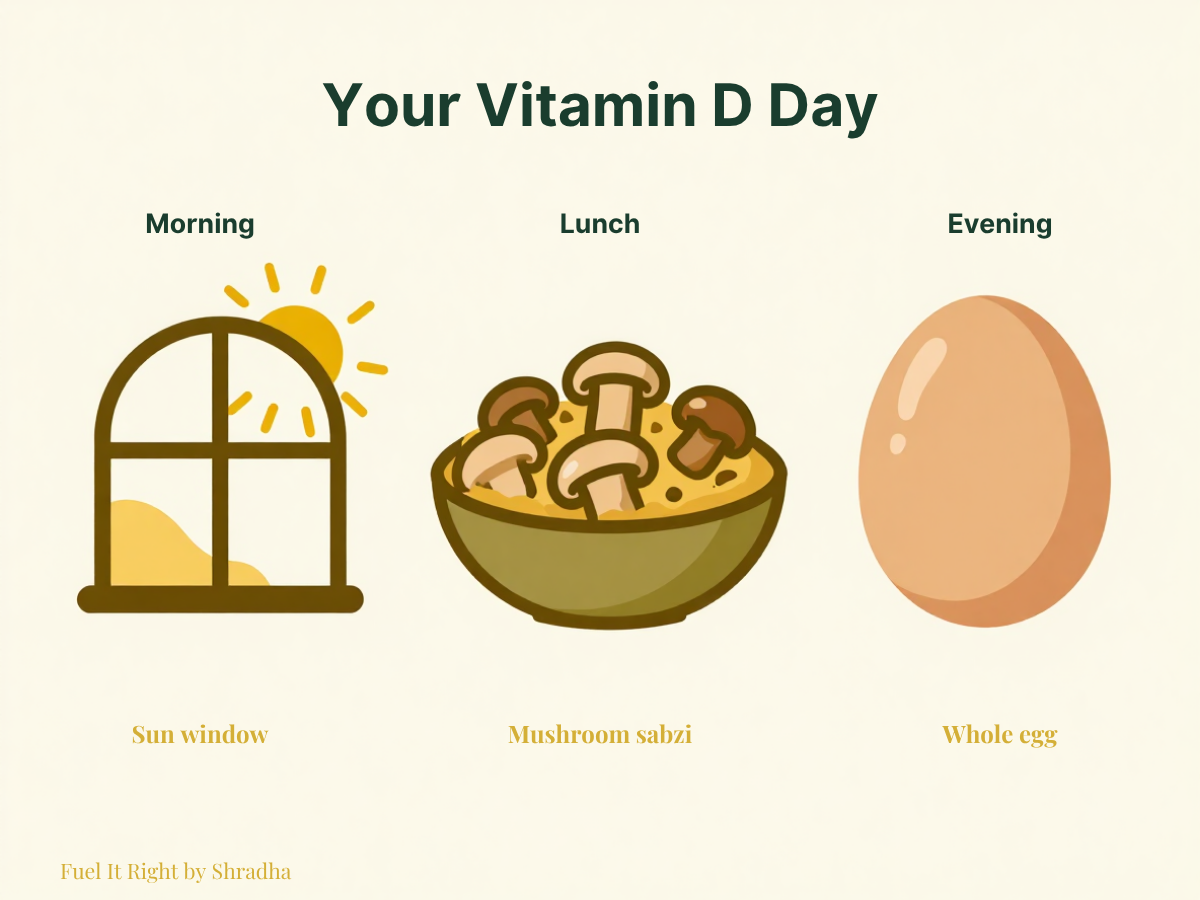
Three Real Moments, Fully Assembled
Morning | 15-20 minutes outdoors between 11am and 1pm if your schedule allows, arms and legs exposed, no sunscreen for this specific window. |
Lunch | A sabzi made with mushrooms that spent 20-30 minutes sun-exposed on the balcony beforehand, alongside fortified curd or milk if available. |
Evening | A boiled egg or an omelette using the whole egg, not just the white, as a small additional contributor alongside your regular meal. |
Bring your last vitamin D report, whatever the number.
We'll tell you if it actually needs fixing:
Conclusion
Vitamin D deficiency in India is real, but the widely quoted 70 to 90% figure likely overstates the share of people facing an actual health risk, since it typically blends a smaller genuinely deficient group with a much larger, more debated "insufficient" one. That nuance matters for how much to worry about a borderline lab report. It doesn't change what actually helps: a genuine midday sun window, fortified foods where available, and sun-exposed mushrooms as a food-first source most people have never tried.
FAQs
1. Why does India have such high vitamin D deficiency despite so much sunlight?
Melanin content, urban pollution, glass windows, indoor-first schedules, and cultural clothing norms all reduce how much UVB actually reaches skin and gets converted to vitamin D, regardless of how much sunlight exists outside.
2. Is the 70-90% deficiency figure accurate?
It's accurate to the thresholds being applied, but those thresholds are debated. Granular data shows a smaller share, often under 20%, are deficient by the stricter definition, while a larger share fall into a more contested "insufficient" category.
3. How much sun exposure do I actually need?
Roughly 15-20 minutes of arms-and-legs exposure during peak UVB hours, generally 11am to 1pm across most of India, without sunscreen for that specific window.
4. Does sitting by a window count as sun exposure?
No. Ordinary glass blocks nearly all UVB radiation, the wavelength needed for vitamin D synthesis, even though it lets warmth and visible light through.
5. Does the sun-exposed mushroom trick actually work?
Yes, it's measurable in controlled studies. Just 15 minutes of midday sun exposure on sliced mushrooms raised their vitamin D2 content to a level comparable to a serving of fatty fish.
6. What is the recommended daily vitamin D intake in India?
ICMR-NIN's 2020 guidelines set the RDA at 600 IU (15 micrograms) daily for most adults, pregnant and lactating women, and children over one year.
7. Do darker-skinned people need more sun exposure for the same vitamin D benefit?
Yes. Melanin competes with the skin's vitamin D synthesis pathway, so more melanin means proportionally longer sun exposure is needed to produce an equivalent amount of vitamin D.
8. Should I still get my vitamin D level tested?
Yes. The threshold debate is about how alarmed to be at a borderline result, not a reason to skip testing. A genuinely low result, well below the debated range, still warrants medical attention and possible supplementation.
About the Author
Shradha | Nutritionist & Dietitian | Fuel It Right. Food-first, evidence-based nutrition for real, sustainable results.