
Chronic Constipation: Why More Fibre Isn't the Fix
Chronic constipation affects 12-17% of Indians, and the standard advice, eat more fibre, doesn't work for everyone. Here's what the evidence actually shows, including when more fibre makes things worse.
Table of Contents
1. Chronic Constipation in India: How Common, and Why the Wrong Fix Sticks
2. Not All Fiber Works the Same
3. When More Fiber Actually Makes It Worse
4. The Water-Fiber Combination Nobody Gets Right
5. What Actually Moves the Needle: Verdict by Verdict
6. Building a Constipation-Smart Day
Conclusion
FAQs
1. Chronic Constipation in India: How Common, and Why the Wrong Fix Sticks
Chronic constipation affects an estimated 12-17% of Indian adults, broadly in line with global rates. A central India study found normal-transit constipation, where stool moves at a roughly normal pace but evacuation still feels incomplete or difficult, was the most common subtype, not the slow, sluggish gut most people picture.
The same study found something telling: 80% of patients had already tried complementary or over-the-counter remedies and remained unsatisfied. That's not a failure of willpower. It's a sign that generic advice, more fibre, more water, isn't matching the actual problem for most people trying it.
2. Not All Fibre Works the Same
"Eat more fibre" treats fibre as one thing. It isn't. Soluble fibre, found in psyllium (Isabgol), oat bran, barley, and beans, absorbs water and forms a gel that softens and bulks stool while resisting fermentation in the colon. Insoluble and highly fermentable fibres, found in wheat bran and some raw vegetables, behave differently: they ferment in the colon, produce gas, and can lose their water-holding capacity in the process.
A 2023 joint clinical guideline from the American Gastroenterological Association and American College of Gastroenterology reviewed fibre supplements specifically for constipation and found psyllium was the only one with solid evidence of benefit, associated with meaningfully more people reporting relief. Bran and inulin, by contrast, had limited and uncertain data behind them.
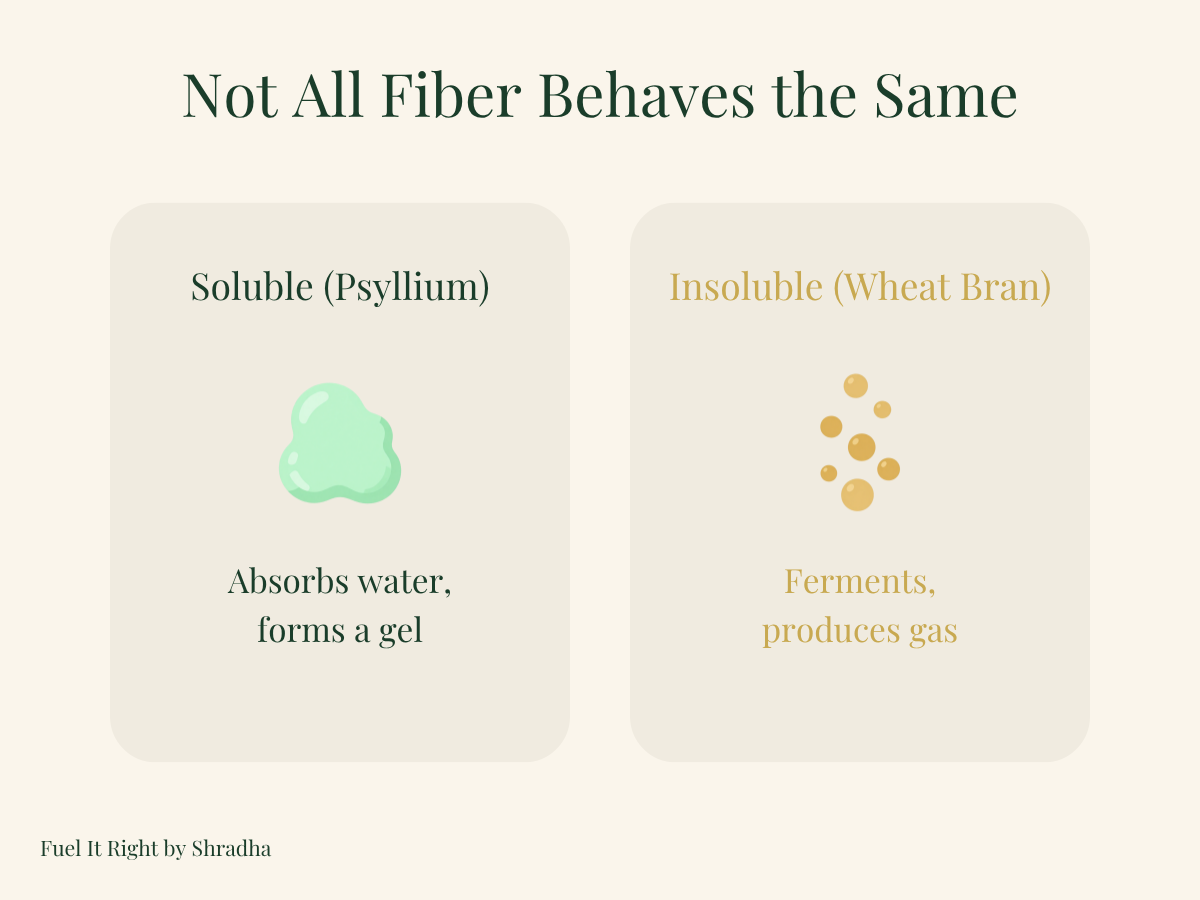
Fibre isn't a single ingredient with one effect. Psyllium and wheat bran can produce opposite experiences in the same gut.
3. When More Fibre Actually Makes It Worse
This is the part generic advice skips entirely. A study published in the World Journal of Gastroenterology found that for some patients with chronic constipation, reducing dietary fibre intake, not increasing it, improved their symptoms. A 2025 global clinical guideline echoes this, noting that fibre's evidence base is notably weak for specific constipation subtypes, including dyssynergic defecation, where the muscles involved in evacuation aren't coordinating properly, and that high-fibre diets should be avoided entirely in patients with intestinal obstruction.
The practical takeaway isn't that fibre is bad. It's that adding more bulk to a system that isn't moving or coordinating properly just adds more bulk, more bloating, and no more relief. If you've genuinely increased fibre and water and symptoms haven't improved after a few weeks, that's a signal to see a doctor about the underlying subtype, not a sign to double the fibre again.
Wondering what else your gut might be trying to tell you?
Take the free Gut Health Quiz:
4. The Water-Fibre Combination Nobody Gets Right
Fibre needs water to do its job; without enough fluid, soluble fibre can't form the gel that softens stool, and can theoretically worsen blockage. A Dutch study found that fibre's effectiveness for constipation specifically improved when paired with at least 2 litres of daily water intake, not as two separate habits but as a combination.
The central India study on chronic constipation found 55.3% of patients were drinking less than 2 litres of water a day, below what the National Institute of Nutrition, Hyderabad recommends for the Indian population. Fibre intake without matching water intake is a common, quietly self-defeating combination.
5. What Actually Moves the Needle: Verdict by Verdict
WHAT YOU'VE HEARD: Any fibre-rich food will fix constipation. |
WHAT'S ACTUALLY TRUE: The strongest evidence is specifically for psyllium (isabgol), a soluble, gel-forming fibre. Wheat bran and other highly fermentable fibres have much weaker evidence and are more likely to cause bloating without proportionate relief, especially if increased quickly. |
WHAT YOU'VE HEARD: Warm water with lemon first thing in the morning cures constipation. |
WHAT'S ACTUALLY TRUE: There's no direct evidence this specific ritual outperforms simply meeting your total daily water needs. It's a reasonable habit because it starts hydration early in a day where intake often falls short overall, not because the timing or lemon carries special effect. |
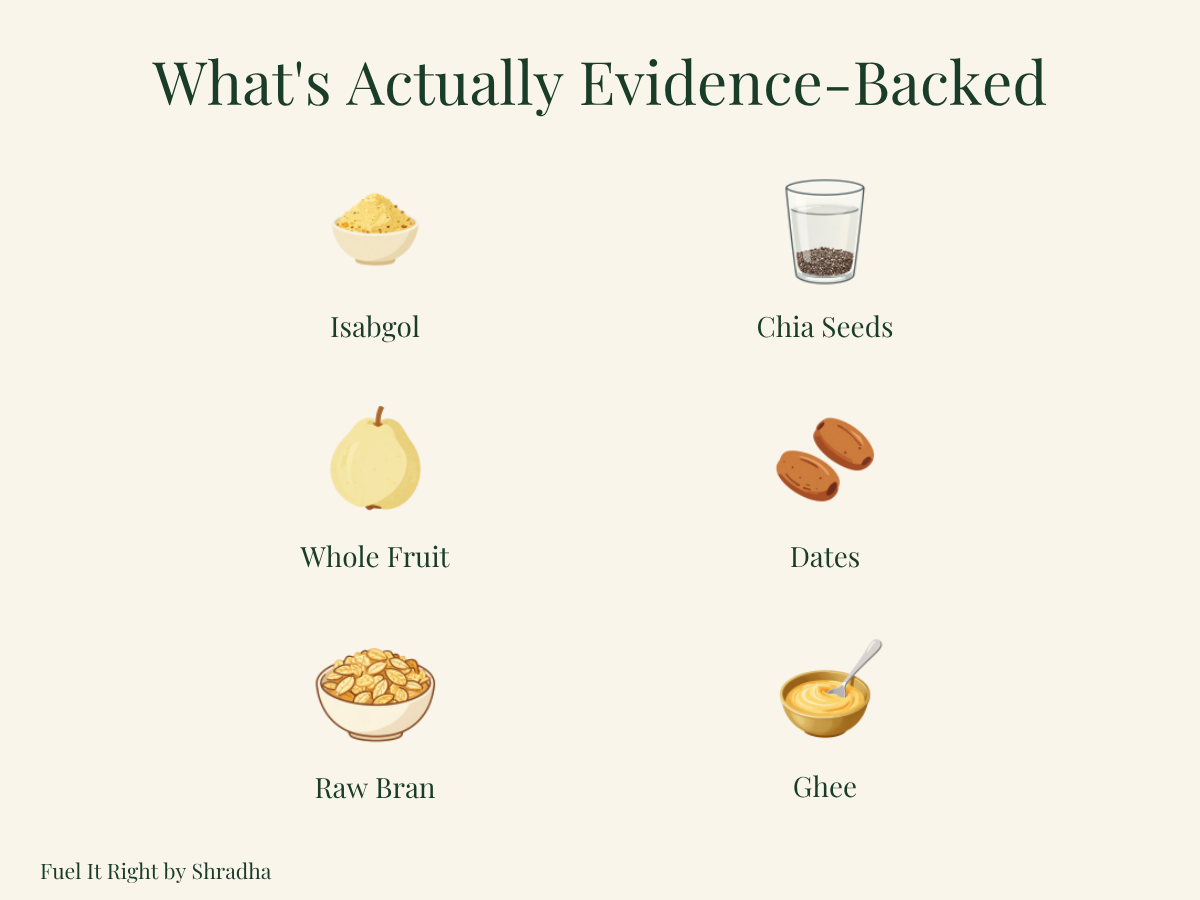
Isabgol (Psyllium Husk) STRONG CHOICE |
The only fibre supplement with solid randomised-trial evidence specifically for constipation relief. How to make it work: Start with 1 teaspoon in a full glass of water, build gradually toward 10g a day over a few weeks, always with adequate water alongside it. |
Chia Seeds STRONG CHOICE |
Soluble fibre that forms a gel with water through a mechanism similar to psyllium. How to make it work: Soak for 15-20 minutes before eating; eaten dry, they don't have the chance to absorb water and can do the opposite of what you want. |
Whole Fruit With Skin STRONG CHOICE |
Combines fibre content with water content in a single food, and skin (where edible) adds meaningful bulk. How to make it work: Eat guava, papaya, or pear whole rather than juicing; juicing removes most of the fibre that makes the fruit useful for this specific purpose. |
Dates GOOD, IN MODERATION |
Natural sorbitol content has a mild osmotic laxative effect, drawing water into the stool. How to make it work: 2-3 dates is a reasonable amount; more than that can cause the bloating and gas it's meant to relieve, since excess sorbitol ferments too. |
Raw Bran or a Sudden Big Increase in Raw Vegetables NEEDS CAUTION |
Insoluble, highly fermentable fibres added quickly are the most common cause of bloating without proportionate relief. How to make it work: If you've added a lot of raw fibre fast and feel worse, scale back and reintroduce gradually, or switch toward psyllium instead. |
Ghee or Oil-Based Home Remedies MODEST, NOT A FIX ALONE |
Some fat can support motility as part of an overall meal, but there's no strong evidence any single fat functions as a standalone constipation remedy. How to make it work: Treat it as one part of a balanced plate, not a substitute for adequate fibre and water. |
6. Building a Constipation-Smart Day: Three Real Moments, Fully Assembled
This is a starting structure, not a fix for every subtype. If symptoms persist for more than a few weeks despite consistent change, or if you notice blood, unintended weight loss, or new symptoms after age 50, see a doctor rather than continuing to self-manage.
Your Constipation-Smart Checklist, At a Glance |
Choose psyllium (isabgol) over other fibre supplements if you're going to use one |
Increase fibre gradually over weeks, not days, alongside matching water intake |
Hit at least 2 litres of water across the whole day, not just one ritual glass in the morning |
If more fibre is making things worse, not better, after a few weeks, that's a signal to see a doctor, not to add more |
Eat whole fruit with skin rather than juicing it |
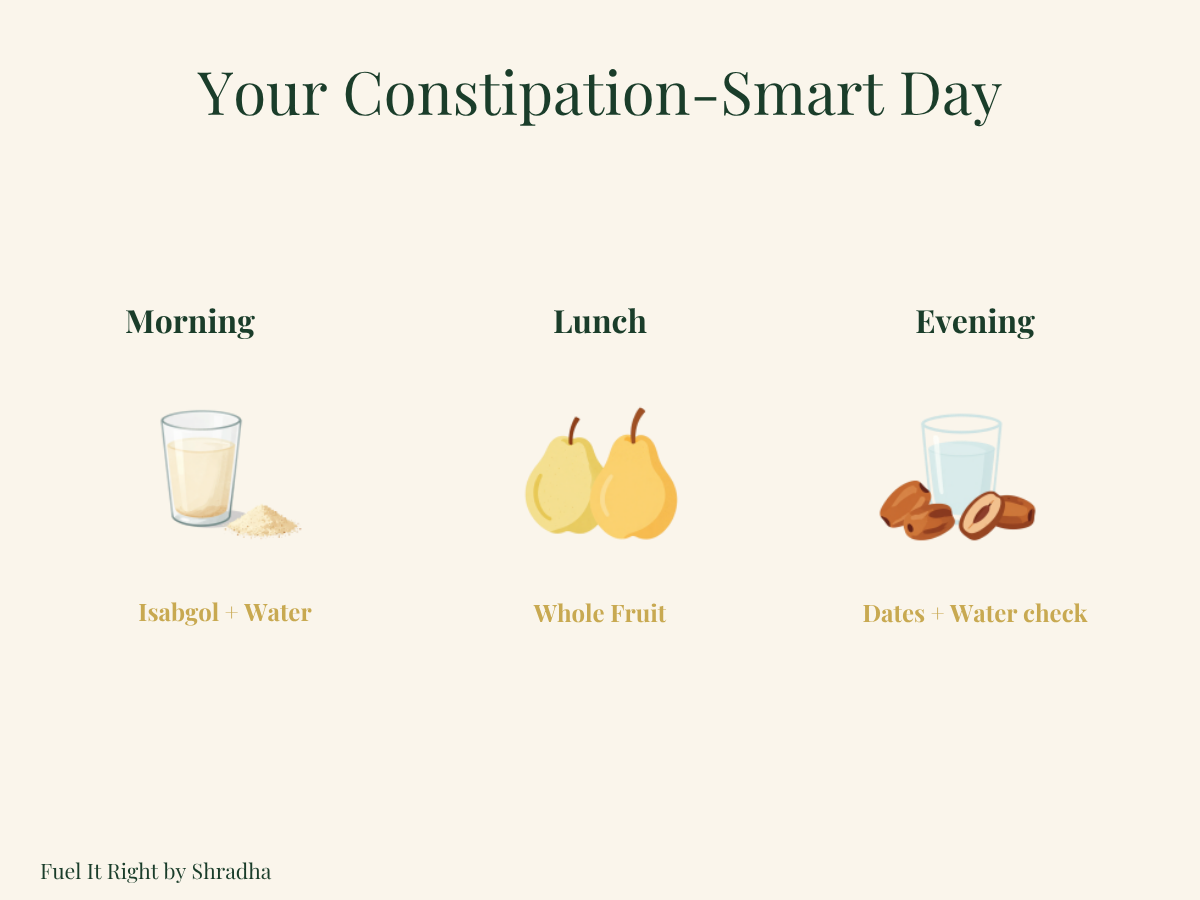
Three Real Moments, Fully Assembled
Morning | 1 teaspoon isabgol in a full glass of water, or chia seeds soaked overnight in water or curd. |
Lunch | Whole fruit with skin as dessert instead of juice, vegetables added to the half-vegetable, quarter-protein plate gradually if you're not used to a high-vegetable meal yet, not all at once. |
Evening | 2-3 dates with warm water or milk, and a final check on whether you've hit 2 litres of water across the day. |
Not sure which type of constipation you're actually dealing with?
Let's work it out together:
Conclusion
Chronic constipation affects a meaningful share of Indian adults, and "eat more fibre" is true often enough to have become the default advice, which is exactly why it fails so many people who've already tried it. The evidence points to something more specific: psyllium over other fibre types, water and fibre increased together rather than separately, gradual increases over weeks rather than days, and a willingness to recognise when more fibre is making things worse rather than better. That last point alone is the piece most generic advice leaves out entirely.
FAQs
1. How common is chronic constipation in India?
An estimated 12-17% of Indian adults experience chronic constipation, broadly similar to global rates. Normal-transit constipation, where stool moves at a near-normal pace but evacuation still feels difficult, appears to be the most common subtype.
2. What's the best fibre supplement for constipation?
Psyllium (isabgol) has the strongest clinical trial evidence among fibre supplements. Bran and inulin have considerably weaker and less consistent evidence for constipation specifically.
3. Can too much fibre make constipation worse?
Yes, for some people. Research has found that reducing fibre intake improved symptoms in certain patients, particularly where the underlying issue involves coordination of the evacuation muscles rather than simply insufficient bulk.
4. How much water do I actually need for fibre to work?
At least 2 litres a day is the commonly cited target for the Indian population. Research suggests fibre's effectiveness for constipation is meaningfully better when paired with adequate water intake, rather than either habit alone.
5. Does warm water and lemon in the morning really help?
The habit itself isn't specifically proven to help more than plain water. It's useful mainly because it starts your day's hydration early, in a day where total water intake often falls short.
6. How quickly should I increase fibre intake?
Gradually, over several weeks, not days. Jumping straight to a high-fibre intake is a common cause of bloating and discomfort that leads people to give up before it has a chance to help.
7. Are dates a good natural laxative?
In moderation, yes. Their natural sorbitol content has a mild osmotic effect. Two to three dates is a reasonable amount; larger quantities can cause the same bloating and gas they're meant to relieve.
8. When should I see a doctor instead of managing this myself?
If consistent dietary changes over several weeks haven't helped, or if you notice blood, unintended weight loss, or new symptoms appearing after age 50, see a doctor rather than continuing to self-manage with food alone.
About the Author
Shradha | Nutritionist & Dietitian | Fuel It Right. Food-first, evidence-based nutrition for real, sustainable results.