
PCOS, PMOS and Diabetes: How to Stop It Before It Starts
Women with PMOS have a 4x higher lifetime risk of type 2 diabetes. Over half will develop it by age 40 if insulin resistance goes untreated. Here is how to stop it before it starts.
Table of Contents
1. The Statistic Every Woman With PMOS Needs to Hear
2. Why PMOS and Diabetes Share the Same Root
3. Who Is at Highest Risk Among Indian Women With PMOS
4. How to Know Where You Are on the Spectrum Right Now
5. The Prediabetes Window: What It Means and Why It Matters
6. What Indian Food Does to Stop Diabetes Before It Starts
7. The Meal That Matters Most
8. What to Watch for as Your Numbers Improve
9. Conclusion
10. FAQs
The Statistic Every Woman With PMOS Needs to Hear
Women with PMOS have a 4x higher lifetime risk of type 2 diabetes than women without the condition. Over half will develop type 2 diabetes by age 40 if insulin resistance goes unaddressed. And in Indian women specifically, this risk arrives earlier, at lower body weights, and with fewer warning signs than in Western populations.
This is not a distant risk. It is a trajectory that is already in motion for most women with PMOS, building silently while periods are being managed with the pill and acne is being treated with antibiotics.
Over half of women with PMOS will develop type 2 diabetes by age 40 if insulin resistance goes untreated.
The good news is that the trajectory is reversible. Insulin resistance, the driver of both PMOS and type 2 diabetes, responds directly and measurably to food. You do not need to wait for a diabetes diagnosis to act. You act now, with what is already in your kitchen.
Why PMOS and Diabetes Share the Same Root
Understanding the PMOS-diabetes connection requires understanding that these are not two separate conditions that happen to co-occur. They are two expressions of the same underlying metabolic dysfunction: insulin resistance.
The Shared Mechanism
In PMOS, cells in muscle and fat tissue become resistant to insulin. The pancreas compensates by producing more insulin. This hyperinsulinemia drives androgen excess, disrupts ovulation, and causes the symptoms women associate with PMOS. At the same time, the chronically overworked pancreas gradually loses its ability to compensate. Beta cell function declines. When compensation fails, blood sugar rises above the threshold for type 2 diabetes.
This is the same process in every woman with PMOS. The difference between the woman who develops diabetes at 35 and the one who does not is how early the metabolic intervention happens and how sustained it is. For more on how insulin resistance works throughout the body, see our blog on insulin resistance and PMOS.
Beta Cell Exhaustion: The Turning Point
The pancreatic beta cells that produce insulin can sustain compensation for years, sometimes decades. But they are not inexhaustible. Chronic high demand accelerates beta cell fatigue. Once a significant proportion of beta cell function is lost, restoring normal blood sugar without medication becomes much harder. This is why early intervention matters so much. The earlier the dietary changes happen, the more beta cell function is preserved.
Who Is at Highest Risk Among Indian Women With PMOS
Not all women with PMOS carry equal diabetes risk. Certain clinical and lifestyle factors significantly accelerate the trajectory. If you recognise yourself in this list, your window to act is now.
Family history of type 2 diabetes | 43% of Indian women with PMOS have a family history of type 2 diabetes. The genetic predisposition to beta cell dysfunction compounds the metabolic risk from PMOS. If your mother, father, or sibling has type 2 diabetes, your own risk is significantly higher than average. |
HOMA-IR above 2.5 | Significant insulin resistance means the compensation phase is already active. The longer compensation runs at this level, the faster beta cell fatigue accumulates. |
HbA1c between 5.4% and 5.6% | This range is technically normal but represents rising average blood sugar in the context of PMOS. Women in this range are on a trajectory toward prediabetes even when their numbers look acceptable. |
Lean women with PMOS | Research confirms that Asian ethnicity and hyperandrogenism are independent risk factors for type 2 diabetes in normal-weight women with PMOS. Being thin is not protective. Read more about lean PMOS in our dedicated blog [internal link]. |
Previous gestational diabetes | Women with PMOS who develop gestational diabetes have a significantly higher subsequent incidence of type 2 diabetes, 2.8 per 100 person-years, and fourfold higher if pharmacological treatment was required during pregnancy. |
Sedentary urban lifestyle | Skeletal muscle is the primary site of insulin-mediated glucose uptake. Reduced muscle activity compounds insulin resistance independently of diet. Urban sedentary lifestyles are a direct accelerator of the PMOS-diabetes trajectory in Indian women. |
Co-existing fatty liver | PMOS, insulin resistance, and fatty liver form a triad that dramatically accelerates metabolic progression. If you have elevated ALT or a fatty liver finding on ultrasound alongside PMOS, your diabetes risk timeline is compressed. See our blog on PMOS and fatty liver [internal link]. |
How to Know Where You Are on the Spectrum Right Now
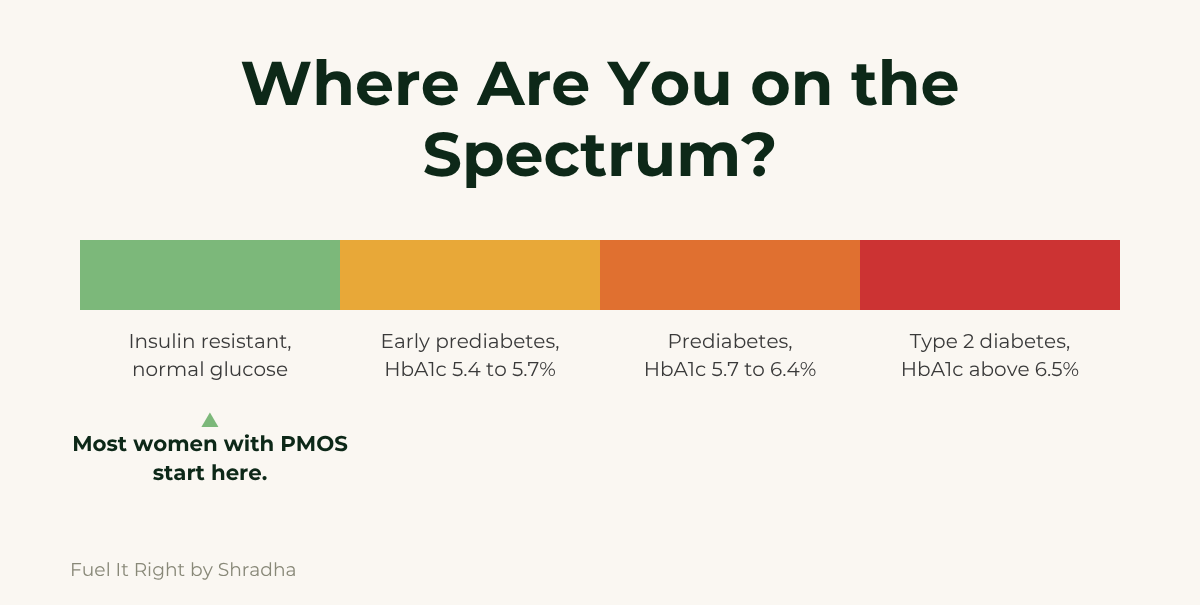
Type 2 diabetes does not arrive suddenly. It develops across a spectrum, and most women with PMOS are somewhere on that spectrum right now, without knowing it. Here is how to find out where you stand.
The Tests That Tell You
These are the numbers that matter. For the full panel with optimal ranges, see the PMOS diagnosis checklist.
Test | What it shows | PMOS-specific interpretation |
Fasting insulin | Whether insulin resistance is present | Above 10 mIU/L means compensation is active. Above 15: significant IR. This is the earliest signal — years before glucose rises. |
HOMA-IR | Severity of insulin resistance | Below 1.5: good. 1.5 to 2.5: early IR. 2.5 to 3.5: significant. Above 3.5: severe. Calculate from fasting insulin and glucose. |
HbA1c | 3-month average blood glucose | 5.7% or above is prediabetes. But for PMOS management, 5.4% is the target — below standard normal but more protective. |
75g OGTT 2-hour | Post-meal glucose handling | Catches what fasting tests miss. 140 to 199 mg/dL at 2 hours is impaired glucose tolerance — prediabetes territory missed by fasting glucose alone. |
Fasting glucose | Baseline blood sugar | Normal until the compensation phase fails. Do not rely on this alone — it is the last number to change. |
C-peptide | Beta cell reserve | Measures how much insulin-producing capacity remains. Low C-peptide means beta cell fatigue is advanced. |
Know your diabetes risk before it becomes diabetes.
Book a free 30-minute discovery call. Bring your fasting insulin, HbA1c, and HOMA-IR. We will tell you exactly where you stand and what to eat to reverse the trajectory.
The Prediabetes Window: What It Means and Why It Matters
Prediabetes is the most important stage in the PMOS-diabetes journey, and the most overlooked. It is the period where insulin resistance is significant, HbA1c is rising, and the trajectory toward type 2 diabetes is established, but the damage is still largely reversible.
Prediabetes is not a warning. It is a reversible condition. Most people with prediabetes never develop type 2 diabetes if they intervene now.
What Prediabetes Looks Like in PMOS
In standard clinical practice, prediabetes is defined as fasting glucose between 100 and 125 mg/dL, or HbA1c between 5.7% and 6.4%, or 2-hour OGTT between 140 and 199 mg/dL. But in women with PMOS, the trajectory is often already significant at values below these thresholds. An HbA1c of 5.5% in a woman with PMOS, a family history of diabetes, and HOMA-IR of 3.0 is a more urgent clinical picture than the numbers alone suggest.
The Reversal Evidence
The Diabetes Prevention Program, one of the largest lifestyle intervention trials ever conducted, found that intensive lifestyle intervention reduced the risk of developing type 2 diabetes by 58% in people with prediabetes. For people over 60, the reduction was 71%. Dietary change and modest physical activity were more effective than Metformin alone. The food intervention works. The question is whether it happens early enough.
The most common mistake in the prediabetes window Waiting. Most women with PMOS who are told their blood sugar is 'a little high' or 'borderline' are told to 'watch what they eat and come back in six months.' No specific protocol. No food guidance. No metabolic target. Six months later, the numbers are worse. The prediabetes window is not a waiting room. It is the most powerful intervention point available. |
What Indian Food Does to Stop Diabetes Before It Starts
The PMOS-diabetes prevention protocol through food works through three simultaneous mechanisms: reducing the insulin surges that exhaust beta cells, improving cellular insulin sensitivity, and rebuilding the gut microbiome that regulates glucose metabolism.
The Gut-Blood Sugar Connection
The gut microbiome directly influences insulin sensitivity and glucose metabolism through short-chain fatty acids, GLP-1 production, and bile acid signalling. Women with PMOS who rebuild their gut bacteria through consistent fibre and fermented food intake see measurable improvements in insulin sensitivity alongside their gut health. The gut-PMOS connection blog covers the mechanism in detail.
The Foods That Protect Beta Cell Function
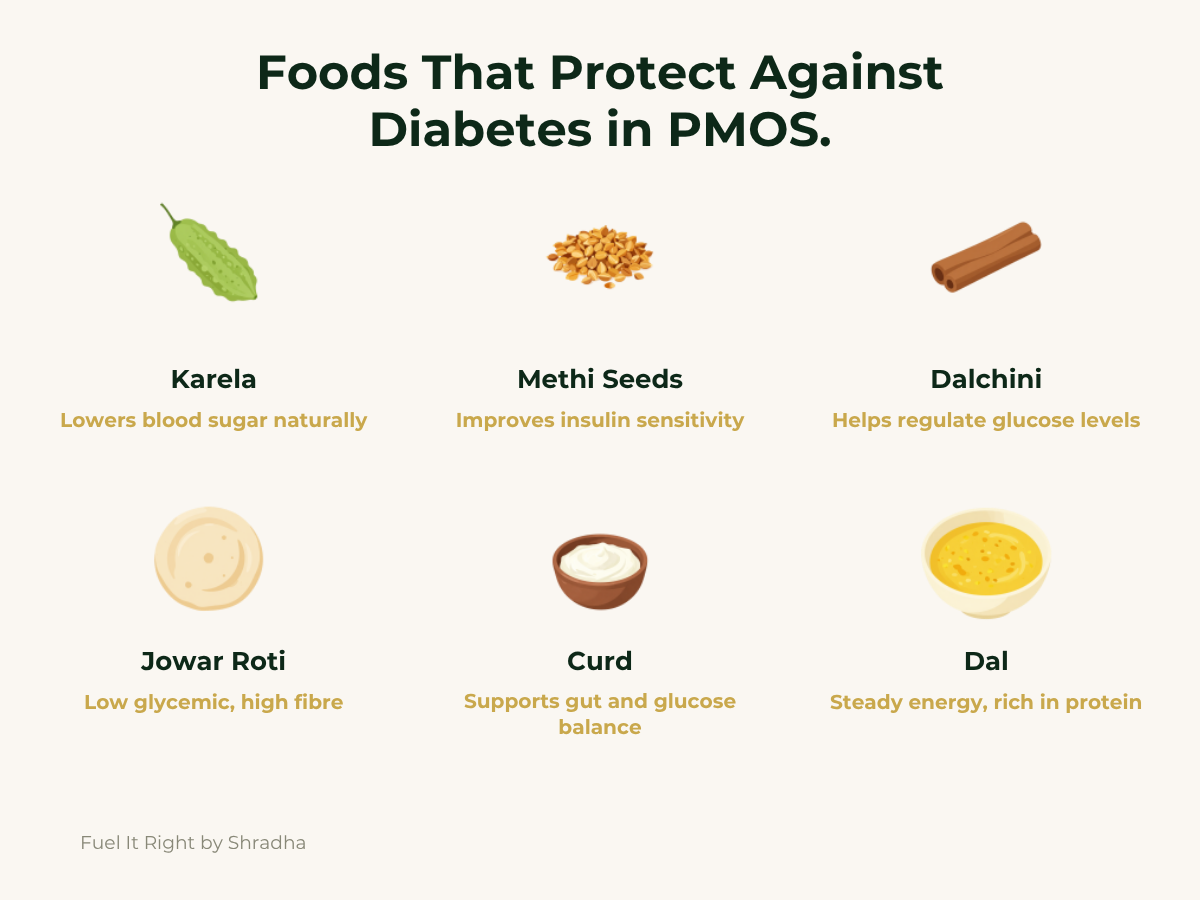
1 | Dal and legumes The prebiotic fibre in legumes feeds bacteria that produce butyrate and propionate. Propionate directly signals the liver to reduce glucose production. Dal also provides slow-digesting protein that blunts post-meal glucose. One cup daily is the minimum for meaningful metabolic benefit. |
2 | Bitter gourd (karela) Clinical studies consistently show that karela reduces fasting blood sugar and improves insulin sensitivity through multiple mechanisms including momordicin, which mimics insulin action. Two to three servings per week. Not a supplement. The vegetable itself. |
3 | Methi seeds Half a teaspoon soaked overnight, taken on waking, consistently reduces fasting glucose in clinical studies. The galactomannan fibre slows glucose absorption at every meal eaten after taking it. A simple daily practice with strong evidence. |
4 | Cinnamon (dalchini) Half a teaspoon of cinnamon daily consistently reduces fasting blood sugar and improves insulin sensitivity in clinical studies. Easy to add to chai, oats, or any cooked dish. One of the most accessible blood sugar interventions in the Indian kitchen. |
5 | High-fibre grains over refined Jowar, bajra, ragi, and whole wheat reduce post-meal glucose significantly compared to maida and white rice. The bran slows starch digestion. Switching one refined grain serving daily to a whole grain reduces the daily insulin demand meaningfully. |
6 | Curd and chaas Short-chain fatty acids from gut bacteria fed by curd's live cultures improve GLP-1 secretion, which directly supports beta cell function and reduces post-meal glucose. Two servings daily. |
Based in Goa? Come in and see us.
The Diet Dr Clinic team works with clients managing PMOS, prediabetes, thyroid conditions, and weight through food. No supplements. No machines. Real food in your kitchen.
+91 7057063984
The Meal That Matters Most
If there is one intervention that reduces PMOS-related diabetes risk more than any other, it is the first meal of the day. Breakfast determines the insulin and cortisol pattern for the entire day. A protein-first breakfast reduces the morning insulin surge that accumulates into beta cell fatigue over years.
What Most Indian Breakfasts Do
Poha, upma, white bread and butter, cornflakes, fruit juice. These are predominantly carbohydrate with minimal protein. They trigger a sharp glucose spike within 30 minutes, a significant insulin response, and then a glucose crash that drives cortisol elevation and sugar cravings through the morning. Repeated daily for years, this pattern is the most consistent dietary driver of the PMOS-to-diabetes trajectory.
What a Protective Breakfast Looks Like
• Moong dal chilla with green chutney and a side of curd.
• Two eggs any style with one slice of multigrain toast and a handful of sprouts.
• Paneer bhurji with one roti and fresh cucumber.
• Sprout salad with lemon, salt, and a small amount of curd.
• Ragi porridge with nuts and seeds, no sugar
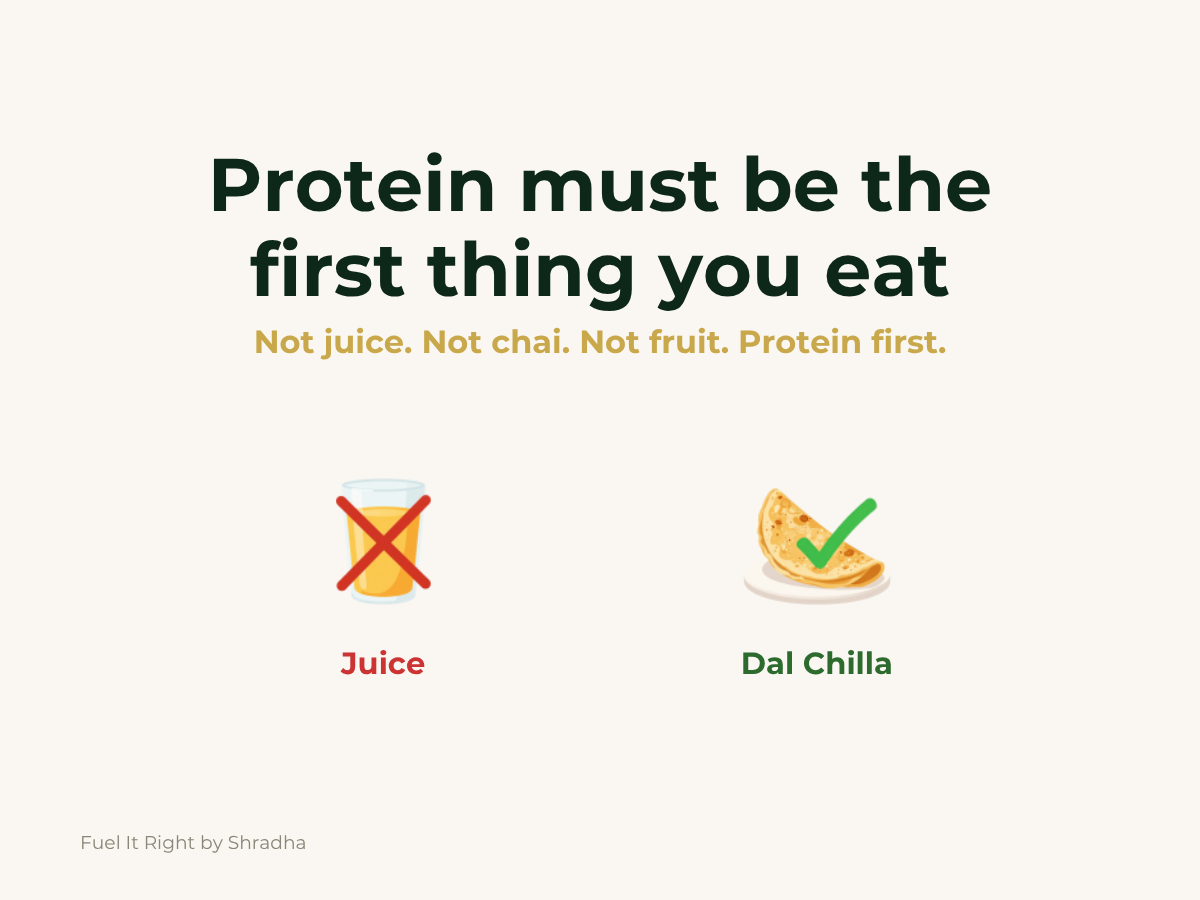
The rule: protein must be the first thing you eat at breakfast. Not a glass of juice. Not fruit. Not chai. Protein first, then everything else. This single rule, applied consistently, reduces the daily insulin demand more than almost any other single dietary change.
The sequence rule applies to every meal, not just breakfast Vegetables and protein first. Dal second. Rice or roti last. The same food eaten in this sequence produces a glucose response up to 30% lower than the same food eaten with carbohydrates first. This is not a restrictive diet. It is the same Indian food, in the right order. |
What to Watch for as Your Numbers Improve
Once you start addressing insulin resistance to prevent PMOS-related diabetes, these are the markers to track and the timeline to expect.
• HOMA-IR: retest every 3 months. Should be moving toward 1.5. Any downward movement is meaningful.
• HbA1c: retest every 3 months. Each 0.1% reduction represents a significant improvement in average glucose exposure.
• Fasting insulin: retest every 3 months. Declining fasting insulin means the pancreas is under less demand and beta cells are recovering.
• Fasting glucose: slower to change than insulin. Do not use this as your primary progress marker.
• Energy levels and afternoon cravings: subjective but meaningful early signals. Reduced afternoon energy crashes indicate improving insulin sensitivity before blood tests show it.
• Cycle regularity: as insulin resistance improves, androgen levels reduce, and ovulation regularises. Cycle improvement is often the first visible sign that metabolic change is happening.
When to involve a doctor alongside dietary change If your HOMA-IR is above 3.5, your HbA1c is above 5.7%, or your 2-hour OGTT is above 140 mg/dL, dietary change alone may not be sufficient as the sole intervention. Food is the foundation. It is not always the ceiling. Metformin, when prescribed alongside dietary change, significantly improves outcomes over either approach alone. The combination is not a failure of the food-first philosophy. It is the evidence-based application of it. |
Conclusion: The Window Is Open. Use It.
PMOS and type 2 diabetes are running on the same metabolic track. The insulin resistance driving your PMOS symptoms today is the same mechanism that leads to diabetes if it goes unaddressed. The trajectory is not fixed. It is a road you can turn off — but only while the window is open.
Indian women with PMOS face a specific and well-documented risk: earlier onset, lower BMI thresholds, higher genetic predisposition. But the same food that addresses PMOS symptoms addresses diabetes risk. You are not managing two separate problems. You are managing one metabolic picture, and every meal you eat in the right order is a diabetes prevention act.
Get your numbers. Know your HOMA-IR, your HbA1c, your fasting insulin. Understand where on the spectrum you are today. And start with breakfast this week.
Book a Free 30-Minute Discovery Call
Bring your fasting insulin, HbA1c, and HOMA-IR. We will build your diabetes prevention protocol from your own Indian kitchen.
Or call us: +91 7057063984
FAQs: PMOS and Diabetes Prevention
Q1. If I have PMOS, will I definitely get diabetes?
No. The 4x higher lifetime risk means the trajectory is significantly elevated, not that diabetes is inevitable. Women who address insulin resistance through food, lifestyle, and where necessary medical management, substantially reduce or eliminate that elevated risk. The risk is real but it is highly modifiable. The key variable is how early and how consistently the intervention happens.
Q2. My fasting glucose and HbA1c are normal. Does that mean my diabetes risk is low?
Not necessarily. Fasting glucose is the last marker to rise in insulin resistance. The compensation phase, where the pancreas produces excess insulin to maintain normal blood sugar, can last years before fasting glucose becomes abnormal. Ask for fasting insulin and HOMA-IR. A HOMA-IR above 2.5 with a normal fasting glucose is a significant finding in the context of PMOS, even when it looks reassuring on a standard report.
Q3. I am 24 years old with PMOS and a family history of diabetes. Should I be worried?
You should be informed and proactive, not worried. 24 is the ideal age to intervene because your beta cell reserve is at its maximum. The dietary changes that reduce insulin resistance now preserve beta cell function for the next two to three decades. Start with your breakfast, get your fasting insulin tested, and understand your HOMA-IR. That knowledge, applied through consistent food choices, is more powerful than any supplement or medication at this stage.
Q4. Can Metformin alone prevent diabetes in PMOS?
Metformin reduces diabetes incidence in high-risk individuals but less effectively than intensive lifestyle intervention. The Diabetes Prevention Program found that lifestyle change reduced diabetes risk by 58% while Metformin reduced it by 31%. For most women with PMOS, dietary change is the more powerful primary intervention. Metformin is most valuable as an adjunct when insulin resistance is severe, or when dietary change alone is insufficient after a sustained trial.
Q5. Does losing weight prevent diabetes in PMOS?
Weight loss does reduce insulin resistance and diabetes risk, but it is not the only pathway and it is not required for meaningful risk reduction in Indian women with PMOS. Dietary composition changes, meal sequencing, and gut health improvement reduce insulin resistance independently of weight loss. A lean woman with PMOS who eats protein-first meals and consistently uses anti-inflammatory foods reduces her diabetes risk meaningfully even without significant weight change.
Q6. How long does it take to see meaningful improvement in blood sugar markers?
Fasting insulin and HOMA-IR typically begin improving within 6 to 8 weeks of consistent dietary change. HbA1c, reflecting a 3-month average, requires at least 3 months to show meaningful movement. Post-meal glucose responses improve within days of consistent protein-first meal sequencing. The subjective markers, reduced afternoon energy crashes and cravings, often improve within 2 to 4 weeks, before blood tests reflect the change.
Q7. I was told I have prediabetes. Is it too late to reverse it?
No. Prediabetes is the most reversible stage of the glucose metabolism spectrum. The Diabetes Prevention Program demonstrated that most people with prediabetes who implement consistent dietary and lifestyle changes do not develop type 2 diabetes. The earlier in prediabetes the intervention happens, the more completely it reverses. If your HbA1c is between 5.7% and 6.4%, you are in the most powerful intervention window available.
Q8. What is gestational diabetes and why does it matter for PMOS?
Gestational diabetes is diabetes that develops during pregnancy. Women with PMOS have a significantly higher risk of gestational diabetes, estimated at 19%, compared to a background rate of 6 to 8% in the general population. Women with PMOS who develop gestational diabetes then face a substantially elevated risk of type 2 diabetes in the years following pregnancy, with incidence rates of 2.8 per 100 person-years. If you have PMOS and plan to become pregnant, addressing insulin resistance before conception is the most protective intervention available.
About the Author
Shradha | Nutritionist and Dietitian | Fuel It Right. Practising out of Goa, India, with a focus on gut health, PMOS/PCOS, thyroid disorders, and weight management using real Indian food. No supplements. No machines. Just food, and the science behind it.
fuel-it-right.com | @fuelitright