
PCOS and PMOS: What Changes in Your 20s, 30s and 40s
Table of Contents
1. The One Thing That Does Not Change at Any Age|
2. Your 20s: When PCOS/PMOS Is Loudest
3. Your 30s: When the Stakes Get Higher
4. Your 40s: When Perimenopause Enters the Picture
5. What the Research Shows About PCOS/PMOS and Ageing
6. The Food Protocol Stays the Same, What Changes Is the Emphasis
7. Conclusion
8. FAQs
The One Thing That Does Not Change at Any Age
PCOS and PMOS do not resolve with age. This is the most important and the most consistently misrepresented fact about the condition. Women are frequently told to wait, wait until your cycle settles, wait until you have children, wait until menopause. The implication is always that the condition will eventually go away.
It does not. What changes across decades is which symptoms dominate and which risks become most urgent. What does not change is the underlying metabolic dysfunction: insulin resistance persists, the cardiovascular risk accumulates, and the metabolic complications, fatty liver, diabetes risk, thyroid vulnerability, continue to develop if the root is not addressed.
Your periods may get more regular in your 40s. Your insulin resistance will not. The condition does not disappear. It just changes what it shows you.
Understanding what PCOS/PMOS looks like at each decade of life helps you know what to watch for, what to test for, and where to focus your food protocol. The insulin resistance and PCOS/PMOS blog covers the root mechanism that persists across all decades.
Your 20s: When PCOS/PMOS Is Loudest
PCOS/PMOS in your 20s is typically the most symptom-dense decade. The hormonal environment is highly active, the adrenal androgen production is at its peak, DHEAS is highest in the 20s and naturally declines by approximately 40% by the 30s, and most women either receive their first diagnosis in this decade or are struggling to understand symptoms that have not yet been named.
Your 20s: When PCOS/PMOS Is Loudest
PCOS/PMOS in your 20s is typically the most symptom-dense decade. The hormonal environment is highly active, the adrenal androgen production is at its peak, DHEAS is highest in the 20s and naturally declines by approximately 40% by the 30s, and most women either receive their first diagnosis in this decade or are struggling to understand symptoms that have not yet been named.
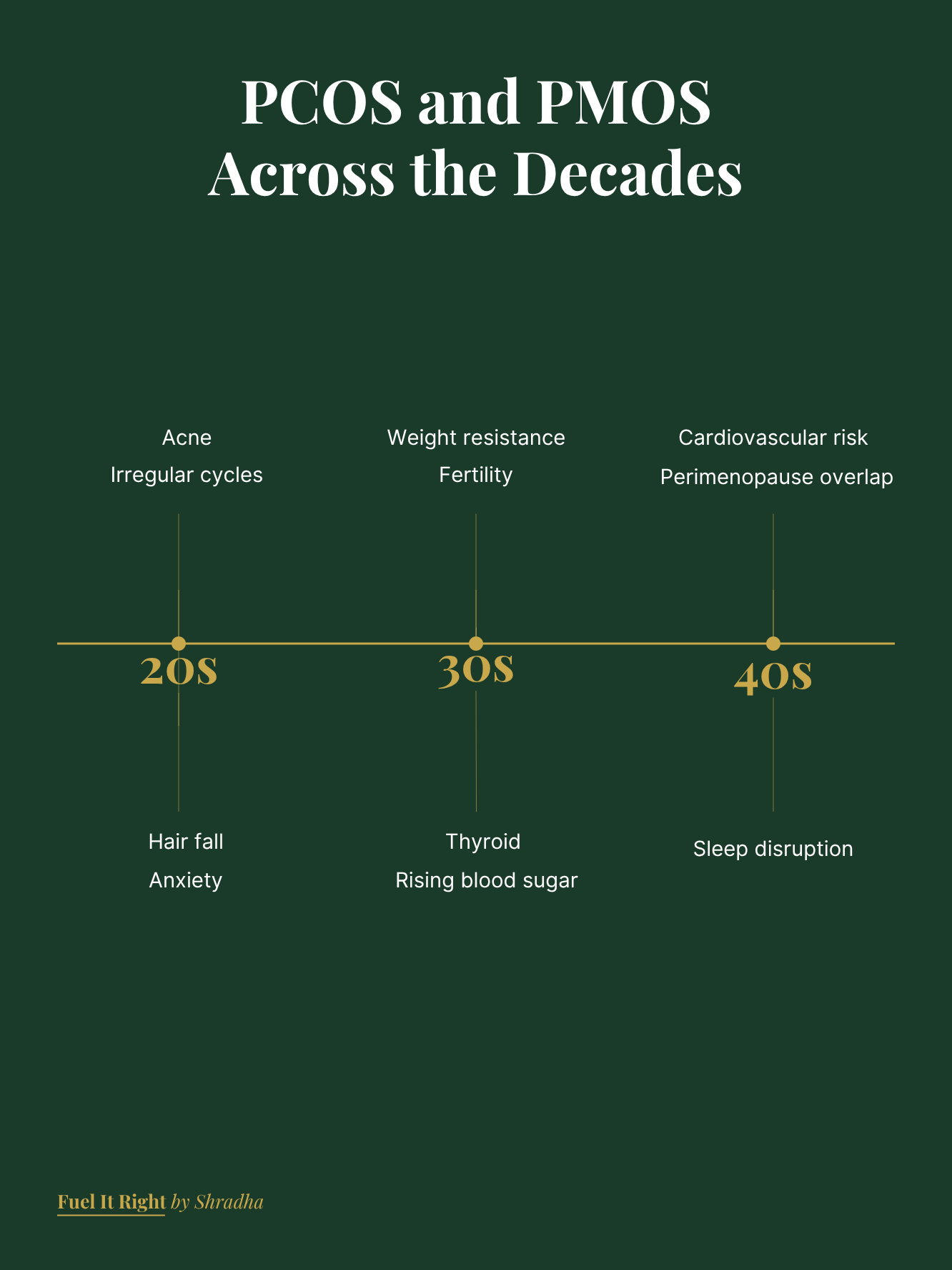
Your 20s Highest symptom intensity What is happening: Peak adrenal androgen production. Hormonal environment most active. Most women first diagnosed or first symptomatic. Insulin resistance establishing. Gut dysbiosis often beginning. Dominant symptoms: Irregular or absent cycles. Significant acne and hair fall. Hirsutism. Weight gain especially abdominal. Anxiety and mood instability. Brain fog. Poor sleep. Food priority: Establish the food protocol early. Protein-first breakfast every day. Dal and curd daily. Sequence rule at every meal. Anti-inflammatory spices. This decade sets the metabolic trajectory for the next twenty years. Test focus: HOMA-IR, free testosterone, DHEAS, hsCRP, TSH, free T3. Baseline everything now. |
What Matters Most in Your 20s
Women in their 20s with PCOS/PMOS report the highest burden of mental health symptoms like anxiety, poor self-esteem, and disordered eating concerns, alongside the most visible skin and hair symptoms. A 2023 study found that women in their 20s with PCOS expressed distress due to poor mental health, needing a longer time to get the diagnosis, and having weight and eating concerns. The psychological burden of this decade is under addressed because clinical attention focuses on the reproductive symptoms.
The food protocol in your 20s is the most impactful investment you can make. Establishing insulin-stable eating habits before the metabolic picture deepens over time is the highest-leverage intervention available. The habits built in this decade either slow the progression of insulin resistance or allow it to compound.
Your 30s: When the Stakes Get Higher
PCOS/PMOS in your 30s shifts in character. Visible androgenic symptoms like acne, hirsutism often moderate as DHEAS naturally declines. Cycles may become slightly more regular. For many women this feels like improvement. The metabolic picture behind it, however, is deepening.
Your 30s Fertility and metabolic deepening What is happening: DHEAS naturally declines by 40% from peak. Visible androgenic symptoms moderate. Cycles may become slightly more regular. Insulin resistance, if unaddressed, deepening. Fertility often becomes the primary clinical concern. Dominant symptoms: Fertility challenges. Weight that is harder to shift than in the 20s. Fatigue that does not respond to sleep. Increasing blood sugar markers. Thyroid conditions commonly presenting or worsening. Depression often peaking. Food priority: Fertility preparation: protein at every meal, gut health through dal and curd, anti-inflammatory spices, reducing refined carbohydrates. Iron and folate-rich foods. Timing of rice and carbohydrates becomes more important as insulin sensitivity declines. Test focus: HOMA-IR, fasting insulin, HbA1c, ALT/AST (fatty liver), free testosterone, anti-TPO antibodies (Hashimoto's screening), ferritin, Vitamin D. |
The Fertility Window
Women in their 30s with PCOS/PMOS discuss menstrual irregularities and fertility issues as their primary concerns. This is the decade where the relationship between insulin resistance and ovulation becomes clinically urgent, because restoring ovulation requires addressing insulin resistance, and every year of unaddressed insulin resistance makes that restoration harder. See the blog on PCOS/PMOS and fertility for the specific food interventions most relevant to ovulatory restoration.
The Silent Metabolic Progression
With aging, the observational data shows diabetes increases from 24% in women with PCOS below 40 to 28% in those above 40, and hypertension increases from 13% to 28%. The 30s are when this trajectory is being set. Women who address their insulin resistance through food in their 30s significantly reduce the diabetes and cardiovascular risk that otherwise accumulates through this decade and into the next. See the blog on PCOS/PMOS and diabetes prevention.
Want to understand where your PCOS/PMOS metabolic picture stands right now?
Book a free 30-minute discovery call. Bring your blood report. We will tell you exactly which risks are most active in your decade and what food protocol addresses them.
Your 40s: When Perimenopause Enters the Picture
PCOS/PMOS in your 40s is the most complex and the most confusing decade, because perimenopause creates a hormonal shift that overlaps with many PCOS/PMOS symptoms, making it genuinely difficult to distinguish what is the condition and what is the normal ageing of the reproductive system.
Your 40s Perimenopause overlap and cardiovascular risk What is happening: Perimenopause begins for most women between 40 and 45. Cycles may paradoxically become more regular as ovaries slow down. Estrogen and progesterone start declining. Symptom picture becomes harder to read. Dominant symptoms: Cycles that seem more regular but may still be anovulatory. Sleep disruption. Weight gain despite no change in eating. Worsening blood sugar markers. Mood changes that overlap with both PCOS/PMOS and perimenopause. Cardiovascular risk increasing measurably. Food priority: Anti-inflammatory eating becomes even more important as cardiovascular risk rises. Protein intake needs to increase to preserve muscle mass as metabolism slows. Magnesium-rich foods for sleep and mood. Evening complex carbohydrates for serotonin. Test focus: Full lipid panel, fasting insulin, HbA1c, FSH (distinguishes perimenopause from anovulation), AMH, liver ultrasound (fatty liver accumulation), bone density if not already done. |
The Dangerous Reassurance of Regular Cycles
A cycle that suddenly seems more regular in your 40s is not necessarily a sign that PCOS/PMOS is resolving. As the ovaries slow down in perimenopause, the hormone chaos that made periods unpredictable in the 20s and 30s starts to ease, but the underlying metabolic dysfunction continues. This can create a false sense of improvement at precisely the time when cardiovascular and metabolic risks are peaking.
As one OB/GYN and medical director at Northwell Health put it in 2026: perimenopause does not cancel out PMOS. It can just make the picture less obvious. A cycle that suddenly seems normal may still be a meaningful change. The metabolic monitoring must continue regardless of what the cycle is doing.
What Perimenopause Does to PCOS/PMOS Symptoms
• Estrogen decline compounds the cardiovascular risk already elevated by PCOS/PMOS. Women with PMOS are at significantly higher cardiovascular risk entering menopause than women without
• Progesterone decline worsens the mood and sleep picture that PCOS/PMOS already disrupts. Anxiety and depression may worsen in perimenopause in ways that are attributed to hormonal ageing rather than the PCOS/PMOS metabolic picture
• Insulin resistance worsens in perimenopause as estrogen's insulin-sensitising effects decline. The metabolic picture deepens at the same time as the reproductive symptoms ease
• Women with PMOS reach menopause an average of two years later than women without the condition. The condition stretches the reproductive window slightly, but does not change the metabolic trajectory
Want to know how your gut health is affecting your PCOS/PMOS right now?
Take the free Gut Health Quiz. 2 minutes. Get a personalised read and receive the free 3-Day Indian Gut Reset straight to your inbox.
What the Research Shows About PCOS/PMOS and Ageing
A 2019 observational study of 36 women with PCOS between 35 and 65 found that infertility decreased sharply with age. 75% of women below 40 presented with infertility versus 28% above 40. Of those who sought treatment, 95% conceived successfully with management. But metabolic complications moved in the opposite direction: diabetes increased from 24% below 40 to 28% above 40, hypertension from 13% to 28%.
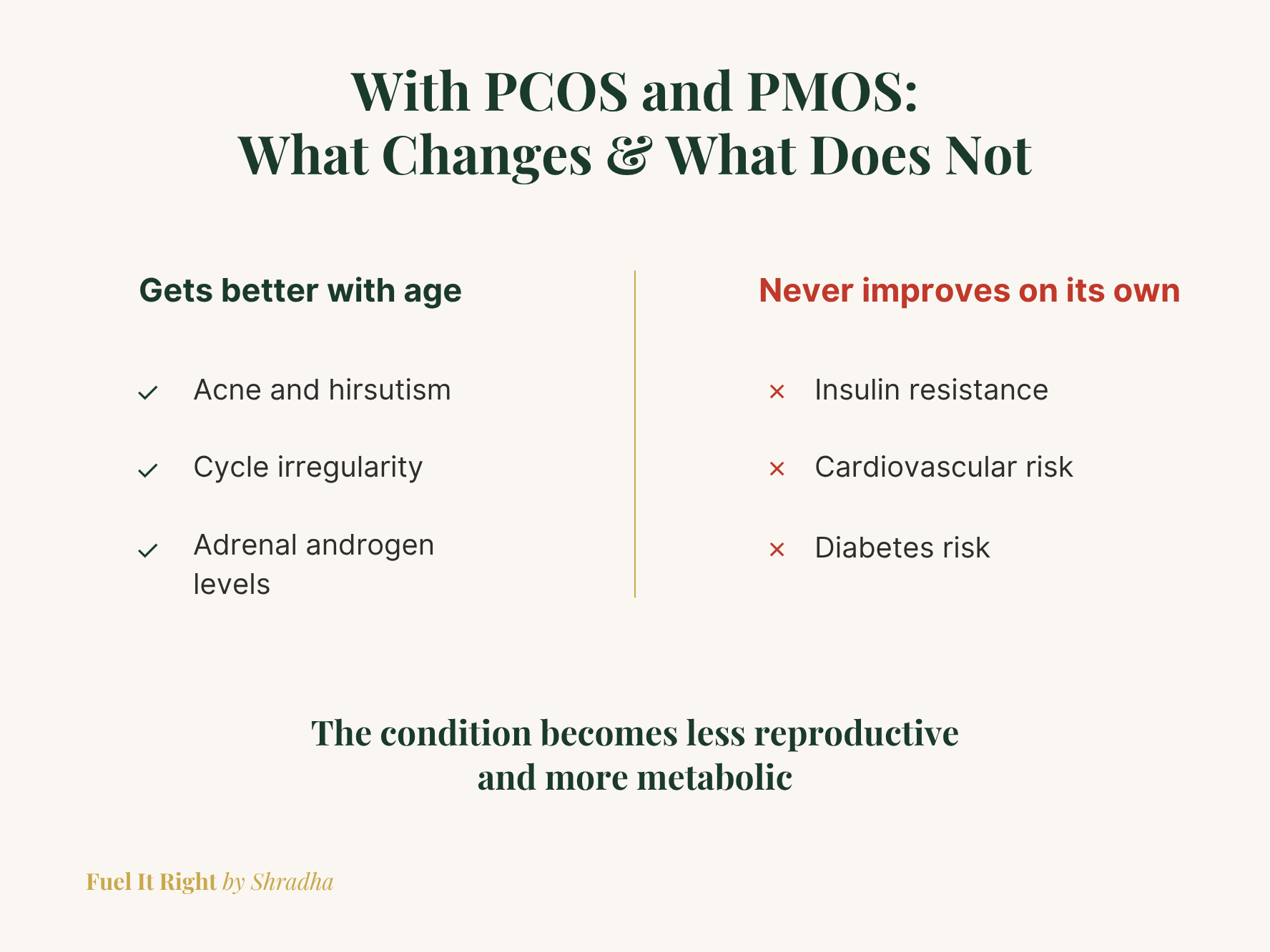
The condition does not become benign with age. It becomes less reproductive and more metabolic. The symptoms that are most visible and distressing in the 20s are acne, irregular cycles, hirsutism which are moderate. The risks that are most dangerous are diabetes, cardiovascular disease, fatty liver which increase. This is the shift that must be understood and that determines what the food protocol should emphasise at each decade.
What changes across decades, the summary Acne and hirsutism: Peak in 20s, moderate in 30s as DHEAS declines naturally Cycle irregularity: Most irregular in 20s, may seem more regular in 40s, but for hormonal reasons unrelated to metabolic improvement Fertility concerns: Peak in 30s, still present in early 40s Insulin resistance: Begins in 20s, deepens through 30s and 40s without intervention, never improves on its own Diabetes and hypertension risk: Increases measurably from 30s to 40s Cardiovascular risk: Accumulates across all decades, peaks in 40s and 50s Thyroid vulnerability: Present in all decades, Hashimoto's often presenting in 30s Mood and mental health: Most acute in 20s, can worsen again in 40s with perimenopause |
The Food Protocol Stays the Same. What Changes Is the Emphasis
The core food protocol for PCOS/PMOS does not change across decades. Protein-first meals, the sequence rule, dal and curd daily, anti-inflammatory spices, consistent meal timing. What changes is which elements to emphasise most based on what the decade brings.
In Your 20s: Build the Habit Foundation
Every metabolic outcome in your 30s and 40s is shaped by what you eat consistently in your 20s. The most important priority is establishing non-negotiable daily habits: protein at breakfast within one hour of waking, curd twice daily, dal at lunch, the sequence rule at every meal. These habits do not need to be perfect. They need to be consistent. The compound effect of consistent protein-first eating over ten years is more powerful than any intervention available in your 30s.
In Your 30s: Add the Fertility and Gut Layer
Add iron and folate-rich foods if fertility is a goal like palak, rajma, methi leaves, til. Add omega-3 from flaxseeds and walnuts daily for reproductive hormone support. Increase attention to gut health through consistent curd and dal, the gut microbiome's role in androgen clearance becomes most clinically relevant when fertility is the focus. Thyroid screening should be added to your annual blood panel if not already there.
In Your 40s: Prioritise Cardiovascular and Muscle
Increase protein quantity as muscle mass naturally declines with age and the metabolism slows. So, aim for protein at every meal, not just breakfast. Add magnesium-rich foods (pumpkin seeds, dark leafy greens, dark chocolate) for sleep support as perimenopause disrupts sleep architecture. Continue the full anti-inflammatory protocol, the cardiovascular risk that is rising in this decade responds directly to the same anti-inflammatory eating that managed the hormonal symptoms in the 20s.
Managing PCOS or PMOS in Goa across any decade?
The Diet Dr Clinic team in Margao works with clients at every stage. Real Indian food. No supplements. No machines. Food-first protocols built around your age, your blood work, and your life.
+91 7057063984
Conclusion: The Condition Ages With You. Your Protocol Should Too.
PCOS and PMOS across decades is a condition that changes its face without changing its root. The visible symptoms of your 20s like acne, hair fall, irregular cycles, give way to the less visible but more consequential risks of your 30s and 40s: fertility challenges, rising blood sugar, cardiovascular accumulation, and the confusing overlap of perimenopause.
The food protocol that addresses all of this is the same across every decade. Protein first, dal daily, curd daily, the sequence rule, anti-inflammatory spices. What changes is the emphasis. In your 20s the habit foundation, in your 30s the fertility and gut layer, in your 40s the cardiovascular and muscle protection. The same food doing different jobs at each stage.
Do not wait until the condition forces your hand in your 40s to start addressing what could have been established in your 20s. And do not assume that the easing of visible symptoms in your 30s means the underlying metabolic work is done. PCOS and PMOS is a lifelong metabolic condition. It deserves a lifelong food-first response.
Book a Free 30-Minute Discovery Call
Tell us which decade you are in and bring your blood report. We will build your PCOS/PMOS food protocol for exactly where you are right now.
Call us: +91 7057063984
OR
FAQs: PCOS and PMOS Across the Decades
Q1. Does PCOS/PMOS get better as you get older?
Partially. The visible androgenic symptoms like acne, hirsutism, irregular cycles are often moderate in the 30s and 40s as adrenal androgen production naturally declines. Cycles may become more regular in the 40s as the ovaries slow down. But the underlying metabolic dysfunction like insulin resistance, cardiovascular risk accumulation, diabetes risk does not improve with age and may worsen if not actively managed. The condition becomes less reproductive and more metabolic over time.
Q2. I am 40 and my periods are suddenly more regular. Does that mean my PCOS/PMOS is resolving?
Not necessarily. Cycles becoming more regular in the early to mid-40s is often a sign of perimenopause beginning rather than PCOS/PMOS resolving. As the ovaries slow down, the hormonal chaos that made periods unpredictable earlier in life eases, but the insulin resistance that drives the metabolic complications continues. More regular periods in your 40s require investigation, not reassurance.
Q3. When is the best time to start the food protocol for PCOS/PMOS?
Immediately, regardless of age. In your 20s, establishing the protocol sets the metabolic trajectory for the next two decades. In your 30s, it directly supports fertility and slows the progression of insulin resistance. In your 40s, it reduces the cardiovascular and diabetes risks that are actively accumulating. The earlier the protocol is established, the more of the long-term metabolic progression it prevents. But it is never too late to begin.
Q4. I was diagnosed with PCOS in my 20s but my symptoms have improved. Do I still need to follow the protocol?
Yes. The easing of visible symptoms does not mean the metabolic root has resolved. Insulin resistance, if it was present in your 20s, is still present unless it has been specifically addressed through sustained dietary change. The absence of acne and the appearance of regular cycles does not equal normal insulin sensitivity. Continue the blood panel annually which should include fasting insulin, HOMA-IR, HbA1c, lipid panel.
Q5. How does perimenopause interact with PCOS/PMOS?
Perimenopause adds a second layer of hormonal disruption to an already-disrupted hormonal system. Estrogen's insulin-sensitising effects decline, worsening insulin resistance. Progesterone's calming neurosteroid effects decline, worsening mood and sleep. Cycles may become more regular as the ovaries slow, creating false reassurance. Cardiovascular risk, already elevated by PCOS/PMOS, increases further with estrogen decline. The PCOS/PMOS food protocol. Protein-first, anti-inflammatory, gut-supportive, addresses many of these compounding risks simultaneously.
Q6. I am in my 40s and was never diagnosed with PCOS/PMOS. Could I still have it?
Yes. Many women go undiagnosed for years or decades because their symptoms were attributed to stress, lifestyle, or normal variation. If you have persistent insulin resistance, abdominal weight gain, difficulty shifting weight, elevated blood sugar markers, a history of irregular cycles, or skin darkening on the neck or underarms. Ask for a full PCOS/PMOS panel including fasting insulin, HOMA-IR, free testosterone, and DHEAS, even if your cycles are now regular.
Q7. Does the food protocol need to change significantly after 40?
The core protocol stays the same. The emphasis shifts: more protein per meal to counter natural muscle mass decline, more magnesium-rich foods for sleep support, continued anti-inflammatory eating for rising cardiovascular risk, and careful attention to blood sugar markers as insulin sensitivity worsens with estrogen decline. The plate method, the sequence rule, curd daily, and consistent meal timing remain the foundation at every age.
Q8. Is fertility possible with PCOS/PMOS in the 30s?
Yes. An observational study of women with PCOS above 35 found that 95% of those who sought treatment for infertility conceived successfully with management. The fertility window is narrower in the 30s than the 20s, but it is very much present. Addressing insulin resistance through food is the most fundamental step, because restoring ovulation requires reducing the hyperinsulinaemia that suppresses it. See the blog on PCOS/PMOS and fertility for the specific food protocol.
About the Author
Shradha | Nutritionist and Dietitian | Fuel It Right. Practising out of Goa, India, with a focus on gut health, PMOS/PCOS, thyroid disorders, and weight management using real Indian food. No supplements. No machines. Just food, and the science behind it.
fuel-it-right.com | @fuelitright