
Late-Night Eating: Why Timing Beats Calories
A camera-phone study of Indian adults found most people spread their eating across 15+ hours a day, with no let-up on weekends. Here's what the timing itself does to your body, independent of how much you eat.
Table of Contents
1. India's Eating Pattern Is More Broken Than You'd Think
2. Why WFH Made This Worse, Not Just Different
3. It's Not Just What You Eat Late, It's That You're Eating Late
4. The Circadian Mechanism: Why Your Body Treats Food Differently at Night
5. What Actually Helps: Verdict by Verdict
6. Building a Circadian-Smart WFH Day: Three Real Moments, Fully Assembled
Conclusion
FAQs
1. India's Eating Pattern Is More Broken Than You'd Think
A camera-phone study tracked the actual eating patterns of 93 healthy Indian adults over 21 days, recording every food and beverage intake event in real time rather than relying on memory-based food diaries. The results describe something far more disorganised than the standard "three meals a day" assumption most diet advice is built around.
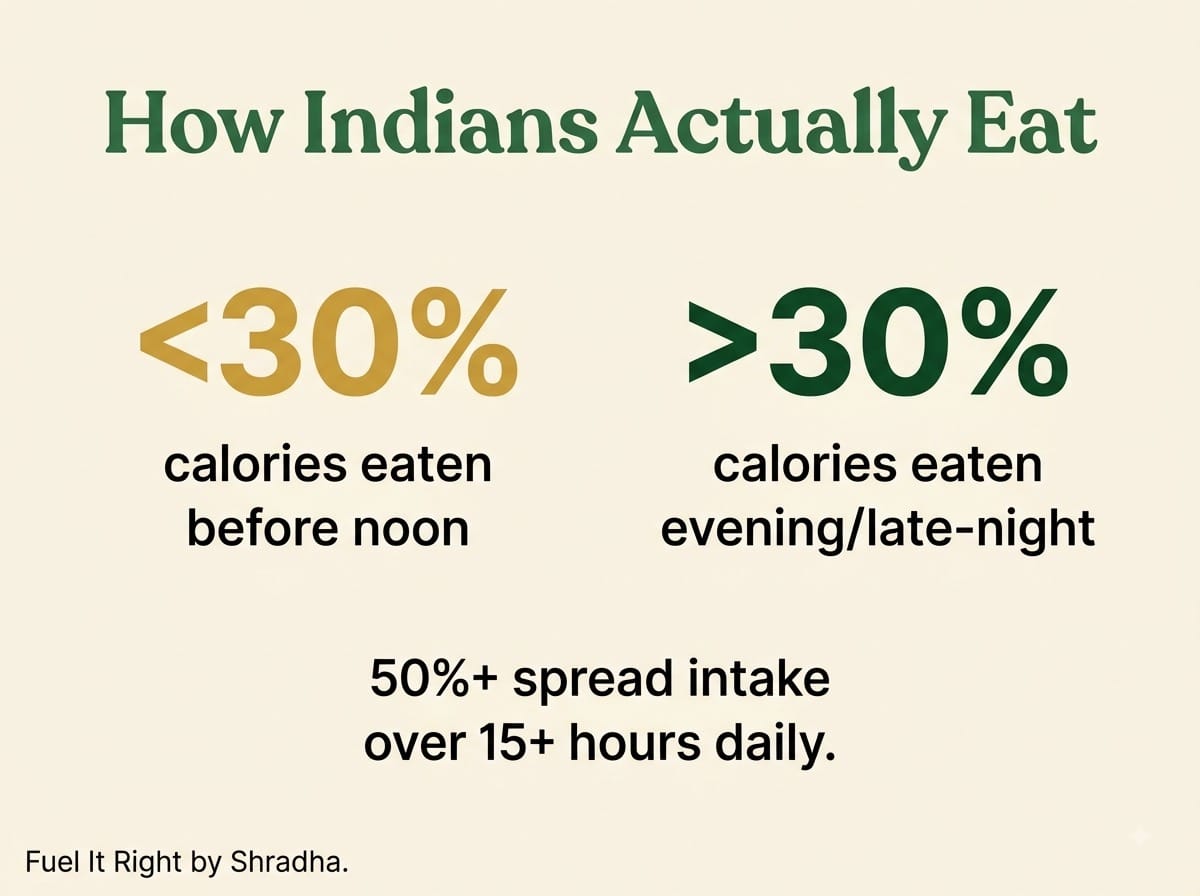
Less than 30% of daily calories were consumed before noon, while more than 30% came in the evening and late-night hours. Over half the group spread their caloric intake across 15 hours or longer each day, and a subset with flexible or shift-based schedules spread it across 20 hours or more. Notably, there was little difference between weekdays and weekends, this isn't an occasional indulgence pattern, it's a daily baseline for a lot of people.
2. Why WFH Made This Worse, Not Just Different
Before remote work became common, a commute, a fixed lunch break, and an office kitchen you weren't standing in all day created accidental structure around eating, whether anyone thought of it that way or not. Working from home removes that imposed rhythm without necessarily replacing it with anything.
The result isn't usually "eating more meals." It's meals losing their edges: a coffee that becomes a snack, a snack that blurs into lunch eaten at the desk mid-call, dinner that slides later because the workday no longer has a hard stop. The eating window stretches quietly, often without feeling like a deliberate change in how much or how often someone is eating.
The problem usually isn't more food. It's food with no edges left around it.
3. It's Not Just What You Eat Late, It's That You're Eating Late
WHAT YOU'VE HEARD: As long as I'm eating the same total calories, it doesn't matter when I eat them. |
WHAT'S ACTUALLY TRUE: A controlled study of adults with overweight and obesity found that eating the exact same calories later in the day increased hunger and decreased energy expenditure compared to eating earlier, with measurable changes in metabolic pathways. Timing had an effect independent of the amount eaten. |
This is a genuinely counterintuitive finding worth sitting with. It's not simply that late-night eating tends to involve less healthy food choices, though it often does. The timing itself, independent of what or how much is eaten, changes how the body processes it.
Curious how your own eating window compares to what's healthy?
Take the free Gut Health Quiz:
4. The Circadian Mechanism: Why Your Body Treats Food Differently at Night
The thermic effect of food, the energy your body spends digesting and processing what you eat, is measurably lower in the evening than in the morning, under the influence of the body's internal circadian clock. Separately, research simulating night-shift work found that eating during the body's biological night caused a measurable misalignment between central and peripheral circadian rhythms, directly impairing glucose tolerance, the same territory we covered in Insulin Resistance vs Diabetes. Eating during the daytime, even on a shifted sleep schedule, prevented this misalignment entirely.
This is why "just eat less at night" undersells the mechanism. The body isn't simply less hungry or more disciplined earlier in the day, it's biologically better prepared to process food at certain times than others.
5. What Actually Helps: Verdict by Verdict
WHAT YOU'VE HEARD: WFH just means more snacking opportunities; that's the whole problem. |
WHAT'S ACTUALLY TRUE: It's not only about opportunity. WFH removes externally imposed structure, a commute, a fixed lunch hour, that previously created a natural eating rhythm without requiring deliberate effort. The fix is rebuilding that structure intentionally, not simply resisting snacks. |
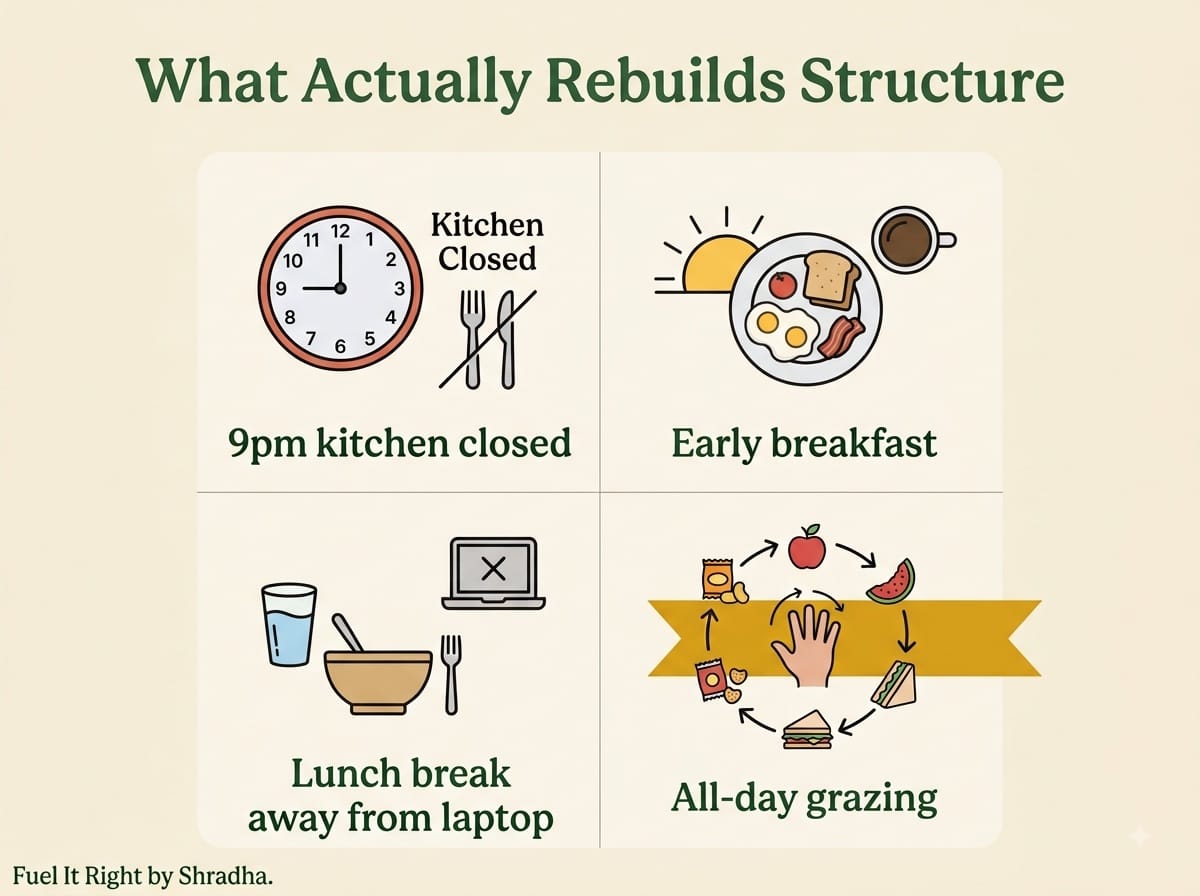
A Fixed "Kitchen Closed" Time STRONG PRACTICE |
Creates an artificial but effective boundary that WFH otherwise removes, closing the eating window deliberately rather than by accident. How to make it work: Pick a specific time, 9pm is a reasonable default, and treat it as a hard stop most days, not a suggestion. |
Eating Breakfast Within an Hour of Waking GOOD PRACTICE |
Anchors the start of the eating window to a consistent, earlier point in the day, shifting the overall pattern earlier rather than later. How to make it work: This doesn't need to be a large meal, consistency in timing matters more than size here. |
A Real Lunch Break Away From the Screen STRONG PRACTICE |
Recreates the structural break that used to happen naturally with office lunches, which WFH otherwise erases entirely. How to make it work: Even 20 minutes away from the desk, eaten without multitasking, meaningfully separates lunch from constant, unstructured grazing. |
Grazing Without Fixed Meals COMMON, OVERLOOKED PROBLEM |
Without deliberate structure, WFH defaults toward continuous small intake rather than distinct meals, which is exactly the pattern the Indian eating-tracking study found in over half its participants. How to make it work: If you can't clearly name your last three meals and roughly when they happened, that's a sign the structure has quietly dissolved. |
6. Building a Circadian-Smart WFH Day: Three Real Moments, Fully Assembled
This is a starting structure, not a rigid rule. The goal is rebuilding edges around eating, not adding a new source of stress to an already demanding schedule.
Your Circadian-Smart Checklist, At a Glance |
Set a specific, consistent "kitchen closed" time and treat it as a real boundary |
Eat breakfast within an hour of waking to anchor the start of your eating window |
Take a genuine lunch break away from your screen, even if it's short |
Notice if you can't clearly name your last three meals and when they happened; that's a sign structure has dissolved |
Aim to finish your last meal 2-3 hours before sleep where your schedule allows |
Three Real Moments, Fully Assembled
Morning | Breakfast within an hour of waking, before opening email or starting calls, to anchor the eating window early. |
Midday | A genuine 20-30 minute lunch break away from the laptop, treated the way an office lunch break used to be. |
Evening | A fixed kitchen-closed time, ideally leaving 2-3 hours before bed, with a specific plan for what counts as an acceptable exception rather than an open-ended "we'll see." |
Bring a rough log of when you actually eat, not just what.
We'll map your real pattern together
Call/ WhatsApp: +91 70570 63984 OR
Conclusion
Late-night eating and WFH weight gain aren't really about willpower or how much food is available in the kitchen during the day. A camera-phone study of Indian adults found eating already sprawled across 15 or more hours a day well before remote work became common, and WFH mainly removed the last structural guardrails that kept that pattern in check. The evidence points to timing itself, not just quantity, as a genuine, measurable lever: rebuilding a defined eating window, even loosely, changes how your body processes food independent of what's on the plate.
FAQs
1. Does eating late at night really cause weight gain, or is it just about food choices?
Both matter, but timing has an independent effect. A controlled study found identical calories eaten later in the day increased hunger and decreased energy expenditure compared to the same calories eaten earlier, separate from what specific foods were involved.
2. How disorganised is the average Indian eating pattern, really?
A camera-phone tracking study of 93 healthy Indian adults found less than 30% of calories consumed before noon, over 30% in evening and late-night hours, and more than half the group spreading intake across 15 or more hours daily, with little difference between weekdays and weekends.
3. Why did working from home make eating patterns worse specifically?
WFH removes externally imposed structure, commutes, fixed lunch breaks, an office kitchen, that previously created eating rhythm without deliberate effort. The eating window tends to quietly stretch rather than any single meal becoming dramatically larger.
4. What is the thermic effect of food, and why does it matter for timing?
It's the energy your body spends digesting and processing food, and research shows it's measurably lower in the evening than the morning under circadian control, meaning identical meals may be processed somewhat differently depending on when they're eaten.
5. Does eating at night affect blood sugar specifically?
Research simulating night-shift schedules found eating during the body's biological night caused measurable circadian misalignment and impaired glucose tolerance, while shifting meals to daytime hours prevented this even on an otherwise shifted sleep schedule.
6. What's a reasonable "kitchen closed" time for most schedules?
Around 9pm is a reasonable default for many schedules, ideally leaving 2-3 hours before sleep, though the specific time matters less than having a consistent, genuinely enforced one.
7. Do I need to count total eating hours to fix this?
Not necessarily with precision. A useful gut check is whether you can clearly name your last three meals and roughly when they happened; difficulty answering that is itself a sign the structure has dissolved.
8. Is intermittent fasting the same thing as fixing eating timing?
They overlap but aren't identical. The core lever here is shifting the eating window earlier and keeping it consistent, not necessarily adopting a specific formal fasting protocol; the timing shift itself is what the evidence supports most directly.
About the Author
Shradha | Nutritionist & Dietitian | Fuel It Right. Food-first, evidence-based nutrition for real, sustainable results.