
Indian Breakfast GI: Idli, Dosa, Poha Ranked
The GI of poha, idli, and dosa varies wildly across the internet, and that's not sloppy reporting. Here's what one consistent, peer-reviewed South Indian breakfast study actually found, ranked.
Table of Contents
1. Why the Same Foods Get Wildly Different GI Numbers Online
2. The Actual Rankings: A 2022 South Indian Breakfast Study
3. Why Vada Sambar Beats Dosa (and the Myths That Don't Hold Up)
4. Does International GI Data Even Apply to Indian Bodies?
5. Practical Fixes That Actually Lower GI
6. Building a Lower-GI Breakfast Rotation
Conclusion
FAQs
1. Why the Same Foods Get Wildly Different GI Numbers Online
Search for the glycemic index of poha and you'll find numbers ranging from the 40s to the 70s, sometimes on the same page. This isn't sloppy reporting. Poha describes flattened rice broadly, not one standardised dish, and rice variety, flake thickness, and what else goes into the pan, potato, peanuts, vegetables, all change the final number. The same is true for idli, dosa, and upma.
One controlled study found a commercial rice idli testing at GI 85, while a specialised millet dosa in a different study tested at just 37. Neither number is wrong. They're testing different foods that happen to share a name. That's why the rankings below come from one single, consistent, peer-reviewed dataset, rather than pulling averages from a dozen inconsistent sources.
2. The Actual Rankings: A 2022 South Indian Breakfast Study
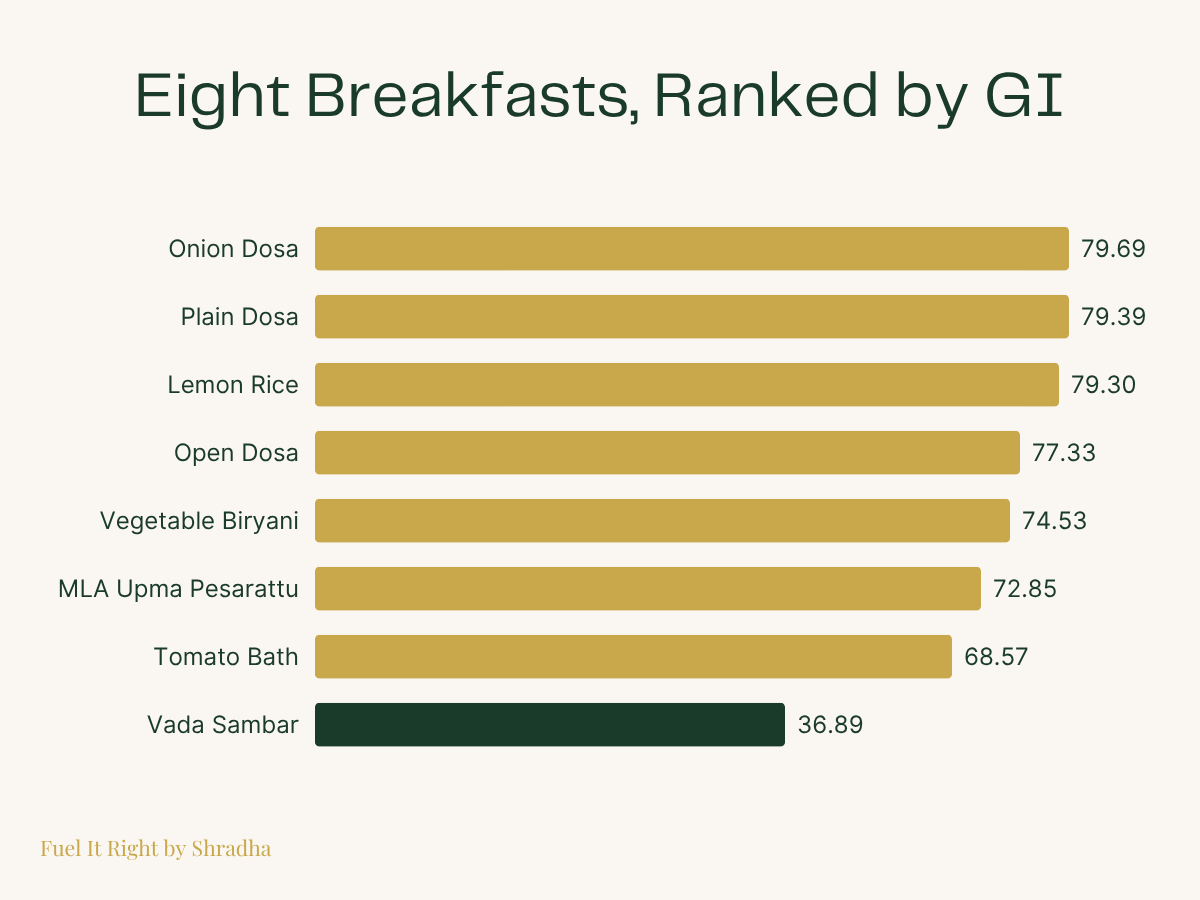
A 2022 study published in the Journal of Food Science and Technology tested 23 commonly eaten South Indian breakfast foods using the standard FAO/WHO glycemic index method, giving one of the only internally consistent datasets available for this category. Here's where eight of the most common items landed, from highest to lowest glycemic index:
Breakfast Item | Glycemic Index | Glycemic Load |
Onion dosa | 79.69 | 39.84 |
Plain dosa | 79.39 | 39.69 |
Lemon rice | 79.30 | 39.65 |
Open dosa | 77.33 | 39.34 |
Vegetable biryani | 74.53 | 37.26 |
MLA upma pesarattu | 72.85 | 36.42 |
Tomato bath | 68.57 | 36.54 |
Vada sambar | 36.89 | 18.44 |
Using the standard classification (low GI is 55 or under, medium is 56 to 69, high is 70 or above), most rice-and-batter breakfast staples in this study land solidly in high-GI territory. Only vada sambar crossed into low-GI range.
The Dish-by-Dish Verdict
Numbers on a table are useful. Knowing what to actually do with each dish is more useful. Here's the practical verdict on all eight, based on the same dataset.
Onion Dosa HIGH GI |
The onion and oil don't change the rice-and-batter base underneath. Tested highest of the eight items. How to make it work: Order it with extra sambar and eat the sambar first. Ask for less oil in the batter if homemade. |
Plain Dosa HIGH GI |
A fermented rice and urad dal batter, griddled thin. Fermentation helps somewhat but doesn't override the rice base. How to make it work: Blend a tablespoon of oats into the batter, and eat a full katori of dal-heavy sambar before the dosa. |
Lemon Rice HIGH GI |
Straightforward rice dish with minimal fibre or protein to slow digestion. How to make it work: Add extra peanuts and a side of curd. Keep the portion to one cup, not a heaped plate. |
Open Dosa HIGH GI |
Same batter as plain dosa, cooked thicker with more surface browning. How to make it work: Same fix as plain dosa: oats in the batter, sambar first, curd on the side. |
Vegetable Biryani HIGH GI |
Rice-dominant by volume even with vegetables mixed through. How to make it work: Pair with a cup of curd (raita) and eat the vegetables and protein pieces first, rice last. |
MLA Upma Pesarattu HIGH GI |
A combination dish; the upma (semolina) portion pulls the number up more than the pesarattu (moong dal) layer does. How to make it work: Ask for extra pesarattu and less upma if ordering out, or make it at home in that ratio. |
Tomato Bath MEDIUM GI |
Sits just below the high-GI threshold, better than the rice dishes above it but still rice-dominant. How to make it work: Add extra vegetables and a spoon of curd on the side; portion to one cup. |
Vada Sambar LOW GI |
Higher proportion of urad dal, a legume, than the rice-based dishes above, plus the fibre and protein in the sambar itself. How to make it work: Already a strong choice. The only real adjustment: stop at one vada, since the frying oil adds up. |
3. Why Vada Sambar Beats Dosa (and the Myths That Don't Hold Up)
Vada sambar's GI of 36.89 against plain dosa's 79.39 isn't a small gap, it's more than double. Both are made largely from the same base ingredients, rice and urad dal, fermented and cooked. The difference comes down to form and ratio. Vada uses a higher proportion of urad dal, a legume, and is deep-fried rather than steamed or griddled, which changes how quickly its starch is digested.
The study's broader finding backs this up: glycemic load was consistently higher in rice-based breakfast items than in legume-based ones. This matches a wider pattern across Indian nutrition research. Legumes are structurally lower-GI than rice-based batters, and India, which consumes more lentils per capita than almost any other country, has an underused advantage here.
Two dishes can share the same base ingredients and still land worlds apart on glycemic index. Ratio and form decide the outcome, not just what's in the bowl.
A few specific claims about Indian breakfasts get repeated constantly without holding up against the data above.
WHAT YOU'VE HEARD: Fermentation makes idli and dosa automatically safe for blood sugar. |
WHAT'S ACTUALLY TRUE: Fermentation measurably lowers glycemic response, but it doesn't override the base ingredient. Plain dosa, made from fermented rice and urad dal batter, still tested at GI 79.39 in the South Indian dataset, solidly in high-GI range. Fermentation helps. It doesn't neutralise a rice-heavy base. |
WHAT YOU'VE HEARD: If you have diabetes, skipping a high-GI breakfast is safer than eating one. |
WHAT'S ACTUALLY TRUE: Research on the second-meal effect, first documented by Jenkins and colleagues and replicated since, shows skipping breakfast often produces a larger glucose spike at lunch than eating a moderate breakfast would have. An imperfect breakfast, paired with protein, usually beats no breakfast at all. |
WHAT YOU'VE HEARD: Millet-based versions are always the better choice. |
WHAT'S ACTUALLY TRUE: Millet dosa and millet-based upma have tested lower than their rice and semolina counterparts in multiple studies, but "millet" isn't a single guarantee. Ratio, grinding, and what's added still change the result the same way they do for rice-based versions. Read the actual recipe, not just the ingredient name. |
Curious where your usual breakfast actually lands on this scale?
Take the free Gut Health Quiz:
4. Does International GI Data Even Apply to Indian Bodies?
A 2008 comparative study tested identical foods in Oxford, UK and Chennai, India, measuring actual blood glucose response, not just lab-calculated starch digestibility, in both Caucasian and Asian Indian subjects. The purpose was to check whether international GI tables, developed almost entirely on European, North American, and Australian populations, hold up for Indian bodies eating the same food.
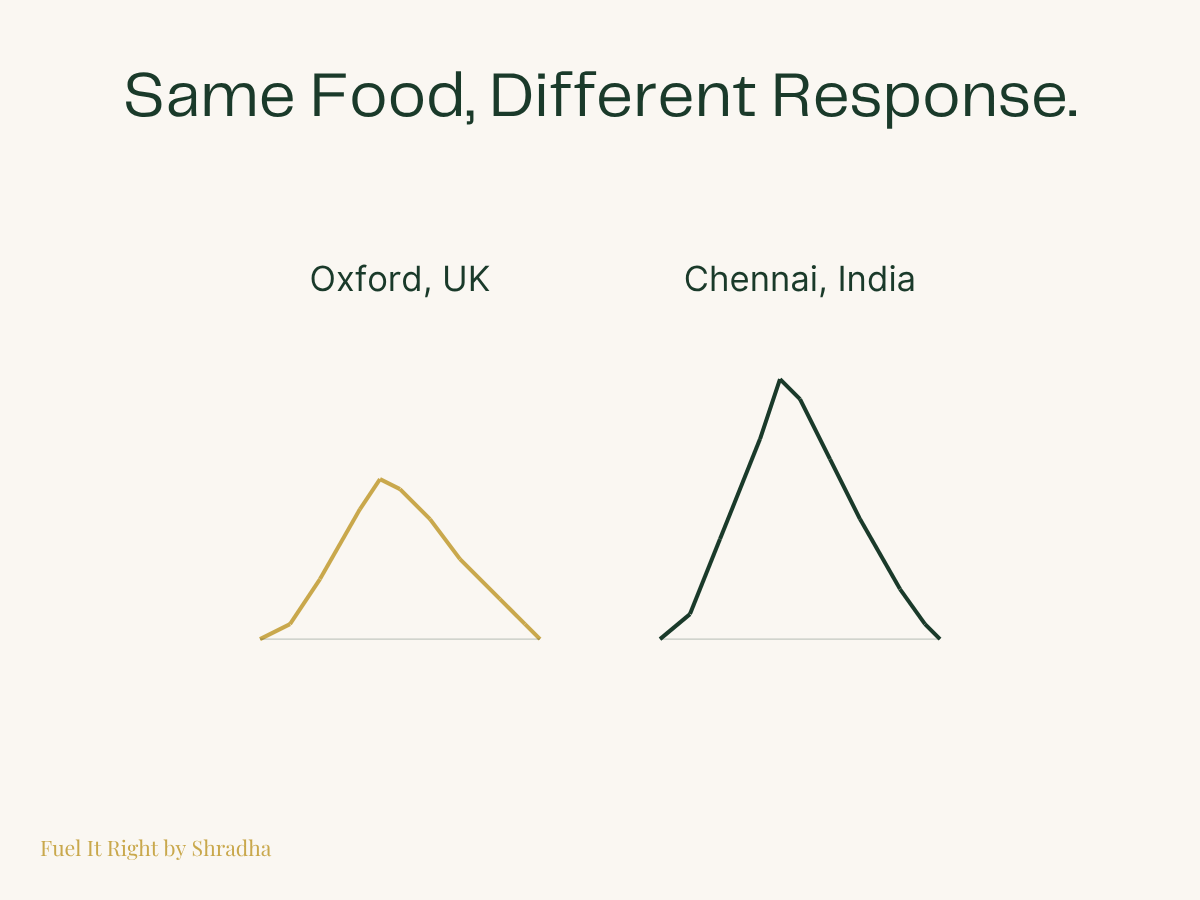
This question matters beyond breakfast. We've covered before, in Insulin Resistance vs Diabetes, how Indian bodies process glucose and store fat differently at the same BMI as other populations. A GI number calculated on a Western reference population isn't guaranteed to predict the same blood sugar response in an Indian body, which is another reason population-specific data, like the South Indian breakfast study above, matters more than generic international GI charts.
5. Practical Fixes That Actually Lower GI
A study specifically testing idli, dosa, upma, and chapatti batter found that adding barley, oats, gluten, or guar gum in small quantities, 1 to 9 grams per 100 grams of flour, produced a measurable, dose-dependent drop in glyacemic index. Oats and guar gum were the most effective of the four at reducing starch digestibility.
Practically, this means a spoonful of oats blended into your dosa or idli batter isn't a gimmick, it's a change with actual measured effect. Fermentation itself already does some of this work; fermented batters produce organic acids that slow gastric emptying, which is part of why idli and dosa don't test as high as some non-fermented rice dishes despite similar ingredients.
Pairing any of these breakfasts with a protein source, sambar with extra dal, an egg on the side, a spoon of curd, further blunts the glucose response, the same food-order principle that applies at other meals.
The Most Common Breakfast Mistake |
Eating dosa, idli, or poha entirely on its own, on an empty stomach, then having chai immediately after, with nothing to slow the sugar hit |
The dish itself is often not the biggest problem. Eating it alone, before anything has a chance to blunt the spike, is |
Adding even a small side of dal, curd, or an egg changes the outcome more than switching dishes entirely would |
6. Building a Lower-GI Breakfast Rotation
This is a starting rotation, not a rule that dosa or poha are off-limits. The goal is shifting your default, not eliminating a food category.
Your Lower-GI Breakfast Checklist, At a Glance |
Pair every breakfast with a protein source: extra dal in sambar, curd, or an egg |
Blend roughly 1 tablespoon of oats into every cup of dosa or idli batter |
Eat vegetables or chutney before the carb-heavy portion, not after |
Choose a legume-forward option (vada sambar, pesarattu, moong chilla) 2-3 times a week |
On your highest-GI breakfast day, halve the portion rather than skipping the meal entirely |
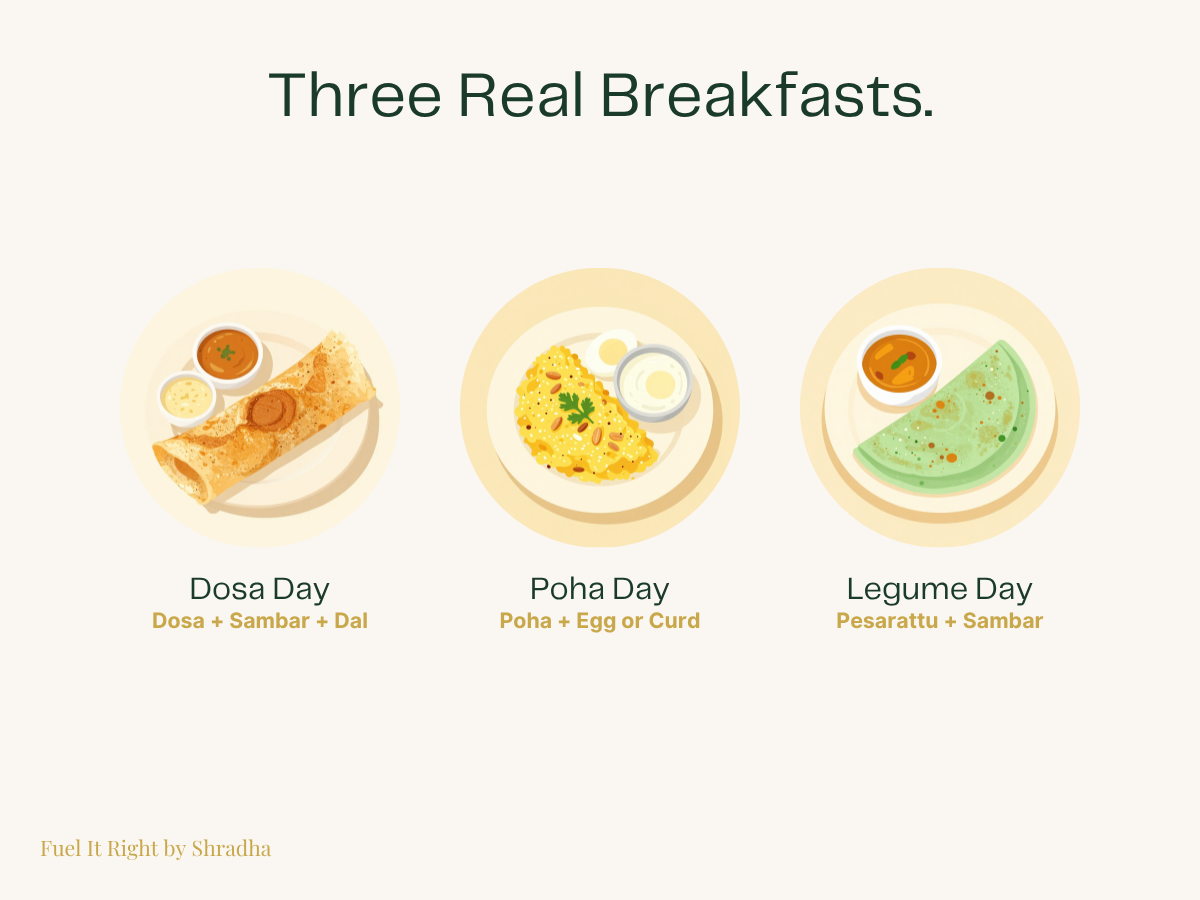
Three Real Breakfasts, Fully Assembled
Not themes to interpret, actual breakfasts you can eat tomorrow morning.
Dosa day | One plain or vegetable dosa, cooked with a tablespoon of oats blended into the batter. A full katori of sambar with extra dal stirred in, eaten first. Dosa eaten second. Filter coffee after, not before. |
Poha day | One cup of poha cooked with peanuts, green peas, and vegetables. A boiled egg or a small bowl of curd alongside, eaten with the poha, not after. Skip the extra chivda or sev on top. |
Legume day | Pesarattu (moong dal dosa) or one vada with a full bowl of sambar, extra dal stirred in. This is the closest thing to a genuinely low-GI, high-protein Indian breakfast, using the same half-vegetable, quarter-protein plate logic from the diabetes plate method, just built for breakfast. |
Bring a note of what you usually eat for breakfast.
We will map it against your actual blood sugar picture:
Conclusion
There's no single "good" or "bad" Indian breakfast, and the widely different GI numbers floating around online reflect real variation in how these foods are made, not confusion about the underlying science. What the one consistent dataset available shows is that legume-forward, fermented, and protein-paired breakfasts consistently test lower than plain rice-and-batter dishes, and that small recipe changes, not wholesale elimination, move the number that actually matters for your blood sugar.
FAQs
1. What is the GI of poha?
There's no single reliable number, rice variety, flake thickness, and added ingredients like potato or peanuts all change the result. What actually helps: keep the portion to one cup, cook in extra peanuts and vegetables, and eat it with a small bowl of curd rather than alone. That combination matters more than chasing an exact GI figure.
2. Is idli or dosa better for blood sugar?
In the South Indian breakfast dataset, plain dosa tested at GI 79.39. Idli wasn't part of this specific eight-item comparison, but steamed preparations generally involve less added fat than griddled ones. The bigger lever isn't idli versus dosa, it's what sits beside it: a katori of sambar with extra dal and a spoon of coconut chutney changes the outcome more than the dish choice itself.
3. Why does vada sambar have a lower GI than dosa?
Vada uses a higher proportion of urad dal, a legume, than dosa batter, and is prepared differently. Legume-heavy, protein-and-fibre-rich foods consistently test lower on glycemic index than rice-dominant batters.
4. Does adding oats to dosa batter actually lower its GI?
Yes. A controlled study adding oats, barley, gluten, or guar gum to idli, dosa, upma, and chapatti batter found a measurable, dose-dependent reduction in glycemic index, with oats among the most effective. Roughly one tablespoon of oats blended dry into every cup of batter is enough to register a difference without changing the taste noticeably.
5. Is upma a good breakfast for diabetics?
It depends on the formulation. MLA upma pesarattu tested at GI 72.85 in the South Indian dataset, in high-GI range, while sorghum-based upma variations have tested considerably lower in separate research. Add a fistful of chana or moong while it cooks, and use vegetables to bring down the semolina ratio, rather than avoiding upma altogether.
6. Do international GI charts apply to Indian foods?
Not reliably. A 2008 UK-India comparative study found that population-specific glucose response can differ from internationally published GI values. When Indian-specific data exists for a food, like the South Indian breakfast dataset above, it's more useful than a generic international chart.
7. What's the single best low-GI Indian breakfast?
Vada sambar tested lowest in the South Indian dataset at GI 36.89, but it's deep-fried, so it comes with a fat and calorie trade-off. If you want the metabolic benefit without the fried oil, pesarattu (moong dal dosa) is the closer everyday option, since it shares the same legume-forward logic without deep-frying.
8. Does fermentation really change the glycemic index?
Yes. Fermented batters, used in idli and dosa, produce organic acids during fermentation that slow gastric emptying and glucose absorption. This effect depends on a full ferment, roughly 8 to 10 hours, not a rushed one, so batter fermented quickly in warm weather may not carry the same benefit as a properly rested batch.
About the Author
Shradha | Nutritionist & Dietitian | Fuel It Right. Food-first, evidence-based nutrition for real, sustainable results