
GLP-1 Muscle Loss: What the Scary Number Misses
GLP-1 drugs are now mass-market in India, generic prices crashed from Rs.1,415 to Rs.325 a week. The headline muscle-loss numbers sound alarming, but they measure more than muscle. Here's what the evidence actually shows, and the protocol that closes the gap.
Table of Contents
1. GLP-1 in India Right Now: Why This Conversation Changed
2. The Scary Number: 25-45% of Weight Lost Is "Lean Mass"
3. What That Number Doesn't Tell You
4. Why Indian Bodies May Carry More Relative Risk
5. The Protocol That Actually Works: Verdict by Verdict
6. Building a GLP-1-Smart Day: Three Real Moments, Fully Assembled
Conclusion
FAQs
1. GLP-1 in India Right Now: Why This Conversation Changed
Semaglutide's patent expired in India on 20 March 2026, and generic prices followed almost immediately, from roughly Rs.1,415 a week for branded Ozempic down to as little as Rs.325 a week for generic versions. Over 40 Indian drugmakers are launching more than 50 generic products. What was a premium, mostly urban-affluent treatment a year ago is now genuinely mass-market. We covered the broader risks and questions in Ozempic & Mounjaro: A Dietitian's Honest Warning; this piece goes deeper into one specific, high-stakes piece of that picture: what actually happens to muscle, and what to do about it.
If you're already on one of these medications, or considering it now that it's affordable, the muscle question deserves more precision than either the alarming headlines or the dismissive reassurance you will find online.
2. The Scary Number: 25-45% of Weight Lost Is "Lean Mass"
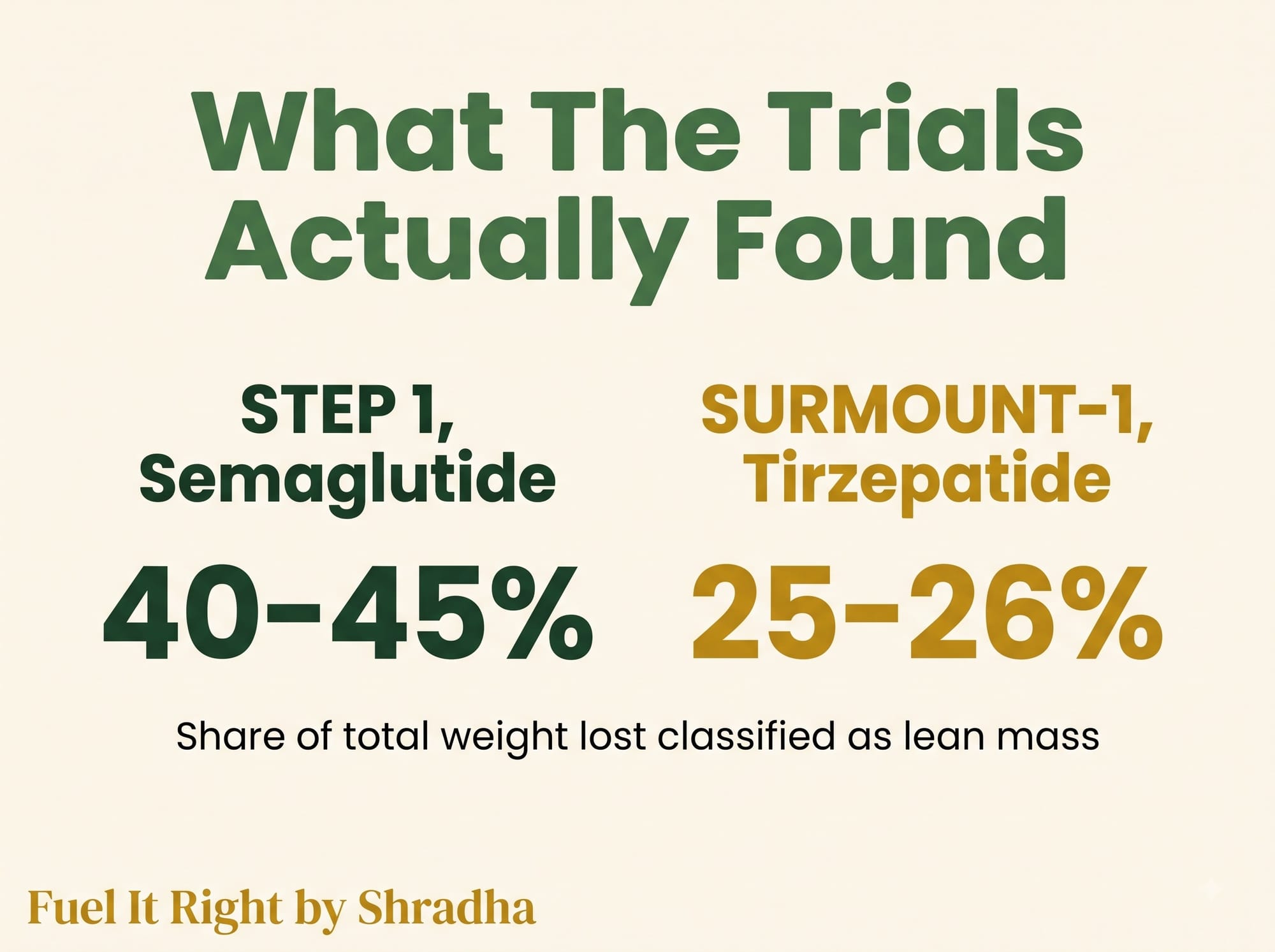
The body composition sub studies from the major GLP-1 trials are consistent and genuinely worth knowing. The STEP 1 trial found roughly 40 to 45% of the weight lost on semaglutide (Ozempic, Wegovy) came from lean mass. The SURMOUNT-1 trial found around 25 to 26% for tirzepatide (Mounjaro, Zepbound). Real-world data suggests around a third of patients on either drug lose more than 5% of their lean body mass.
These are real, published numbers, not exaggeration. They're also not the whole story.
3. What That Number Doesn't Tell You
WHAT YOU'VE HEARD: GLP-1 drugs cause dramatically more muscle loss than normal dieting. |
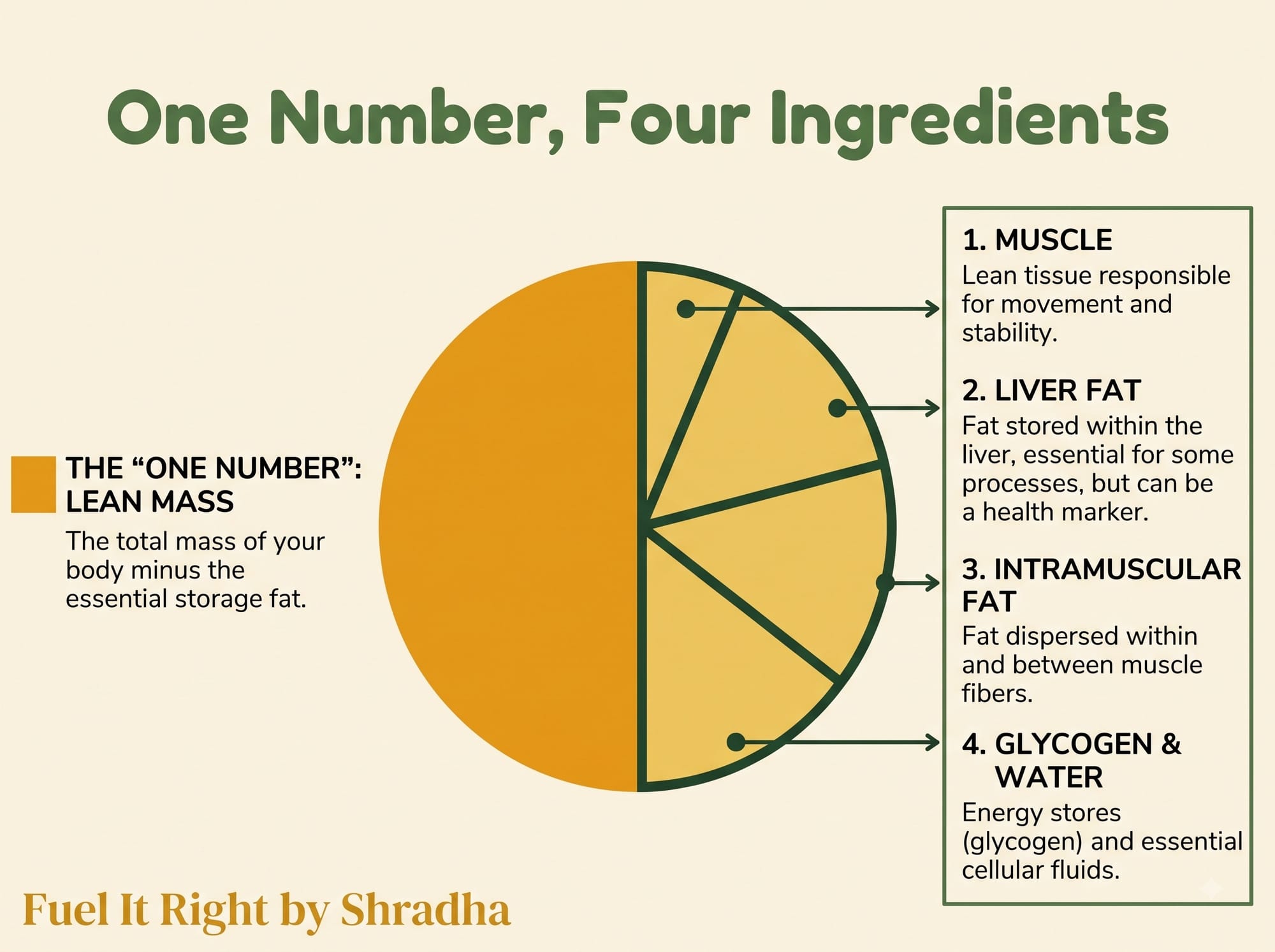
WHAT'S ACTUALLY TRUE: The "lean mass" measured on a standard body composition scan (DXA) includes far more than contractile muscle: liver fat, fat stored between and within muscle tissue, glycogen, and water are all counted in that same category. When these non-muscle components are separated out, the actual muscle tissue lost on GLP-1 medications appears comparable to diet-induced weight loss generally, not dramatically worse. The absolute numbers look larger mainly because total weight loss is larger. |
A useful way to picture it: if someone is reported to have lost 3kg of "lean mass" on a GLP-1, the actual contractile muscle portion of that is typically closer to 200 to 500 grams, not 3kg of strength-relevant tissue.
A number on a scan and a number that matters for your strength are not automatically the same number.
4. Why Indian Bodies May Carry More Relative Risk
This nuance doesn't mean the muscle question is unimportant for Indian patients specifically, if anything, the opposite. We covered in Insulin Resistance vs Diabetes how Indian bodies, at the same BMI as other populations, tend to carry less muscle mass and more body fat to begin with, the thin-fat phenotype. Starting from a lower muscle baseline means the same proportional loss carries more real-world consequence.
An Indian clinical review identified what it called a "depletive GLP-1 metabotype", patients losing more than 20% total body weight and more than 5% lean mass, in roughly 7% of treated patients, about one in fifteen. Given the thin-fat starting point common in Indian bodies, this is a genuinely higher-stakes conversation here than the international averages alone suggest.
Curious what your gut and metabolic picture looks like right now?
Take the free Gut Health Quiz:
5. The Protocol That Actually Works: Verdict by Verdict
WHAT YOU'VE HEARD: If I stop the medication, the muscle loss reverses on its own. |
WHAT'S ACTUALLY TRUE: Stopping a GLP-1 typically just stops the weight loss, and often triggers fat regain, it doesn't rebuild muscle by itself. Reversing muscle loss requires active protein intake and resistance training, whether or not the medication stays part of the plan. |
Protein at 1.2-1.6g per kg Body Weight STRONG, EVIDENCE-BACKED |
A joint advisory from four professional societies recommends this range during active GLP-1 weight loss; a 2025 study of 200 adults combining this protein target with resistance training saw only 3% muscle loss despite 13% total body weight loss, far below the 25-45% headline ratio. How to make it work: For an 65kg adult, that's roughly 78-104g of protein daily, genuinely achievable through food even with a suppressed appetite, if protein is prioritised deliberately rather than left to chance. |
Resistance Training, 2-3x a Week STRONG LEVER |
Multiple analyses describe resistance training as cutting muscle loss during GLP-1 treatment to near zero when combined with adequate protein. How to make it work: Bodyweight or light resistance work counts meaningfully; the consistency across weeks matters more than intensity in any single session. |
Protein First on the Plate STRONG PRACTICE |
GLP-1 medications suppress appetite significantly, which makes it easy to fill limited capacity with whatever's easiest rather than what's most protein-dense. How to make it work: Eat the dal, paneer, egg, or chicken portion of a meal before the rice or roti, so reduced capacity doesn't quietly become reduced protein first. |
Creatine, 3-5g Daily GOOD, OPTIONAL ADJUNCT |
A well-studied, low-risk supplement that supports resistance training adaptations and muscle maintenance. How to make it work: Worth discussing with your doctor as an addition to, not a replacement for, protein and resistance training. |
Relying on the Medication Alone HIGH RISK |
Without deliberate protein and resistance training, the headline lean-mass-loss ratios are what you're statistically exposed to, not a worst-case scenario. How to make it work: If nobody has discussed a muscle-protection plan with you alongside your prescription, that's worth raising directly with your doctor or a dietitian. |
6. Building a GLP-1-Smart Day: Three Real Moments, Fully Assembled
This is a starting structure, not a substitute for your doctor's guidance on the medication itself. If you're newly starting a GLP-1, or noticing significant strength loss, involve your prescribing doctor in this conversation directly.
Your GLP-1-Smart Checklist, At a Glance |
Target 1.2-1.6g of protein per kg of body weight daily, spread across meals |
Add resistance training 2-3 times a week, even short sessions count |
Eat the protein portion of a reduced-capacity meal first, not last |
Don't assume stopping the medication reverses muscle loss on its own |
Ask your doctor for a body composition check if you're concerned, not just a weight check |
Three Real Moments, Fully Assembled
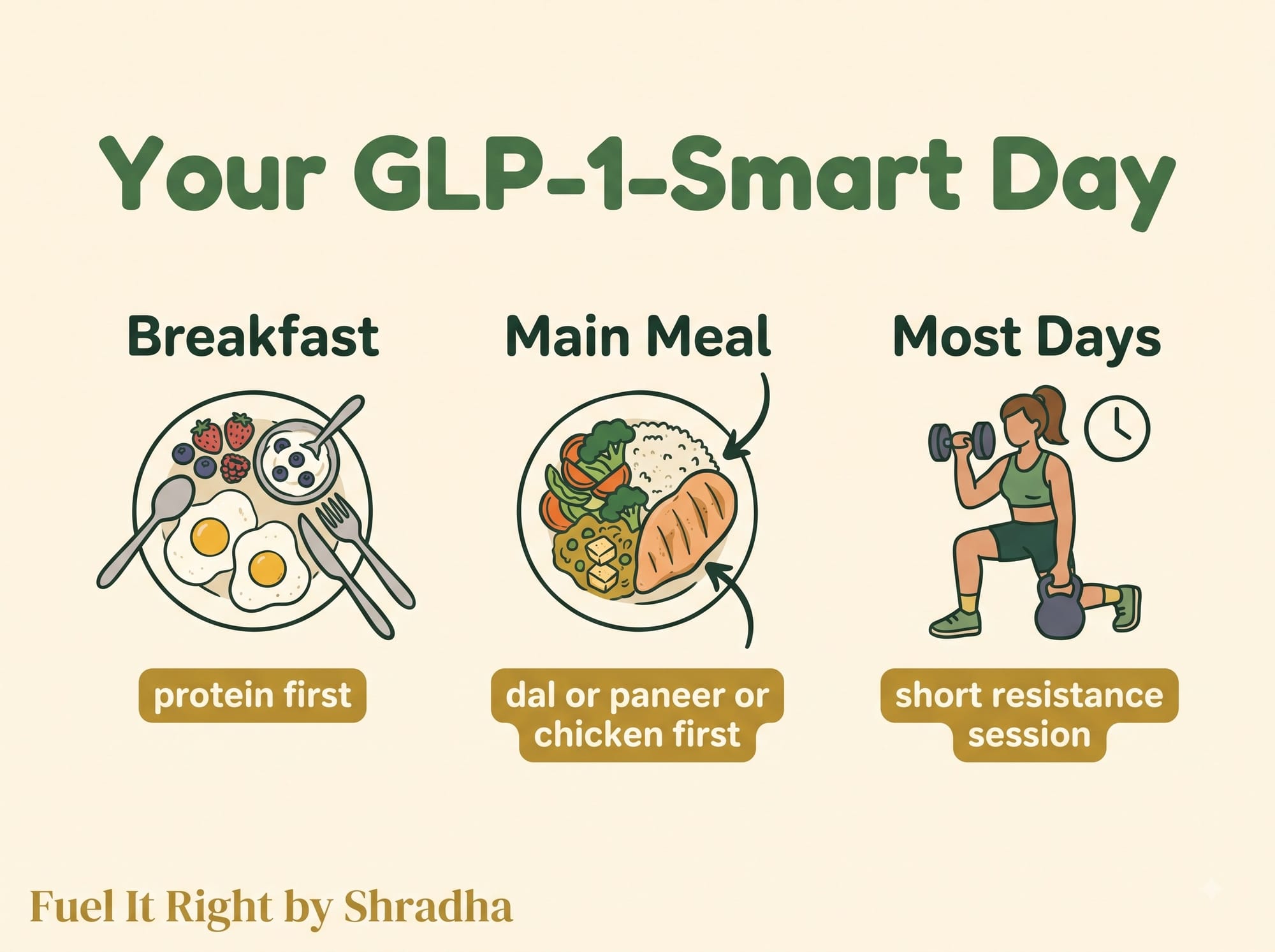
Breakfast | An egg or a moong dal chilla eaten first, before anything else on the plate, given how little capacity a suppressed appetite may leave for the rest of the meal. |
Main meal | Dal, paneer, or chicken portioned generously relative to the rest of the plate, eaten before rice or roti, not after. |
Most days | A short resistance session, even 15-20 minutes of bodyweight or light-weight work, treated as non-negotiable alongside the medication, not optional. |
On a GLP-1 and want your nutrition to actually protect your muscle?
Let's build that plan together:
Call or WhatsApp: +91 7057063984 or
Conclusion
GLP-1 medications are now genuinely accessible to a much larger share of India than a year ago, and the muscle-loss conversation deserves more precision than either the alarming headline ratios or a dismissive "don't worry about it." The 25-45% lean-mass figure is real, but it measures more than muscle, and the actual contractile muscle loss looks much closer to ordinary diet-induced weight loss once that's accounted for. What doesn't change is the fix: adequate protein, prioritised deliberately given a suppressed appetite, and resistance training, consistently, close most of the gap regardless of which drug or dose you're on.
FAQs
1. How much muscle do you actually lose on Ozempic or Mounjaro?
Trial data shows 25-45% of total weight lost is classified as "lean mass," but this category includes liver fat, intramuscular fat, glycogen, and water, not just muscle. The actual contractile muscle loss appears comparable to ordinary diet-induced weight loss.
2. Is Mounjaro worse for muscle loss than Ozempic?
The proportional fat-to-muscle ratio is similar between the two. Mounjaro tends to produce greater total weight loss, so the absolute muscle loss number can look larger, without necessarily being proportionally worse.
3. How much protein should I eat while on a GLP-1?
A joint advisory from four professional societies recommends 1.2 to 1.6g of protein per kilogram of body weight daily during active GLP-1 weight loss.
4. Can I actually hit my protein target with a suppressed appetite?
Yes, with deliberate prioritisation. Eating the protein portion of a meal first, before rice, roti, or other lower-protein foods, helps ensure reduced capacity doesn't default into reduced protein.
5. Does resistance training really make a measurable difference?
Yes. A 2025 study combining GLP-1 treatment with resistance training education and adequate protein found only 3% muscle loss despite 13% total body weight loss, well below the 25-45% headline ratio seen without those interventions.
6. Are Indian patients at higher risk of muscle loss on GLP-1s?
Potentially, in relative terms. Indian bodies tend to carry less muscle mass and more body fat than other populations at the same BMI, so a given proportional muscle loss starts from a lower baseline and may carry more functional consequence.
7. If I stop the medication, will my muscle loss reverse?
Not on its own. Stopping typically halts the weight loss and often triggers fat regain, but reversing muscle loss specifically requires active protein intake and resistance training, independent of whether the medication continues.
8. Is creatine worth taking alongside a GLP-1?
It's a reasonable, well-studied, low-risk addition that supports resistance training adaptations, typically 3-5g daily, but it supports the protein and training plan rather than replacing either.
About the Author
Shradha | Nutritionist & Dietitian | Fuel It Right. Food-first, evidence-based nutrition for real, sustainable results.