
Ozempic & Mounjaro: A Dietitian's Honest Warning
GLP-1 drugs like Ozempic and Mounjaro are everywhere, but up to 40% of weight lost is muscle, bone density drops within one year, two-thirds of weight returns when you stop. See what the research says, and why real food remains the only strategy that works with your body.

There is a drug being used as the "miracle injection that melts fat." Its name, Ozempic and its sibling, Mounjaro. And right now, thousands of Indians, most of them with no diabetes diagnosis, are injecting themselves with it every week in the hope of finally losing weight.
I need to talk about this. Not to create panic, not to dismiss the science, but because as a dietitian, I have watched fads come and go, and this one has a paper trail that deserves your full attention before you or someone you love considers picking up that syringe.
First, What Are These Drugs, and Who Were They Actually Made For?
Let's be clear about something the which people always skip.
Ozempic (semaglutide, by Novo Nordisk) was approved by the US FDA as a Type 2 diabetes medication. So was Mounjaro (tirzepatide, by Eli Lilly). Their higher-dose versions Wegovy and Zepbound respectively were later approved specifically for weight management.
The difference between them matters. Ozempic is a GLP-1 receptor agonist which mimics a gut hormone called glucagon-like peptide-1 that signals fullness and regulates blood sugar. Mounjaro is a dual GIP + GLP-1 agonist hits two hormonal pathways simultaneously, making it more potent, more expensive, and more aggressive on the body.
These drugs were developed for people managing serious metabolic disease. The world watched them get co-opted into a weight loss trend, and the consequences are now showing up in courtrooms and research papers.
The Numbers That Made Them Famous
I am going to be fair, because credibility demands it.
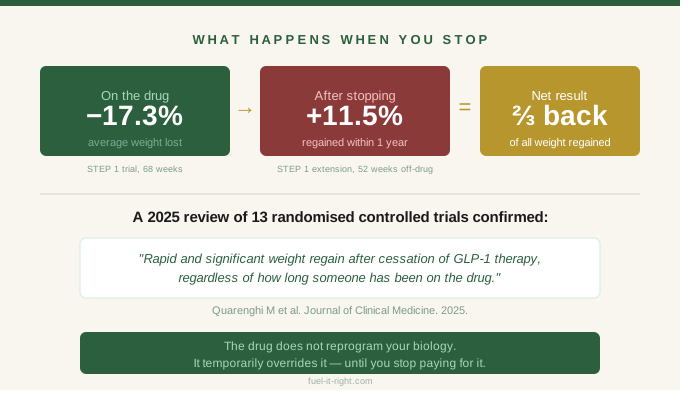
GLP-1 drugs do produce meaningful weight loss. Semaglutide 2.4 mg weekly showed an average weight loss of 17.3% at 68 weeks in landmark clinical trials. Mounjaro demonstrated superior blood sugar control and greater weight reduction than Ozempic. In March 2024, the FDA approved Ozempic to reduce the risk of cardiovascular events in overweight and obese adults with established heart disease. Some research has identified benefits to cognitive and behavioural health in users.
The Side Effects Nobody Warned You About
The Ones on the Label
Nausea, vomiting, diarrhea, constipation, and fatigue are classified as common side effects. Most users expect some gastrointestinal disruption going in. What is far less known, is how deep that disruption can go.
The Hidden Ones
A study that analysed over 410,000 Reddit posts from users of semaglutide and tirzepatide found that 43.5% of users who reported side effects mentioned at least one. The most notable underreported effects were menstrual irregularities, chills, hot flashes, and mood shifts. These are effects reaching the reproductive and thermoregulatory systems, not just the digestive tract.
The Serious Ones
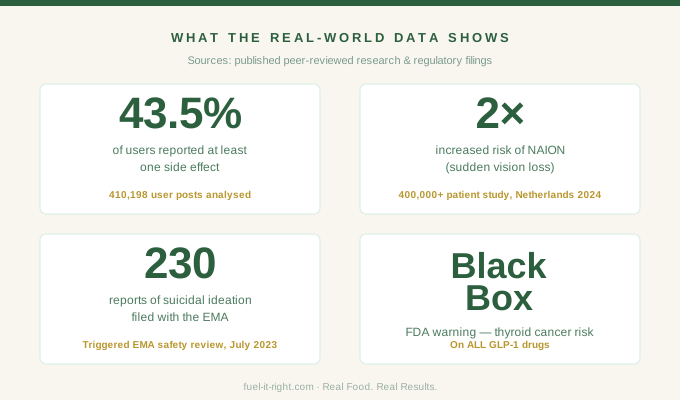
Pancreatitis and Kidney Injury: A landmark WashU Medicine study, one of the most comprehensive real-world analyses of GLP-1 use to date, confirmed that alongside potential cognitive benefits, users face increased risks for both pancreatitis and kidney conditions.
Vision Loss: A 2024 population study of over 400,000 patients in the Netherlands found that people using semaglutide had more than double the risk of developing NAION - non-arteritic anterior ischaemic optic neuropathy, a form of sudden, often irreversible optic nerve damage. In December 2025, the US Judicial Panel on Multidistrict Litigation established a dedicated federal docket for GLP-1-linked vision loss claims.
Thyroid Risk: GLP-1 receptors are present in thyroid tissue. Every GLP-1 drug carries an FDA boxed warning, the most serious category of warning a drug can carry, prohibiting use in anyone with a personal or family history of medullary thyroid carcinoma or Multiple Endocrine Neoplasia type 2. This is a major warning, not a footnote.
Suicidal Ideation: In July 2023, the European Medicines Agency launched a formal safety review of GLP-1 receptor agonists specifically investigating the risk of suicidal thoughts and self-harm. This review was triggered by 230 documented reports in the European Pharmacovigilance Database, including reports of suicide attempts among GLP-1 users. Research findings remain mixed, the investigation is ongoing.
The Crisis Your Dietitian Is Most Alarmed About: Muscle and Bone
Read this section carefully. Because this is the clinical finding that should make every person, pause before proceeding.
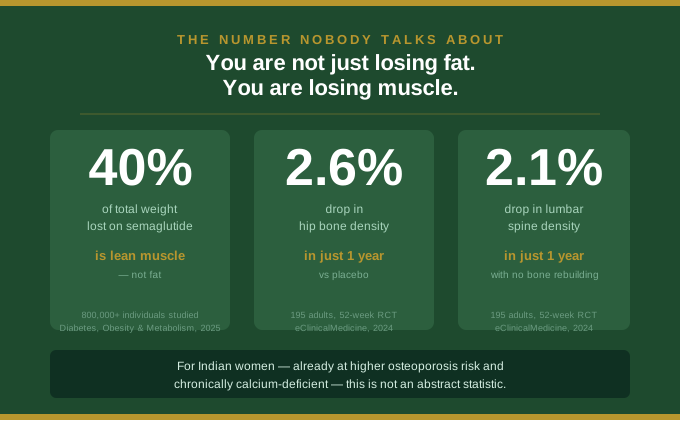
A genetic analysis of over 800,000 individuals, published in Diabetes, Obesity and Metabolism, confirmed that GLP-1 drugs reduce both fat mass and lean mass. In some studies, up to 40% of total weight loss from semaglutide came from lean body mass, that is muscle, not fat. The University of Alberta is now running a dedicated clinical trial called the GLIMMER study, formally titled "GLP-1 Receptor Agonist-Induced Loss and Impairment of Muscle Mass", using advanced MRI to track this specifically. That a major academic institution needed to create a dedicated research programme around this question tells you everything.
Loss of lean body mass is not a cosmetic problem. Reduced skeletal muscle is directly associated with increased rates of hospitalisation, frailty, sarcopenia, disability, and mortality, particularly in women.
And the Bones Are Also Under Threat
A 2024 randomised controlled trial published in eClinicalMedicine that 195 adults with obesity, 52 weeks of follow-up found that once-weekly semaglutide reduced hip bone mineral density by 2.6% and lumbar spine density by 2.1% compared to placebo. There was increased bone resorption with no compensatory increase in bone formation. In one year. On a drug that millions of people are being told to take.
For Indian women, who already carry significantly higher baseline osteoporosis risk, who are chronically calcium-deficient, and who are under-muscled relative to body fat, this is not an abstract statistic. This is a direct projection of what your skeleton may look like at 55 if you start this drug at 32.
The Rebound: The Part Nobody Puts in the Advertisement
Most people do not stay on these drugs for life. A JAMA Network Open analysis found that the vast majority of people quit within two years because of cost, side effects, or simple discontinuation.
What happens next has been studied rigorously. A 2025 narrative review in the Journal of Clinical Medicine examined 13 randomised controlled trials and concluded with clarity: there is rapid and significant weight regain after cessation of GLP-1 therapy, regardless of how long someone has been on the drug. The authors noted that this rebound "is likely to substantially mitigate the metabolic benefits attained through weight loss."
The STEP 1 trial, the flagship semaglutide clinical trial, followed participants after they stopped the drug. The finding: approximately two-thirds of the weight lost was regained within one year. Blood pressure returned to pre-treatment levels. Cardiovascular markers reset. The body's physiology reasserted itself the moment the drug was removed.
At a cost of approximately $935 to $1,069 per month for what is, by the drug's own clinical evidence, a lifelong prescription.
The Lawsuits: 3,700+ People Are Currently in Court
As of May 1, 2026, there are 3,636 pending claims in MDL-3094. In Re: Glucagon-like Peptide-1 Receptor Agonists Products Liability Litigation and 86 additional claims in MDL-3163, the separate federal docket for GLP-1-linked vision loss. Both are consolidated before the US District Court for the Eastern District of Pennsylvania.
The central allegation across most of these cases: failure to warn. Plaintiffs allege they developed gastroparesis, a condition where the stomach becomes partially or fully paralysed, losing its ability to move food forward into the small intestine after using these drugs.
Law firm Morgan & Morgan, which filed among the earliest cases, stated at a press conference: "It is our opinion that these drugs are causing these problems. We think the evidence is sufficient to prove it."
The regulatory detail that gives these lawsuits weight: when this litigation began, Mounjaro's label did not explicitly list gastroparesis as a possible side effect. Ozempic and Wegovy's labels did not mention it at all — despite the condition being mechanistically consistent with a drug designed to slow gastric emptying. In January 2025, the Ozempic label was updated to state the drug is "not recommended in patients with severe gastroparesis" but it still does not state that the drug may cause the condition.
That distinction is the basis of the litigation. No global settlements have been reached as of May 2026. The number of cases is still climbing.
Myths vs. Facts
What You've Heard | What the Research and Legal Record Show |
"It's completely safe — the FDA approved it" | FDA-approved drugs carry documented risks. Every GLP-1 drug carries an FDA boxed warning. Post-market safety reviews are actively ongoing. |
"You'll keep the weight off after stopping" | Approximately two-thirds of weight lost is typically regained within one year of stopping, per the STEP 1 trial extension. |
"It only affects your appetite" | It affects the gut, pancreas, kidneys, reproductive system, bones, skeletal muscle, and potentially the eyes and thyroid. |
"It's just like boosting your natural GLP-1" | Natural GLP-1 is released in meal-driven pulses. Injecting a synthetic long-acting analogue is a physiologically different and far more sustained hormonal intervention. |
"Diet doesn't work — this is the only option" | The research concludes GLP-1 drugs work best combined with structured lifestyle changes, and that lifestyle remains foundational. Medication without dietary change produces inferior and less durable outcomes. |
"Everyone is doing it — it must be fine" | One in eight Americans has used GLP-1 drugs. We are within the first decade of mass use. Long-term data beyond five years does not yet exist for the overwhelming majority of users. |
What Your Body Was Actually Designed to Do
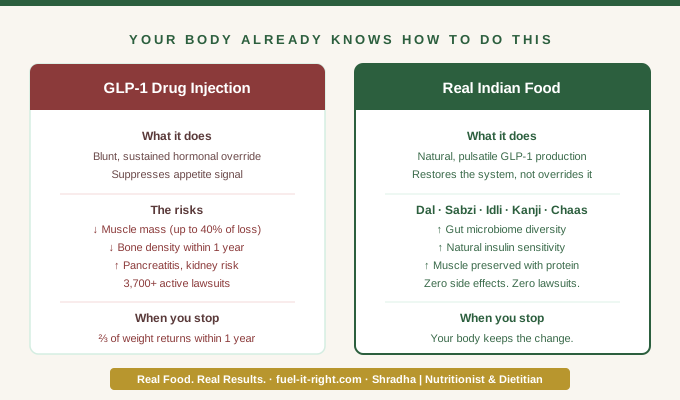
A healthier gut microbiome supports your body's own GLP-1 production and improves insulin sensitivity naturally. The research itself explicitly states: "Future obesity management is likely to prioritise integrated approaches that combine pharmacotherapy with lifestyle interventions, rather than replacing lifestyle changes with medication alone." Even the researchers advocating for these drugs know that food is non-negotiable.
The difference between the drug and the dietary approach is the speed of the beginning — and the permanence of the outcome. A drug delivers a blunt, high-amplitude hormonal override within weeks. Diet delivers a recalibration, slower, yes, but one that your gut bacteria, your muscle tissue, your bone density, and your hormonal system can actually sustain.
Our traditional Indian foods — dal, sabzi, hand-pounded rice, seasonal vegetables, fermented preparations like idli, kanji, and chaas are naturally prebiotic, naturally anti-inflammatory, and naturally supportive of gut GLP-1 production. This is not nostalgia. This is biochemistry. These foods feed the gut bacteria that make the hormone that does, naturally and safely, what these drugs attempt to do chemically.
A Closing Word
There are patients — with severe obesity, documented Type 2 diabetes, or serious cardiovascular disease — for whom GLP-1 drugs represent a legitimate medical intervention, under specialist supervision, with full blood work, body composition monitoring, and a structured dietary plan running alongside it. That is a clinical conversation between a patient and their endocrinologist, with complete information on both the benefits and risks outlined above.
But for the woman who wants to lose weight for a wedding, for the young woman with PCOS who found out about this from others who have done it, for the person who saw a before-and-after reel and thought, finally, something that works, this drug was not designed for you. And the 3,700 people currently in court are the early evidence of what happens when a metabolic disease medication becomes a weight loss trend without guardrails.
Ready to work with your body, not override it?
Book a free 30 mins consultation with me here: calendly.com/shradhajp/30min
or WhatsApp +91 7057063984
References
1. Wilding JPH et al. Weight regain and cardiometabolic effects after withdrawal of semaglutide: The STEP 1 trial extension. Diabetes, Obesity and Metabolism. 2022. DOI: 10.1111/dom.14725
2. WashU Medicine / VA St. Louis. Study identifies benefits and risks linked to popular weight-loss drugs. January 2025.
3. Hansen M et al. Semaglutide and bone mineral density: 52-week RCT findings. eClinicalMedicine. 2024.
4. Quarenghi M et al. Weight Regain After Liraglutide, Semaglutide or Tirzepatide Interruption: A Narrative Review. Journal of Clinical Medicine. 2025. DOI: 10.3390/jcm14113791
5. Nature Health / Healthline. Hidden side effects of GLP-1 drugs — analysis of 410,198 Reddit posts. April 2026.
6. European Medicines Agency (EMA). Safety review of GLP-1 receptor agonists — suicidal ideation and self-harm. Initiated July 2023.
7. MDL-3094. In Re: GLP-1 Receptor Agonists Products Liability Litigation. US District Court, Eastern District of Pennsylvania. 3,636 pending claims as of May 1, 2026.
8. MDL-3163. In Re: GLP-1 Receptor Agonists Non-Arteritic Anterior Ischaemic Optic Neuropathy Products Liability Litigation. Established December 2025.
9. University of Hong Kong. Lean and fat mass analysis across 800,000+ individuals treated with GLP-1 drugs. Diabetes, Obesity and Metabolism. 2025.
10. University of Oxford / WHO Commission. Long-term effectiveness and post-discontinuation outcomes of GLP-1 drugs. Cochrane review. January 2026.
11. GLIMMER Trial — GLP-1 Receptor Agonist-Induced Loss and Impairment of Muscle Mass. University of Alberta. ClinicalTrials.gov: NCT07272837.
12. JAMA Network Open. GLP-1 drug discontinuation rates within two years. Analysis of 120,000+ patients.
13. Columbia University Irving Medical Centre / Dr Marc Bessler. The Ozempic Effect: Medical Weight Loss overview.
Shradha | Nutritionist and Dietitian| Fuel It Right
The information in this article is for educational purposes and does not constitute medical advice. Always consult a qualified healthcare professional before starting, stopping, or changing any medication.