
Does Ghee Raise Cholesterol? What Research Shows
Does ghee raise cholesterol? Even the research is divided. What a 2025 meta-analysis, a conflicting Indian study, and the landmark PURE trial actually show, and how much ghee fits a balanced Indian diet.

Table of Contents
1. The Ghee Debate: Why Even Researchers Disagree
2. What a 2025 Meta-Analysis Found (and Didn't Find)
3. The Study That Complicates the Picture
4. What the PURE Study Showed About Saturated Fat and Heart Disease
5. So How Much Ghee Is Actually Fine?
6. Building a Ghee-Smart Plate: A 7-Day Starting Framework
Conclusion
FAQs
1. The Ghee Debate: Why Even Researchers Disagree
Ask ten people whether ghee raises cholesterol and you'll likely get ten different answers, several of them confident. That confidence isn't fully earned by the evidence. Ghee sits in a genuinely unsettled corner of nutrition science, and the honest answer is more nuanced than either "ghee is a superfood" or "ghee will clog your arteries."
Ghee is roughly 62% saturated fat by weight, alongside butyric acid, medium-chain fats, and stearic acid, fatty acids that don't all behave identically in the body. That biochemical complexity is part of why studies on ghee and cholesterol have produced genuinely mixed results, not just marketing spin in either direction.
2. What a 2025 Meta-Analysis Found (and Didn't Find)
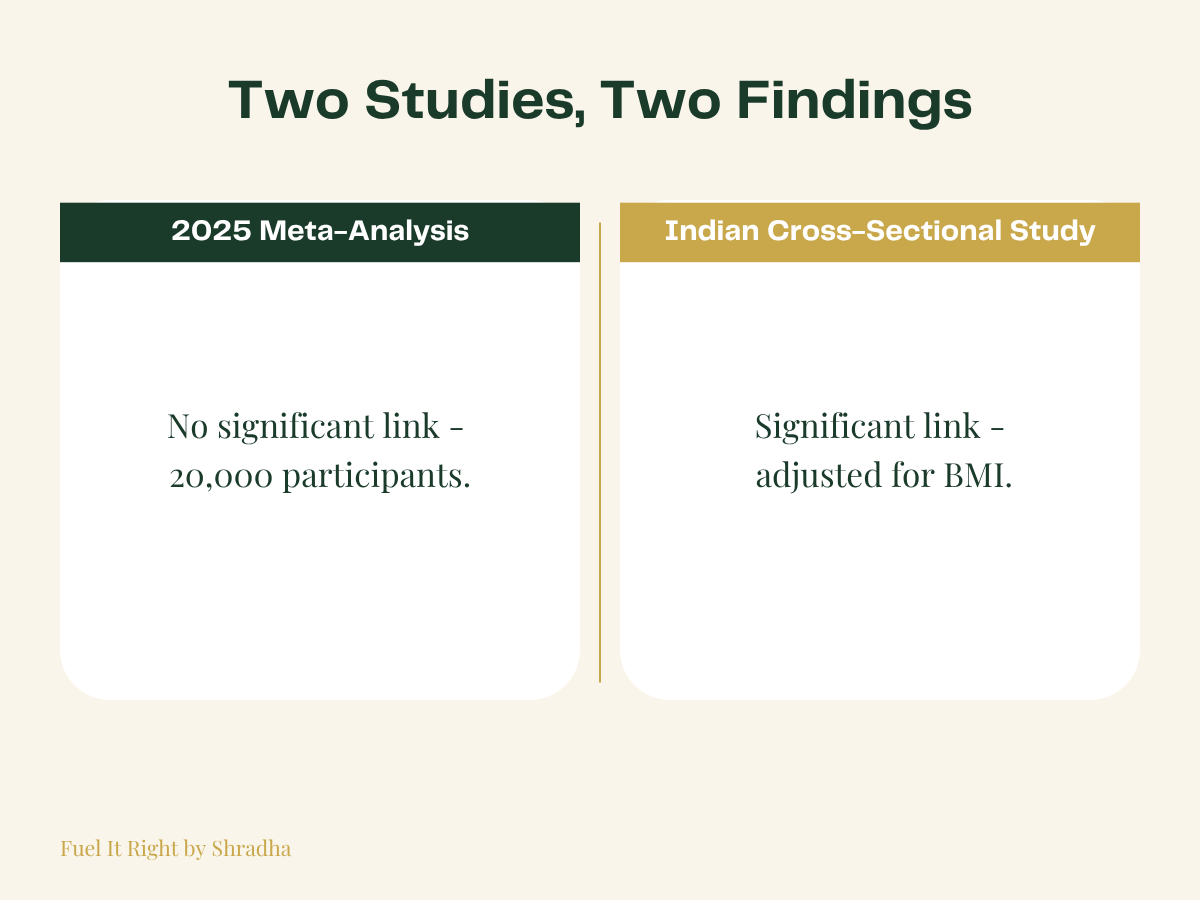
The most comprehensive recent synthesis is a 2025 systematic review and meta-analysis published in Progress in Nutrition, pooling 18 studies out of 919 screened, spanning research from 1994 to 2024. Its analysis of ghee consumption and coronary heart disease risk covered 10 studies and nearly 20,000 participants, including over 4,500 from the Indian subcontinent.
The pooled result showed no statistically significant association between ghee consumption and coronary heart disease risk. A separate pooled analysis of eight studies on ghee and lipid profiles found neutral to positive effects, and for LDL cholesterol specifically, the difference between ghee consumers and non-consumers wasn't statistically significant either.
No significant association isn't the same as proof of safety. It means the pooled evidence doesn't show clear harm at typical intake.
3. The Study That Complicates the Picture
Evidence isn't unanimous, and pretending otherwise wouldn't be honest. A separate 2025 Indian cross-sectional study found that ghee consumption was associated with significantly higher total cholesterol and LDL-C in both men and women, even after adjusting for age, physical activity, and BMI.
Both papers can be accurate at once. Cross-sectional studies capture a single snapshot and can't establish cause and effect the way pooled data can, but they also reflect real-world eating patterns, including quantity consumed, which meta-analyses sometimes can't fully account for. The honest takeaway is that amount and individual response likely matter more than any single verdict on ghee itself.
4. What the PURE Study Showed About Saturated Fat and Heart Disease
Zooming out from ghee specifically, the PURE study, a Lancet-published prospective cohort of 135,335 people across 18 countries including an Indian research site in Bangalore, remains one of the largest studies on dietary fat and cardiovascular outcomes. Comparing the highest to lowest intake groups, saturated fat was not significantly associated with myocardial infarction or cardiovascular disease mortality, and was actually linked to a lower risk of stroke.
This doesn't mean saturated fat is irrelevant to your numbers. It means the relationship between diet, cholesterol, and cardiovascular risk is more complicated than "saturated fat in, heart disease out." As we covered in Insulin Resistance vs Diabetes, the same triglyceride-to-HDL ratio used as an insulin resistance proxy is also shaped by overall diet quality and body composition, not fat intake in isolation.
Curious how your overall metabolic picture fits together?
Take the free Gut Health Quiz:
5. So How Much Ghee Is Actually Fine?
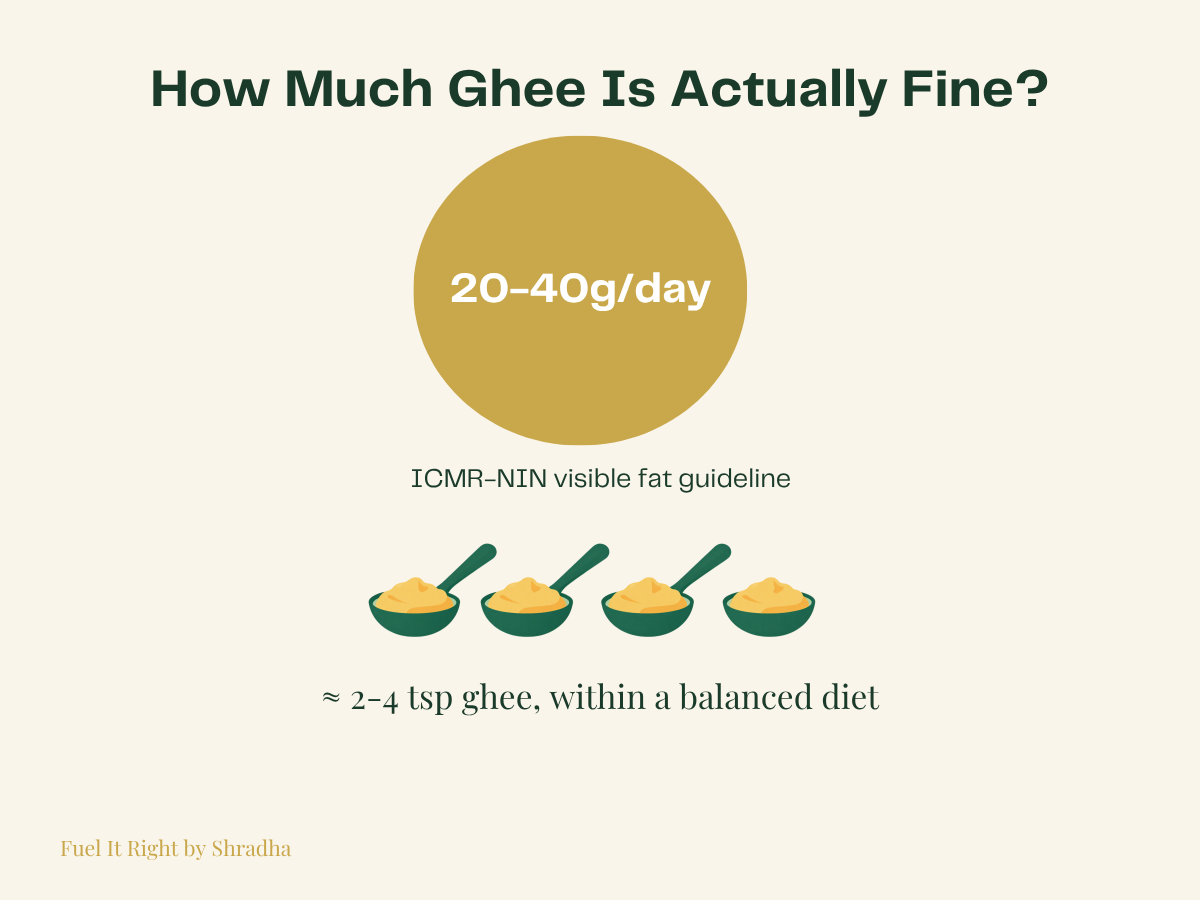
ICMR-NIN's 2020 nutrient guidelines cap total visible fat, meaning oil and ghee combined, at 20 to 40 grams a day depending on sex and activity level, and specifically flag more than 10 grams a day of visible saturated fat (on a 2000 kcal reference diet) as high intake. One teaspoon of ghee is roughly 5 grams, so this generally allows 2 to 4 teaspoons a day within a broader balanced diet, not zero.
This changes for specific people. Those with familial hypercholesterolaemia, a genetic condition affecting roughly 1 in 250 people, and those who are LDL "hyper-responders" to dietary saturated fat, a real and individually variable trait, should follow stricter limits set with their doctor, not a general guideline.
For most people without a specific lipid disorder, the more useful question isn't "ghee or no ghee." It's what ghee is replacing. Swapping refined vanaspati or repeatedly reheated oil for measured ghee is a different trade than adding ghee on top of an already fat-heavy plate. The Indianised Mediterranean approach we covered for fatty liver applies the same logic: the quality and quantity of the whole pattern matters more than any single ingredient.
6. Building a Ghee-Smart Plate: A 7-Day Starting Framework
This is a starting structure for someone without a diagnosed lipid disorder. If you have known high LDL or a cardiac history, work these changes through with your doctor or a dietitian who can see your actual lipid panel, not just general guidance.
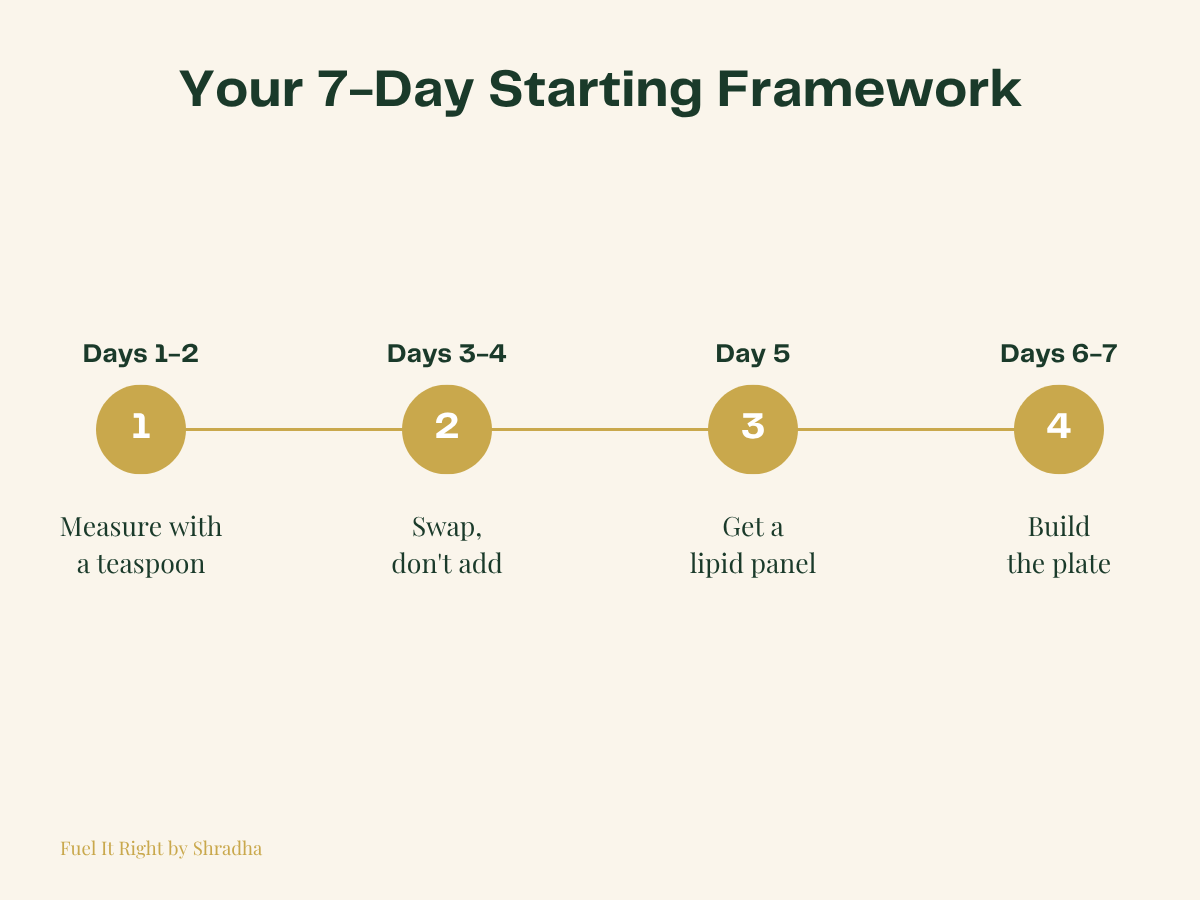
● Days 1-2: Measure your ghee with a teaspoon for a week instead of eyeballing it; most people underestimate their actual intake by two to three times.
● Days 3-4: Swap ghee added on top of already-fried food for ghee used in place of refined oil during cooking, not in addition to it.
● Day 5: Get a fasting lipid panel if you haven't had one in the past year, so any changes are measured against your actual numbers, not guesses.
● Days 6-7: Build meals around the same half-vegetable, quarter-protein plate structure regardless of which fat you're using, since the overall plate matters more than the fat source alone.
Ready for a food-first plan built around your numbers?
Book a 30-minute consult:
Conclusion
Ghee doesn't have a single verdict backed by all the evidence, and anyone offering you one, in either direction, is oversimplifying real research disagreement. What's consistent across the data is that quantity matters, individual response varies, and the fat you're using is only one part of a much larger dietary pattern. Measuring your intake and getting an actual lipid panel will tell you more about your personal risk than any headline about ghee ever will.
FAQs
1. Does ghee increase cholesterol?
The evidence is genuinely mixed. A 2025 meta-analysis found no significant association between ghee consumption and LDL cholesterol or coronary heart disease risk, while a separate Indian cross-sectional study found a significant association. Quantity and individual response likely explain much of the gap.
2. How much ghee is safe per day?
ICMR-NIN's 2020 guidelines cap total visible fat (oil plus ghee) at 20-40 grams daily depending on sex and activity level, with more than 10 grams a day of visible saturated fat flagged as high. That works out to roughly 2-4 teaspoons of ghee within an otherwise balanced diet.
3. Is ghee better than refined oil?
It depends what you're comparing it to. Ghee's high smoke point and saturated fat structure make it more heat-stable than PUFA-rich oils at typical Indian cooking temperatures, meaning less oxidative breakdown, but this doesn't override the overall quantity guidance above.
4. Does saturated fat cause heart disease?
The PURE study, following over 135,000 people across 18 countries, found saturated fat was not significantly associated with heart attack or cardiovascular death, and was linked to a lower risk of stroke. The relationship is more complex than older single-nutrient guidance suggested.
5. Who should limit ghee strictly?
People with familial hypercholesterolaemia, known LDL hyper-responders to dietary saturated fat, and those with an existing cardiac history should follow limits set with their doctor based on their actual lipid panel, not a general population guideline.
6. Is A2 ghee healthier than regular ghee for cholesterol?
Evidence specifically comparing A2 and regular ghee's effect on cholesterol is limited. Most existing lipid research doesn't distinguish between the two, so quantity remains the more evidence-backed lever than A2 status.
7. Does dietary cholesterol in ghee raise blood cholesterol?
One teaspoon of ghee contains about 13mg of dietary cholesterol. Current research shows dietary cholesterol has a weaker effect on blood cholesterol for most people than once believed; the saturated fat content matters more than the cholesterol content itself.
8. Does cooking method change how ghee affects cholesterol?
Repeated reheating of any fat, including ghee, increases oxidative byproducts and should be avoided. Used fresh and in measured amounts, ghee's heat stability is generally considered a practical advantage over repeatedly reheated vegetable oils.
About the Author
Shradha | Nutritionist & Dietitian | Fuel It Right. Food-first, evidence-based nutrition for real, sustainable results.