
Creatine for Women: What Actually Works
Creatine sales for women have jumped 120% as researchers move it from a bodybuilder's supplement to genuine women's health territory. Here's what a 2026 meta-analysis and a new menopause-specific trial actually found, and where the evidence still has real gaps.

Table of Contents
1. Creatine for Women: Why This Conversation Just Changed
2. Does Creatine Actually Help After Menopause?
3. What About Brain and Mood?
4. The "Bulky" Myth and Other Things Worth Knowing
5. Where the Evidence Still Has Real Gaps
6. Building a Creatine-Smart Routine
Conclusion
FAQs
1. Creatine for Women: Why This Conversation Just Changed
WHAT YOU'VE HEARD: Creatine is a men's supplement, mostly for bodybuilders trying to bulk up. |
WHAT'S ACTUALLY TRUE: A 2021 review specifically called creatine "a particularly important supplement for females across the lifespan," and the research base has only grown since. Creatine sales among women rose roughly 120%, an increase of about 20 million dollars, in recent years, reflecting a genuine shift in how researchers and consumers think about who it's actually for. |
This new interest isn’t just marketing trying to catch up with a trend. That means more research into how creatine works differently in women during different hormonal stages of life – menstruation, pregnancy and menopause – which has really been understudied until recently.
2. Does Creatine Actually Help After Menopause?
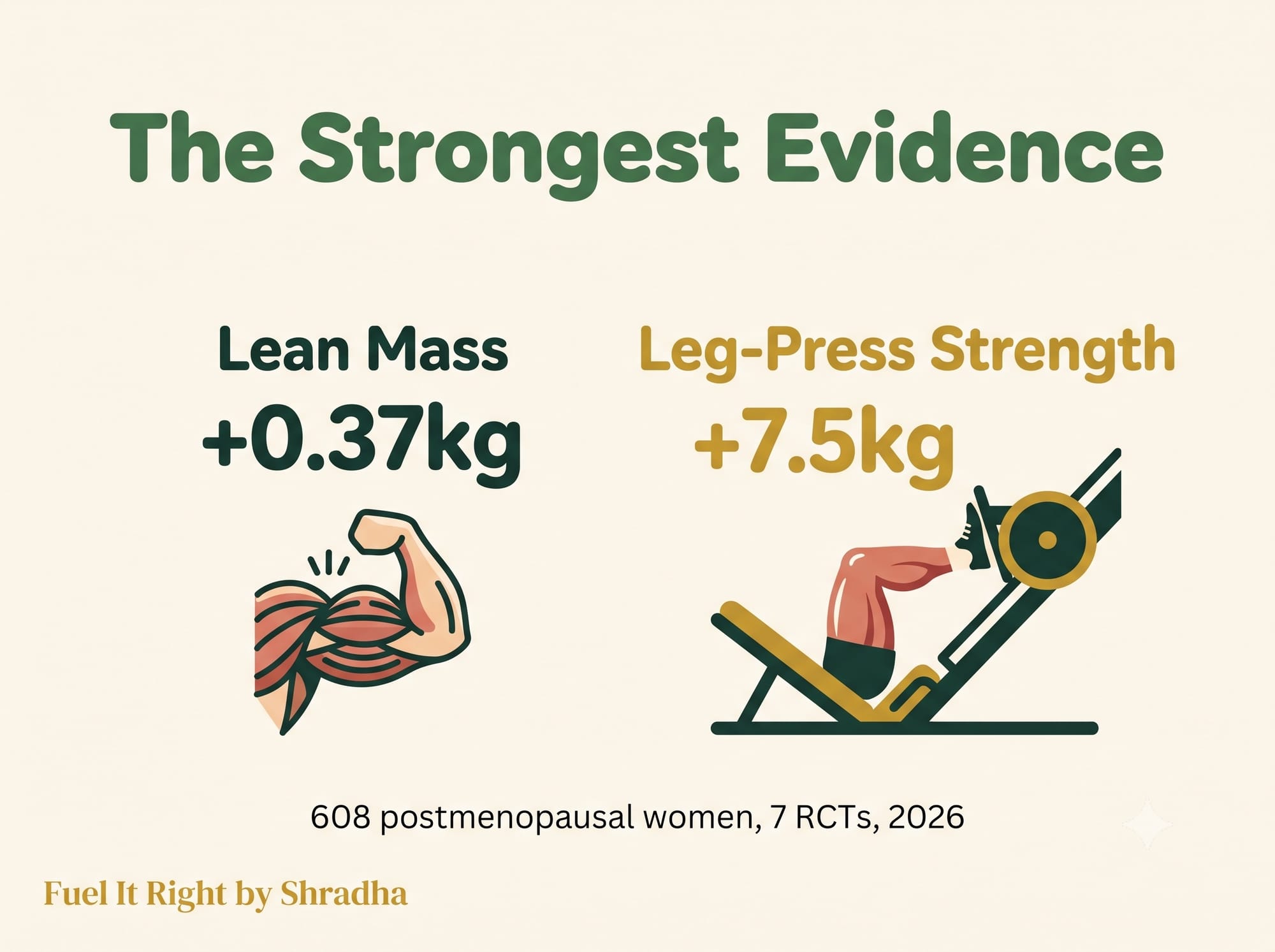
This is the most robust and consistent female-specific evidence. A meta-analysis of seven randomized controlled trials and 608 post-menopausal women, published in 2026, found that creatine supplementation increased lean mass by an average of 0.37kg and leg-press strength by 7.5kg compared with placebo. The benefit was most apparent in studies that paired at least 5g a day with resistance training, the same active lever we found in Menopause Weight Gain: Why Indian Women Face It Earlier, the strongest evidence-backed lever for preserving muscle through this transition was resistance training alone (not protein or supplements).
3. What About Brain and Mood? The Newer, More Tentative Findings
The first randomized controlled trial specifically investigating creatine in peri- and postmenopausal women, CONCRET-MENOPA, was published in 2026 and included 36 women who received a placebo or one of several doses of creatine hydrochloride for 8 weeks. The higher-dose group (1,500mg daily) showed a 6.6% improvement in reaction time compared with 1.2% with placebo, a 16.4% increase in frontal brain creatine levels, favorable changes in lipid markers and a trend for reduced severity of mood swings.
WHAT YOU'VE HEARD: Creatine is now a proven treatment for menopause symptoms and mood. |
WHAT'S ACTUALLY TRUE: The CONCRET-MENOPA trial found real changes in reaction time and brain creatine levels, but most broader menopausal symptom outcomes were unchanged, and the mood finding was described as a trend, not a settled result. Separately, small studies combining creatine with antidepressant therapy in younger women showed promise as an adjunct to treatment, not as a standalone fix for mood or depression. |
This is a genuinely promising early signal, not a finished story. Treat brain and mood benefits as an area worth watching, not yet something to expect with confidence.
Curious what your gut and metabolic picture looks like right now?
4. The "Bulky" Myth and Other Things Worth Knowing
WHAT YOU'VE HEARD: Creatine will make me bulky or bloated. |
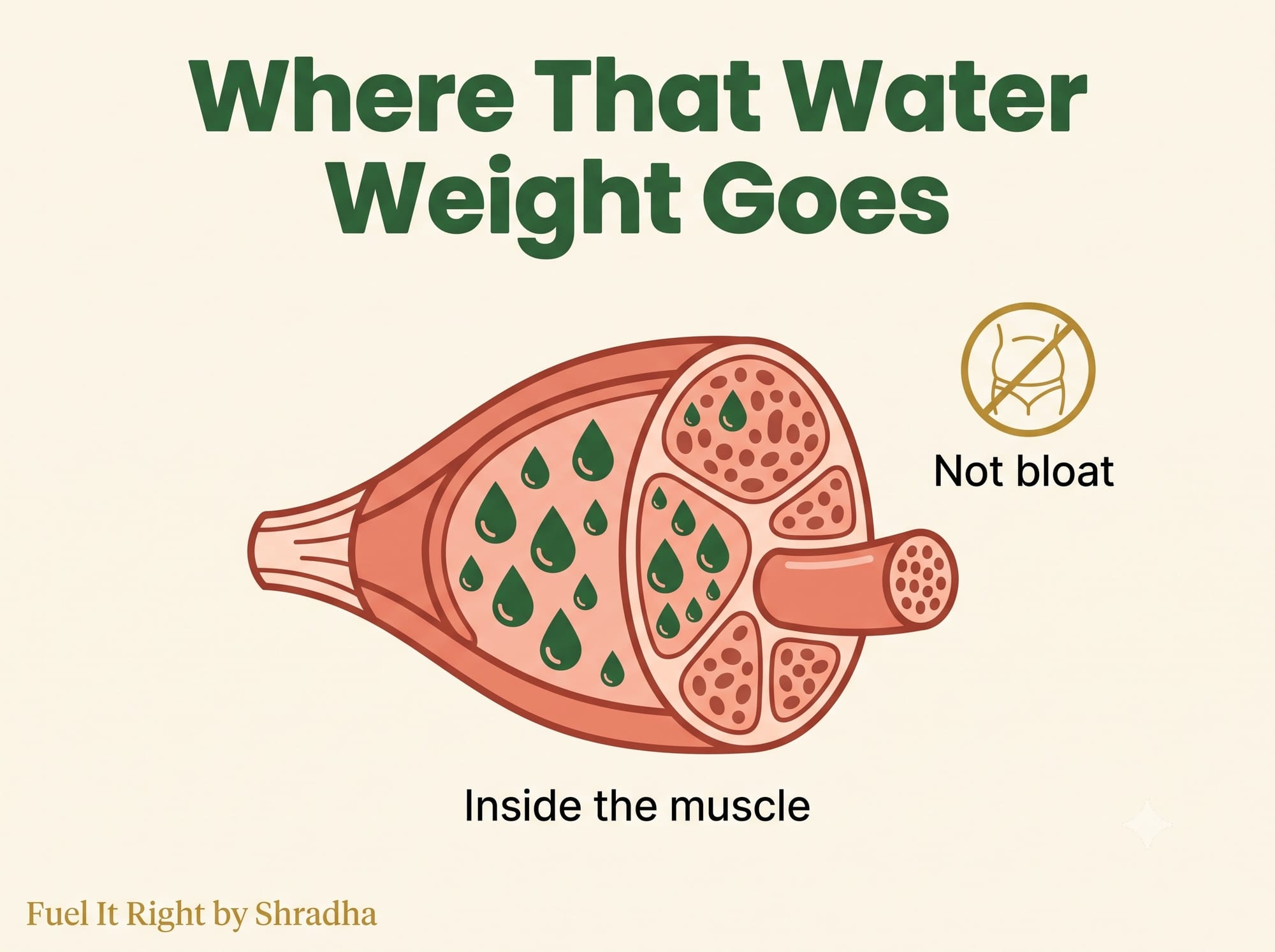
WHAT'S ACTUALLY TRUE: Some people notice a 1-2 pound weight increase in the first week, and this is due to water being pulled into muscle cells, not fat and not the kind of visible bloating people fear. It doesn’t add bulk in the bodybuilder sense on its own – you still need the workout and calorie surplus to actually build muscle. |
The practical dose is simple and well established: 3 to 5 grams of creatine monohydrate daily, with no loading phase required and no particular time of day that matters more than another. Consistency, not timing or ritual, is what the evidence actually supports.
5. Where the Evidence Still Has Real Gaps: Verdict by Verdict
Strength and Lean Mass in Postmenopausal Women STRONG, BEST-SUPPORTED EVIDENCE |
Supported by a 2026 meta-analysis of 608 women in 7 randomized trials. Most effective when combined with resistance training. |
Brain and Cognitive Effects PROMISING, EARLY-STAGE |
Real signals from CONCRET-MENOPA on reaction time and brain creatine, but from one small trial (36 women) over 8 weeks. |
Broad Menopause Symptom Relief NOT YET ESTABLISHED |
Most menopausal symptom outcomes in the CONCRET-MENOPA trial were unchanged despite the cognitive findings. How to make it work: Don't expect creatine to address hot flashes or broader menopause symptoms based on current evidence. |
Creatine Alongside a GLP-1 Medication REAL DATA GAP |
How to make it work: Worth raising directly with your doctor if you're on a GLP-1 and considering creatine, rather than assuming the general evidence transfers directly. |
Creatine During Pregnancy NOT ENOUGH EVIDENCE YET |
The pregnancy-specific literature remains thin compared to other life stages studied. How to make it work: This is a conversation for your obstetrician specifically, not a decision to make from general population research. |
6. Building a Creatine-Smart Routine: Three Real Moments, Fully Assembled
This is a starting structure for a generally healthy adult woman. It is not medical advice for pregnancy, kidney conditions or medication interactions, all of which deserve a specific conversation with your doctor first.
Your Creatine-Smart Checklist, At a Glance |
3-5g of creatine monohydrate daily, no loading phase needed, timing doesn't meaningfully matter |
Pair it with resistance training; the strongest evidence is for this combination, not creatine alone |
Expect modest, real strength and lean mass gains, not a dramatic transformation |
Treat brain and mood benefits as promising but early, not an established outcome |
If you’re pregnant or taking a GLP-1 medication, chat with your doctor about creatine first — there’s just not much evidence in those areas. |
Three Real Moments, Fully Assembled
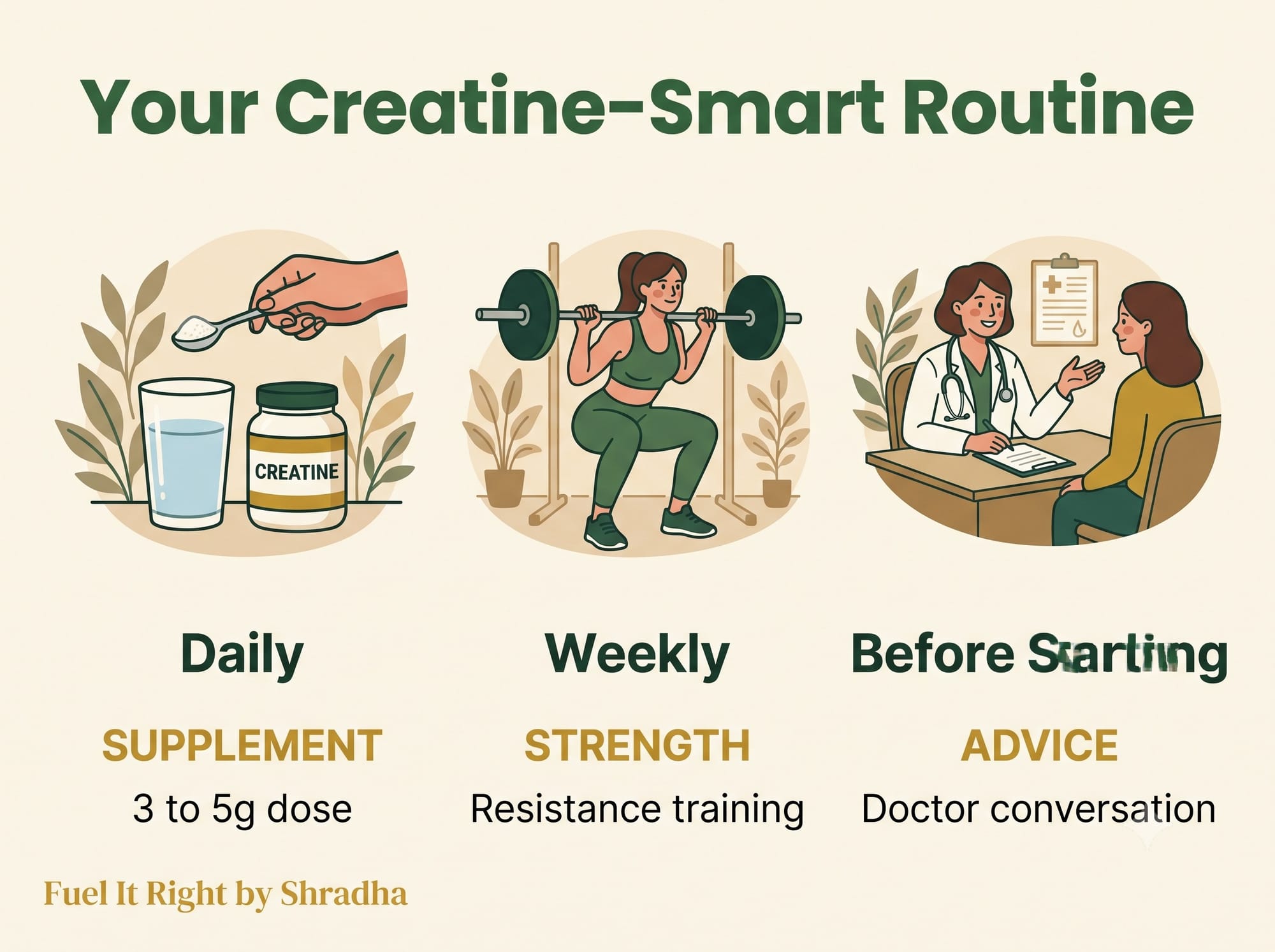
Daily | 3-5g of creatine monohydrate, mixed into water or a meal, at whatever time is easiest to remember consistently. |
Weekly | And the strongest evidence actually supports the combination of creatine with 2-3 resistance training sessions . |
Before starting | A quick conversation with your doctor if you're pregnant, on a GLP-1 medication, or managing a kidney condition, since the evidence for those specific situations is still limited. |
Wondering if creatine actually fits your specific situation?
Let's figure that out together
Call/ WhatsApp: +91 70570 63984 Or
Conclusion
Creatine earned a reputation as a men’s bodybuilding supplement that never really fit the physiology, and the research finally catching up demonstrates real, if modest, benefit for women, strongest and best established for strength and lean mass preservation after menopause when combined with resistance training. Brain and mood findings are really promising but early days, small trials that need replication. What’s consistent across the evidence: This acts as a support tool alongside training and food, not a standalone fix. The dose is simple, 3-5 grams daily, no loading phase or ritual needed.
FAQs
1. Is creatine actually beneficial for women, or is it mainly for men?
The evidence base has grown substantially and specifically for women. A 2021 review called it "a particularly important supplement for females across the lifespan," and female-specific trials have expanded significantly since.
2. Does creatine help with menopause specifically?
Yes, a meta-analysis of 608 post-menopausal women in 2026 found real benefit for strength and lean mass when combined with resistance training. For more general menopausal symptoms, the evidence is much less clear-cut. A 2026 trial showed some improvements in cognition, but most symptom outcomes were unaffected.
3. Will creatine make me bulky?
No. The early water weight increase some people notice is stored inside muscle cells, not fat or visible bloat, and doesn't produce bodybuilder-style bulk on its own without deliberate training and a calorie surplus.
4. What's the right dose of creatine for women?
3 to 5 grams of creatine monohydrate daily is the well-established dose, with no loading phase required and no specific time of day that matters more than consistency.
5. Does creatine actually improve brain function or mood?
Early results are promising: a 2026 study demonstrated improved reaction time and increased brain creatine levels in women who are perimenopausal and menopausal, with a trend toward reduced severity of mood swings. This is from one small trial and so is not an established result to confidently expect.
6. Can I take creatine if I'm on a GLP-1 medication like Ozempic or Mounjaro?
Research combining creatine with GLP-1 medications specifically is essentially just beginning. This is worth a direct conversation with your doctor rather than assuming general creatine research applies the same way.
7. Is creatine safe during pregnancy?
The pregnancy-specific evidence is still thin compared to other life stages. This is a decision to make with your obstetrician, not from general population research.
8. Do I need a loading phase for creatine to work?
No. The current evidence does not support a loading phase as necessary, the well supported approach is a consistent daily dose of 3-5 grams.
About the Author
Shradha | Nutritionist & Dietitian | Fuel It Right. Food-first, evidence-based nutrition for real, sustainable results.