
Menopause Weight Gain: Why Indian Women Face It Earlier
Indian women reach menopause 3-5 years earlier than the global average, and most weight-gain advice online isn't written for that timeline. Here's what the evidence actually shows about the mechanism, and what genuinely helps.
Table of Contents
1. Menopause Weight Gain: Why Indian Women Face It Earlier
2. The Real Mechanism: It's Not Just "Slowing Metabolism"
3. Does More Protein Actually Fix the Muscle Loss?
4. What Exercise Actually Does (and Doesn't Do)
5. Building the Plate: Verdict by Verdict
6. Building a Menopause-Smart Day: Three Real Moments, Fully Assembled
Conclusion
FAQs
1. Menopause Weight Gain: Why Indian Women Face It Earlier
According to research from the Indian Menopause Society and WHO, the average age of menopause in India is 46 to 48, three to five years earlier than the global average of 51. Most menopause weight gain content online, including plenty aimed at Indian readers, is written around the global timeline, not the one most Indian women are actually on.
That gap matters practically. If your body is going through this transition in your mid-to-late 40s rather than your early 50s, the planning window, for bone health, muscle mass, and metabolic changes, starts earlier too. Waiting for symptoms that match a Western timeline means many Indian women are already well into the transition before they start looking for answers.
2. The Real Mechanism: It's Not Just "Slowing Metabolism"
"Your metabolism slows down" is true but vague enough to be unhelpful. What's actually happening is more specific: declining estrogen shifts the ratio of testosterone to estradiol in the body, and this shift redirects fat storage from the hips and thighs toward the visceral area around the abdomen and organs. Estrogen also supports muscle tissue's structure and oxidative capacity directly, so its decline accelerates muscle loss independent of any change in diet or activity.
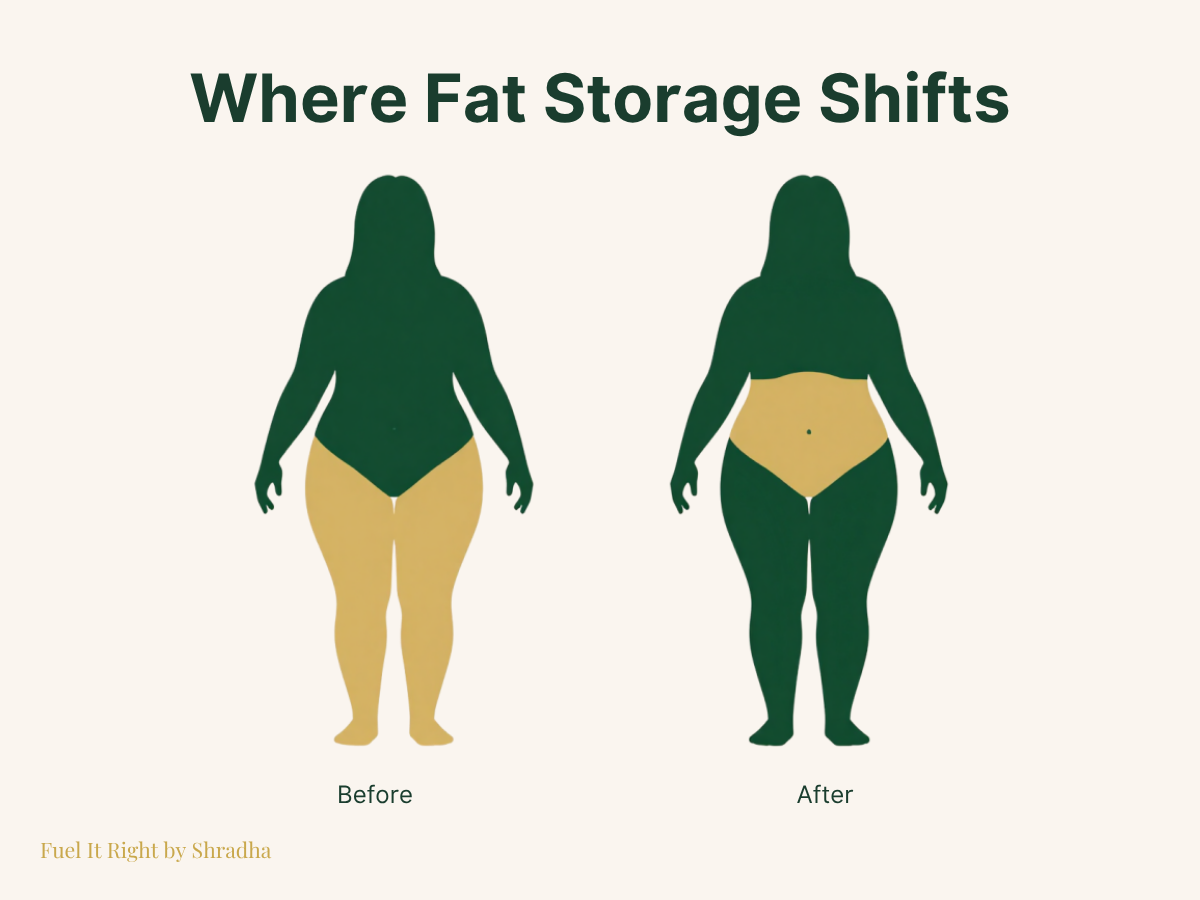
Visceral fat isn't just a cosmetic change. It's metabolically active tissue linked to insulin resistance, similar to what we covered in Insulin Resistance vs Diabetes, which is part of why cardiovascular and metabolic risk often shift meaningfully around this transition, not just body shape.
This isn't a personal failing showing up as extra weight. It's a specific, describable hormonal shift with a specific, describable mechanism.
3. Does More Protein Actually Fix the Muscle Loss?
WHAT YOU'VE HEARD: Weight gain during menopause means you're eating too much or not exercising enough. |
WHAT'S ACTUALLY TRUE: Declining estrogen directly redistributes fat toward the abdomen and accelerates muscle loss, independent of intake or activity changes. This is a genuine hormonal driver, not primarily a discipline problem. |
The standard RDA for protein, 0.8g per kilogram of body weight, is now widely considered too low for postmenopausal women specifically, with many researchers suggesting 1.0 to 1.2g per kilogram better supports muscle maintenance. But it's worth being precise about what protein alone can and can't do.
A randomised controlled trial comparing postmenopausal women on RDA-level protein (0.8g/kg) against a higher-protein group (1.2g/kg), both doing the same resistance training programme, found no significant difference in lean mass gained between the two groups after 10 weeks. Protein supports the process. Resistance training appears to be the active ingredient; more protein without it is unlikely to rebuild muscle on its own.
Wondering how your gut and metabolic picture fit into this?
Take the free Gut Health Quiz:
4. What Exercise Actually Does (and Doesn't Do)
WHAT YOU'VE HEARD: Extreme calorie cutting is the fastest way to lose the menopause belly. |
WHAT'S ACTUALLY TRUE: Aggressive restriction tends to accelerate muscle loss and slow metabolism further in this population specifically, working against the two things that most need protecting during this transition. A moderate, protein-supported, resistance-trained approach outperforms severe restriction here. |
A 2024 American College of Sports Medicine statement found exercise-driven weight loss in this population is genuinely modest, typically 0.5 to 3kg, and dose-dependent on how much energy the activity actually burns. That's not a discouraging number, it's an honest one: exercise's biggest value here isn't dramatic weight loss, it's preserving the muscle and cardiovascular capacity that food changes alone can't protect.
Resistance training specifically maintains lean mass and strength; aerobic activity supports cardiovascular capacity and oxygen consumption. Both matter, and they're not interchangeable substitutes for each other.
5. Building the Plate: Verdict by Verdict
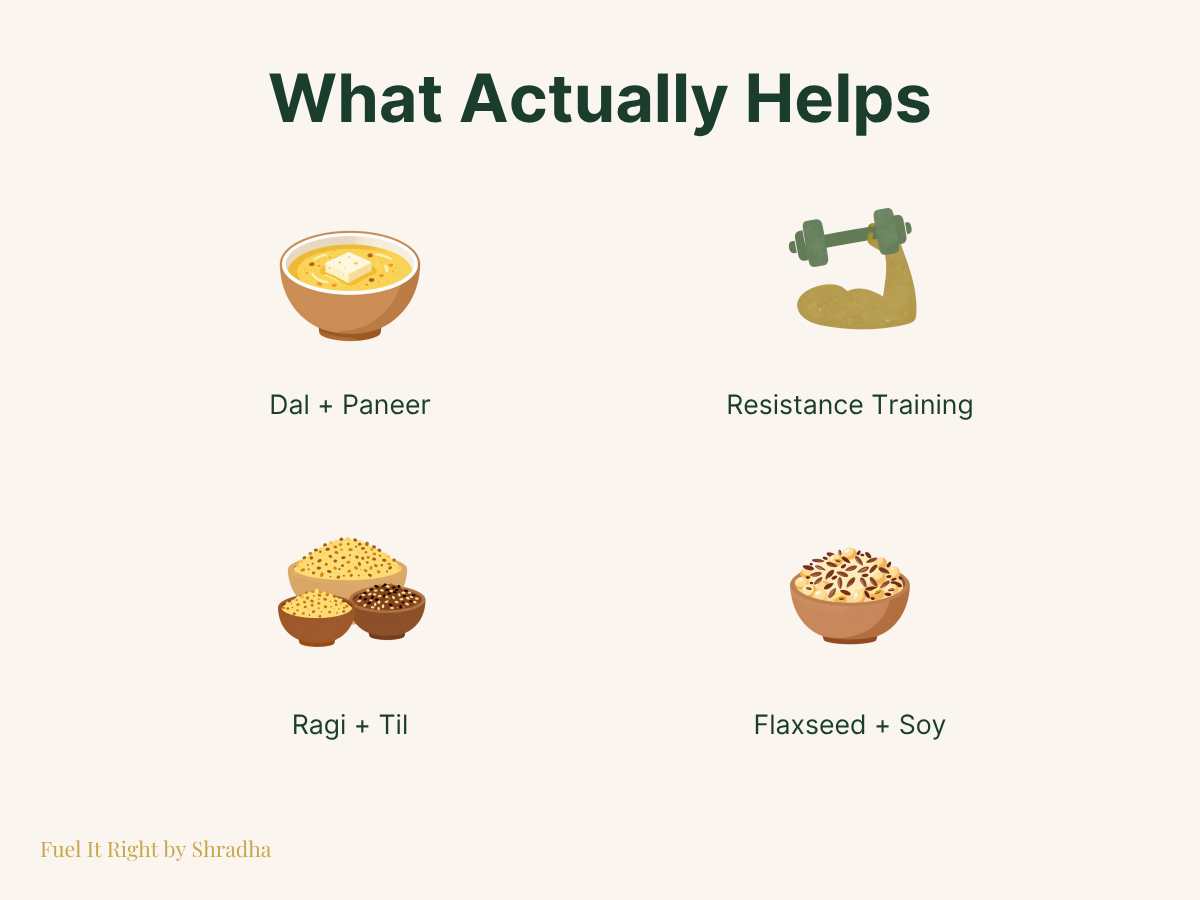
Dal and Paneer or Curd Together STRONG COMBO |
Combines plant and dairy protein across a meal, an easy way to move toward the higher end of protein targets without relying on supplements. How to make it work: Aim for a protein source at every meal rather than concentrating it at dinner; spreading intake across the day supports muscle maintenance better than one large serving. |
Resistance Training, 2-3x a Week THE ACTUAL LEVER |
The intervention with the clearest evidence for preserving lean mass during this transition; food alone doesn't replace it. How to make it work: Bodyweight or light resistance work counts; consistency across weeks matters more than intensity in any single session. |
Ragi and Til (Sesame) GOOD FOR BONE HEALTH |
Both are meaningful calcium sources at a life stage where bone density loss accelerates alongside the hormonal changes. How to make it work: Ragi dosa or porridge and a daily spoon of til chutney are easy, repeatable ways to work these in without a specific 'health food' meal. |
Flaxseed and Soy (Tofu, Soy Chunks) MODEST, WORTH INCLUDING |
Both contain phytoestrogens with modest evidence for easing some menopausal symptoms; not a replacement for medical treatment where that's needed. How to make it work: A tablespoon of ground flaxseed or a few times a week with soy is a reasonable addition, not positioned as a guaranteed fix. |
6. Building a Menopause-Smart Day: Three Real Moments, Fully Assembled
This is a starting structure. If symptoms are significantly affecting quality of life, or you're concerned about bone density specifically, that's a conversation for your doctor alongside these food and activity changes, not instead of them.
Your Menopause-Smart Checklist, At a Glance |
Include a protein source at every meal, not just at dinner |
Prioritise resistance training 2-3 times a week; it's the clearest lever for preserving muscle |
Work in ragi and til regularly for bone-supporting calcium |
Treat flaxseed and soy as a reasonable addition, not a guaranteed symptom fix |
Avoid severe calorie restriction, which tends to work against muscle and metabolism specifically at this stage |
Three Real Moments, Fully Assembled
Breakfast | Ragi dosa or porridge with a side of curd, plus a tablespoon of ground flaxseed mixed in. |
Lunch | Dal and a vegetable sabzi with paneer or tofu added, eaten with one roti or a small bowl of rice. |
Evening | A 20-30 minute resistance or bodyweight session two to three times a week, and a spoon of til chutney with dinner on the other days. |
Bring your last bone density or blood work, whatever you have.
We'll build a plan around your actual stage
Call or WhatsApp: +91 70570 63984 Or
Conclusion
Menopause weight gain in Indian women isn't just an earlier version of a global story, the timeline itself is different, arriving three to five years ahead of the global average, which means the planning window is different too. The mechanism is specific and hormonal, not a discipline problem, and the evidence points toward resistance training as the clearest lever for the muscle loss piece, with protein and specific foods like ragi, til, flaxseed, and soy supporting rather than replacing that work. None of it requires waiting for a Western-timeline symptom checklist to start.
FAQs
1. At what age do Indian women typically go through menopause?
Research from the Indian Menopause Society and WHO puts the average at 46 to 48 years, three to five years earlier than the global average of 51.
2. Why does menopause cause weight gain specifically around the belly?
Declining estrogen shifts the testosterone-to-estradiol ratio, which redirects fat storage from the hips and thighs toward the visceral area around the abdomen, independent of any change in diet or activity.
3. Does eating more protein alone fix menopausal muscle loss?
Evidence suggests not reliably. A randomised trial found no significant difference in lean mass between postmenopausal women on standard versus higher protein intake when both groups did the same resistance training; protein appears to support the process, not replace resistance training as the active driver.
4. How much weight can I realistically expect to lose through exercise alone?
A 2024 ACSM statement found exercise-driven weight loss in this population is typically modest, around 0.5 to 3kg, and dose-dependent on activity level. Exercise's bigger value here is preserving muscle and cardiovascular capacity, not dramatic weight loss alone.
5. Is severe calorie restriction a good strategy during menopause?
Generally not. Aggressive restriction tends to accelerate muscle loss and slow metabolism further in this population, working against the two things most worth protecting during this transition.
6. Do flaxseed and soy actually help with menopausal symptoms?
The evidence is modest but real for some symptom relief, largely attributed to their phytoestrogen content. They're a reasonable addition to the diet, not a guaranteed or complete fix, and not a substitute for medical treatment where that's needed.
7. What's the single most useful habit for menopausal weight management?
Resistance training 2-3 times a week has the clearest evidence for preserving muscle mass specifically, which food changes alone don't reliably replace.
8. How much protein should I actually be eating?
Many researchers suggest 1.0 to 1.2g per kilogram of body weight for postmenopausal women, above the standard RDA of 0.8g/kg, spread across meals rather than concentrated in one sitting.
About the Author
Shradha | Nutritionist & Dietitian | Fuel It Right. Food-first, evidence-based nutrition for real, sustainable results.