
Is Berberine Really Nature's Ozempic?
Berberine has racked up 127 million TikTok views as 'nature's Ozempic,' often chosen simply because it's far more affordable than the real thing. Here's what the actual research shows when the numbers are put side by side, and why the mechanism isn't what the nickname implies.
Table of Contents
1. Berberine Is Having a Moment
2. The Numbers Nobody Puts Side by Side
3. Why the Gap Is So Large: Different Mechanisms Entirely
4. What Berberine Actually Does Have Evidence For
5. Red Flags Worth Knowing: Verdict by Verdict
6. Building a Realistic Approach: Three Real Moments, Fully Assembled
Conclusion
FAQs
1. Berberine Is Having a Moment
Berberine, a bright yellow plant compound with a long history in traditional Chinese and Ayurvedic medicine, has amassed over 127 million TikTok views under the nickname “nature’s Ozempic.” A significant chunk of its appeal is genuinely understandable: branded semaglutide can cost tens of thousands of rupees per month, and people are specifically choosing berberine because it’s dramatically cheaper, not just because they’ve been duped by marketing. We have covered the muscle-protection aspect of actual GLP-1 use in GLP-1 Muscle Loss: What the Scary Number Misses. This piece examines whether the cheaper alternative is doing anything close to the same thing. The honest answer requires putting real numbers next to each other, not just comparing nicknames.
2. The Numbers Nobody Puts Side by Side
WHAT YOU'VE HEARD: Berberine works basically like Ozempic, just from a plant instead of a lab. |
WHAT'S ACTUALLY TRUE: A 2020 meta-analysis of 12 RCTs found berberine resulted in an average weight loss of 2.07kg. In comparison, the STEP-1 trial found semaglutide resulted in an average weight loss of 14.9% of body weight, and the SURMOUNT-1 trial found tirzepatide resulted in 20.9%. For context, that’s about a seven to tenfold difference in magnitude, and berberine has never been tested head-to-head against a GLP-1 medication in a published RCT. |
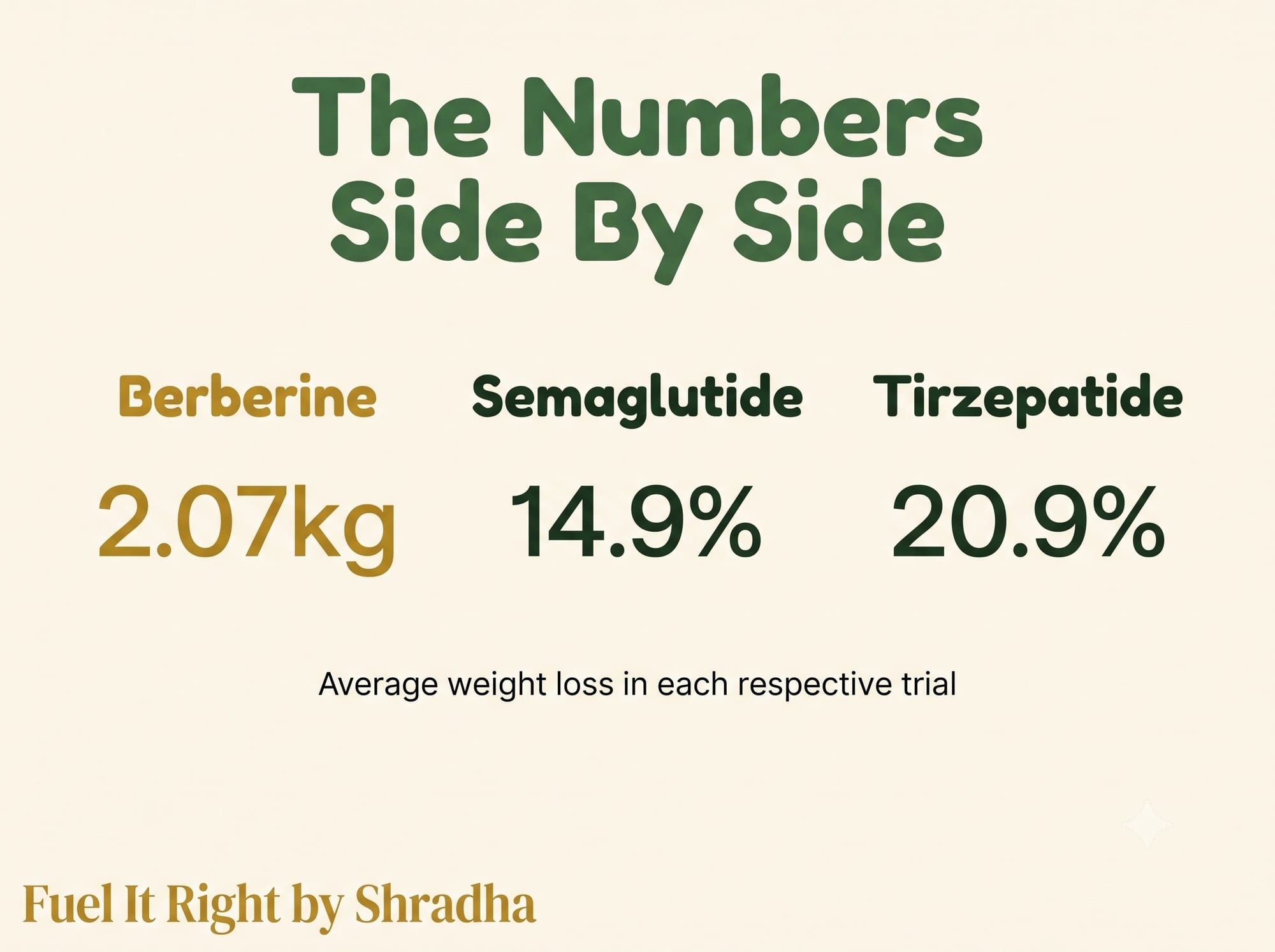
Calling something “nature’s Ozempic” because they both affect weight is like calling a bicycle “nature’s airplane” because both involve travel.
3. Why the Gap Is So Large: Different Mechanisms Entirely
The gap isn't a dosing issue; it's a fundamentally different mechanism. GLP-1 medications work by mimicking a hormone that suppresses appetite and slows digestion directly at the GLP-1 receptor. Berberine works primarily by activating an enzyme called AMPK, a pathway more similar to how metformin functions, affecting blood sugar and lipid metabolism rather than appetite directly.
There’s also a basic pharmacological limitation to consider. In the only published pharmacokinetic study that measured it, berberine’s oral bioavailability which is the amount of what you swallow that actually ends up in your bloodstream was less than 1%. Melinda Ring, an integrative medicine physician at Northwestern University, has called the “nature’s Ozempic” comparison “overblown.” Dana Ellis Hunnes, a senior clinical dietitian at UCLA Health, says there simply isn’t enough gold-standard trial evidence yet to know berberine’s true potential, much less to assert it’s equivalent to an approved medication.
Curious what your actual metabolic picture looks like?
4. What Berberine Actually Does Have Evidence For
WHAT YOU'VE HEARD: Since berberine hasn't been proven to match Ozempic, it doesn't actually do anything useful. |
WHAT'S ACTUALLY TRUE: That's an overcorrection. Small clinical trials do show berberine can meaningfully improve blood sugar control and cholesterol and triglyceride levels and a modest degree of weight loss, roughly the 2.07 kg average mentioned earlier, real effects worth knowing about, just far short of the dramatic results driving the comparison. |
Berberine-containing plants (including those used to produce Berberis aristata) have a real history in Ayurvedic medicine for digestive and metabolic complaints, which is why the compound wasn’t unknown to researchers when the recent wave of interest began. Traditional use and modern clinical evidence are two different kinds of support, but neither means the modern GLP-1 comparison holds up.
5. Red Flags Worth Knowing: Verdict by Verdict
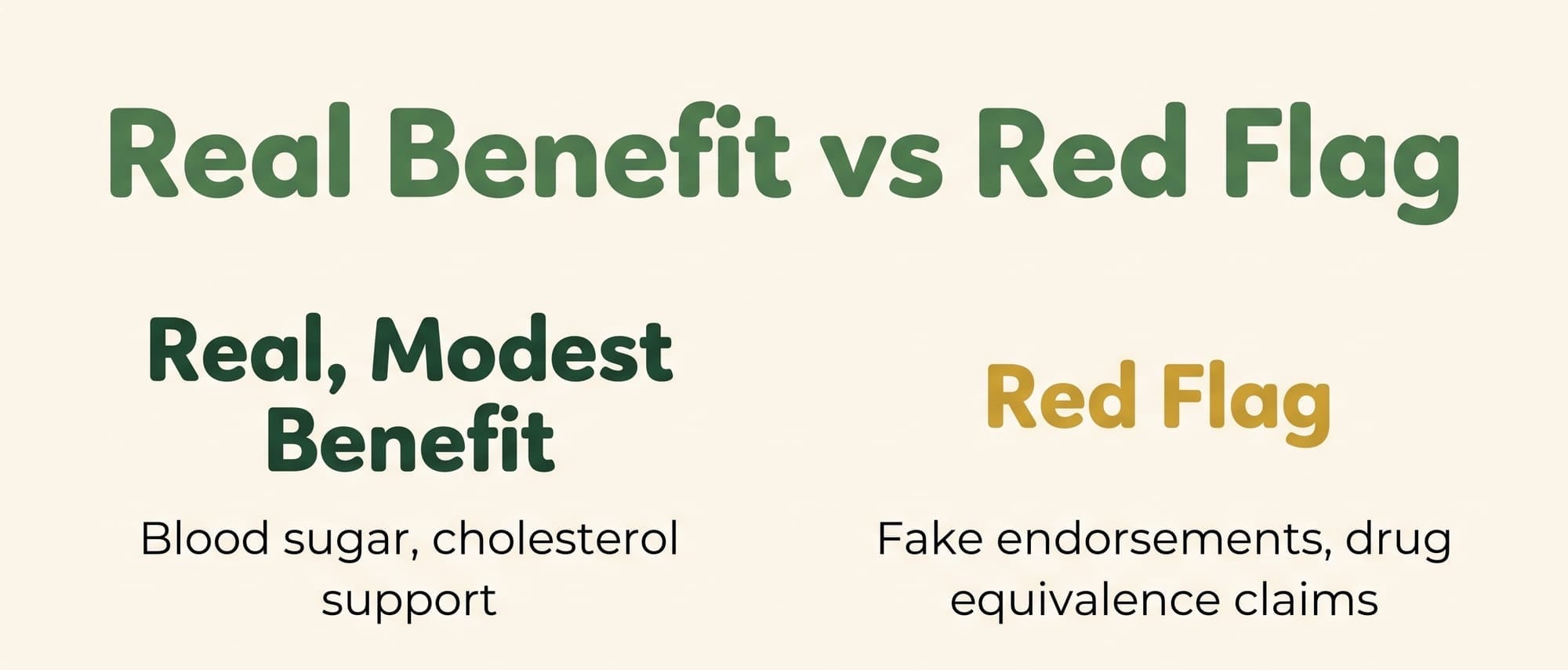
Modest Blood Sugar and Lipid Support: REAL, MODEST BENEFIT |
Small clinical trials genuinely support berberine's effect on blood glucose and cholesterol markers. How to make it work: A reasonable supplement to discuss with your doctor for these specific goals, with realistic expectations about the size of the effect. |
Expecting GLP-1-Level Weight Loss: UNREALISTIC EXPECTATION |
The evidence gap is roughly seven to tenfold in magnitude, and no head-to-head trial exists to support equivalence. How to make it work: Go in expecting a modest effect, not a substitute for what a GLP-1 medication does. |
"Doctor-Endorsed" Ads With Dramatic Before-and-Afters less than RED FLAG; LIKELY SCAM MARKETING |
Documented marketing tactics in this space include AI-generated celebrity or doctor endorsements, false equivalency claims to prescription drugs, and hidden auto-billing subscriptions. How to make it work: Be specifically sceptical of any ad claiming a supplement is 'identical' or 'more powerful' than an approved medication. |
Skipping a Doctor Conversation Before Starting IMPORTANT, OFTEN SKIPPED |
"Natural" doesn't mean risk-free; berberine can interact with certain medications and isn't automatically appropriate for everyone. How to make it work: Mention it to your doctor the same way you would any supplement, especially if you're on other medications. |
Choosing Berberine Mainly for Cost Reasons: UNDERSTANDABLE, NEEDS REALISTIC EXPECTATIONS |
Affordability is a legitimate, real constraint, not a reason to be talked out of a choice, but it changes what result to actually expect. How to make it work: Choose it for what it can realistically offer, blood sugar and lipid support with modest weight effects, not as a budget substitute for a GLP-1's results. |
6. Building a Realistic Approach: Three Real Moments, Fully Assembled
This is a starting structure for a person looking at berberine with clear eyes, not medical advice to start or stop any medication. Talk to your doc before adding berberine along with other scripts.
Your Realistic-Expectations Checklist, At a Glance |
Expect blood sugar and lipid support, and modest weight change, not GLP-1-level results |
Mention berberine to your doctor before starting, especially alongside other medications |
Be sceptical of any ad claiming equivalence to an approved prescription medication |
Remember affordability is a legitimate reason to consider it, as long as expectations match the actual evidence |
Combine it with food-first changes rather than treating it as a standalone fix |
Three Real Moments, Fully Assembled
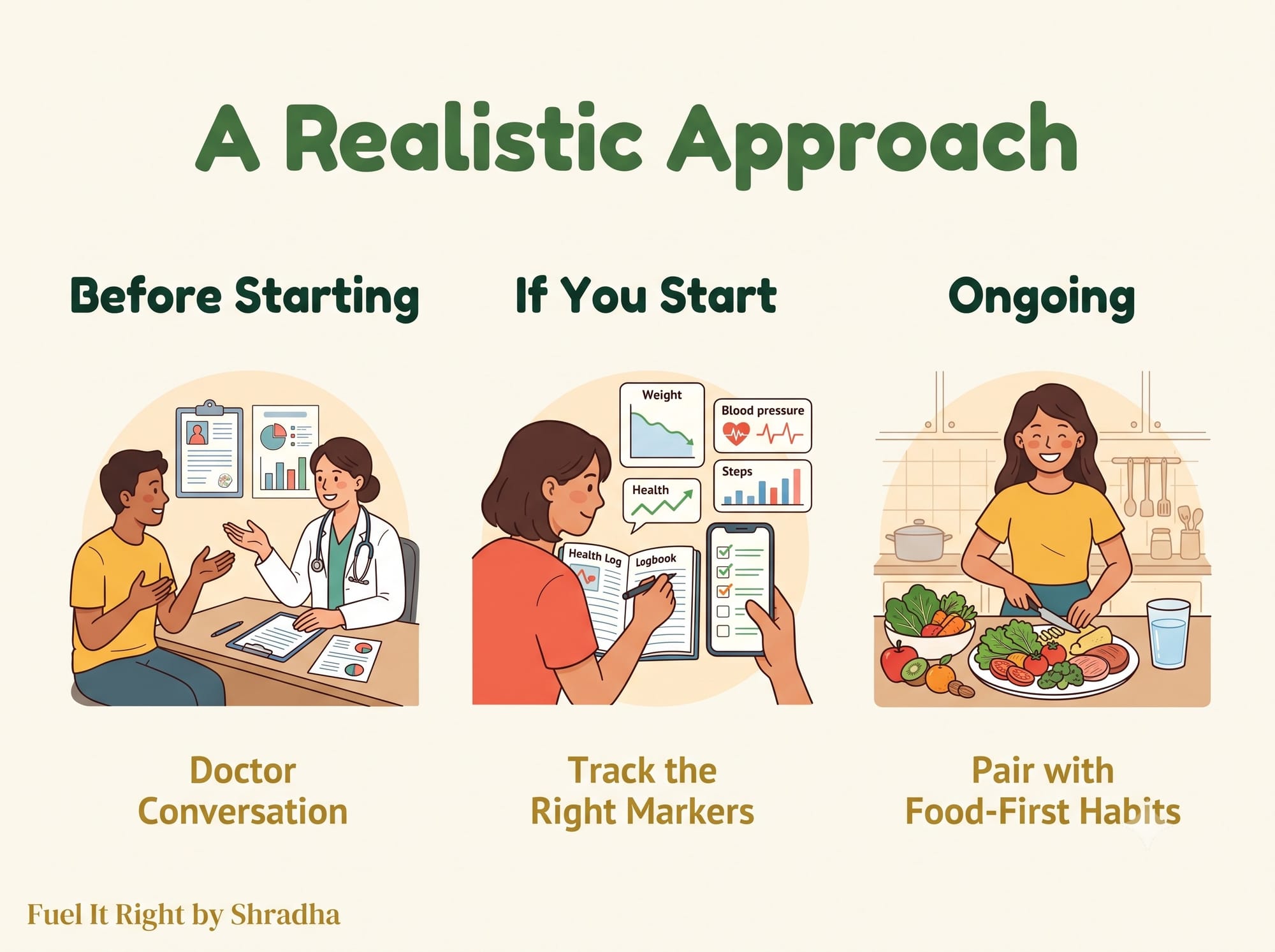
Before starting | A real talk with your doctor about berberine in particular and any medications you may already be taking. |
If you start | Track blood sugar and lipid markers over time rather than only the scale, since that's where the strongest evidence actually points. |
Ongoing | Pair it with the same food-first, evidence-based habits that matter regardless of any supplement, not as a replacement for them. |
Weighing cost against actual results for your metabolic health?Let's find a realistic, affordable plan
Call or WhatsApp: +91 7057063984 Or
Conclusion
It's understandable why berberine is so popular: it's cheap, it's been around for a long time in traditional medicine, and it does have some real (although modest) benefits for blood sugar and lipids. But based on the actual evidence, it's not a natural replacement for what GLP-1 meds do. The magnitude gap is about seven times to ten times; the mechanisms are actually different; and no study has ever compared the two head to head. That doesn't make berberine useless. It makes the nickname misleading and a more useful version of this story an honest one. A modest supplement with real evidence behind a specific narrower set of benefits, not the viral one.
FAQ's
1. Is berberine actually similar to Ozempic?
Not in mechanism or magnitude. Berberine works through AMPK activation, similar to metformin, while Ozempic works through GLP-1 receptor activation affecting appetite directly. A 12-trial meta-analysis found berberine's average weight loss was 2.07kg, compared to 14.9-20.9% of body weight in GLP-1 clinical trials.
2. Why is berberine called 'nature's Ozempic' then?
The label is social media popularity, not clinical comparison. Both impact blood sugar and weight to some degree, but the mechanisms and magnitude of effect are substantially different and no head-to-head trial has ever been performed.
3. Does berberine actually do anything useful?
Yes, within a narrower scope. Small clinical trials support real benefits for blood sugar control and cholesterol and triglyceride levels, along with modest weight loss, genuine effects, just far short of GLP-1-level results.
4. Why does berberine have such a limited effect on weight compared to GLP-1 medications?
Berberine is part mechanism, part pharmacology. It doesn’t blunt appetite directly like GLP-1 medications do, and the only published study measuring its oral bioavailability found that less than 1% actually reaches the bloodstream after you swallow it.
5. Is berberine safe to take?
It can interact with certain medications and isn't automatically risk-free just because it's derived from plants. Mention it to your doctor before starting, particularly if you're on other prescriptions.
6. Why are people choosing berberine over GLP-1 medications?
Cost is a big and legitimate factor to consider. Branded GLP-1 drugs can cost tens of thousands of rupees per month, so a cheap supplement is attractive even if the results are not nearly as dramatic.
7. Does berberine have a history in Ayurvedic medicine?
Yes. Berberine-containing plants, including those used to produce Berberis aristata, have a genuine history of traditional use for digestive and metabolic complaints, separate from, though sometimes cited alongside, the recent GLP-1 comparison.
8. What red flags should I watch for when buying berberine?
Watch out for ads with celebrity or doctor endorsements created by AI, any indication that a supplement is “the same” or “more powerful” than an approved prescription drug, and free-trial offers that lock consumers into hard-to-cancel subscriptions.
About the Author
Shradha | Nutritionist & Dietitian | Fuel It Right. Food-first, evidence-based nutrition for real, sustainable results.