
Weight Loss Plateau: What Diet Breaks Actually Do
Up to 85% of people trying to lose weight hit a plateau. A 2024 meta-analysis of 881 people finally settles whether diet breaks actually help, and the answer to reverse dieting is more complicated than social media suggests.
Table of Contents
1. Weight Loss Plateau: Why It Happens to Almost Everyone
2. The Real Mechanism: Adaptive Thermogenesis
3. Do Diet Breaks Actually Work? The 2024 Meta-Analysis
4. Does Reverse Dieting "Fix" Your Metabolism?
5. What Actually Moves the Needle: Verdict by Verdict
6. Building a Plateau-Break Routine: Three Real Moments, Fully Assembled
Conclusion
FAQs
1. Weight Loss Plateau: Why It Happens to Almost Everyone
Weight loss plateaus are less an exception and more the default. Research estimates they affect as many as 85% of people actively trying to lose weight, most commonly emerging around six months into a weight-loss effort, though they can happen earlier or later. If the scale has stopped moving despite doing everything the same as when it was working, you're not doing anything unusual. You're having an extremely common experience.
For decades, the default explanation was quiet cheating or fading discipline. That framing has aged badly. The Minnesota Starvation Experiment, conducted in the 1940s, first systematically documented that the body actively defends against weight loss once it perceives a sustained energy deficit, treating it less like an aesthetic change and more like a threat to respond to.
2. The Real Mechanism: Adaptive Thermogenesis
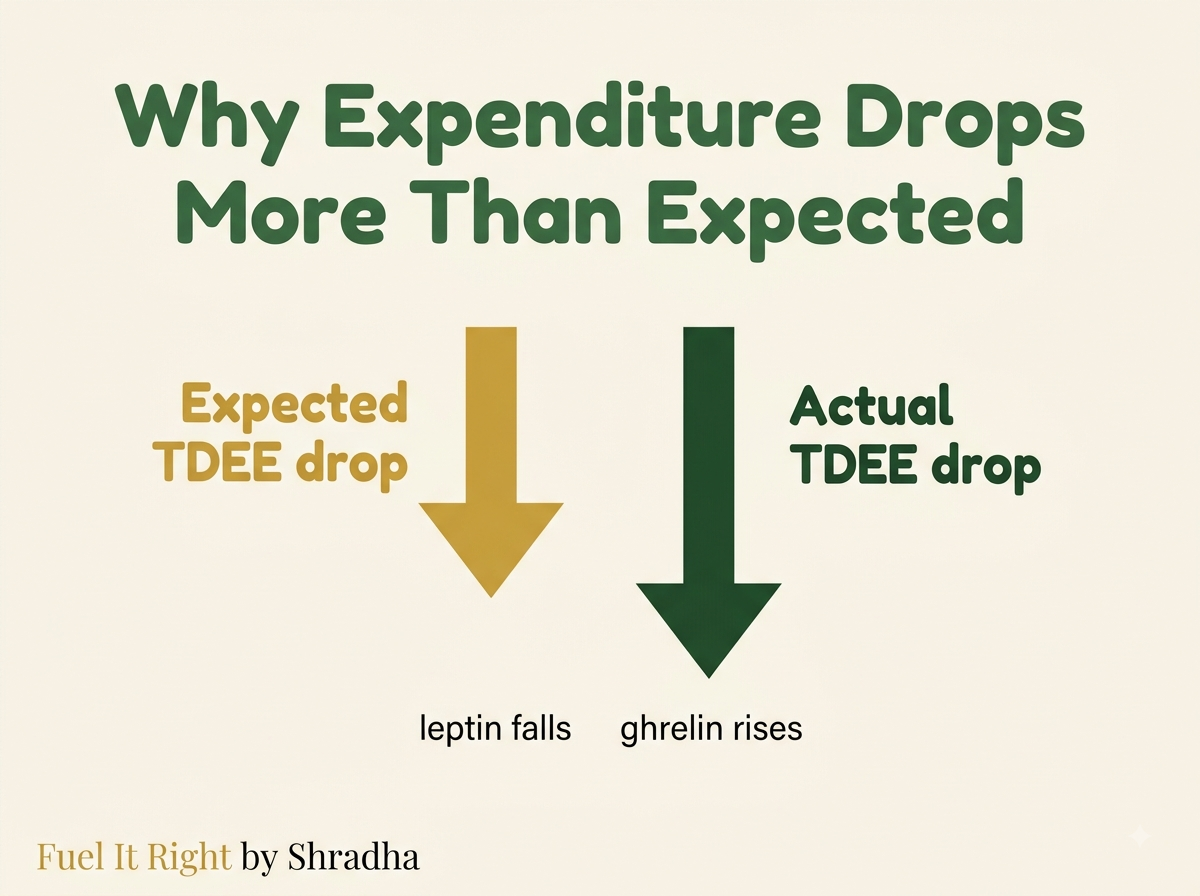
Adaptive thermogenesis is the term for what actually happens: your Total Daily Energy Expenditure drops by more than your reduced body mass alone would predict. Losing 10kg doesn't just mean burning slightly fewer calories because you're a smaller person, it means your body actively lowers its energy expenditure beyond that, as a defensive response to sustained restriction.
This is driven partly by hormonal shifts. Leptin, which signals fullness and supports energy expenditure, drops during sustained calorie restriction. Ghrelin, the hunger hormone, tends to rise and stay elevated even in people who've successfully maintained a lower weight for years. Both changes push in the same direction: eat more, burn less, return to the previous weight.
Your body isn't failing to cooperate. It's succeeding at a very old job: making sure you don't starve.
3. Do Diet Breaks Actually Work? The 2024 Meta-Analysis
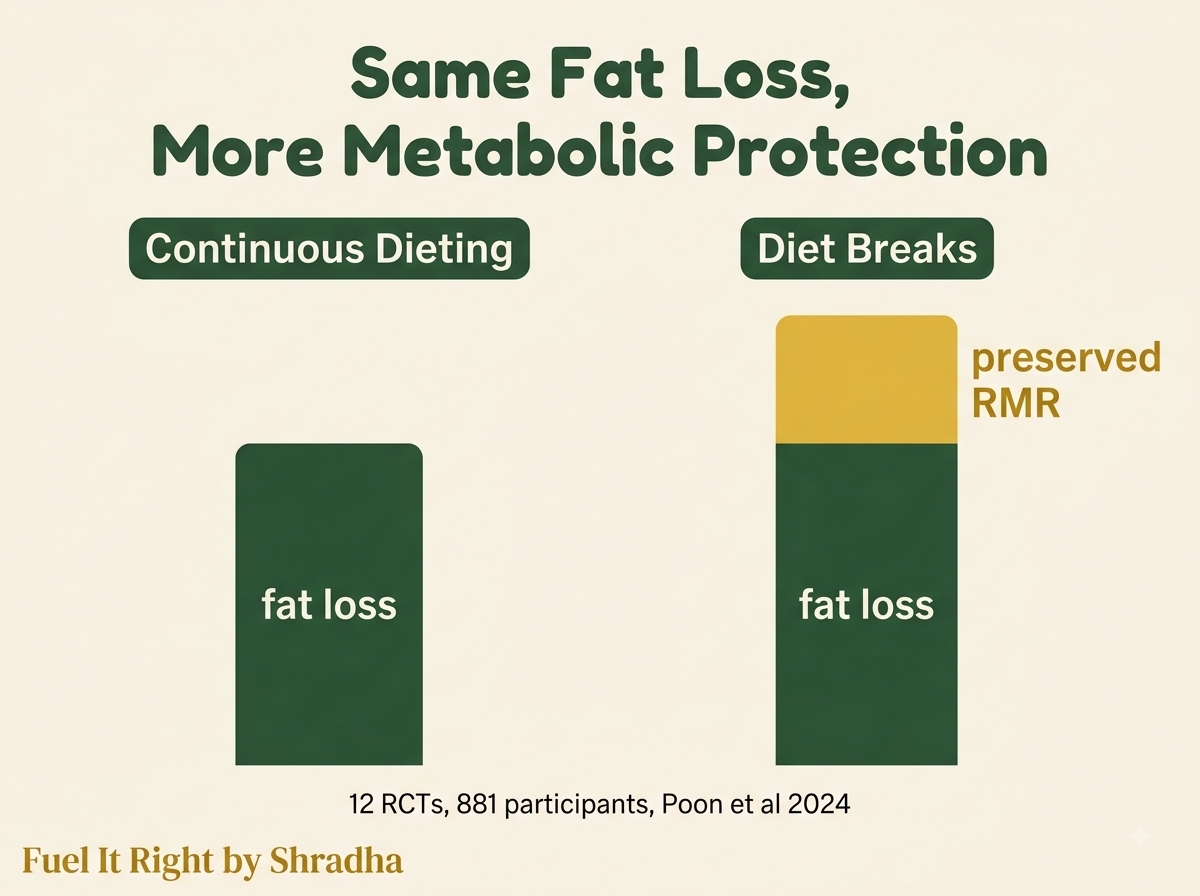
A 2024 systematic review and meta-analysis by Poon and colleagues, pooling 12 randomised controlled trials and 881 participants, is the most comprehensive look yet at whether planned diet breaks, returning to maintenance calories for one to two weeks periodically during a weight-loss phase, actually help. The finding is more nuanced than a simple yes or no.
Fat loss, body weight, and waist circumference outcomes were statistically indistinguishable between people who took planned breaks and people who dieted continuously. But break-takers preserved meaningfully more resting metabolic rate along the way, and a subgroup analysis found people with more weight to lose got substantially more of this metabolic protection than leaner participants close to their goal.
WHAT YOU'VE HEARD: Diet breaks are a waste of time, or just an excuse to fall off track. |
WHAT'S ACTUALLY TRUE: A meta-analysis of 881 people found planned diet breaks produced statistically identical fat loss to continuous dieting, while preserving more resting metabolic rate along the way, particularly for people with more weight to lose. They're a legitimate strategy, not a euphemism for quitting. |
Wondering what else might be quietly working against your progress?
Take the free Gut Health Quiz:
4. Does Reverse Dieting "Fix" Your Metabolism?
WHAT YOU'VE HEARD: If you've hit a plateau, you're probably cheating or not trying hard enough. |
WHAT'S ACTUALLY TRUE: Adaptive thermogenesis is a measurable, documented physiological response, not a discipline failure. Your total energy expenditure can drop beyond what your reduced body weight alone would explain, driven by real hormonal changes, not willpower. |
Reverse dieting, gradually increasing calories after a diet to supposedly "repair" a slowed metabolism, has considerably more hype behind it than evidence. Current analysis finds no support for the idea that it boosts metabolism beyond what normal recovery to maintenance calories would already achieve on its own. Much of its popularity comes from a few explainable illusions: improved adherence once restriction eases, the fact that "maintenance calories" is really a range rather than one fixed number, and the natural lag between eating more and the scale reflecting it, which gets misread as a metabolic boost.
None of this means increasing calories after a diet phase is wrong. It means the honest goal is finding your actual maintenance intake, not chasing a metabolic "reset" that current evidence doesn't support as a distinct phenomenon.
5. What Actually Moves the Needle: Verdict by Verdict
A Planned Diet Break Every 8-12 Weeks STRONG, EVIDENCE-BACKED |
Meta-analysis-level evidence shows real metabolic rate protection with no cost to eventual fat loss, especially for people with more weight to lose. How to make it work: One to two weeks at maintenance calories, planned in advance rather than triggered by a bad week, gets the benefit without derailing progress. |
Resistance Training 3-4x a Week STRONG LEVER |
People who resistance train regularly during a weight-loss phase experience meaningfully smaller reductions in resting metabolic rate than those relying on cardio alone. How to make it work: |
Recalculating Your Actual Intake Needs STRONG PRACTICE |
A calorie target that worked at a higher body weight becomes progressively less accurate as weight drops; sticking to an outdated number is a common, quiet cause of stalled progress. How to make it work: Reassess intake needs every meaningful chunk of weight lost, rather than assuming the original number still applies indefinitely. |
Reverse Dieting as a "Metabolism Hack" OVERSOLD |
No current evidence supports reverse dieting boosting metabolism beyond ordinary recovery to maintenance; the perceived benefit is largely explained by adherence and measurement timing. How to make it work: Use it descriptively, as a gradual, controlled way to find maintenance, not as a promised metabolic upgrade. |
Sleep and Stress OFTEN OVERLOOKED |
Poor sleep and chronic stress both influence the same hormonal pathways, leptin and ghrelin among them, that drive adaptive thermogenesis. How to make it work: Treat consistent sleep as part of the weight-management plan itself, not a separate wellness afterthought. |
6. Building a Plateau-Break Routine: Three Real Moments, Fully Assembled
This is a starting structure. If a plateau has lasted many months despite consistent effort, or if something feels off beyond typical stalling, that's worth a conversation with your doctor or dietitian rather than another round of self-adjustment alone.
Your Plateau-Break Checklist, At a Glance |
Plan a 1-2 week diet break at maintenance calories every 8-12 weeks of active dieting |
Add or maintain resistance training 3-4 times a week to protect metabolic rate directly |
Recalculate your calorie needs periodically rather than trusting a number set at a higher body weight |
Treat reverse dieting as finding maintenance, not as a promised metabolic reset |
Prioritise consistent sleep as part of the plan, not an unrelated extra |
Three Real Moments, Fully Assembled
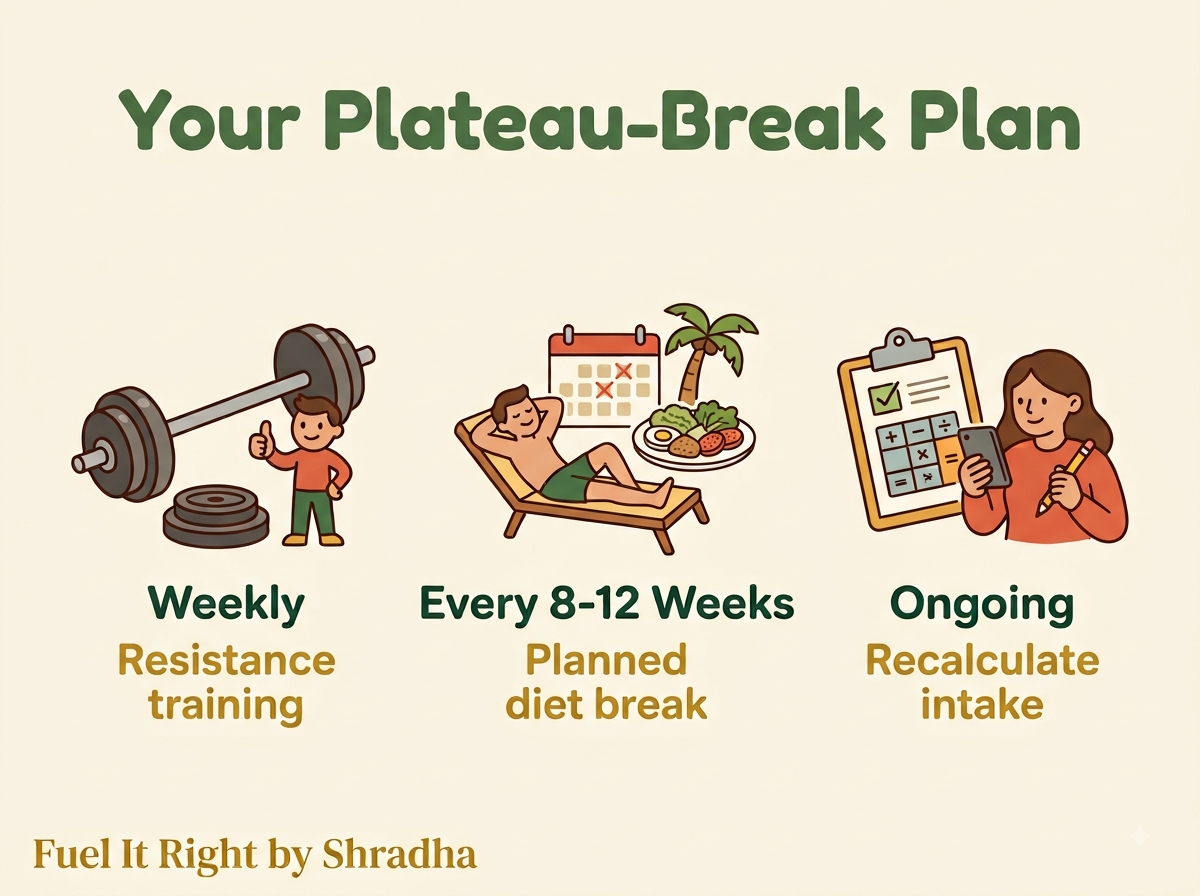
Weekly | A resistance training session 3-4 times this week, even short ones, rather than relying on cardio alone to manage the deficit. |
Every 8-12 weeks | A planned one to two week break at maintenance calories, scheduled in advance rather than decided in the middle of a hard week. |
Ongoing | A quick recheck of your calorie target after every few kilos lost, rather than running the same number for months regardless of how much has changed. |
Bring your weight log, even the flat weeks.
We'll figure out if it's a real plateau or a normal stall:
https://calendly.com/shradhajp/30min
Or WhatsApp: +91 70570 63984
Conclusion
A weight loss plateau is close to a universal experience, not a personal failure, and the evidence now gives a clearer answer than "just push through it harder." Planned diet breaks offer real, measurable protection for your metabolic rate without costing you fat loss, especially if you have more weight left to lose. Reverse dieting, despite the social media reputation, isn't a metabolic reset, it's a controlled way of finding your actual maintenance intake. Between the two, resistance training remains the most consistently evidence-backed lever for protecting your metabolism through the whole process, not just during a stall.
FAQs
1. How common are weight loss plateaus, really?
Research estimates they affect as many as 85% of people actively trying to lose weight, most commonly emerging around six months into a weight-loss effort.
2. What actually causes a weight loss plateau?
Adaptive thermogenesis: your total daily energy expenditure drops by more than your reduced body mass alone would explain, driven by hormonal changes including falling leptin and rising ghrelin, as your body responds to sustained calorie restriction.
3. Do diet breaks actually help break a plateau?
A 2024 meta-analysis of 881 people found diet breaks produced fat loss statistically identical to continuous dieting, while preserving more resting metabolic rate along the way, with people who have more weight to lose seeing the most benefit.
4. How long should a diet break last?
Research on this approach generally uses one to two week breaks at maintenance calories, spaced roughly every 8 to 12 weeks of active dieting.
5. Does reverse dieting really boost your metabolism?
Current evidence doesn't support that claim. It's more accurately described as a gradual, controlled way to find your actual maintenance calorie intake, not a distinct metabolic "reset" or boost.
6. Why does resistance training matter for breaking a plateau?
People who resistance train regularly during a weight-loss phase experience smaller reductions in resting metabolic rate than those relying on cardio alone, since muscle tissue is metabolically active and worth protecting directly.
7. Should I recalculate my calorie target as I lose weight?
Yes. A target set at a higher body weight becomes progressively less accurate as weight drops, and continuing to eat based on an outdated number is a common, easily missed cause of a stalled plateau.
8. When should I stop troubleshooting a plateau myself and see a professional?
If a plateau has persisted for many months despite consistent, verified effort, or something feels different from a typical stall, it's worth involving a doctor or dietitian rather than continuing to self-adjust indefinitely.
About the Author
Shradha | Nutritionist & Dietitian | Fuel It Right. Food-first, evidence-based nutrition for real, sustainable results.