
Seed Oils: What the 2026 Research Actually Shows
Seed oil panic has reached India, with 'toxic' and 'inflammatory' claims about sunflower and soybean oil now confusing consumers here too. A 2026 scoping review says the fear isn't supported by evidence. Here's what actually holds up.
Table of Contents
1. The Seed Oil Panic Has Reached India
2. Where the Fear Actually Comes From
3. What the 2026 Evidence Actually Shows
4. The Confounding Variable Nobody Mentions
5. So Is Any Oil "Better"? Verdict by Verdict
6. Building an Oil-Smart Kitchen: Three Real Choices, Fully Assembled
Conclusion
FAQs
1. The Seed Oil Panic Has Reached India
Google searches for "seed oil and health" grew from around 366,000 in 2019 to 9.7 million in 2024, and the claim has now spread well beyond US wellness social media into Indian kitchens too. Indian cooking oil brands have started publishing content directly addressing consumer confusion about sunflower and soybean oil, a sign the panic is genuinely affecting purchasing decisions here, not just abroad. We've covered the other side of the fat debate in Does Ghee Raise Cholesterol? What Research Shows; this piece takes the same evidence-first approach to the oils on the other end of the conversation.
The claim, in short: that sunflower, soybean, corn, canola, and similar oils, sometimes nicknamed the "hateful eight," are secretly toxic and driving modern disease. It's a striking claim, and striking claims deserve a look at what actually backs them.
2. Where the Fear Actually Comes From
The modern version of this claim traces to 2020, when a podcast interview between Joe Rogan and carnivore-diet proponent Paul Saladino popularised the idea that seed oils' omega-6 fatty acid content drives body-wide inflammation. The theory rests on the idea that omega-6 fats, relative to omega-3s, tilt the body toward a pro-inflammatory state strongly enough to cause chronic disease.

It's a coherent-sounding theory. It's also one that's now been tested directly, repeatedly, rather than left as a plausible idea.
3. What the 2026 Evidence Actually Shows
WHAT YOU'VE HEARD: Seed oils are toxic and cause body-wide inflammation, heart disease, and other chronic illness. |
WHAT'S ACTUALLY TRUE: A 2026 scoping narrative review of the clinical and observational evidence concluded that concerns about seed oils and linoleic acid increasing inflammation, oxidative stress, and cardiovascular risk were without foundation. The review found data overwhelmingly support the safety and health benefits of seed oils, consistent with decades of dietary guidance recommending unsaturated fats over saturated ones. |
A separate 2026 clinician's guide to trending cardiovascular nutrition controversies sorted commonly debated foods into three evidence tiers. Seed oils landed in "evidence of benefit," alongside seafood, for improved cardiovascular outcomes. Beef tallow, the fat many restaurants have been switching to specifically to avoid seed oils, landed in "evidence of harm," due to its association with raised LDL cholesterol. The trend of swapping seed oil for tallow has the current evidence pointing the opposite direction from the marketing.
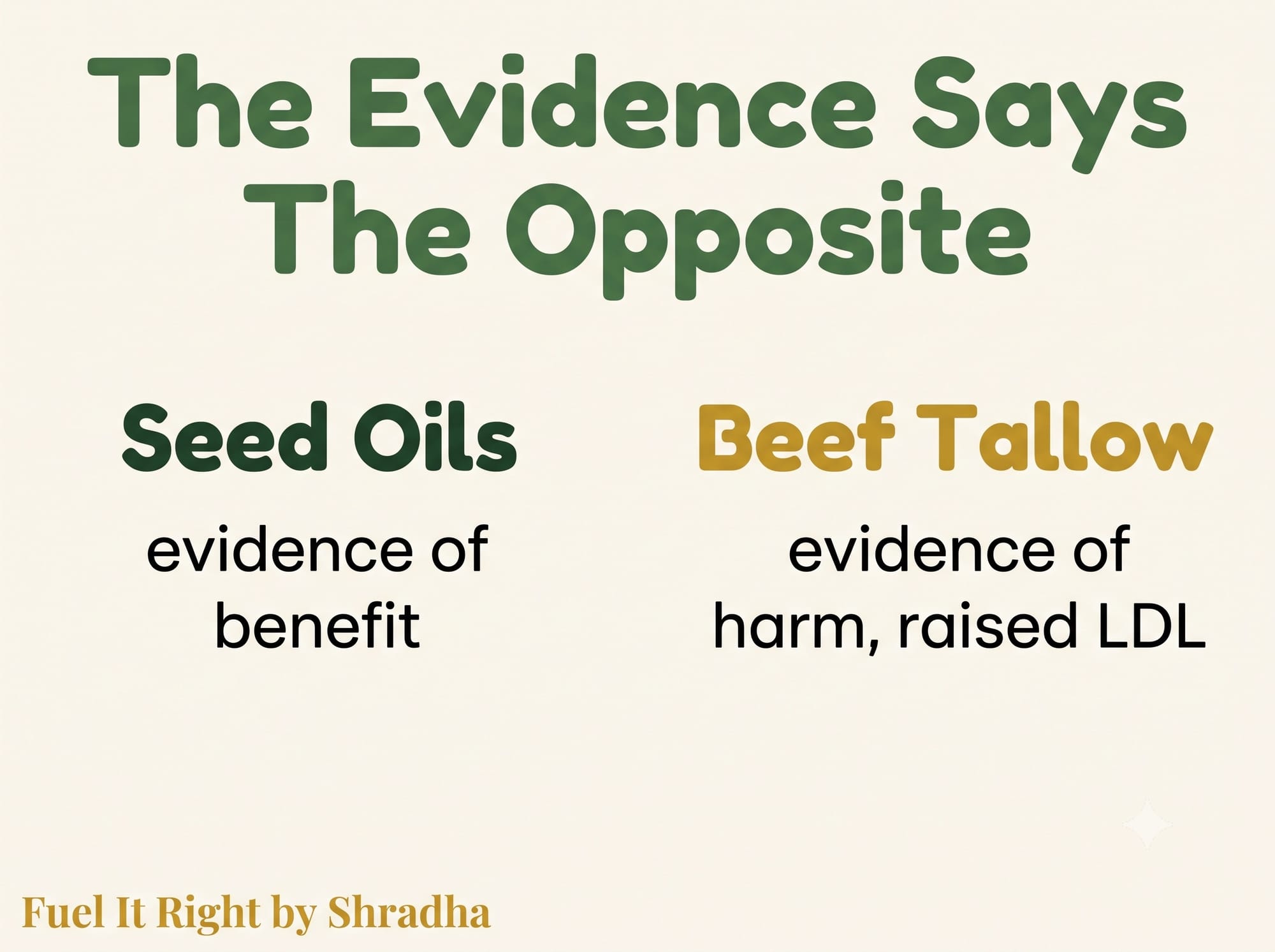
The oil restaurants are switching to for health reasons is the one with evidence of harm. The oil they're avoiding is the one with evidence of benefit.
Curious how your overall diet quality actually stacks up?
4. The Confounding Variable Nobody Mentions
WHAT YOU'VE HEARD: If a food is high in seed oils, that's a reliable sign it's unhealthy. |
WHAT'S ACTUALLY TRUE: Foods high in seed oils tend to be fried snacks, packaged goods, and fast food, items that are also high in refined carbohydrates, added sugar, and sodium. Researchers, including those at Harvard's School of Public Health, point out it's these other ingredients, not the oil itself, that are more consistently linked to poor health outcomes. Seed oils get blamed by association with the foods they're commonly found in. |
The chemistry claims don't hold up well either. Hexane, the solvent used to extract many seed oils, is present in the finished product at less than one milligram per kilogram, with no evidence of toxicity at that level in clinical research. And refined seed oils typically have higher smoke points, often above 230°C, than unrefined oils like extra-virgin olive oil, which contradicts the specific claim that they're uniquely prone to breaking down under normal cooking heat.
5. So Is Any Oil "Better"? Verdict by Verdict
Refined Sunflower or Soybean Oil for Everyday Cooking STRONG, EVIDENCE-BACKED |
High smoke point, well-studied, consistently associated with cardiovascular benefit when replacing saturated fat, and compliant with FSSAI standards in India. How to make it work: Perfectly reasonable as a default cooking oil for sauteing, roasting, and most everyday Indian cooking. |
Mustard Oil GOOD, REGIONALLY FAMILIAR CHOICE |
A traditional Indian cooking oil with a different fatty acid profile, higher in monounsaturated fat, and long-standing regional use. How to make it work: A reasonable rotation option alongside refined seed oils, not a required replacement for them. |
Wood-Pressed or Cold-Pressed Claims MOSTLY MARKETING, NOT STRONG EVIDENCE |
Claims of dramatically higher nutrient retention are often made by brands selling the alternative product, and refined oils' higher smoke point is actually an advantage for high-heat Indian cooking, not a flaw. How to make it work: Fine to use if you prefer them, but don't treat refined oil as inferior based on marketing claims alone. |
Beef Tallow or Ghee as a Seed Oil Replacement MIXED, DEPENDS ON THE GOAL |
A 2026 clinician's guide placed beef tallow specifically in the 'evidence of harm' category for LDL cholesterol; ghee's evidence is more genuinely mixed, as we've covered separately. How to make it work: Don't assume a saturated fat swap is automatically the 'safer' choice; check what the evidence says about the specific fat, not just whether it's traditional. |
Reheated or Repeatedly Reused Frying Oil AVOID, REGARDLESS OF OIL TYPE |
Any oil, including olive oil and ghee, degrades and produces harmful compounds when overheated or reused repeatedly; this is a usage issue, not specific to seed oils. How to make it work: Discard oil after deep-frying rather than reusing it multiple times, whichever oil you're using. |
6. Building an Oil-Smart Kitchen: Three Real Choices, Fully Assembled
This is a starting structure, not a rule that any single oil is forbidden. The goal is choosing based on evidence and cooking method, not fear.
Your Oil-Smart Checklist, At a Glance |
Don't treat refined sunflower or soybean oil as toxic; current evidence doesn't support that claim |
Use an oil's smoke point to match your cooking method, not its social media reputation |
Rotate between a refined seed oil and a traditional oil like mustard oil rather than fearing either |
Be sceptical of wood-pressed or cold-pressed marketing claims that oversell nutrient differences |
Never reuse or repeatedly reheat any frying oil, regardless of type |
Three Real Choices, Fully Assembled
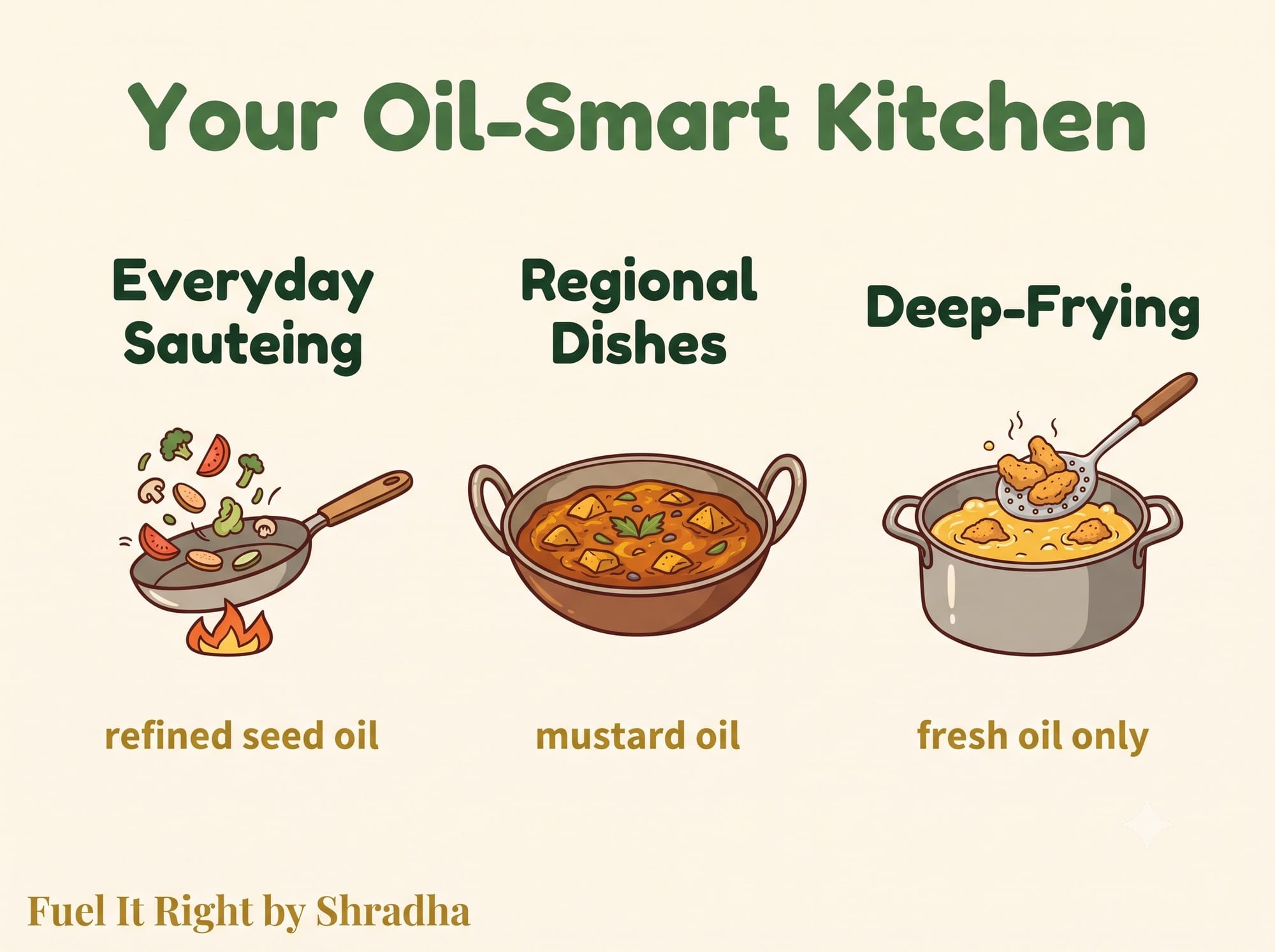
Everyday sautéing | Refined sunflower or soybean oil, used fresh each time rather than reused, for most daily vegetable and dal preparation. |
Regional dishes | Mustard oil where it's traditionally used, rotated in rather than treated as a mandatory replacement for other oils. |
Deep-frying | A fresh batch of oil, discarded after use rather than strained and reused multiple times, whichever oil is on hand. |
Trying to sort out which oils actually belong in your kitchen?
Let's build a plan around your actual cooking:
Call or WhatsApp: +91 70570 63984 Or
Conclusion
The seed oil panic has real reach, a memorable nickname, a viral podcast origin story, and it's now shaping cooking oil purchases in Indian kitchens too. But the most current, rigorous evidence available, a 2026 scoping review and a clinician's guide to trending fat controversies, points the opposite direction: seed oils show evidence of cardiovascular benefit, while beef tallow, the trendy replacement many are switching to, shows evidence of harm. The oils actually worth being careful about are the ones reheated and reused repeatedly, not the ones with an unfortunate online nickname.
FAQs
1. Are seed oils actually toxic?
Current evidence doesn't support that claim. A 2026 scoping review of the clinical and observational evidence found concerns about seed oils causing inflammation or disease were without foundation, and evidence overall supports their safety and cardiovascular benefit.
2. Why do people think seed oils are unhealthy?
The modern claim traces largely to a 2020 podcast interview popularising the idea that seed oils' omega-6 content causes body-wide inflammation. Foods high in seed oils also tend to be fried and processed, which confounds the picture since those foods' other ingredients, refined carbs, sugar, sodium, are more consistently linked to poor health outcomes.
3. Is beef tallow healthier than seed oil?
Current evidence doesn't support that either. A 2026 clinician's guide to cardiovascular nutrition controversies placed beef tallow in the 'evidence of harm' category due to its association with raised LDL cholesterol, while seed oils were placed in the 'evidence of benefit' category.
4. Is hexane in seed oils a real health risk?
Not at the levels found in the finished product, generally less than one milligram per kilogram, with no evidence of toxicity at that exposure level in clinical research.
5. Do seed oils have a lower smoke point than other oils?
Generally no. Refined seed oils like sunflower and soybean typically have higher smoke points, often above 230 degrees Celsius, than unrefined oils like extra-virgin olive oil, making them less prone to breaking down under typical cooking heat.
6. Is wood-pressed or cold-pressed oil genuinely better than refined seed oil?
The evidence for dramatic differences is weaker than the marketing suggests, and claims often come from brands selling the alternative product. Refined oil's higher smoke point is actually an advantage for high-heat Indian cooking methods.
7. Has the seed oil scare actually reached India?
Yes. Indian cooking oil brands have begun publishing content directly addressing consumer confusion about sunflower and soybean oil, indicating the claim is genuinely affecting purchasing decisions here.
8. What actually matters more than which oil I use?
How the oil is used. Reheating or repeatedly reusing any oil, including olive oil and ghee, produces harmful compounds; using a fresh, appropriate oil for the cooking method matters more than which specific oil is in the bottle.
About the Author
Shradha | Nutritionist & Dietitian | Fuel It Right. Food-first, evidence-based nutrition for real, sustainable results.