
Protein in India: The Evidence Behind the Hype
India just lowered its official protein RDA while the US raised its own. Nearly 80% of Indians are still protein-deficient, and the kidney-damage fear keeping people from fixing that isn't as well-supported as commonly taught. Here's the actual evidence.
Table of Contents
1. Protein in India: A Genuine Deficit, Not Just a Trend
2. Why ICMR and the US Just Moved in Opposite Directions
3. The RDA Is a Floor, Not a Ceiling
4. Does High Protein Actually Damage Your Kidneys?
5. What Actually Matters: Verdict by Verdict
6. Building a Protein-Smart Day: Three Real Moments, Fully Assembled
Conclusion
FAQs
1. Protein in India: A Genuine Deficit, Not Just a Trend
How much protein do I need?
Protein is having a genuine cultural moment in India right now, quick-commerce apps have made protein powder an impulse purchase even in tier-2 and tier-3 cities, and the same conversation is showing up alongside the surge in GLP-1 medication use we covered in GLP-1 Muscle Loss: What the Scary Number Misses. But underneath the trend sits a real, measurable problem: data from the Indian Dietetic Association and the National Sample Survey Office suggests close to 80% of Indians consume less protein than recommended, and traditional meals built around dal, paneer, and curd often fall short in quantity even when the right ingredients are present.
That's the useful starting point. Most Indians genuinely need more protein than they are eating. What's less settled is exactly how much more, and whether the loudest fears about eating too much of it hold up.
2. Why ICMR and the US Just Moved in Opposite Directions
In January 2026, the USDA and HHS released the 2025-2030 Dietary Guidelines for Americans, raising the official protein recommendation from the long-standing 0.8g per kilogram of body weight to a range of 1.2-1.6g/kg, a significant upward revision.
India's own nutrition authority moved the opposite way. The National Institute of Nutrition's 2020 guidelines actually lowered India's RDA for protein, from 1.0g/kg down to 0.83g/kg, based on updated nitrogen balance studies conducted specifically on Indian populations and new data on the protein quality of mixed vegetarian Indian diets. Neither number is wrong. They're answering somewhat different questions, using different population data, and reflect genuinely different research traditions.
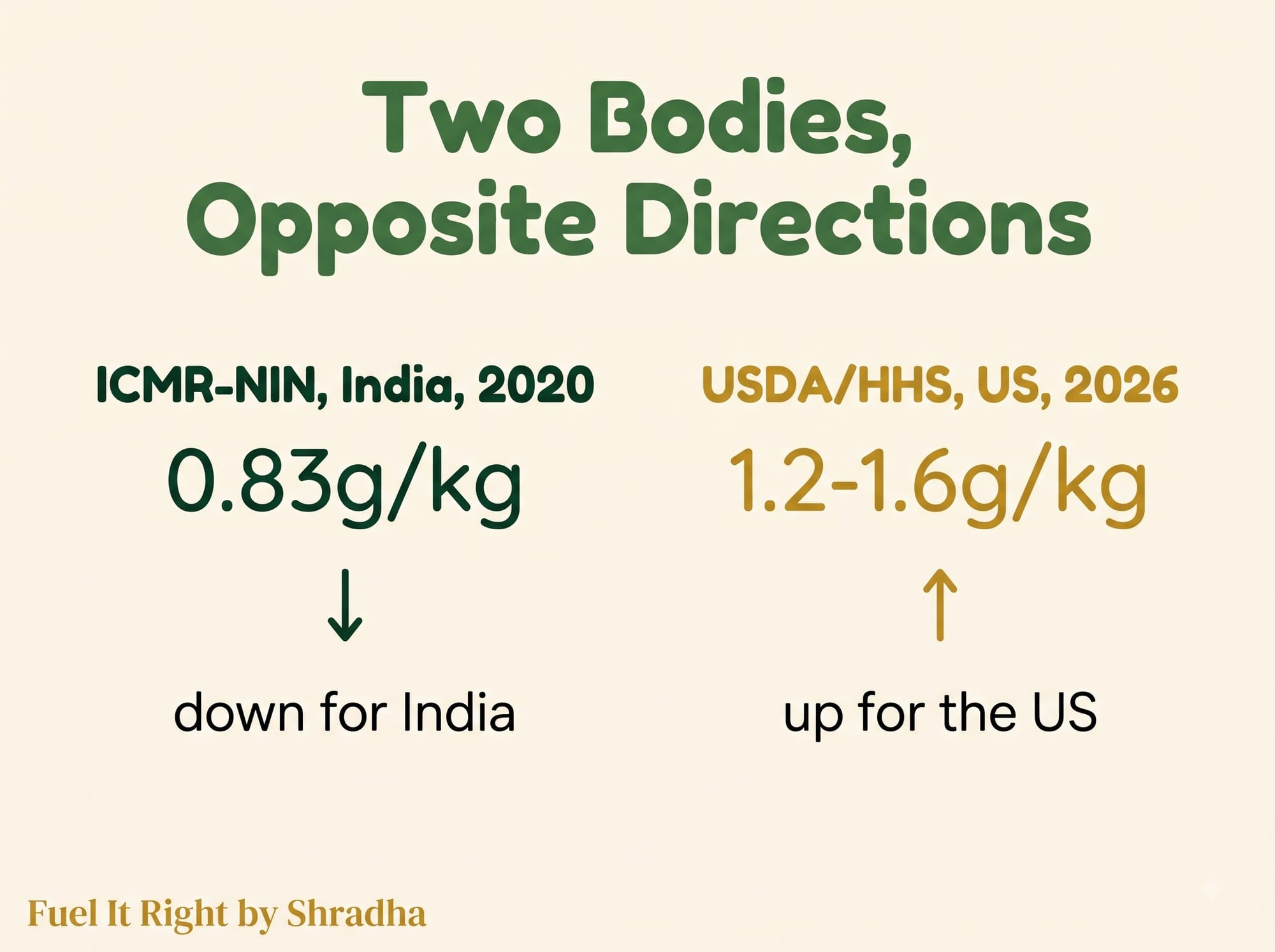
Two national health bodies looked at the same nutrient and moved their official number in opposite directions. That alone tells you that RDA was never meant to be the whole answer.
3. The RDA Is a Floor, Not a Ceiling
A 30-author consensus review published in Critical Reviews in Food Science and Nutrition in May 2026, involving protein researchers including Stuart Phillips, Luc van Loon, and Donald Layman, made this point explicitly: the RDA framework was designed to identify the minimum intake that prevents deficiency in the general population, not to define an optimal target for active adults, older adults, or anyone with elevated protein needs.
WHAT YOU'VE HEARD: The RDA tells you the ideal amount of protein to eat. |
WHAT'S ACTUALLY TRUE: The RDA, in India or the US, represents the minimum intake needed to prevent detectable deficiency in most healthy people, not an optimal or target amount. For people who resistance train, are older, or are recovering from illness, research consistently points toward higher intakes than the RDA alone suggests. |
This matters for reading either number correctly. India's 0.83g/kg is not a ceiling anyone should stay under. It's closer to a baseline that meets basic needs for 97.5% of a general, largely sedentary population, not a specific ceiling for someone resistance training or actively trying to preserve muscle.
4. Does High Protein Actually Damage Your Kidneys?
ICMR's own 2020 guidelines specifically caution against protein powder supplements, citing potential bone mineral loss and kidney damage from prolonged high intake. That's a real, official position worth taking seriously, and worth examining precisely rather than either dismissing or accepting at face value.
WHAT YOU'VE HEARD: Eating a high protein diet damages your kidneys. |
WHAT'S ACTUALLY TRUE: In healthy adults without existing kidney disease, the strongest evidence, including the long-running Framingham Offspring Study and multiple systematic reviews of randomised trials, has consistently failed to find kidney damage from higher protein intake, even well above the RDA. The rise in filtration rate that occurs is now understood as a normal, adaptive response, not injury. |
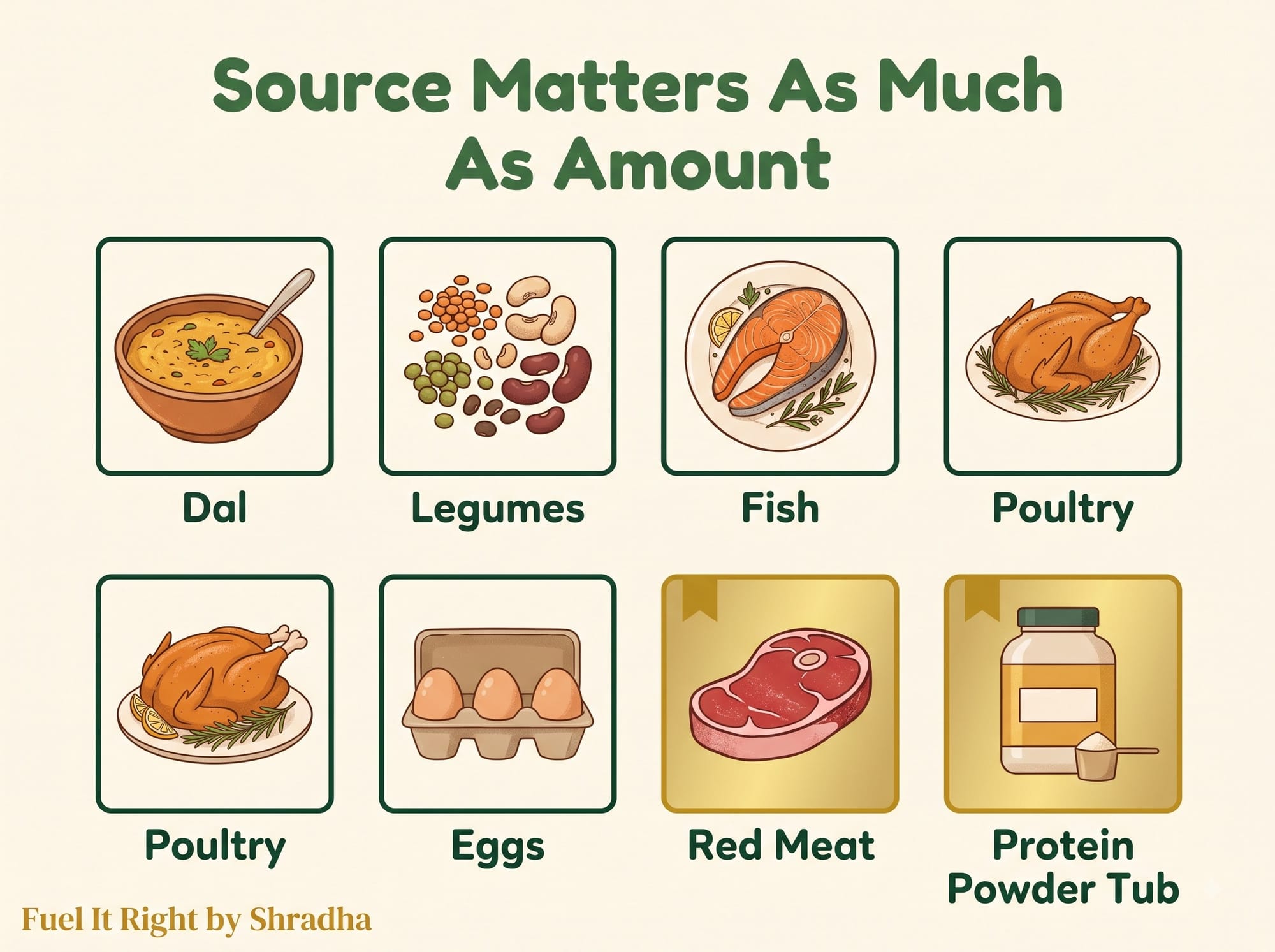
The picture is more nuanced over the long term. A Korean cohort study following 9,226 adults from 2001 to 2014 found the highest protein-intake quartile associated with a meaningfully increased risk of renal hyperfiltration over years, not weeks. Protein source also appears to matter: research suggests a high-protein diet built on legumes, soy, fish, poultry, and eggs carries a different, generally lower long-term kidney-risk profile than the same gram amount built heavily on red meat.
None of this applies to people with existing kidney disease, for whom protein restriction, not addition, is the correct, medically established approach. That distinction is exactly why ICMR's caution about supplements isn't wrong so much as incomplete without it.
Curious what else your everyday plate might be missing?
Take the free Gut Health Quiz:
5. What Actually Matters: Verdict by Verdict
Dal, Paneer, and Curd Together at Meals STRONG CHOICE |
A combination of plant and dairy protein already embedded in most Indian diets; the issue is usually quantity, not the wrong foods. How to make it work: Increase the portion of dal or paneer at a meal you already eat, rather than adding an entirely new food. |
A Legume-Forward High-Protein Pattern STRONG, LOWER RISK PROFILE |
Research associates high protein built on legumes, soy, fish, poultry, and eggs with a lower long-term kidney-risk profile than the same intake built heavily on red meat. How to make it work: This is already the direction most vegetarian Indian diets lean; building on it, rather than replacing it, is the more evidence-aligned path. |
Protein Powder as an Occasional Top-Up MODEST, ICMR FLAGS CAUTION |
ICMR's own guidance specifically cautions against relying on powder supplements for prolonged, large protein intake. How to make it work: Whole food first; if a powder fills a genuine gap, treat it as a supplement to meals, not a replacement for them. |
A Red-Meat-Heavy High-Protein Diet NEEDS MODERATION |
Long-term cohort data associates this specific pattern with a higher kidney-risk profile than the same protein amount from more varied sources. How to make it work: The amount may be appropriate; varying the source is the more evidence-backed adjustment. |
High Protein Intake With Existing Kidney Disease AVOID, NEEDS RESTRICTION |
Protein restriction, not addition, is the established medical approach for existing kidney disease or significantly reduced kidney function. How to make it work: This is a conversation for your nephrologist specifically, not something to self-manage based on general protein guidance. |
6. Building a Protein-Smart Day: Three Real Moments, Fully Assembled
This is a starting structure for someone without diagnosed kidney disease. If you have existing kidney concerns, your protein target should come from your nephrologist, not a general guideline.
Your Protein-Smart Checklist, At a Glance |
Treat India's 0.83g/kg RDA as a baseline for a sedentary population, not a ceiling if you're active |
Increase dal, paneer, and curd portions at meals you already eat before reaching for a powder |
Lean toward legumes, soy, fish, poultry, and eggs over a red-meat-heavy pattern at the same protein amount |
Use protein powder as an occasional top-up, not the primary source, per ICMR's own caution |
If you have existing kidney disease, get your specific target from a nephrologist, not general guidance |
Three Real Moments, Fully Assembled
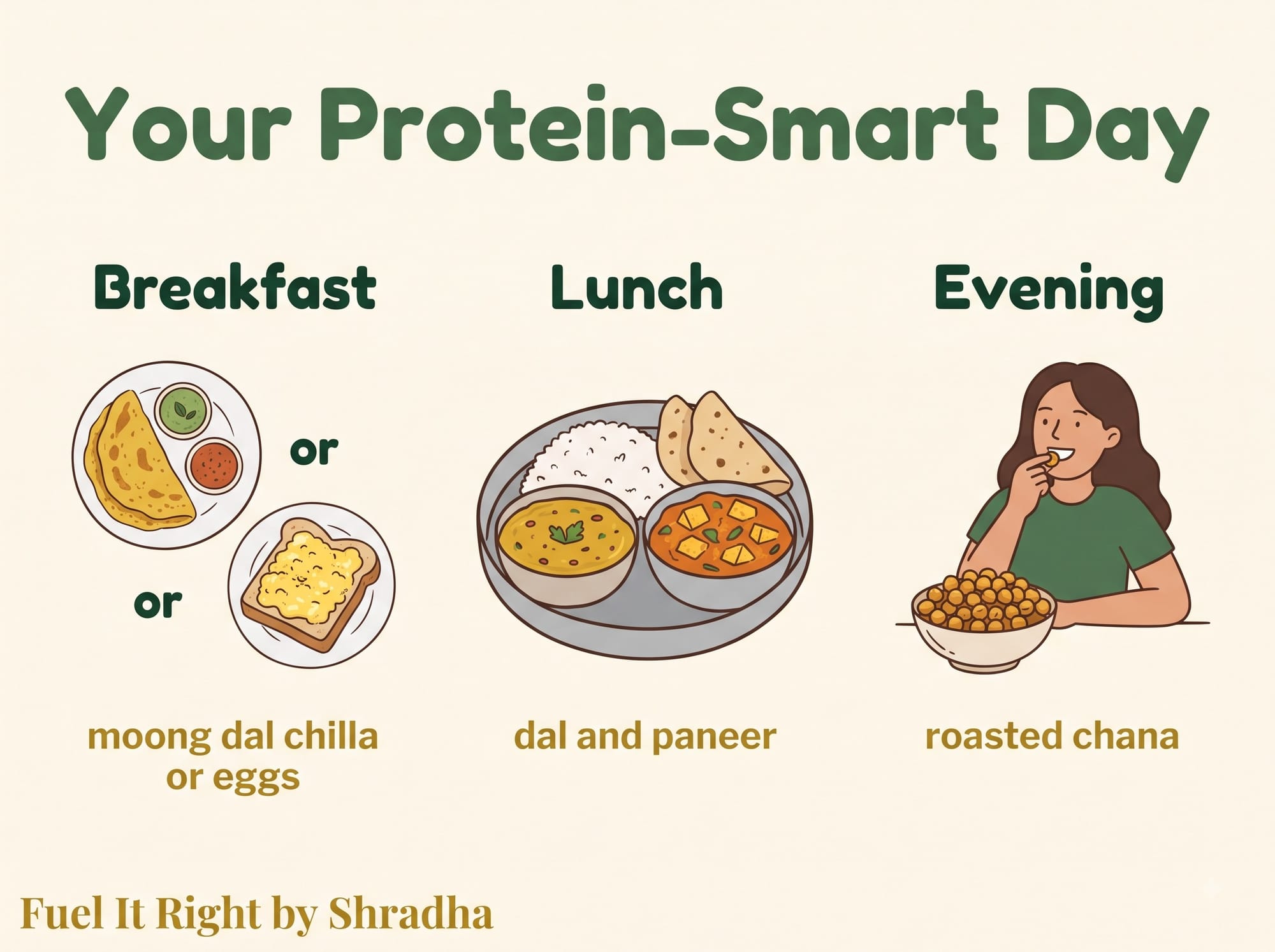
Breakfast | Moong dal chilla or eggs instead of only tea and toast, a genuine protein anchor at the start of the day rather than an afterthought. |
Lunch | Dal portioned generously, with paneer or curd added alongside, not just a small side bowl of dal treated as the protein source for the whole meal. |
Evening | A handful of roasted chana or a small bowl of sprouts as a snack, whole food first, before considering a powder-based option. |
Not sure what your actual protein number should be?
Let's work it out from your real diet:
Call or Whatsapp: +91 7057063984 OR
Conclusion
Protein in India sits at a genuine crossroads: a real, measurable deficiency affecting most of the population, a booming market capitalising on that gap, and two national health bodies whose official numbers just moved in opposite directions. The most useful takeaway isn't a single target number. It's that the RDA, in India or anywhere else, was built as a floor, not a ceiling, that fear of kidney damage from higher protein is far less settled in healthy people than commonly taught, and that where your protein comes from matters as much as how much of it you eat.
FAQs
1. How much protein do I actually need per day?
ICMR's 2020 RDA is 0.83g per kilogram of body weight, meant as a baseline for a general, largely sedentary population. Active adults, older adults, and anyone focused on preserving muscle typically benefit from more, with research supporting a range up to 1.2-1.6g/kg in those groups.
2. Why did India lower its protein RDA while the US raised its own?
India's 2020 revision was based on updated nitrogen balance research specific to Indian populations and new data on the protein quality of mixed vegetarian diets. The US 2026 update reflects a broader research consensus that the old RDA underestimated needs for active and older adults. Both are legitimate, working from different population data and different questions.
3. Does eating a high protein diet damage healthy kidneys?
The strongest evidence in healthy adults, including the Framingham Offspring Study and multiple systematic reviews, has not found kidney damage from higher protein intake. Long-term cohort data suggests some caution is still warranted, particularly with red-meat-heavy protein sources.
4. Why does ICMR caution against protein powder specifically?
ICMR's 2020 guidelines flag potential bone mineral loss and kidney concerns from prolonged, large-quantity powder supplementation specifically, not from eating more whole-food protein, which most Indians are actually falling short on.
5. Does the source of protein actually matter, or just the amount?
Both matter. Research associates high protein intake built on legumes, soy, fish, poultry, and eggs with a lower long-term kidney-risk profile than the same gram amount built primarily on red meat.
6. Is it true that most Indians don't get enough protein?
Data from the Indian Dietetic Association and the National Sample Survey Office suggests close to 80% of Indians consume less protein than recommended, despite protein-rich staples like dal and paneer already being common in the diet.
7. Should I take a protein supplement if I'm vegetarian?
Whole food should come first. If a genuine gap remains after increasing dal, paneer, curd, and legume portions, a supplement can fill it, but ICMR's own guidance cautions against relying on powders as the primary, prolonged source.
8. I have kidney disease. Does this guidance apply to me?
No. Protein restriction, not addition, is the established medical approach for existing kidney disease. Your specific protein target should come from your nephrologist, not general population guidance.
About the Author
Shradha | Nutritionist & Dietitian | Fuel It Right. Food-first, evidence-based nutrition for real, sustainable results.