
Young and Hypertensive: It's Not Just About Salt
Hypertension used to be a condition for your 40s and beyond. Now 17.6% of Indians aged 18-44 have it, and the biggest driver, according to patients themselves, isn't salt. Here's what's actually behind the shift, and what the evidence says helps.
Table of Contents
1. Hypertension in Your 20s and 30s: A Genuine Shift
2. What's Actually Driving This: Stress and Sleep, Not Just Salt
3. The New Risk Factors Nobody's Diet Plan Accounts For
4. Does Breathing Actually Lower Blood Pressure?
5. What Actually Helps: Verdict by Verdict
6. Building a Stress-Smart Day: Three Real Moments, Fully Assembled
Conclusion
FAQs
1. Hypertension in Your 20s and 30s: A Genuine Shift
Hypertension used to be a condition doctors mostly watched for once patients hit their 40s and 50s. That's no longer accurate. A major review found 17.6% of Indians aged 18 to 44 already have hypertension, and cardiologists across the country are reporting a genuine rise in patients in their 20s and early 30s presenting with readings that would have raised concern a decade ago. We've covered the food side of this in Cutting Salt Isn't Enough: The Ratio That Lowers BP; this piece covers a different, equally important side: what's driving the shift toward younger patients specifically.
Globally, an estimated 1.4 billion people live with hypertension, and only about 25% have it adequately controlled. It's still called the "silent killer" for a reason, many people in their 20s and 30s feel completely healthy while carrying numbers that would concern a cardiologist.
2. What's Actually Driving This: Stress and Sleep, Not Just Salt
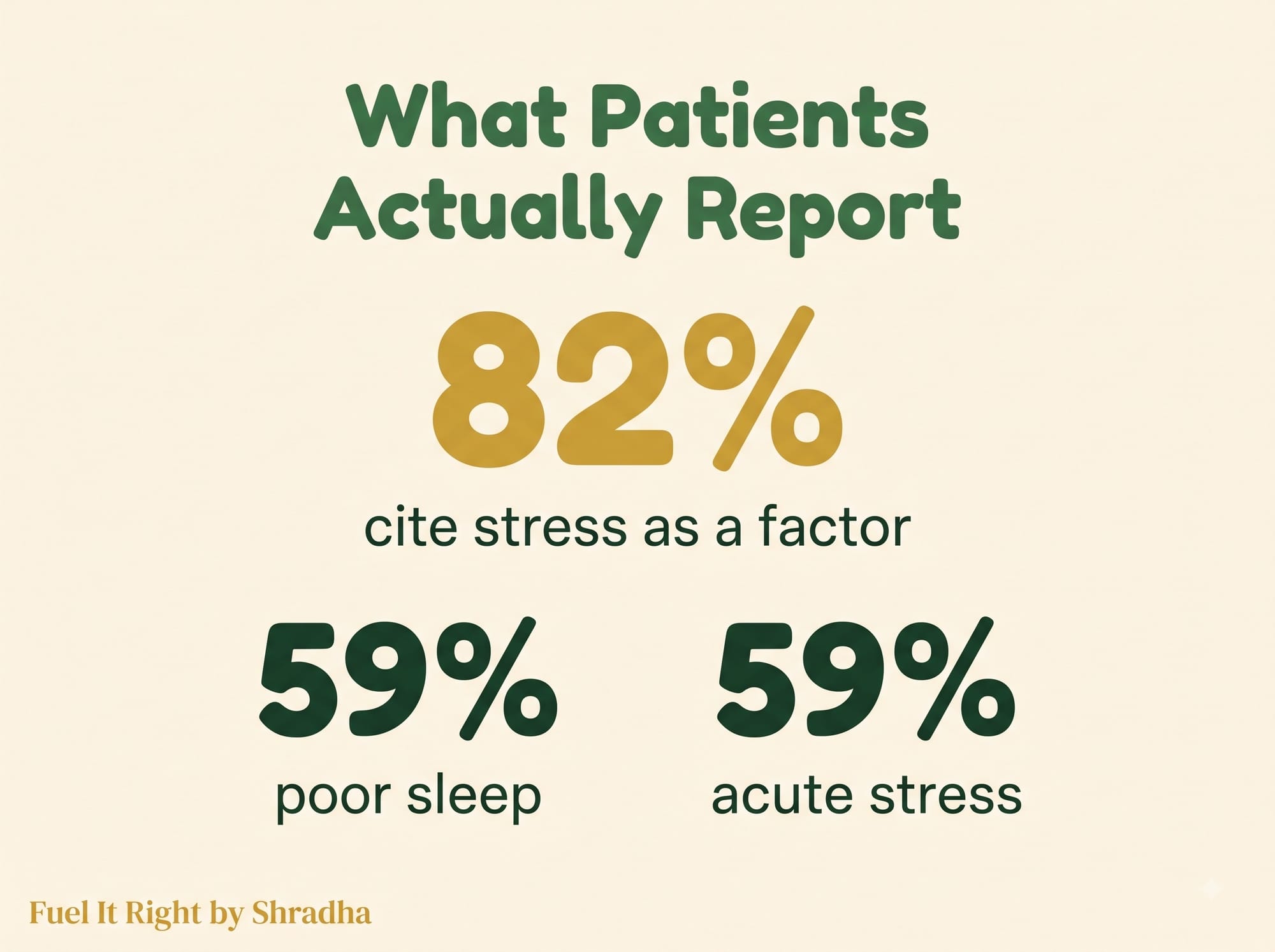
A recent patient survey found 82% of people with high blood pressure identified stress and anxiety as a factor in their condition. Poor sleep and acute stress were tied as the two leading triggers for blood pressure spiking out of control, each cited by 59% of patients. Among those aged 25 to 44 specifically, 43% described their workplace stress as very high.
This doesn't mean diet is irrelevant, the salt and potassium mechanism we covered separately is real and worth addressing. It means that for a large share of younger patients, stress and sleep disruption are doing at least as much damage as anything on the plate, and a food-only approach misses half the picture.
A food plan alone won't fix a blood pressure problem that's being driven from a stress response, not a spice box.
3. The New Risk Factors Nobody's Diet Plan Accounts For
WHAT YOU'VE HEARD: High blood pressure only happens to older people, so I don't need to worry about it in my 20s. |
WHAT'S ACTUALLY TRUE: 17.6% of Indians aged 18-44 already have hypertension, and it's typically silent until complications appear. Age alone isn't a reliable reason to skip a blood pressure check, especially with a family history or a high-stress routine. |
Health experts are increasingly flagging a specific cluster of newer risk factors among young adults: smoking, vaping, alcohol, and rising energy drink consumption. Nicotine narrows blood vessels and increases heart rate directly; the stimulant load in energy drinks can overstimulate the nervous system in a way that compounds an already stressed, under-slept system. None of these show up on a typical food-focused diet plan, which is exactly why they get missed.
Curious how your gut and stress load might be connected?
4. Does Breathing Actually Lower Blood Pressure?
WHAT YOU'VE HEARD: I need to buy a breathing device to get any blood pressure benefit from breathing exercises. |
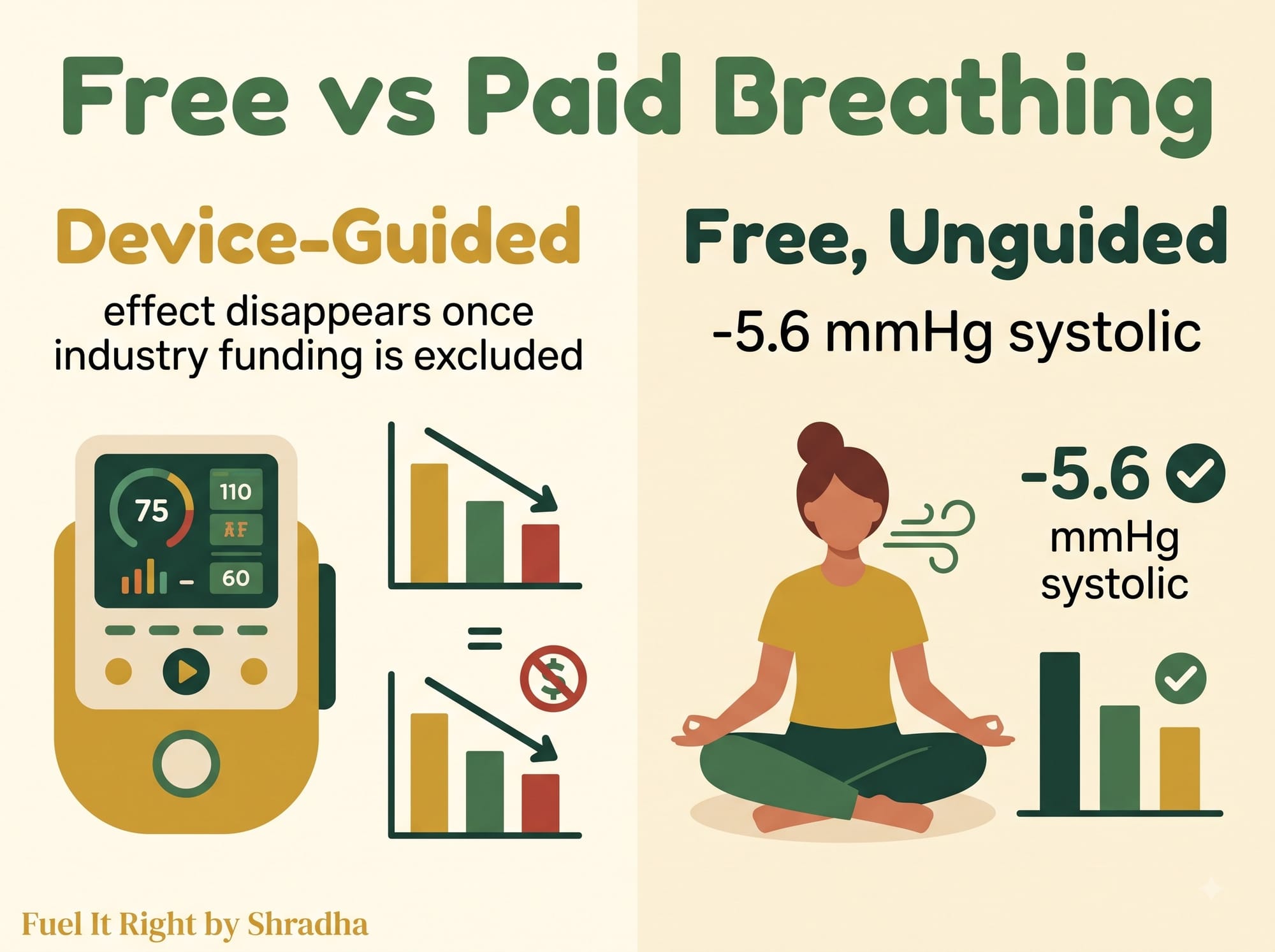
WHAT'S ACTUALLY TRUE: Meta-analyses of device-guided breathing products found a measurable effect only when industry-sponsored trials were included; once those were excluded, the overall effect disappeared. Non-device, unguided slow breathing has more consistent evidence for a comparable modest benefit, for free. |
A systematic review of 17 randomised trials on non-device slow breathing found modest but real reductions: roughly 5.6 mmHg systolic and 3 mmHg diastolic. A separate well-controlled study found 15 minutes of mindful breathing at 6 breaths per minute produced a 9.7 mmHg drop in people with systolic pressure above 130, with resting pressure down by an average of 4.3 mmHg when measured across several days.
This is a genuinely useful, low-cost lever, not a wellness trend. Fifteen minutes of slow, deliberate breathing daily has real evidence behind it, without needing a device with commercially confounded research.
5. What Actually Helps: Verdict by Verdict
A Consistent Sleep Schedule STRONG LEVER |
Poor sleep was tied as a leading trigger for blood pressure spikes in patient-reported data, and it reinforces stress in a cycle that's hard to break once established. How to make it work: Protecting a consistent sleep and wake time matters more than chasing a specific number of hours; consistency is the more evidence-aligned target. |
15 Minutes of Slow Breathing Daily STRONG, EVIDENCE-BACKED, FREE |
Non-device slow breathing has shown modest, real blood pressure reductions across multiple randomised trials, without the funding-related uncertainty seen in device-guided studies. How to make it work: Six breaths a minute for 15 minutes, no app or device required, done consistently rather than occasionally. |
Energy Drinks and Excess Caffeine NEEDS MODERATION |
Stimulant load compounds an already stressed, under-slept system, and is an increasingly common contributor among younger patients specifically. How to make it work: Treat energy drinks as an occasional choice, not a daily routine, especially alongside high workplace stress. |
Regular Movement Breaks From a Desk GOOD PRACTICE |
Sedentary time is repeatedly named alongside stress and poor sleep as a contributing factor in the rise among younger, desk-bound adults. How to make it work: Short, frequent breaks throughout the day appear to matter more than a single long workout compensating for hours of sitting. |
A Paid Breathing Device SKIP, WEAKER EVIDENCE ONCE FUNDING IS ACCOUNTED FOR |
The measurable benefit of guided breathing devices largely disappears in meta-analyses once industry-sponsored trials are excluded. How to make it work: Save the money; the free, unguided version has more consistent evidence behind it for a comparable effect. |
6. Building a Stress-Smart Day: Three Real Moments, Fully Assembled
This is a starting structure, not a diagnosis or a replacement for medication if you're already prescribed it. If your blood pressure readings are consistently high, that's a conversation for your doctor alongside these changes, not instead of them.
Your Stress-Smart Checklist, At a Glance |
Get a blood pressure check in your 20s or 30s if you haven't recently, especially with a family history |
Protect a consistent sleep and wake time over chasing a specific number of hours |
Add 15 minutes of slow, unguided breathing daily rather than buying a device |
Treat energy drinks and excess caffeine as occasional, not routine, especially during high-stress periods |
Build in short movement breaks through the day rather than relying on one workout to offset hours of sitting |
Three Real Moments, Fully Assembled
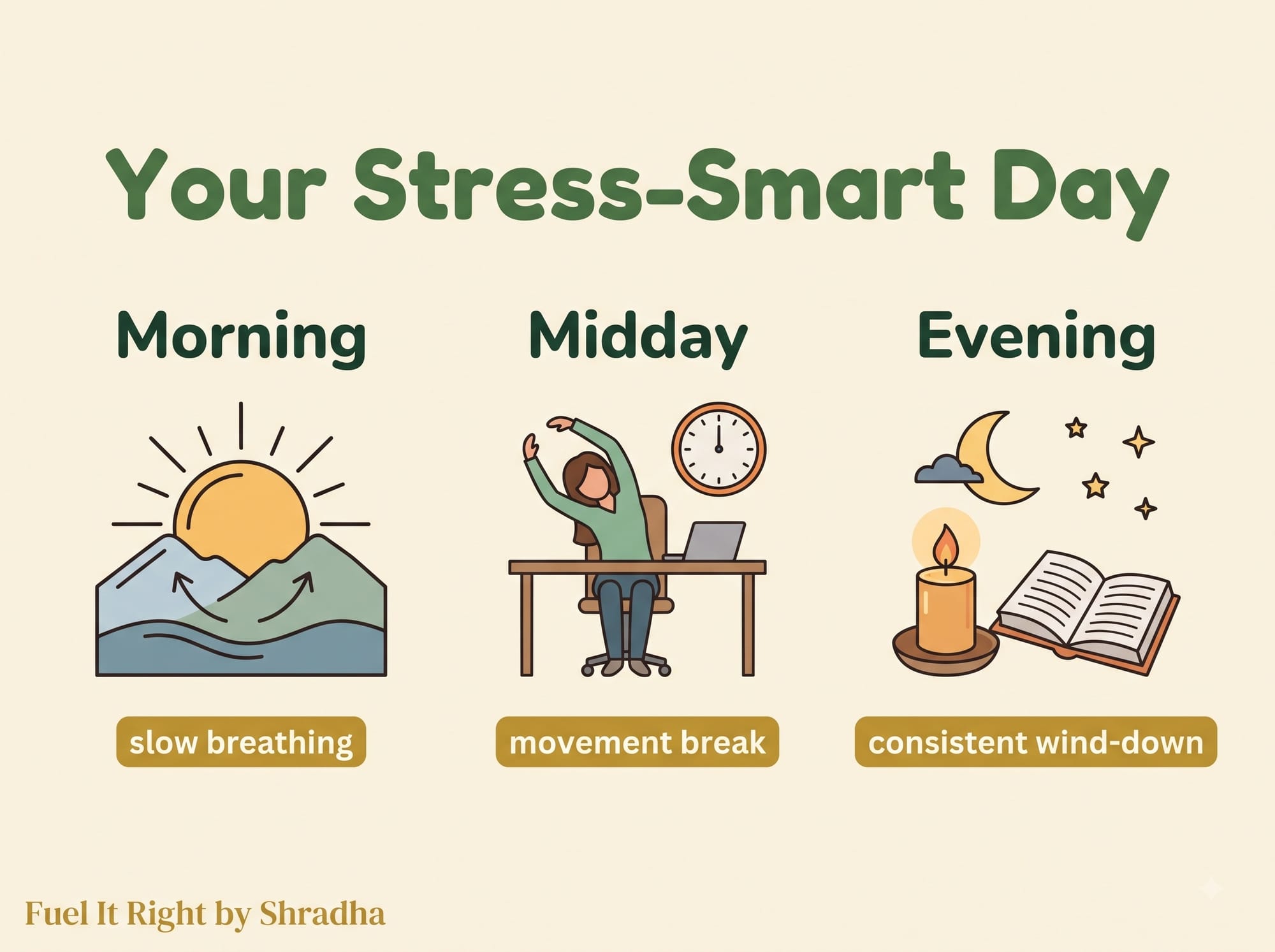
Morning | 15 minutes of slow breathing, six breaths a minute, before the day's messages and meetings start. |
Midday | A short walk or stretch break away from the desk, treated as a scheduled part of the day, not an afterthought. |
Evening | A consistent wind-down and sleep time, with energy drinks or late caffeine skipped rather than reached for to push through the evening. |
Bring your last few blood pressure readings and your actual sleep pattern.
Let's build a plan around both:
Call/ WhatsApp: +91 70570 63984 OR
Conclusion
Hypertension showing up in India's 20s and 30s isn't primarily a story about salt, even though salt still matters. It's a story about stress, sleep, sedentary routines, and a newer cluster of stimulant-heavy habits that don't show up on a typical diet plan. The good news is that some of the most evidence-backed levers here are free: consistent sleep, unguided slow breathing, and regular movement outperform a paid breathing device once the research funding is accounted for honestly. If you're in your 20s or 30s and haven't had your blood pressure checked recently, that's worth doing before assuming age alone protects you.
FAQs
1. How common is hypertension in young Indians now?
A major review found 17.6% of Indians aged 18 to 44 already have hypertension, a figure that would have seemed unusually high for this age group a decade ago.
2. Is salt still relevant if stress is the bigger driver for young adults?
Yes, both matter. Salt and the sodium-potassium ratio remain a real, evidence-backed factor at any age; stress and sleep are an additional, often underaddressed factor that's especially prominent in younger patients specifically.
3. Do energy drinks actually raise blood pressure risk?
Health experts increasingly flag energy drinks, alongside smoking, vaping, and alcohol, as a newer contributor among younger adults, driven by stimulant load compounding stress and poor sleep.
4. Does breathing exercise actually lower blood pressure, or is that a wellness myth?
It's genuinely evidence-backed. A systematic review of 17 randomised trials found modest but real reductions from non-device slow breathing, and a separate study found 15 minutes of mindful breathing produced a meaningful acute drop in systolic pressure.
5. Should I buy a breathing device like RESPeRATE?
The evidence is weaker than it first appears. Meta-analyses found device-guided breathing's benefit largely disappeared once industry-sponsored trials were excluded, while free, unguided slow breathing has more consistent evidence for a comparable effect.
6. How much does poor sleep actually contribute to high blood pressure?
In patient-reported data, poor sleep was tied with acute stress as the leading trigger for blood pressure spiking out of control, each cited by 59% of patients with hypertension.
7. Is workplace stress a real medical risk factor, or just a lifestyle complaint?
It's a documented factor. Among people aged 25-44, 43% described their workplace stress as very high, and stress overall was cited by 82% of hypertension patients as a contributing factor to their condition.
8. Should I get my blood pressure checked in my 20s if I feel completely healthy?
Yes. Hypertension is frequently described as a silent condition precisely because it often causes no noticeable symptoms until complications appear, which is exactly why routine checks matter even when you feel fine.
About the Author
Shradha | Nutritionist & Dietitian | Fuel It Right. Food-first, evidence-based nutrition for real, sustainable results.