
Do Glucose Monitors Work If You are Non Diabetic?
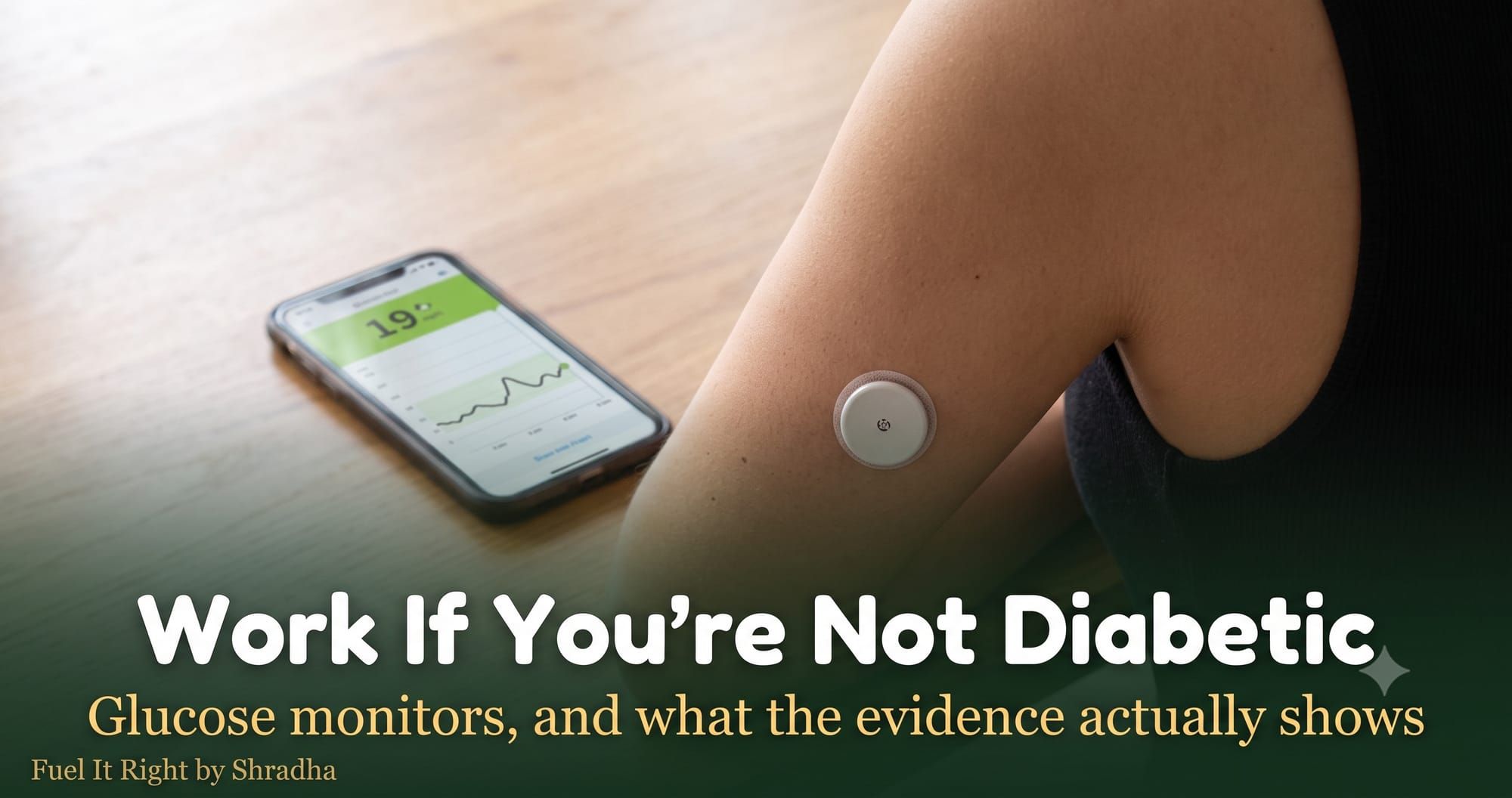
Table of Contents
1. The CGM Wellness Trend Is Everywhere Right Now
2. What JAMA Internal Medicine Just Found
3. Why a Glucose Spike in a Healthy Person Isn't What You Think
4. The Nuance: Some Researchers Still See Potential
5. Who Actually Benefits From a CGM: Verdict by Verdict
6. Building a Smarter Approach Without a CGM
Conclusion
FAQs
1. The CGM Wellness Trend Is Everywhere Right Now
Continuous glucose monitors, which are tiny wearable sensors that measure blood sugar every few minutes, were designed for diabetics who require this information to regulate insulin and make treatment decisions. Since the FDA approved the first over-the-counter CGM two years ago, it has become a rapidly expanding wellness product among those without diabetes, advertised as a means of optimizing weight, metabolic health, exercise, and food.
Real-time input on how your body reacts to meals without having to wait for a lab report is an alluring proposition. Given how rapidly this has grown into a legitimate consumer wellness industry, it's worthwhile to see what the real data says. Two significant reviews that were released in the last few weeks provide a definitive, up-to-date response.
2. What JAMA Internal Medicine Just Found
WHAT YOU'VE HEARD: A CGM will help me lose weight and optimise my health even if I don't have diabetes. |
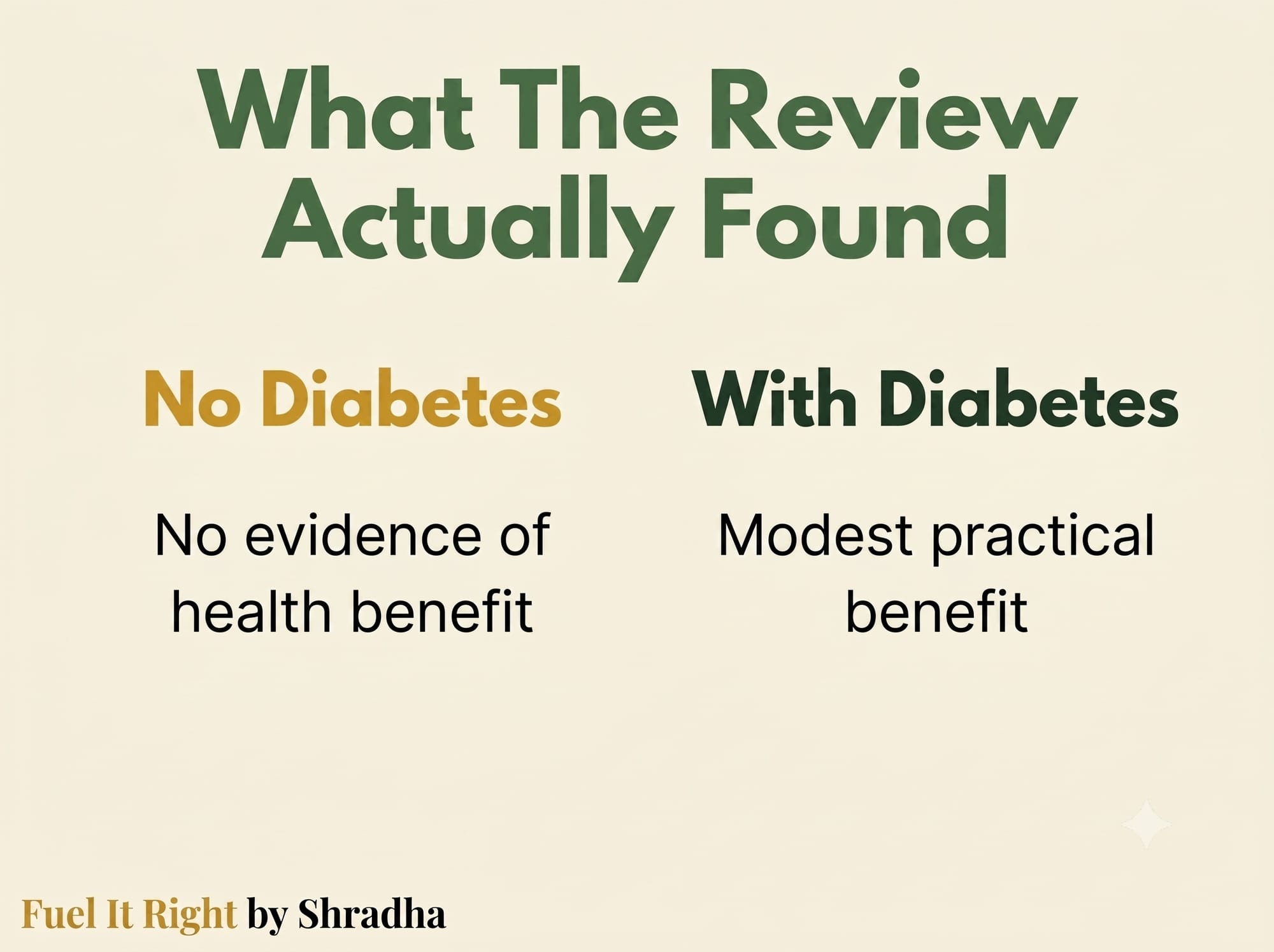
WHAT IS REALLY TRUE: There is no scientific proof that continuous glucose monitoring enhances health or prevents disease in individuals without diabetes, according to two companion reviews published in JAMA Internal Medicine in August 2026. These reviews were commissioned expressly to synthesize the evidence and included a public Patient Page. The reviewers concluded that this evidence gap was substantial enough to justify a direct public explanation rather than only a technical discovery concealed in a journal. |
The same reviews found more nuance for people who do have diabetes. For type 2 diabetes specifically, there's no evidence CGM prevents disease either, but it can make treatment adjustment easier, reduce the need for repeated finger stick tests, particularly for people at risk of dangerously low blood sugar, and is associated with a modest average reduction in HbA1c.
A device built for one medical need doesn't automatically transfer its benefit to a completely different population just because the data looks interesting.
3. Why a Glucose Spike in a Healthy Person Isn't What You Think
WHAT YOU'VE HEARD: Any visible glucose spike on my CGM graph means something is wrong with my metabolism. |
WHAT'S ACTUALLY TRUE: In those without diabetes, an increase in blood glucose following a meal is a typical, anticipated physiological reaction rather than a sign of malfunction. The body is built to withstand these changes, and a functioning pancreas consistently lowers blood sugar levels. It is incorrect to interpret every visible spike as an issue in order to remove them from the graph. |
This matters especially given what we have covered about the Insulin Resistance vs Diabetes distinction, the meaningful clinical markers for insulin resistance are validated lab tests like fasting insulin and HOMA-IR, not the shape of a real-time glucose curve interpreted without clinical context.
Curious what your actual metabolic picture looks like, device or not?
4. The Nuance: Some Researchers Still See Potential
Presenting this as completely resolved would be incorrect. Separate from the JAMA analysis, a number of systematic reviews describe CGM in non-diabetic populations as showing "promise" for improving engagement with diet and activity changes and personalizing lifestyle interventions, even though they acknowledge that the evidence on hard outcomes like cardiovascular events is still sparse and ambiguous.The truth: CGM is a genuine, if small, behavioural tool that can make food and glucose feedback tangible and instantaneous in a way that may enhance someone's participation with dietary modification. According to the most thorough recent synthesis, it has not been demonstrated to significantly enhance health outcomes or prevent disease in individuals without diabetes. These are two distinct assertions, and only the first is truly supported, while the marketing typically suggests the second.
5. Who Actually Benefits From a CGM: Verdict by Verdict
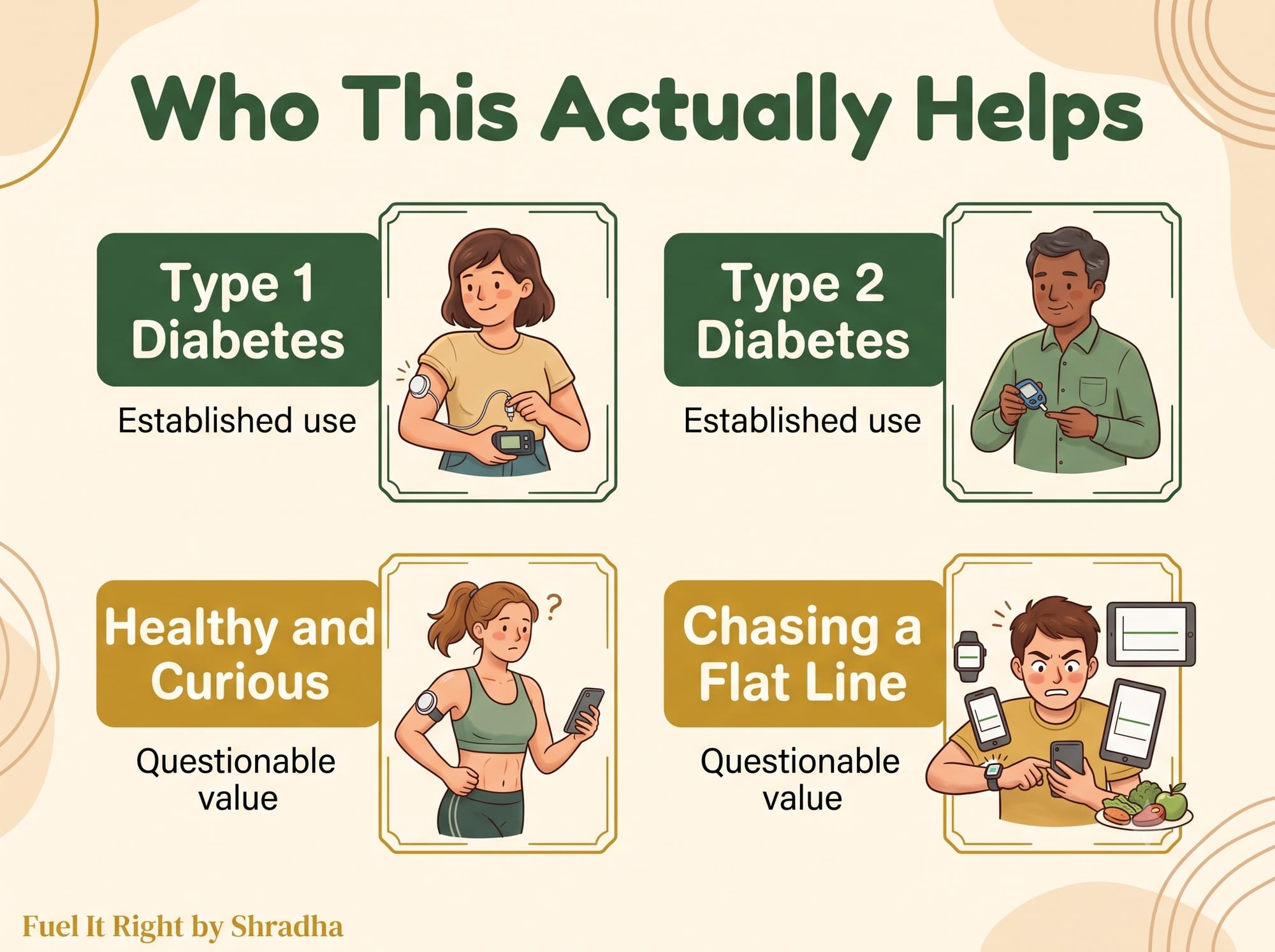
Type 1 Diabetes STRONG, ESTABLISHED USE |
CGM is a proven, truly revolutionary technology for managing type 1 diabetes and determining insulin dosage. |
Type 2 Diabetes, Especially With Hypoglycaemia Risk GOOD, PRACTICAL BENEFIT |
Even in the absence of demonstrated disease prevention, it lowers the frequency of finger stick, facilitates therapy modification, and is associated with a little improvement in average HbA1c. |
Healthy, Curious About "Optimisation" QUESTIONABLE VALUE FOR THE COST |
There is no specific health benefit in this group, according to the most thorough recent research. |
Strong Family History or Known Insulin Resistance WORTH A DOCTOR'S CONVERSATION |
A simple "yes" or "no" isn't well supported by the available data; this falls into more legitimately contentious ground where individual risk factors matter. |
Chasing a Perfectly Flat Glucose Line OVERSHOOTING THE GOAL |
The physiology does not support seeing normal variation as a problem to be solved because normal, healthy glucose responses to food are not flat lines. |
6. Building a Smarter Approach Without a CGM: Three Real Moments, Fully Assembled
This is a basic building that doesn't need any equipment. This complements, not replaces, your doctor's advice if you have been diagnosed with diabetes or another medical condition.
Your Metabolic-Smart Checklist, At a Glance |
Don't assume a CGM will improve your health if you don't have diabetes; the current evidence doesn't support that specific claim |
Remember a normal glucose spike after eating is expected physiology, not a problem to chase away |
Use validated lab markers (fasting insulin, HOMA-IR) rather than real-time graph-watching if you're genuinely concerned about insulin resistance |
Apply known low-GI, food-order principles from your existing knowledge rather than needing a device to relearn them |
If a device is creating food anxiety rather than useful information, that's worth stepping back from |
Three Real Moments, Fully Assembled
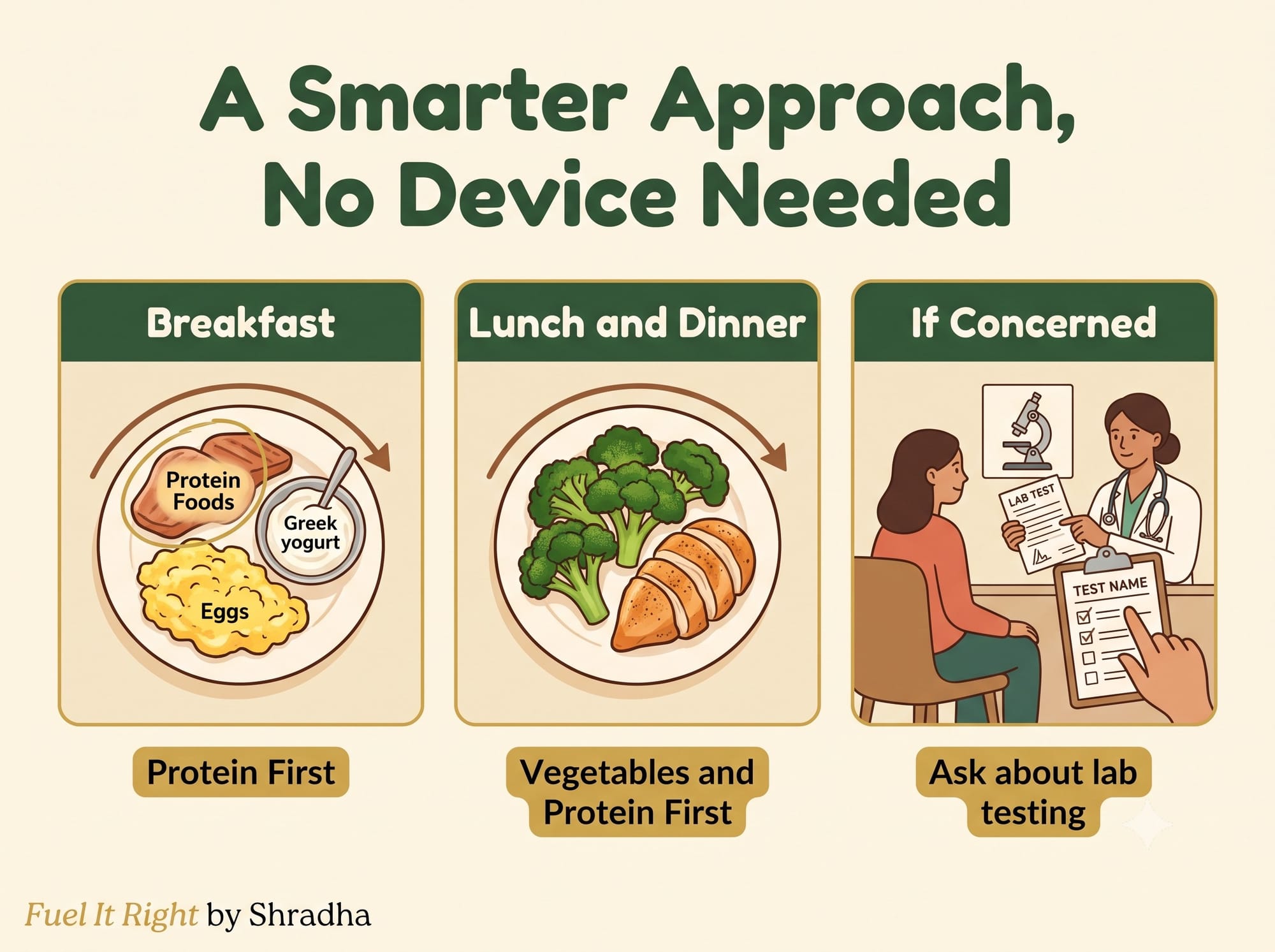
Breakfast | A protein-forward, sequenced meal that follows the same guidelines from well-established GI studies is beneficial; no gadget is required to understand this. |
Lunch and dinner | Vegetables and protein before the carbohydrate portion of the plate, the same evidence-backed sequencing that works regardless of whether you're watching a graph. |
If genuinely concerned | A conversation with your doctor about fasting insulin and HOMA-IR testing, the validated markers, rather than a consumer device as the first step. |
Wondering if a CGM is actually worth it for your specific situation?
Let's figure that out together
Call or WhatsApp: +91 7057063984 OR
Conclusion
Continuous glucose monitors have quickly evolved from a diabetes care tool to a popular wellness product. However, two of the most thorough, recent assessments that were published in JAMA Internal Medicine only a few weeks ago found no proof that they benefit health in non-diabetics. That does not imply that glucose data is meaningless or that the gadget is useless for the group for which it was designed. It indicates that the marketing has overtaken the evidence for the target audience. Whether or not you have a sensor on your arm, the useful food-order and food-choice principles are what really move the needle.
FAQs
1. Do continuous glucose monitors actually help people without diabetes?
According to two 2026 JAMA Internal Medicine reviews, no. The researchers found no scientific evidence that CGM use improves health or prevents disease in people without diabetes.
2. Are CGMs useful for people with diabetes?
Even with type 2 diabetes, there is little proof that CGM prevents disease, according to the same reviews. However, it does have some useful advantages, such as simpler medication adjustment, fewer fingerstick tests, especially for people who are at risk of low blood sugar, and a slight improvement in average HbA1c.
3. Is a glucose spike after eating a bad sign in a healthy person?
No. A rise in blood glucose after a meal is a normal, expected response in people without diabetes. A healthy pancreas brings it back down reliably; the spike itself isn't evidence of a problem.
4. Why has CGM become popular among people without diabetes?
Within the last two years, the FDA approved over-the-counter CGMs. Since then, they have been advertised as aids for improving nutrition, exercise, weight, and overall metabolic health, and they have grown to be a rapidly expanding wellness product regardless of a diabetes diagnosis.
5. What should I use instead of a CGM to manage my blood sugar?
Established, evidence-backed principles: sequencing meals with protein and vegetables before carbohydrates, choosing lower glycaemic index foods, and, if genuinely concerned about insulin resistance, validated lab markers like fasting insulin and HOMA-IR rather than real-time graph interpretation.
6. Is there any legitimate research support for CGM in healthy people?
While noting that there is still little evidence on concrete health outcomes, some smaller systematic reviews define CGM as having promise for enhancing participation with dietary modification and personalizing lifestyle programs. Compared to wellness marketing, that is a more modest claim.
7. Can obsessing over CGM data be harmful?
It can create unnecessary anxiety around normal eating if ordinary, expected glucose fluctuations are treated as problems requiring correction. If a device is creating food anxiety rather than useful information, that's a sign to reconsider its use.
8. Should I get a CGM if I have a family history of diabetes?
Since there isn't a definitive solution, this is actually more contentious. It is worthwhile to discuss with your physician whether a trial period of CGM or validated lab testing is more appropriate for your particular risk profile.
About the Author
Shradha | Nutritionist & Dietitian | Fuel It Right. Food-first, evidence-based nutrition for real, sustainable results.