
Why You're Bloated After Every Meal: The Real Causes
Bloating after every meal isn't just a sensitive gut. Undiagnosed SIBO, lactose intolerance, and specific fermentable carbohydrates are testable, specific causes, and even your grandmother's pinch of hing has real evidence behind it.
Table of Contents
1. Bloating After Every Meal: More Common Than You Think
2. The Overgrowth Nobody Tests For: SIBO
3. The Indian-Specific Culprit Almost Nobody Checks: Lactose Intolerance
4. FODMAPs: The Evidence-Backed Framework
5. Does Hing Actually Work? What the Evidence Shows
6. Building a Bloat-Smart Day: Three Real Moments, Fully Assembled
Conclusion
FAQs
1. Bloating After Every Meal: More Common Than You Think
Bloating is the single most common symptom reported in disorders of gut-brain interaction like IBS, affecting up to 11% of the world's population. If you feel distended after most meals, you're not alone, and more importantly, you're not necessarily dealing with something vague and untestable.
The phrase "sensitive stomach" gets used as an explanation when it's really a description. It describes what's happening without saying why. Chronic post-meal bloating usually traces back to a specific, identifiable, often testable cause, not a permanently fragile digestive system.
2. The Overgrowth Nobody Tests For: SIBO
Small intestinal bacterial overgrowth (SIBO) happens when bacteria that normally belong in the large intestine migrate into and multiply in the small intestine, fermenting food earlier in the digestive process than they should and producing excess gas along the way.
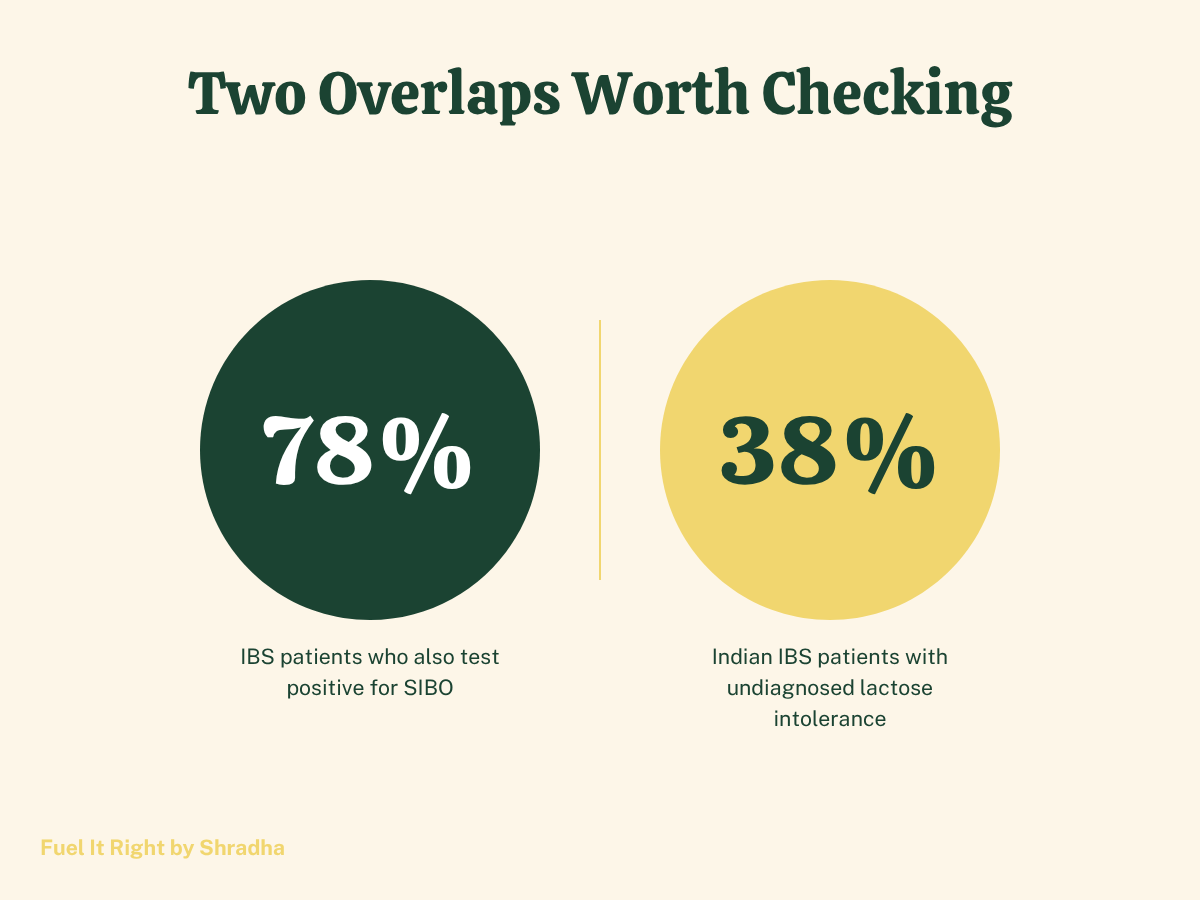
The connection to IBS is striking. Using lactulose breath testing, researchers found 78% of IBS patients also tested positive for SIBO. After antibiotic treatment targeting the overgrowth, 48% no longer met the diagnostic criteria for IBS at all. That's not a minor overlap, it suggests SIBO is a major driver behind a large share of cases labelled simply as "IBS" or "sensitive gut."
A diagnosis of IBS is often the end of the conversation. It should be closer to the beginning of one.
3. The Indian-Specific Culprit Almost Nobody Checks: Lactose Intolerance
A 2021-22 North Indian cohort study tested 100 adults with confirmed IBS using hydrogen breath testing and found 38% also had undiagnosed lactose intolerance layered on top. The overlap was strongest in diarrhoea-predominant IBS, and higher habitual lactose intake was directly linked to more frequent symptoms.
This matters enormously in an Indian context. Milk in chai multiple times a day, curd with most meals, paneer, ghee-based sweets: dairy is threaded through the everyday diet in a way that makes an underlying lactose intolerance easy to miss and easy to blame on "something in the meal" generally, rather than the specific ingredient actually responsible.
Wondering if SIBO or lactose intolerance might be part of your picture?
Take the free Gut Health Quiz:
4. FODMAPs: The Evidence-Backed Framework
FODMAPs, fermentable oligosaccharides, disaccharides, monosaccharides, and polyols, are a group of short-chain carbohydrates poorly absorbed in the small intestine. They pull water into the gut and ferment rapidly, producing the gas and distension behind much of chronic bloating. A meta-analysis found a low-FODMAP approach produced meaningful symptom relief in 50 to 86% of patients with gas and bloating.
The framework has three stages: eliminate high-FODMAP foods for a short period, reintroduce them one at a time to identify your specific triggers, then personalise long-term intake around what you've learned. It's a diagnostic tool, not a permanent diet, and treating it as a lifelong restriction misses the actual point of the process.
This is closely related to what we covered in Chronic Constipation: Why More Fiber Isn't the Fix: more of a food category isn't automatically better. Fermentable carbohydrates that help one gut can distend another, which is exactly why identifying your specific triggers matters more than following a generic "gut health" food list.
5. Does Hing Actually Work? What the Evidence Shows
WHAT YOU'VE HEARD: Bloating means your gut is just weak or sensitive, and there's not much to do about it. |
WHAT'S ACTUALLY TRUE: Chronic bloating is usually traceable to a specific, often testable cause: SIBO, undiagnosed lactose intolerance, or specific fermentable carbohydrates. "Sensitive gut" describes the symptom, not an explanation that rules out finding the actual trigger. |
WHAT YOU'VE HEARD: Going low-FODMAP means avoiding onion, garlic, and legumes forever. |
WHAT'S ACTUALLY TRUE: Low-FODMAP is meant to be a short elimination phase followed by structured reintroduction, not a permanent restriction. Most people tolerate many high-FODMAP foods again once their specific triggers are identified and portions are adjusted. |
Asafoetida, hing, added to legume dishes is one of the most common home remedies in Indian kitchens for exactly this kind of bloating. It's also one of the few traditional remedies with real, if still modest, research behind it.
6. Building a Bloat-Smart Day: Three Real Moments, Fully Assembled
This is a starting structure, not a diagnosis. If bloating is frequent, severe, or accompanied by weight loss, blood, or persistent pain, see a doctor for proper testing rather than managing it with food changes alone indefinitely.
Your Bloat-Smart Checklist, At a Glance |
Notice whether dairy specifically precedes your worst episodes; ask about a lactose breath test if it does |
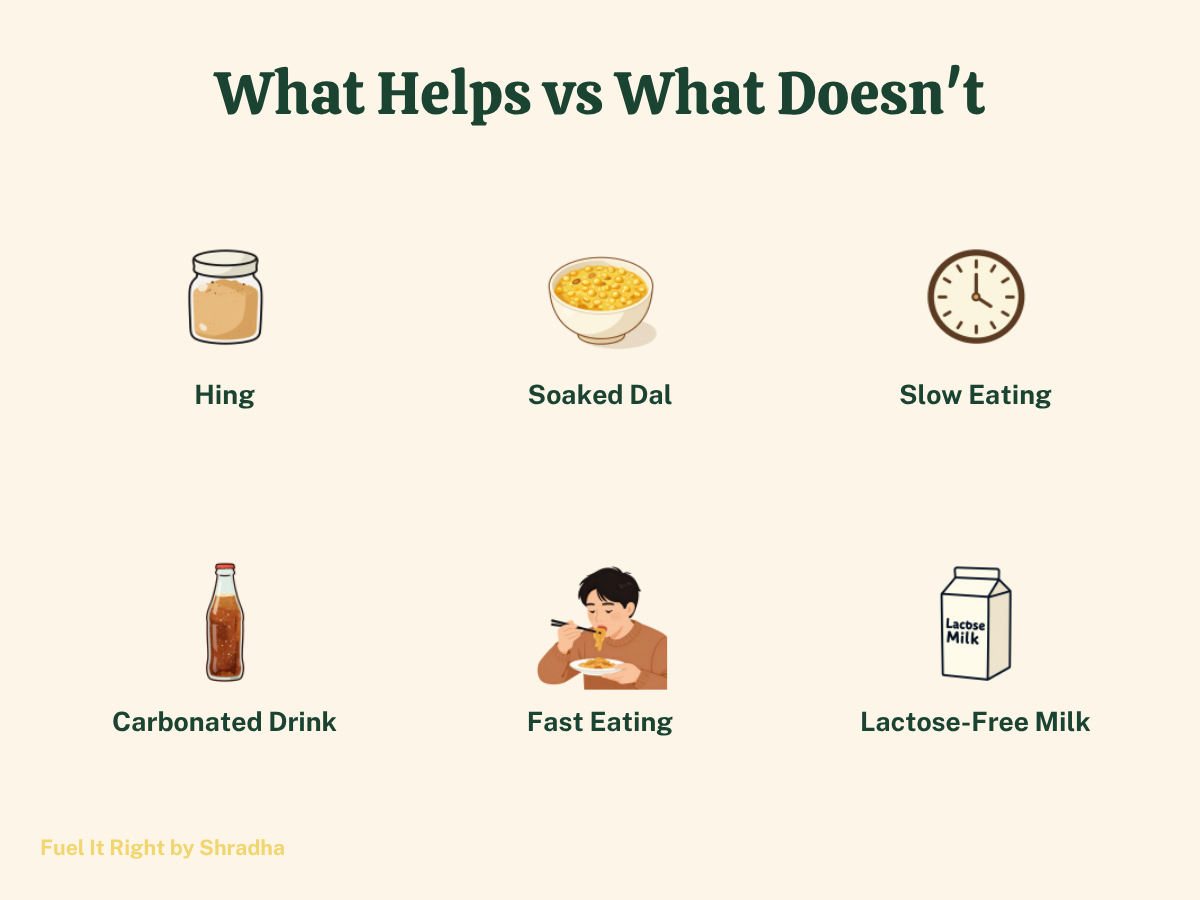
Soak legumes for 6-8 hours before cooking, and temper with a pinch of hing |
Treat carbonated drinks as occasional, not routine, if bloating is frequent |
Slow down and chew thoroughly before assuming a specific food is to blame |
If symptoms persist despite consistent changes over several weeks, ask your doctor about SIBO breath testing |
Three Real Moments, Fully Assembled
Breakfast | If dairy is a suspect, swap milk in chai for a lactose-free alternative for one week as a simple test, rather than guessing. |
Lunch | Dal soaked overnight, tempered with a pinch of hing, eaten slowly. Skip the carbonated drink alongside it. |
Dinner | A smaller, simpler plate than lunch if evenings tend to be your worst bloating window, with a 20-30 minute walk afterward rather than lying down immediately. |

Bring a note of what you ate before your last bad bloating episode.
We'll help you spot the actual pattern:
Conclusion
Bloating after every meal isn't a character trait of your digestive system, it's usually a symptom with a specific, findable cause. SIBO and undiagnosed lactose intolerance together may explain a large share of cases labelled simply as a sensitive gut, the FODMAP framework offers a structured way to identify your own specific triggers, and even the pinch of hing your grandmother adds to dal has real, if modest, evidence behind it. The goal isn't to fear food. It's to find the specific thing worth testing for, rather than living with a vague explanation indefinitely.
FAQs
1. Why do I bloat after almost every meal?
Chronic post-meal bloating usually has a specific, identifiable cause, most commonly SIBO, undiagnosed lactose intolerance, or sensitivity to specific fermentable carbohydrates (FODMAPs), rather than a permanently "sensitive" digestive system.
2. What is SIBO and how common is it?
Small intestinal bacterial overgrowth occurs when bacteria that belong in the large intestine migrate into the small intestine. Breath testing has found it present in roughly 78% of people diagnosed with IBS.
3. Could my bloating actually be lactose intolerance?
It's worth checking, especially in India, where dairy is present in most meals. A North Indian study found 38% of IBS patients also had undiagnosed lactose intolerance, most strongly linked to diarrhoea-predominant symptoms.
4. What does a low-FODMAP diet actually involve?
A short elimination phase, followed by structured one-at-a-time reintroduction of high-FODMAP foods to identify your specific triggers, then a personalised long-term diet. It's not meant to be a permanent restriction of onion, garlic, or legumes.
5. Does hing (asafoetida) actually reduce bloating?
The evidence is real but still modest: small clinical trials in IBS patients showed improvement in bloating and gas, and animal studies confirm a genuine antispasmodic mechanism. A traditional pinch in tempering is a reasonable, low-risk practice with actual research behind it.
6. Does soaking dal before cooking really reduce gas?
Yes. Soaking reduces the oligosaccharide content responsible for fermentation-related gas, independent of any spice added during cooking.
7. Is bloating after eating always related to what I'm eating?
Not always. Eating quickly and swallowing air, and how meals are timed relative to lying down or activity, both contribute independent of specific food choices.
8. When should I see a doctor about bloating instead of adjusting my diet myself?
If bloating is frequent or severe, persists despite consistent dietary changes over several weeks, or comes with weight loss, blood, or persistent pain, see a doctor for proper testing, including SIBO or lactose breath tests, rather than continuing to self-manage indefinitely.
About the Author
Shradha | Nutritionist & Dietitian | Fuel It Right. Food-first, evidence-based nutrition for real, sustainable results